Quick answer
Use StalkChain MCP when a Claude Code investigation starts with FOMO traders, their resolved wallets, PnL, token holders, flows and posted theses.
Use CoinGecko MCP for broad prices, market context and DEX pool data.
Use DEX Screener's REST API for pair discovery, Dune's API for authored SQL studies, Birdeye for labeled Solana holder positions, or Helius for Solana event ingestion.
There is no universal winner.
Claude Code can write an API client, but code generation does not grant it current prices or on-chain evidence.
The useful choice is not simply “which crypto API has the most endpoints?” It is whether Claude needs a ready-to-call MCP tool, a REST endpoint in a script, or a custom query result.
Disclosure: This article is published by Stalkchain Research, which owns StalkChain.
We include our connector and recommend alternatives when they fit the requested data better.
This is a documentation-based comparison, not a measured latency, accuracy or price benchmark; no vendor paid for placement.
How we selected these tools
We checked official live pages and developer docs on October 31, 2026.
The test scenario is the type of evidence Claude Code can retrieve, not an unrun head-to-head benchmark.
We did not authenticate to every vendor, execute the same prompt, test rate limits or normalize plan prices.
An MCP connection offers Claude callable tools directly; REST, SQL and webhooks require code or another integration layer. Check current access and billing terms before automating.
| Provider | Claude Code route | Best question | Important limitation |
|---|---|---|---|
| StalkChain | Remote HTTP MCP; REST also available | What did a named FOMO trader buy, hold or write? | Tracked FOMO traders are a subset, not all crypto traders |
| CoinGecko | Official remote HTTP MCP or API | What is the price, market context or pool picture? | Price and pool data do not establish trader identity |
| DEX Screener | REST called from generated code | Which pair has liquidity and trading activity? | Pair metrics are not a wallet research report |
| Dune | Saved SQL query execution/results API | What did a defined historical cohort do? | You must specify and maintain the query |
| Birdeye | REST called from generated code | Which labeled Solana wallets hold this token? | The cited route supports Solana and Robinhood, with different label coverage |
| Helius | Webhooks consumed by an app | What Solana event just occurred? | You need event storage and deduplication |
StalkChain: for trader, wallet and thesis questions
The live MCP page documents the remote endpoint https://data.stalkchain.com/mcp and this Claude Code setup:
claude mcp add --transport http stalkchain https://data.stalkchain.com/mcp
Then open /mcp in Claude Code, select stalkchain, authenticate in the browser and approve.
The Claude Code setup page also describes project-scoped configuration and an API-key option for unattended environments.
Keep keys out of git.
The REST reference exposes the same research tools for applications using a bearer key and documents the response envelope and OpenAPI spec.
A useful prompt is: “Resolve this FOMO handle to its documented wallets; compare current positions with the trader's written theses, and tell me which data is missing.” The product documents search, positions and thesis tools, but this prompt is illustrative; we did not run it or claim a particular answer.
Ask Claude to show tool calls, chain, timestamps and the difference between realized and unrealized PnL. StalkChain is a strong fit for this linked social-to-wallet workflow, not a replacement for chain-wide indexing or market-data coverage.
CoinGecko: for market and pool context with native MCP
CoinGecko's MCP guide documents a keyless remote server at https://mcp.api.coingecko.com/mcp with shared limits and a separate authenticated server with broader access.
Its Claude Code command is:
claude mcp add --transport http coingecko https://mcp.api.coingecko.com/mcp
This is the easiest complementary connector here when Claude needs prices, market caps, volumes, trending assets or on-chain token/pool context. The free server's shared limits and paid access differ; do not treat a keyless connector as unlimited.
CoinGecko's MCP methods reference is the place to confirm the exact method for a planned question.
Choose it over StalkChain when broad market discovery or pool context is the principal task. Add a trader source only when the analysis actually needs trader behavior.
DEX Screener: for lightweight DEX pair lookup in code
The official API reference lists pair search, token-to-pairs and pair lookup endpoints. Pair responses include price, transaction counts, volume and liquidity fields.
Claude Code can write a small fetch and compare pools by the exact contract address; there is no need to claim an official Claude Code connector to use a documented HTTP API.
Choose it over StalkChain to confirm whether a token has a liquid pair before interpreting an apparent whale position.
A ticker search can return multiple unrelated contracts; identify chain and address first.
Boosted profiles and paid visibility should not be treated as organic demand.
Dune: for scripted historical SQL research
The Dune API quickstart describes retrieving the latest result of a query or executing it for fresher results.
Claude Code can help maintain a parameterized query, fetch its output and explain the SQL definition.
Record whether the response was from a new execution or a previously cached result.
Choose it over StalkChain for custom historical cohort analysis that needs explicit inclusion rules. A saved query is only as sound as its joins, chain coverage and timestamp window.
Birdeye and Helius: for deeper Solana-specific builds
Birdeye's Solana holder-positions endpoint returns wallet-level position and trading fields with labels.
It suits a Claude-generated investigation of labeled holder cohorts, with the caveat that classification labels are not proof of manipulation.
Helius webhooks deliver on-chain events to your service and warn that retries can produce duplicates.
Helius is infrastructure for a monitoring pipeline, not an out-of-the-box narrative answer in a Claude chat.
Choose Birdeye when labeled Solana wallet exposure is the primary evidence. Choose Helius when your application needs transaction events pushed to a backend.
Neither should be described as a drop-in native MCP connection on the basis of the cited REST/webhook docs.
A defensible Claude Code research recipe
- Start with the exact identifier. Specify chain and token address, or a FOMO handle if investigating that platform's trader cohort. Never resolve a position from a ticker alone.
- Ask for provenance. Require the tool name, query parameters, as-of time and any incomplete response notes. StalkChain's REST docs show
notesandmetafields in its response shape. - Cross-check a different layer. Compare a tracked trader's position against a DEX pair's liquidity, or a holder classification against transaction history. Correlation and posted conviction do not prove a token is safe.
- Separate observation from interpretation. “The endpoint returned a holder” is an observation; “smart money is buying” requires a defined cohort, timeframe and sell-side check. Our wallet-tracking guide explains the baseline workflow.
- Constrain automation. Keep API keys in secret storage, respect provider limits and review actions before connecting any trading capability. Research tools do not require a wallet signature.
A practical two-connector setup is StalkChain for the named FOMO trader's wallet/position/thesis trail and CoinGecko for independent token/pool context.
If the question becomes “all wallets that entered a defined launch cohort,” switch to an appropriately scoped query or indexer.
That boundary matters more than a universal ranking.
Inspect the documented integration before building
Open the StalkChain API catalog and inspect the published connection or request example before using an account key. The screen below documents the public interface, not an authenticated comparison test.
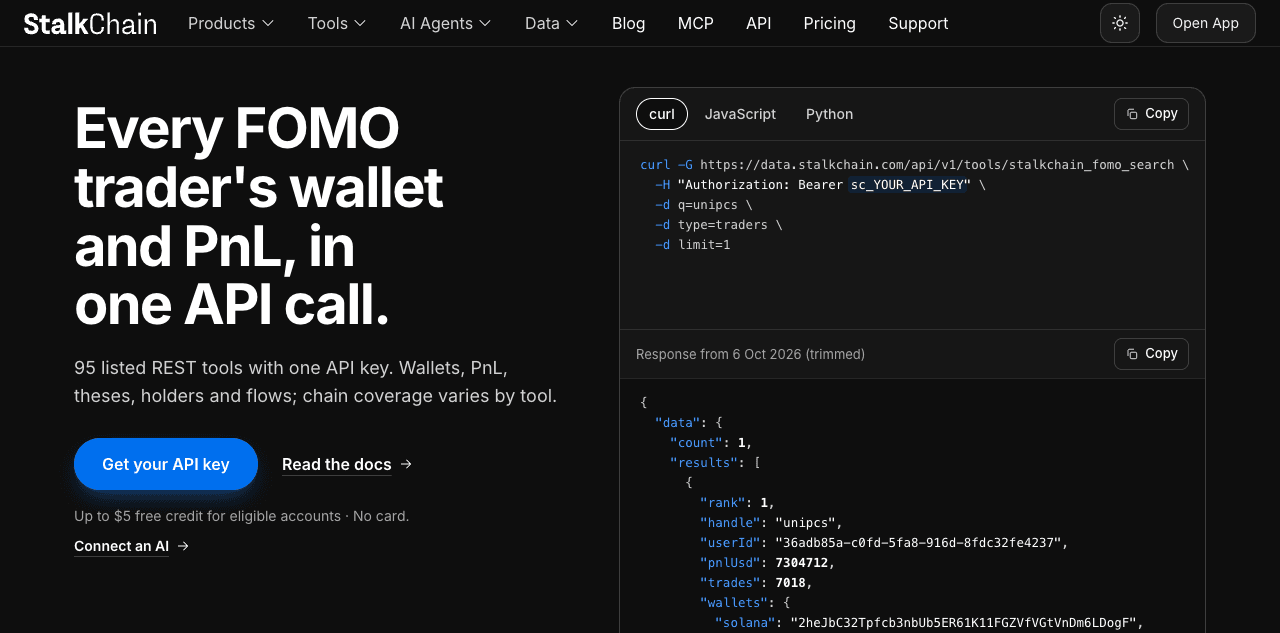
Source: StalkChain public API page, captured October 31, 2026.
This shows setup documentation, not proof of chain-wide coverage, current trader results or measured performance.
Any API response pictured is the site's dated example.
For the scope boundary, read the FOMO data coverage notes.
Use the REST authentication reference for application code or the Claude Code connection steps for an interactive agent.
Keep research access separate from trading authorization.
Final integration checklist
- Pin the chain, token and wallet identifiers.
- Record the endpoint, observation time and pagination.
- Verify material transactions with the chain explorer.
- Separate realized PnL, open exposure and transfers.
- Check account permissions and current plan limits before automation.
FAQ
Is MCP an API?
MCP is a protocol that makes tools callable by an AI client. A vendor may offer both MCP and conventional REST; StalkChain and CoinGecko document both. REST is generally the clearer route for deterministic application code.
Can Claude Code use a REST API without MCP?
Yes. It can write and run an HTTP client where the environment has the required network access and credentials. Review the generated code and its handling of errors, pagination and secrets.
Does connecting a research MCP let Claude trade?
Do not assume research and execution have the same permissions.
StalkChain's MCP page distinguishes data tools from separate agent-wallet tools.
Keep execution permissions outside an exploratory research workflow unless explicitly intended and reviewed.
Which connector should I install first?
Install for the first question you need answered: CoinGecko for broad prices and markets, StalkChain for linked FOMO trader/wallet/thesis analysis. Add specialized REST or SQL sources when the question exceeds either connector's documented scope.