Quick answer
Start with the full address in a Solana explorer. Review transactions and holdings, trace funding, and compare activity across tokens. Judge a complete sample, not one winner. PnL may omit basis, transfers, prices, or open positions, so verify important signatures.
What Solana wallet tracking means
Wallet tracking turns an address into a timeline of decisions. The useful questions are not only what the wallet owns, but how it got funded, when it entered, whether it added or sold, and whether related addresses behaved together.
A chart tells you what the market did. A wallet history tells you what one participant did inside that market.
The strongest research combines six dimensions:
- Funding: where the wallet's SOL originated.
- Activity: swaps, transfers, LP actions, and program interactions.
- Exposure: current balances and positions that may still be open.
- Performance: realized outcomes with explicit basis limitations.
- Behavior: entry timing, holding period, sizing, and repeatability.
- Relationships: shared funders, sibling wallets, and overlapping token activity.
Before you start
Copy the full address from a trusted source. Wallet labels, social profiles, and shortened addresses can be wrong or outdated.
Decide what you want to learn before opening the history:
- Is this wallet consistently early?
- Does it accumulate or chase momentum?
- Is it one address in a larger cluster?
- Did it really profit, or does the calculation ignore transfers and open positions?
- Is its current position small enough that copying would crowd the exit?
This keeps the investigation from becoming a search for evidence that confirms a trade you already want to make.
Use a candidate funnel instead of a smart-money label
Keep four explicit states in your research notes:
- Lead: a wallet appeared in a recent transaction, fresh-wallet, KOL, or token investigation.
- Candidate: its complete address and important signatures have been verified.
- Watchlist: a fixed sample supports repeatable behavior and the funding review found no material contradiction.
- Actionable observation: the current transaction, exposure, and liquidity still fit the strategy's decision window.
This funnel prevents a discovery label from becoming a conclusion. The dedicated guide to finding smart money wallets on Solana explains how to rank candidates by freshness, repeatability, accounting coverage, independence, and executability.
Step 1: read the transaction timeline
Start with recent swaps and work backward. For every token that matters, note the first buy, later adds, partial sells, final sell, and transfers.
Separate economic activity from housekeeping. Token account creation, rent, approvals, failed swaps, and address-to-address movements can clutter the timeline without representing a new position.
Classify the balance effect before the label
Do not let an explorer's action label decide what happened. Compare the wallet's pre-transaction and post-transaction balances, then place the record in one of four buckets:
- Trade: one asset decreased while another increased through a completed swap.
- Transfer: inventory moved between addresses without a matching purchase or sale in the same transaction.
- Position movement: assets entered or left an LP, vault, staking account, or other protocol position.
- Administrative activity: account creation, rent, approval, priority-fee, or failed execution with no new economic exposure.
This classification prevents two common errors. A transfer out does not become a sale, and an LP withdrawal does not become a buy merely because tokens returned to the wallet.
A practical transaction record includes:
- signature and block time
- asset sold and asset received
- raw and normalized amounts
- venue or aggregator
- wallet balance change
- token price source and timestamp, if used
For launch research, compare the wallet with the first-buyer workflow. Being early matters only after you know what the wallet did next.
Qualify the wallet's current activity before deeper research
A wallet can have an excellent historical record and no current strategy activity. Before spending time on PnL, funding clusters, or copyability, classify the newest covered sequence:
- Dormant: no verified signature inside the pre-defined window.
- Administrative: only fees, account changes, rent, or failed attempts are recent.
- Economic: a successful event changed assets or protocol exposure.
- Strategy-consistent: the recent event fits the behavior that earned the wallet attention.
- Decision-fresh: verification and liquidity are still current enough for the intended use.
This is a funnel, not a permanent score. An economically active wallet may fail the strategy-consistency test, while a strategy-consistent entry may already be stale for a follower.
The Solana wallet activity guide shows how to choose the window, separate source time from block time, measure inactivity gaps, and group several signatures into one decision session.
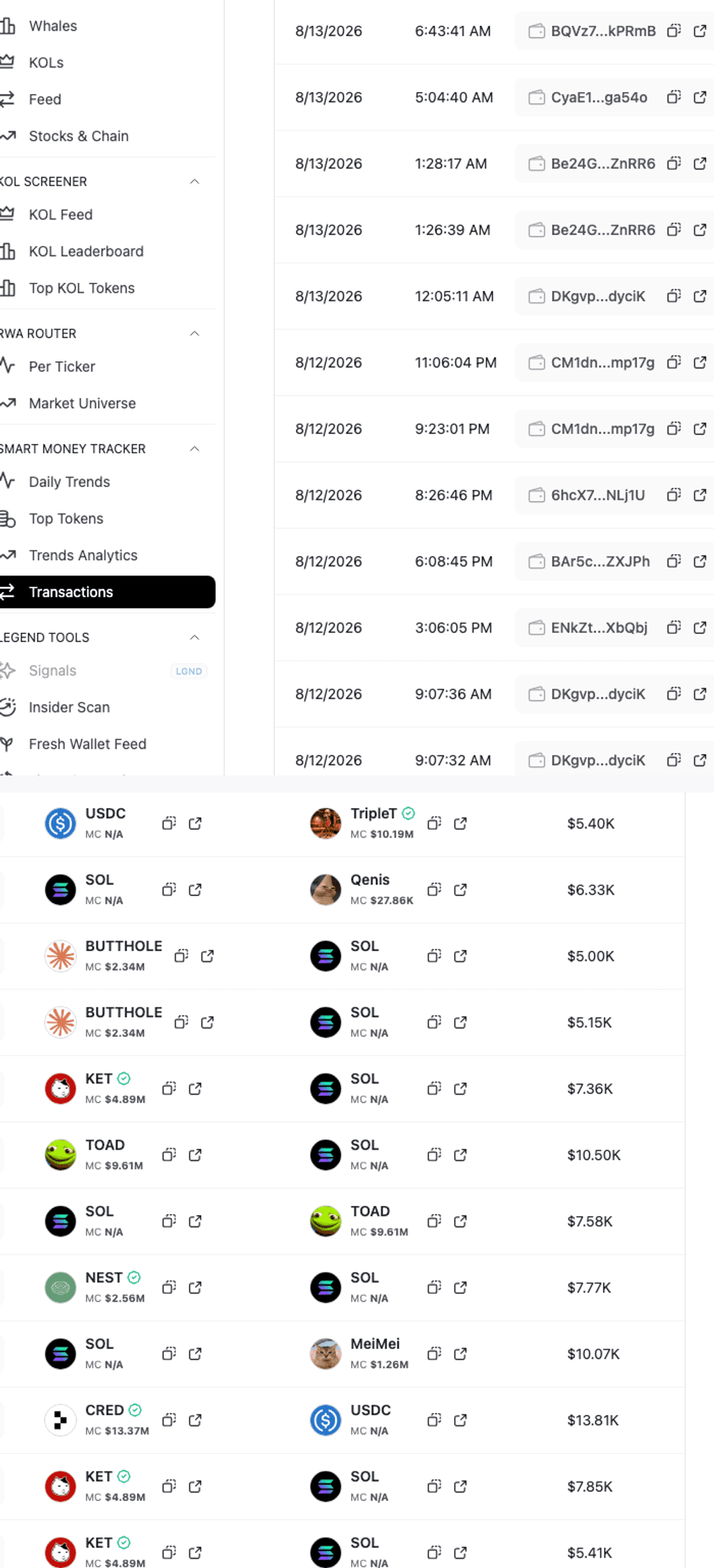
This production capture from August 13, 2026 shows the fields needed to shortlist a wallet and preserve trade direction. It does not show the address's complete history, transferred inventory, fees, or current balance. Open the wallet and signature before promoting a row from a lead to a verified candidate.
Read sequences, not isolated rows
Suppose a wallet swaps 20 SOL for a token, transfers half the tokens to a sibling address, adds the rest to an LP, then later receives SOL from that LP withdrawal. A naive history can describe the last record as profit and the transfer as a sale.
The defensible reading is unresolved until the token lot, sibling transfer, LP shares, withdrawal amounts, and fees reconcile. Preserve the sequence as one investigation rather than assigning meaning to each row independently.
Audit transaction-history coverage before judging behavior
A readable timeline can still be incomplete. Explorers and indexers may paginate results, omit old parsed records, lag new signatures, or simplify transactions they cannot decode.
Record four boundaries before calling the sample complete:
- oldest and newest verified block times
- number of pages or signatures reviewed
- failed, unparsed, and unavailable transactions
- any archival or provider coverage limit
Compare the first visible transaction with the wallet's opening balance. If the address already controlled SOL or tokens, earlier funding or inventory is missing from the reviewed history.
Then compare the final ledger quantity with the current accounts. A mismatch can expose missing transfers, protocol deposits, burns, or pagination gaps.
Use the dedicated Solana wallet transaction-history workflow to classify signatures, preserve failures, and reconcile balances before interpreting wallet style.
Gate every wallet lead on source freshness
A public feed can load its page shell while its newest rows are delayed, unavailable, or retained from a last-good response. Treat page availability and data freshness as separate checks.
Before promoting a row to a wallet candidate, save:
- the newest visible transaction time
- the page observation time and timezone
- any stale, partial, warming-up, or error notice
- whether the row came from a current response or retained data
- the complete signature used for independent verification
Then open the signature and wallet outside the feed. If the row cannot be reproduced, keep it as an unverified lead. Do not use a successful page load, a moving “updated” label, or an old screenshot as proof that the underlying wallet event is current.
This gate also protects the decision window. A valid transaction can be too old to support a fast copy-trading observation even when its historical classification is correct.
Step 2: trace the funding source
Open the wallet's earliest inbound SOL transfer. This often reveals more than the latest swap.
Known exchange: attribution stops at a shared hot wallet. Treat identity as unresolved.
Existing personal wallet: inspect the parent address's history and other recipients. One parent funding several trading addresses can reveal a cluster.
Fresh intermediary chain: repeated new-wallet hops suggest deliberate separation, but not automatically malicious behavior.
Bridge or protocol withdrawal: confirm the contract and originating chain before interpreting the wallet as new capital.
The fresh-wallet guide covers funding patterns and false positives. Do not equate one CEX-funded address with one identifiable person.
Use the dedicated Solana wallet funding-source workflow when the origin or wallet relationship is material. Save every signature, timestamp, amount, and hop instead of jumping from the target address to a distant labeled service.
Grade the funding relationship
Treat funding evidence in three levels:
- Direct path: the immediate sender, amount, and target balance change are verified.
- Corroborated relationship: repeated funding, token transfers, synchronized trades, or return flows independently connect the addresses.
- Attributed actor: reliable evidence outside the transfer path supports a real-world identity.
Most wallet investigations stop at the first or second level. A known exchange proves a service boundary, not the customer behind the withdrawal. Keep ownership unresolved unless the evidence supports the stronger claim.
Step 3: inspect holdings and current exposure
Current balances show what the wallet still risks. They do not reveal acquisition cost by themselves.
For each meaningful holding, check:
- token amount and approximate value
- share of the wallet's portfolio
- share of circulating supply
- whether the balance came from swaps or transfers
- whether price and supply data pass basic sanity checks
- whether the wallet has open LP or staking exposure elsewhere
A wallet can look highly profitable on realized trades while holding large unrealized losses. Conversely, transferred-out tokens may still belong to the same actor in a sibling address.
Reconcile the balance across every account that can hold exposure
Do not treat the wallet overview's headline value as the complete balance. A Solana owner can control native SOL, several token accounts for the same mint, associated token accounts, LP or vault receipts, staked positions, and wrapped SOL that has not been closed back to native SOL.
Build the exposure snapshot in this order:
- Record native SOL and reserve enough for rent and transaction fees.
- Group every token account by mint and verify each mint's decimals.
- Separate freely transferable inventory from delegated, frozen, escrowed, staked, or vault-held inventory.
- Trace LP and vault receipt tokens to the underlying assets when the protocol state is verifiable.
- Reconcile recently closed token accounts so returned rent is not mistaken for trading proceeds.
- Mark spam, unpriced tokens, and positions without defensible liquidity as unvalued rather than zero.
| Balance view | What it can prove | What it cannot prove alone |
|---|---|---|
| Native SOL | SOL currently controlled by the address | How much is available after fees, rent, and open instructions |
| SPL token amount | Normalized inventory for a verified mint | Acquisition basis, ownership history, or executable USD value |
| Portfolio USD mark | A timestamped estimate from current prices | Proceeds available from selling the full position |
| LP or vault receipt | A claim on a protocol position | Current underlying assets without decoding the protocol state |
| Zero visible balance | No inventory in the inspected accounts | A full exit when tokens moved to another wallet or protocol |
The snapshot should include an observation time and the exact accounts reviewed. Balances can change while the investigation is open, and an RPC or indexer can lag newly created or recently closed token accounts.
Separate controlled balance from executable balance
Controlled balance answers how many units the wallet can currently direct. Executable balance asks how much could be sold near the displayed price after pool depth, route availability, transfer restrictions, price impact, slippage, and fees.
A wallet may control $80,000 at the last quoted price while a current route offers only $31,000 for the full position. Keep both figures. The first describes marked exposure; the second describes a time-sensitive exit estimate. Neither reveals acquisition cost.
Step 4: test whether performance repeats
One successful token is not a strategy. Build a sample across multiple closed or mature positions.
Review:
- median return, not only the largest winner
- win rate with a stated sample size
- realized losses and abandoned positions
- average holding time
- entry market cap and liquidity
- size relative to pool depth
- behavior before and after public attention
A wallet with a modest win rate can still be profitable if winners are much larger than losses. A high win rate can hide one catastrophic loss or selective data coverage.
Do not calculate performance from swaps alone. Reconcile transfers, fees, remaining inventory, and the cost basis assigned to partial sells. The dedicated guide to checking Solana wallet profitability explains realized PnL, unrealized PnL, ROI, and win-rate denominators step by step.
Use a coverage ledger before trusting the result
For each position, label buy coverage, sell coverage, transfer coverage, fee coverage, and current-price coverage as complete, partial, or unresolved. A headline return should inherit the weakest material input.
For example, complete sell proceeds plus unresolved transferred-in basis does not produce exact realized PnL. It produces observed proceeds with incomplete basis. This wording is less exciting, but it prevents false precision.
Use the KOL tracking workflow when the address is linked to a public profile. Evaluate the wallet evidence separately from follower count.
Benchmark the wallet against its own strategy cohort
A sitewide win-rate threshold mixes incompatible behavior. A fast launch trader, a multi-day accumulator, and a liquid-token momentum wallet face different entry delays, liquidity, holding periods, and payoff distributions.
Create a cohort from observable operating constraints:
- token age at first covered entry
- market-cap and liquidity range
- typical position size
- median holding period
- launch, momentum, accumulation, or distribution style
- manual versus scheduled entries
- market regime and review dates
Compare win rate, payoff ratio, median return, drawdown, and profit concentration only after the cohort is fixed. A 55% rate can be strong among comparable launch traders if losses are controlled and follower execution remains plausible.
The same rate says little when it combines early illiquid entries with slower liquid-token rotations.
Use the Solana wallet win-rate benchmark to define mature positions and show open, break-even, and unresolved counts. Keep the cohort definition in the watchlist record so later reviews use the same comparison.
Preserve the wallet's pre-observation baseline
Record the date the wallet first entered the watchlist. Split results before and after that checkpoint.
The earlier period explains why the wallet was discovered. The later period tests whether its edge repeated without selecting trades in hindsight. If win rate, payoff, or liquidity-adjusted return deteriorates after observation, downgrade the wallet even when its lifetime headline remains attractive.
Run a shadow-copy test before calling the wallet followable
Historical PnL measures what the wallet achieved. A shadow-copy ledger tests what a follower could have achieved after a real detection and verification delay.
Do not place trades for this test. For a fixed prospective sample, save:
- the wallet's confirmed entry and effective price
- when your monitoring source exposed the event
- when the candidate passed your verification rules
- a fresh quote for your fixed test size, including minimum output and fees
- the first defensible exit observation and a fresh exit quote
- misses caused by stale data, unavailable routes, or insufficient depth
Keep rejected and missed observations in the denominator. Excluding trades that moved too quickly recreates hindsight bias because speed is part of the strategy's edge.
Compare wallet return and shadow-copy return only across the same token, side, test size, and exit rule. The difference is follower slippage from detection delay, market movement, price impact, fees, and crowding.
| Shadow result | Interpretation |
|---|---|
| Wallet and shadow sample both remain positive | The observed edge may be followable at the tested size |
| Wallet positive, shadow sample weak or negative | The edge exists, but followers arrive too late or move the market |
| Both weak | Historical selection or a changed strategy may explain the reputation |
| Many observations unquotable | Liquidity, route coverage, or source delay prevents a followability claim |
Step 5: identify the wallet's operating style
Classify behavior instead of applying a generic "smart money" label.
Early-launch trader
Enters near pool creation, rotates quickly, and may use fresh addresses. Check sniper competition, failed entries, and survival bias.
Accumulator
Adds across separate sessions and often buys weakness. Compare the history with whale accumulation and live DCA activity.
Momentum trader
Enters after volume expands and exits quickly. Copying after detection can erase the timing advantage.
Liquidity operator
Adds or removes LP positions and may transfer inventory between vaults. Do not mislabel every outflow as a sale.
Distributor
Sells into rising attention, often across several wallets. Check whether fresh or smaller buyers are absorbing the exit.
A wallet can switch styles by token. Classification is a summary of observed behavior, not a permanent identity.
Build a wallet watchlist that can be audited
A useful watchlist is a set of testable observations, not a collection of labels. Save enough context to decide later whether the wallet repeated its edge or whether the original signal disappeared.
For every watched address, record:
| Watchlist field | Minimum evidence | Refresh trigger |
|---|---|---|
| Address identity | Complete address and source | Label or linked profile changes |
| Funding state | Earliest covered funder, amount, time | New material inbound SOL |
| Demonstrated style | Fixed sample of entries, exits, and holding periods | Activity outside the prior pattern |
| Current exposure | Raw balances and protocol positions at a checkpoint | Buy, sell, transfer, or protocol movement |
| Performance coverage | Basis, sales, fees, transfers, and open lots | A covered position matures or moves |
| Liquidity constraint | Quote size, output, impact, and time | Position size or pool depth changes |
| Relationship state | Direct, corroborated, or unresolved | New funding, transfer, or synchronized behavior |
Add a source-state field to the same record. Use current only when the event time, source response, and independent signature check agree. Use delayed, last-good, partial, or unavailable when that is what the evidence supports.
Do not erase the previous good observation when a source degrades. Preserve it with its original timestamp, then stop using it as a live trigger until a newer signature is verified.
Avoid a permanent “smart money” badge. Use a status such as lead, candidate, watchlist, paused, or rejected, plus the evidence that caused the last change.
Define alerts from behavior, not every transaction
An alert should answer a decision question. Useful examples include:
- first covered buy after fresh funding
- second buy in the same token after a separate session
- partial sale that changes the wallet from accumulation to distribution
- transfer to a newly funded address already in the relationship map
- full-size exit quote falling below the watchlist's liquidity threshold
- activity outside the wallet's demonstrated holding period or token-age range
Do not alert on rent, token-account creation, failed transactions, or internal route legs unless those events are part of the research question. Preserve them in the ledger so balances and fees still reconcile.
Use fixed review checkpoints
Review the watchlist on a schedule and after material alerts. At each checkpoint, save what changed since the prior one, what remains unresolved, and whether the original reason for following the wallet still holds.
A concise checkpoint can say:
The wallet added twice over six hours, retained 72% of covered inventory, and still fits its accumulator sample. Full-size quoted exit value fell 19%, so the observation remains useful but is not currently copyable at the reviewed size.
That conclusion is more actionable than “smart wallet bought.” It preserves direction, remaining exposure, historical fit, and your own execution constraint.
Step 6: map related wallets
Look for shared funding, synchronized transactions, repeated co-entry, identical sizing, and transfers between addresses.
Strong relationship evidence includes one parent wallet funding several fresh addresses that buy the same token. Weak evidence includes unrelated wallets withdrawing from the same exchange.
When a cluster is credible, calculate exposure and performance at the actor level. Counting five sibling addresses as five independent profitable wallets exaggerates demand and diversification.
Example: representative wallet readout
Consider an anonymized wallet with this profile:
- first funded 47 days ago from a known exchange
- 18 token positions with usable entry and exit coverage
- 10 profitable closed positions and 8 losing positions
- two large winners responsible for most realized gains
- median holding time of 3.4 hours
- seven entries within ten minutes of launch
- four current holdings, including one illiquid position
- two sibling addresses funded through the same intermediate wallet
The wallet is early and net profitable in the covered sample, but the edge is concentrated in two outcomes. Its current illiquid holding and sibling-wallet exposure make the headline win rate less informative than it first appears.
This wallet belongs on a watchlist. It is not a safe blind copy target.
The distinction matters operationally. If the wallet's last verified edge came from seven launch entries but the current lead is a later momentum buy, the historical category does not validate the present trade. Reclassify each new observation against the wallet's demonstrated style before assigning it weight.
Use Stalkchain for discovery, then verify on-chain
The Solana wallet tracker guide explains the research workflow, but it is not an address-input analytics screen. For live discovery, use Transactions for market-wide activity, Fresh Wallets Feed for newly activated addresses, and Insider Scan for token-level wallet concentration.
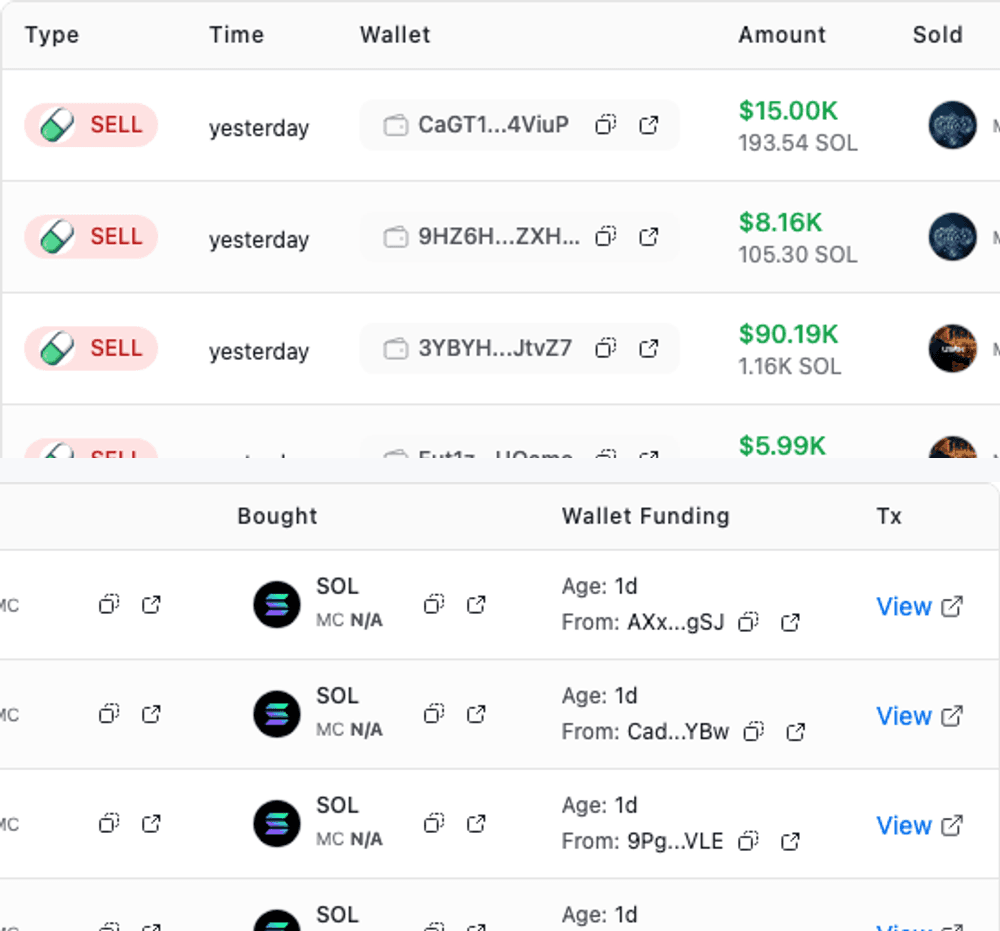
This production capture shows the fields that make a wallet lead investigable: the address, trade direction and amount, funding context, and a transaction link. It is a discovery record, not a complete wallet statement. Open the full signature and address in a Solana explorer before assigning basis, ownership, or profit.
When the wallet appears early in a launch, verify the exact signature and compare it with the first buyers of that Solana token. When it keeps adding, compare the pattern with Jupiter DCA orders and repeated buying.
The product surfaces shorten discovery. They do not remove the need to confirm signatures, identify infrastructure accounts, or preserve uncertainty around PnL.
Common mistakes
- Following a wallet because of one screenshot or one winner.
- Treating transfers as buys or sells without checking the destination.
- Calling CEX-funded wallets related based on the hot wallet alone.
- Ignoring open positions when judging performance.
- Copying after a thin token has already moved.
- Assuming a public label still controls the same address.
- Forgetting that your trade changes the liquidity available to exit.
Final checklist
- Confirm the full wallet address.
- Define the research question.
- Read swaps and balance changes, not only labels.
- Trace the first funding source.
- Review current holdings and open exposure.
- Reconcile native SOL, token accounts, and protocol positions.
- Separate controlled inventory from a fresh executable exit estimate.
- Measure performance across a complete sample.
- Compare prospective wallet results with a fixed-size shadow-copy sample.
- Classify the wallet's operating style.
- Map only evidence-backed related addresses.
- Verify important signatures on-chain.
- Size for liquidity and copy-trade crowding.
- Save watchlist status, evidence, checkpoint time, and refresh trigger.
- Save source freshness and distinguish current rows from retained last-good data.
FAQ
Can you track any Solana wallet?
You can inspect public on-chain activity for any address. You cannot always identify the person controlling it, see off-chain trades, or prove that several addresses have the same owner.
How do I know if a Solana wallet is profitable?
Reconstruct token inflows, outflows, buys, sells, fees, transfers, and remaining inventory. Use historical prices with timestamps. Treat results as partial when acquisition basis or transfer ownership is unknown.
What is a good wallet win rate?
There is no universal threshold. Compare win rate with sample size, median return, loss size, holding period, liquidity, and concentration of profits. A 70% win rate based on ten selectively covered trades is weak evidence.
Are fresh Solana wallets worth following?
Some are. The useful signal comes from funding, first action, cluster behavior, and what happens after entry. A new address alone has no proven edge.
Is copying a profitable wallet safe?
No. Detection delay, price impact, liquidity, different position size, and the wallet's ability to exit before followers can reverse the expected outcome.
How often should I refresh a Solana wallet watchlist?
Refresh after a material buy, sale, transfer, funding event, or liquidity change, and on a fixed schedule suited to the wallet's demonstrated holding period. Fast launch traders need shorter checkpoints than multi-day accumulators.