Quick answer
Yes. Tether can freeze USDT and Circle can freeze USDC by blacklisting the address that holds them, and the funds can't move after that. Several other issuers can do the same for their tokens. Native coins like ETH and BTC have no issuer, so nobody can freeze them. In the Binance hack, Binance says about $3B of the roughly $6.3B stolen was frozen, almost all of it stablecoins.
How a stablecoin freeze works
USDT and USDC are smart contracts with an admin role. Among other things, that role can add an address to a blacklist.
- Tether (USDT): a blacklisted address can't send or receive USDT. Tether can also destroy the blacklisted balance and reissue it.
- Circle (USDC): a blacklisted address can't send, receive or approve USDC.
The freeze happens at the token contract, so it works no matter which wallet app or exchange the holder uses. It's also fast: once the issuer decides, it's one transaction.
The catch is that a freeze hits an address, not a person. If the stolen tokens have already moved to a new address, or into a protocol contract like Aave's, blacklisting the old address does nothing. That's the race every hacker of stablecoins runs.
What was frozen in the Binance hack
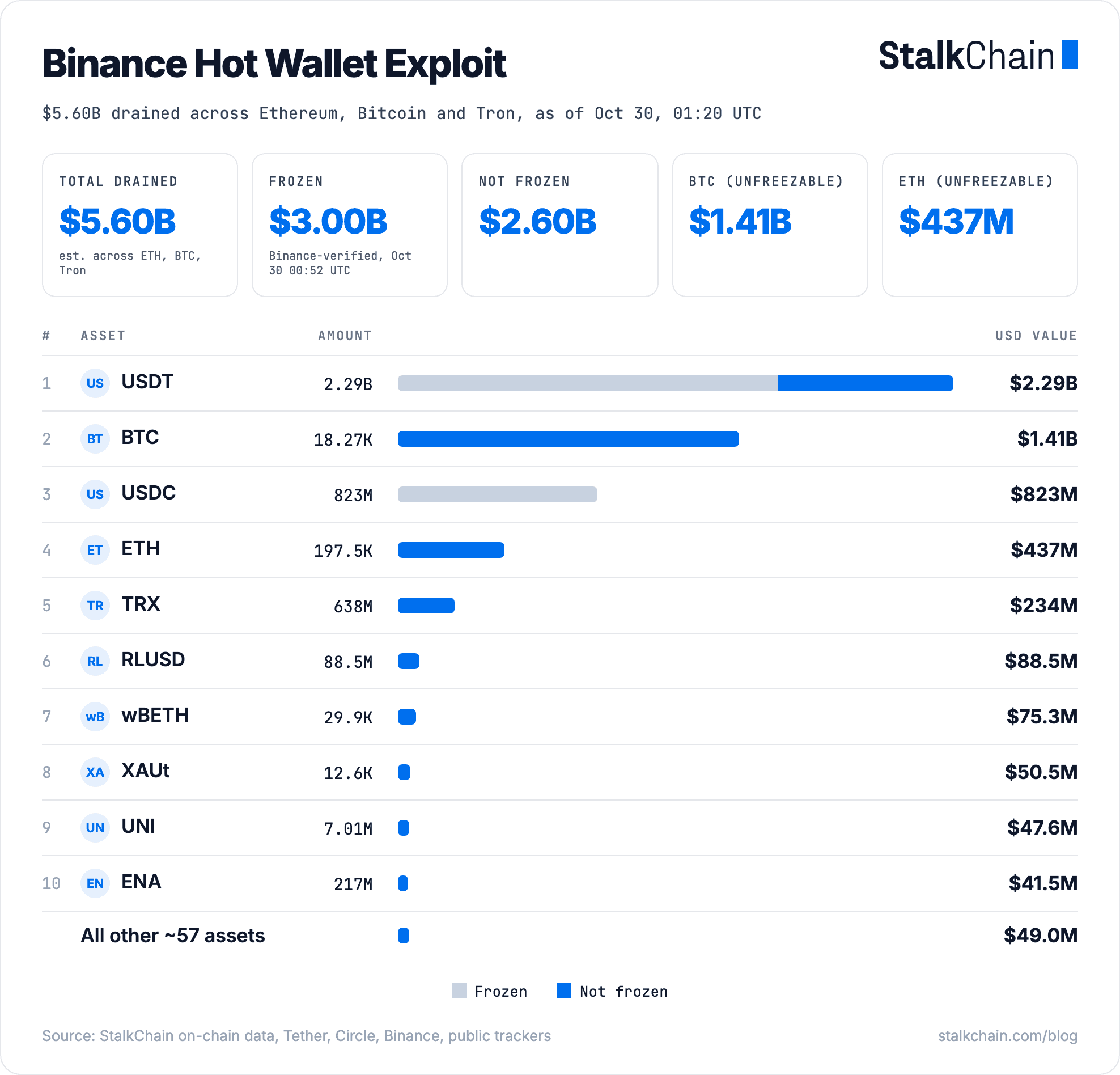
From issuer statements, Binance and StalkChain wallet data:
| Who froze | What | Amount |
|---|---|---|
| Tether | USDT on Ethereum and Tron | 1.567B USDT, per CEO Paolo Ardoino |
| Circle | USDC in the main attacker wallet, "in coordination with law enforcement" | 823M USDC |
| Ripple | RLUSD | about 200M, per press reports |
| Arbitrum Security Council | 74.56M ARB and 8,425 ETH on Arbitrum | about $30.5M |
| World Liberty Financial | USD1 | about 27M, per press reports |
| Paxos | PAX Gold | 1,906.67 PAXG |
| Binance total | "Verified total frozen", 00:52 UTC Oct 30 | about $3B |
StalkChain data shows the main attacker wallet still holding exactly 1,175,464,712 USDT and 823,000,000 USDC, untouched since the freezes.
Who else can freeze crypto
- Most fiat-backed stablecoins (USDT, USDC, RLUSD, USD1, FDUSD, PYUSD) have freeze or blacklist functions.
- Tokenized gold like XAUt and PAXG works the same way.
- Some chains' governance can act in emergencies. Arbitrum's Security Council moved the attacker's ARB and ETH into its freeze vault with a system transaction he never signed.
- Centralized exchanges can freeze deposits that land in their accounts. That's why hackers avoid them.
What can't be frozen
ETH, BTC and other native coins. There's no issuer and no admin key. The only way to stop them is for an exchange or service to refuse them when they arrive.
That's why, within minutes of the drain, the Binance attacker started converting everything freezable into ETH. About 700M USDT left the main wallet in nine minutes and was swapped or borrowed into ETH before Tether's first freeze at 21:05 UTC. The cleverest part used Aave: see how the hacker used Aave to beat the freeze.
By 02:35 UTC on October 30, StalkChain data showed about 470,900 ETH ($1.04B) sitting in six attacker wallets, plus about 17,270 BTC ($1.33B) on Bitcoin. Nobody can freeze any of it.
What the freezes tell us
- They work at scale. Over half the stolen value is frozen. Without stablecoin freezes, this hack would have been far worse.
- Speed decides. The ~$3B frozen is what the attacker couldn't move in time. What he moved in the first hour escaped.
- DeFi is a way around a blacklist. Depositing frozen-to-be tokens into a lending protocol and borrowing native ETH works if done before the freeze.
- Frozen isn't returned. Frozen funds still need a legal process before they go back to Binance. Binance has pledged to cover user losses either way.
The live timeline tracks the freeze total as it changes.