Quick answer
For named FOMO traders, their wallets, positions, PnL and written theses, start with StalkChain MCP. For labeled Smart Money and wallet relationships, choose Nansen.
For a reproducible cross-chain cohort query, use Dune.
Bitquery fits swap-level trading and fund-flow investigation; CoinGecko fits prices, pools and broad market context.
These jobs overlap but are not interchangeable.
An MCP server gives an AI assistant callable tools, not a guarantee that its answer is correct.
For on-chain research, choose the server whose underlying evidence matches your question: identifiable traders, labeled wallets, custom SQL cohorts, transaction-level trades or market prices.
Disclosure: Stalkchain Research wrote this guide and operates StalkChain.
This is a review of published product surfaces, not a hands-on benchmark.
We did not run matched prompts across providers, verify output accuracy, measure latency or compare current plan prices.
No vendor paid for placement.
Documentation and the live StalkChain page were checked October 31, 2026; capabilities and access can change.
How we compared them
We required first-party documentation of an actual MCP connection and evaluated research fit, evidence granularity, setup/authentication and a consequential limitation. The labels below are editorial recommendations, not measured rankings.
We excluded REST-only products; that is a different integration decision. A tool catalog establishes what an agent can request, not the completeness of any answer or availability on every chain.
Always inspect returned timestamps, addresses, sample boundaries and underlying transactions before drawing a trading conclusion.
| Server | Best research question | Evidence advantage | Important boundary |
|---|---|---|---|
| StalkChain | What is a tracked trader holding and why? | FOMO trader profiles, positions, theses and token-holder context | Tracked trader coverage is not the universe of wallets |
| Nansen | Which labeled wallets accumulated this token? | Smart Money, labels, flows and wallet PnL | Chain/tool coverage varies; connector and full catalog differ |
| Dune | How did my defined cohort behave over time? | Dataset discovery, SQL, results and dashboards | Analyst must inspect schemas and query assumptions |
| Bitquery | Which swaps and transfers support this narrative? | Trade rows, candles and tracing datasets | Rows and heuristics need interpretation; not a trader thesis feed |
| CoinGecko | What is the market and pool context? | Prices, exchange and DEX pool data | Price context alone cannot establish wallet intent |
StalkChain: best for tracked trader narratives
The live MCP page documents https://data.stalkchain.com/mcp, OAuth sign-in, and connections for Claude, ChatGPT, Grok, Cursor and Claude Code.
Its listed tools include trader balances, positions, swaps, PnL reports, token holders, buy/sell flow and written FOMO theses.
It is especially useful when the research question begins with a known or discoverable tracked trader, then asks whether that person still holds a token and what they said about it.
The site lists Solana and six other chains, but individual data sources and tool coverage are not identical across chains.
Do not turn a tracked cohort into a claim about every holder.[1]
Try: “Find a tracked trader discussing this token; show their resolved wallets, open position and recent swaps. Separate their written thesis from observable trades, and state the observation time.” Explore the live tool list and setup.
Nansen: best for labeled-wallet context
Nansen's MCP overview describes labeled wallets, Smart Money activity, token flows, wallet PnL and related-wallet analysis.
Its OAuth connectors present a curated tool set; direct API-key connection exposes the broader catalog.
That distinction matters if a desired investigation is absent from the connector.
Nansen explicitly says data coverage varies by chain and tool.
Choose it over StalkChain when entity labeling and broad Smart Money screening matter more than a tracked trader's posted thesis.[2]
Try: “Find Smart Money inflows for this asset, identify the labeled wallets, and distinguish fresh buys from existing positions.”
Dune: best for an auditable cohort definition
Dune MCP lets an agent search datasets, create and execute DuneSQL, inspect results, generate visualizations and manage dashboards.
It supports OAuth or an API key.
The strength is explicit logic: you can define a window, exclusions and a cohort that another analyst can inspect.
The cost is analytical responsibility.
A plausible SQL result can still be wrong if joins duplicate trades, entity assumptions are weak or a table omits a venue.[3]
Try: “Find the relevant swap tables, show schemas, then write a query for distinct buying wallets in a defined seven-day window. Show SQL, row count and exclusions before interpreting.”
Bitquery: best for swap rows and fund-flow reconstruction
Bitquery's hosted MCP describes trade-level rows, transfer tracing, candles and wallet history across supported chains, with account-based OAuth in supported clients.
Its tracing and trade evidence is useful when a story needs transaction hashes and money paths rather than a social identity.
The vendor describes outlier filtering, but a filter is not proof that all wash trading is removed.
Review the transactions and the method behind any suspicious-flow label.[4]
Try: “List the swaps for this wallet and token during this window with transaction hashes; separate swaps from transfers and note missing venues.”
CoinGecko: best for market and DEX context
CoinGecko MCP offers live and historical price, market, token and pool data.
Its keyless remote server uses shared rate limits; its API-key server exposes a fuller set according to the account plan.
Use it to check whether apparent wallet conviction coincided with a thin pool or abrupt price move.
It is not, by itself, evidence of who controlled a wallet or why it traded.[5]
Try: “For this chain and token address, identify the relevant pools, recent price movement and liquidity context; do not infer trader identity from pool activity.”
A research workflow that uses the right evidence
Imagine a claim that several recognized traders are accumulating a token. This is a procedure to run, not a reported test result:
- Fix identity: record the chain and token contract or mint, not just a ticker. Ask StalkChain which tracked FOMO traders hold it, then request position history and any theses. Record observation time; a trader's words and swaps are separate evidence.[1]
- Check the broader cohort: ask Nansen whether labeled Smart Money wallets show comparable flows. Compare address lists rather than treating vendor labels as ground truth.[2]
- Reconstruct activity: use Bitquery's swaps/transfers for relevant addresses and a bounded window; inspect transaction hashes. If the question is cohort-wide or historical, define the cohort and exclusions in Dune SQL instead.[3][4]
- Add denominator and market context: use CoinGecko for pools and price context. A cluster of buys into a thin pool is different from broad, sustained demand.[5]
- Write the conclusion with limits: specify sampled wallets, timeframe, source and unresolved attribution. Do not say “all smart money bought” because a tracked list increased.
Dune permissions: Its MCP can also create or change queries and dashboards, and delete materialized views. Review tool permissions and approve writes separately from read-only research.
Which should you connect first?
- Named FOMO trader and thesis: StalkChain's MCP setup.
- Labeled entities and Smart Money screening: Nansen's connector guide.
- Custom, inspectable historical study: Dune MCP documentation.
- Swap-level audit or fund tracing: Bitquery MCP documentation.
- Market price and pool sanity check: CoinGecko MCP documentation.
The strongest answer often combines two data types.
Add providers only when the next one resolves a specific evidentiary gap, not to collect more agreeing summaries.
For a Solana-specific investigation, see our wallet and token MCP comparison.
Check the documented StalkChain connection
Open the StalkChain MCP connection guide and inspect the published connection or request example before using an account key. The screen below documents the public interface, not an authenticated comparison test.
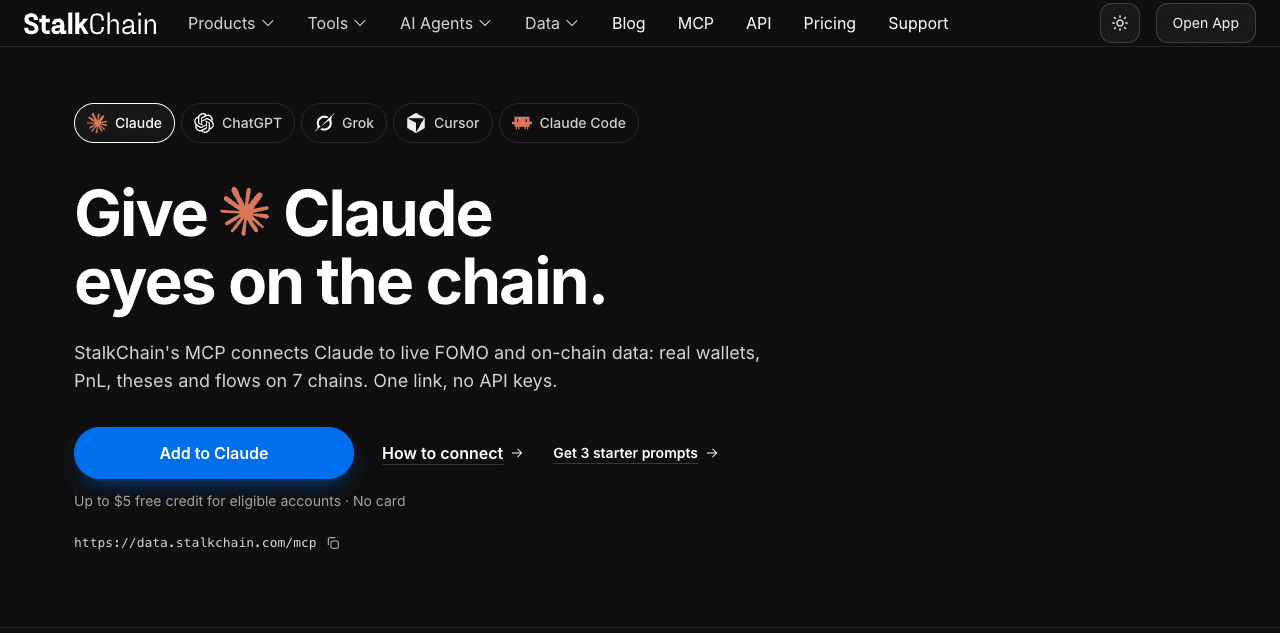
Source: StalkChain public MCP page, captured October 31, 2026.
This shows setup documentation, not proof of chain-wide coverage, current trader results or measured performance.
Any API response pictured is the site's dated example.
For the scope boundary, read the FOMO data coverage notes.
Use the REST authentication reference for application code or the Claude Code connection steps for an interactive agent.
Keep research access separate from trading authorization.
Final integration checklist
- Pin the chain, token and wallet identifiers.
- Record the endpoint, observation time and pagination.
- Verify material transactions with the chain explorer.
- Separate realized PnL, open exposure and transfers.
- Check account permissions and current plan limits before automation.
FAQ
Is an MCP server the same as a crypto API?
No. MCP exposes tools to an AI client; a REST or query API is typically called directly by code. Some providers offer both. See the API-oriented Claude Code guide for that separate decision.
Can these servers prove insider trading?
No. An address, a label or a profitable trade does not by itself establish common control or intent. Preserve transaction evidence and qualify attribution.
Is StalkChain a general blockchain indexer?
No. Its strongest documented use here is tracked FOMO trader, wallet, thesis and token-flow research. Use Dune, Bitquery or chain-native infrastructure for broader raw-data questions.[1][3][4]
Sources
First-party pages reviewed October 31, 2026. Descriptions reflect vendor documentation, not independently measured performance.
[1] StalkChain MCP live page
[2] Nansen MCP overview
[3] Dune MCP documentation
[4] Bitquery MCP documentation
[5] CoinGecko MCP documentation