Quick answer
Choose Helius for Solana-native wallet, asset and transaction infrastructure; Solscan for explorer-style account, token-holder and decoded-transaction queries; and StalkChain when a question centers on tracked FOMO traders, their Solana wallets, positions and theses.
Nansen adds labeled-wallet and Smart Money context.
Dune is strongest when you must define and inspect a historical cohort in SQL.
No single server is the authoritative answer to every wallet question.
A Solana wallet question can mean very different things: decode a transaction, identify the token's largest holders, study the trade history of a known person or test whether an entire cohort accumulated.
A useful MCP choice begins with that distinction, not the longest tool list.
Disclosure: Stalkchain Research authored this guide and operates StalkChain.
We compared published first-party capabilities on October 31, 2026, not matched live outputs.
We did not authenticate to every server, measure completeness or latency, or benchmark plan prices.
No vendor paid for placement.
Selection method and scope
Each pick has an official, documented MCP surface.
We compared the unit of analysis (raw wallet or transaction, labeled entity, tracked trader, token holders or authored cohort), setup, and what might be missing.
“Best for” is an editorial fit judgment, not an accuracy ranking.
We did not reproduce vendor examples as our own tests.
Tool permission matters: Helius's MCP includes write and webhook-management actions, unlike a read-only research connector.
Confirm the tools your client exposes and require human approval for state-changing calls.[1]
| MCP server | Best Solana research job | Distinctive strength | Main caveat |
|---|---|---|---|
| Helius | Decode and investigate raw wallet/asset/transaction activity | Solana-native routed API tools | Includes write and infrastructure-management actions; restrict permissions |
| Solscan | Explorer-style holder, account and decoded-transaction checks | Account, token, DeFi and transaction categories | Both hosted servers require a key; free coverage is limited |
| StalkChain | Investigate a tracked trader's positions and thesis | Resolved trader context, holdings, PnL and FOMO research | Tracked FOMO traders are not all Solana wallets |
| Nansen | Find labeled Smart Money and wallet relationships | Labels, flows, counterparties and wallet PnL | Chain/tool coverage and curated/full access differ |
| Dune | Reproduce a custom holder or trader cohort | Discoverable tables and inspectable SQL | Query design and interpretation remain your responsibility |
Helius: best for Solana-native transaction and asset work
Helius's MCP documentation describes routed tools for wallet balances and history, asset/holder data, parsed transactions and chain state, plus expandResult for large responses.
This is the natural choice when you have a signature or wallet address and need structured chain evidence rather than a prewritten trader narrative.
Its heliusWrite tool can transfer SOL or SPL tokens, and other routed tools can manage streaming or webhooks.
Treat it as a capable infrastructure interface, not a read-only analyst sandbox; use least-privilege credentials and approve sensitive actions.[1]
Question: “For this Solana signature, decode the transaction and list token-account changes. Return the signature and the fields behind the interpretation; make no writes.”
Solscan: best for explorer-style wallet and holder checks
Solscan's official MCP guide documents hosted public/free and Pro endpoints.
Both require a Solscan API key; the free-tier key grants a constrained subset, whereas paid Pro exposes the full documented set.
Its categories include account activity, token holders, decoded transactions, DeFi activity and market data.
This is a practical second view when checking a mint's holder distribution or following an account's activity.
A ranked holder list is not automatically a list of distinct beneficial owners; token accounts, custody and attribution require interpretation.[2]
Question: “For this mint, return top holders and holder-count context, then inspect this wallet's decoded recent transactions. Separate token accounts from asserted owners.”
StalkChain: best for tracked FOMO trader context
The live StalkChain MCP page lists a remote endpoint at https://data.stalkchain.com/mcp, OAuth connection and research tools for trader discovery, wallets, positions, swaps, token holders and written theses.
This is strongest when a Solana token thesis hinges on which tracked people bought, still hold or sold, rather than merely whether an address sent a transfer.
Its documentation also lists other chains; this guide addresses the Solana research use case, not uniform coverage across every source or chain.
Absence from the tracked cohort does not mean a wallet is unimportant.[3]
Question: “For this Solana mint, identify tracked FOMO holders, show their current positions and relevant swaps, and quote their thesis separately from transaction evidence.” See the live connection guide.
Nansen: best for labeled-wallet relationships
Nansen MCP documents Smart Money holdings, token flows, wallet PnL, counterparties and related-wallet research.
Its OAuth connector has a curated tool set, while a direct API-key connection exposes a broader catalog.
Use it when an anonymous address needs a label or when you want to assess whether identified high-signal wallets are accumulating.
Check the chain-by-tool coverage before assuming a particular Solana analysis is available.
Labels and related-wallet signals are leads, not proof of common ownership.[4]
Question: “Which labeled wallets entered this Solana token in this window? Return addresses, classification and flows, and flag uncertain attribution.”
Dune: best for a reproducible Solana cohort
Dune MCP can discover tables, create and execute SQL, inspect results and build charts or dashboards.
It suits questions such as “how many distinct wallets bought this mint in the first day and still held later?” because the analyst can publish the exact filters and joins.
This is a different workflow from opening a prebuilt trader profile.
Confirm the chosen Solana tables, token mint, program coverage and treatment of associated token accounts; SQL can be reproducible and still encode a bad definition.[5]
Question: “Find the relevant Solana trade tables, inspect their columns, and propose SQL for distinct buyers of this mint during a specified window. Show exclusions and possible double counts before running.”
Worked investigation: is a wallet's token accumulation meaningful?
The following is a repeatable research procedure, not a claim that we ran these prompts or found a specific wallet.
- Identify the asset and account. Copy the full Solana mint and wallet address. Use Helius to retrieve structured transactions, or Solscan to inspect decoded account activity and token accounts. A ticker match is not enough.[1][2]
- Separate inflows from buys. Check whether tokens came from swaps, transfers, airdrops or custody moves. Note signatures and the time window. A balance increase is not necessarily a market purchase.[1][2]
- Check the social/trader hypothesis. If StalkChain resolves the address to a tracked FOMO trader, inspect their position, recent swaps and thesis. If it does not, report “not found in this tracked cohort,” not “unknown wallet has no history.”[3]
- Test the larger pattern. Use Nansen's labels for other participating addresses, or define a Dune SQL cohort with exclusions and a disclosed observation window. Neither a label nor a query result proves common control.[4][5]
- Write a bounded conclusion. State the mint, addresses, signatures, timestamps and which parts are inference. Recheck before acting: positions and holder rankings move.
Caution: A “smart money” label, profitable prior trade or clustered entry is a research lead. It does not establish insider status, coordinated control or future returns.
Dune permissions: Its MCP can also create or change queries and dashboards, and delete materialized views. Review tool permissions and approve writes separately from read-only research.
Which connection should you use?
Start with Helius MCP when the question begins with a transaction signature or raw Solana account; Solscan MCP when you want an explorer-style second read on holders and decoded actions.
Use StalkChain MCP for a tracked trader's behavior and thesis, Nansen MCP for labeled-wallet context, and Dune MCP for an inspectable historical definition.
Pair complementary evidence rather than asking five providers the same vague prompt.
For broader multi-chain research choices, see our crypto MCP server comparison.
For manual checks, use the Solana token due diligence checklist and wallet tracking guide.
Check the documented StalkChain connection
Open the StalkChain MCP connection guide and inspect the published connection or request example before using an account key. The screen below documents the public interface, not an authenticated comparison test.
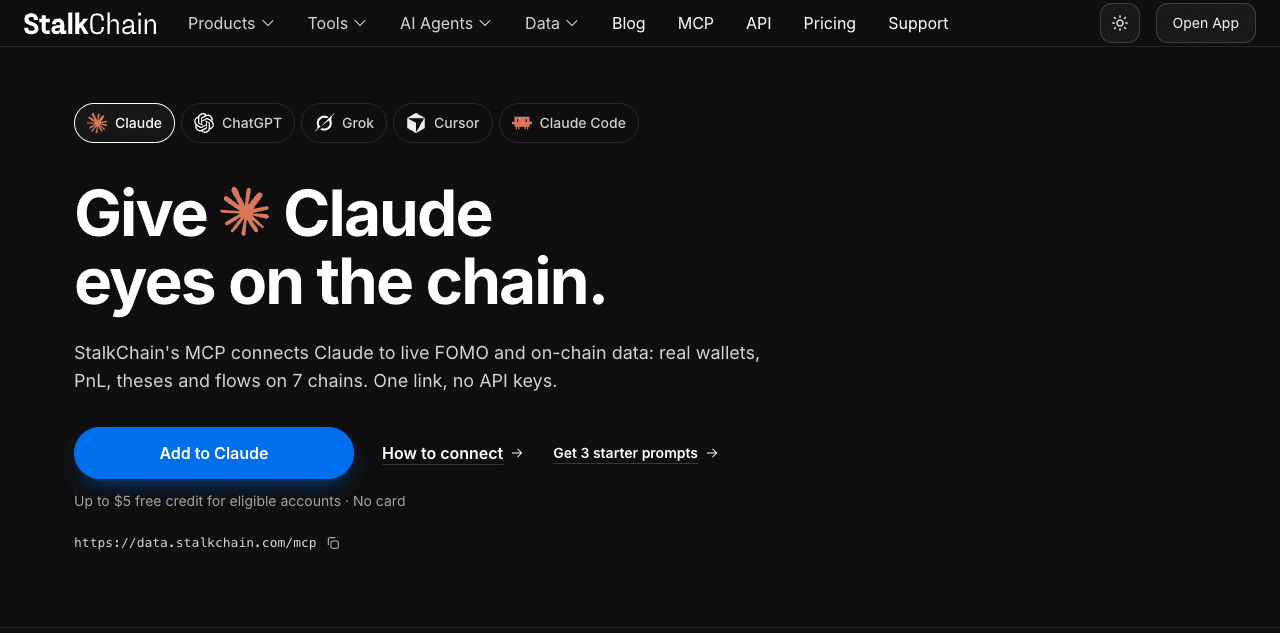
Source: StalkChain public MCP page, captured October 31, 2026.
This shows setup documentation, not proof of chain-wide coverage, current trader results or measured performance.
Any API response pictured is the site's dated example.
For the scope boundary, read the FOMO data coverage notes.
Use the REST authentication reference for application code or the Claude Code connection steps for an interactive agent.
Keep research access separate from trading authorization.
Final integration checklist
- Pin the chain, token and wallet identifiers.
- Record the endpoint, observation time and pagination.
- Verify material transactions with the chain explorer.
- Separate realized PnL, open exposure and transfers.
- Check account permissions and current plan limits before automation.
FAQ
Do I need an API key for Solscan MCP?
Yes. Solscan documents a free-key public server and a paid-key Pro server; the public server is limited, not keyless.[2]
Is Helius MCP read-only?
No. Its documented routed tools include heliusWrite transfers and webhook-management actions. Configure permissions accordingly and never ask a research agent to sign or send funds as part of a fact check.[1]
Can StalkChain identify every Solana wallet?
No. Its strongest documented use here is contextual research around its tracked FOMO traders and associated wallets. For arbitrary raw Solana transactions, start with Helius or Solscan.[1][2][3]
Sources
First-party pages reviewed October 31, 2026. Vendor capabilities are documented claims, not independently benchmarked results.
[1] Helius MCP documentation
[2] Solscan MCP documentation
[3] StalkChain live MCP page
[4] Nansen MCP overview and data coverage
[5] Dune MCP documentation