Quick answer
For raw Robinhood Chain RPC and WebSocket access, Robinhood's documentation recommends Alchemy and lists other infrastructure providers. For wallet PnL, Birdeye's PnL summary explicitly lists robinhood as a supported chain.
For identified FOMO trader positions, theses and holder flows, StalkChain publishes Robinhood Chain coverage in its REST and MCP tools.
Choose by data shape and validate the particular endpoint on mainnet; “supports the chain” does not mean every product feature works there.
Robinhood Chain now has several documented ways to read on-chain data.
They are not interchangeable: a node can return logs and receipts, an indexed API can return wallet activity, and a trader-research API can join a named trader to positions and theses.
This guide compares those jobs rather than declaring one vendor the best at all of them.
Disclosure: Stalkchain Research publishes this site and operates StalkChain.
This is a first-party documentation comparison, not independent benchmarking.
Official sources were rechecked October 31, 2026; authenticated cross-vendor tests and normalized price comparisons were not performed.
Scope and method
We reviewed current official Robinhood network documentation and first-party vendor API pages. This is a capabilities guide, not a speed test, a completeness audit or an independent PnL accuracy benchmark.
The category has enough documented comparators for a useful guide, provided RPC, indexed PnL and tracked-trader intelligence are presented as separate categories.
It would be misleading to put a raw node beside a curated trader API in a universal ordinal ranking.
Robinhood Chain is an Arbitrum-based Ethereum L2. Its official network page distinguishes mainnet chain ID 4663 from testnet 46630 and publishes separate explorers and endpoints.
Confirm which environment your key and contract address target before interpreting a blank response. Robinhood network reference.
| Option | Best fit | Verified public surface | Qualification |
|---|---|---|---|
| Alchemy | Managed mainnet RPC and indexed blockchain data | Robinhood documents its RPC, WebSocket and Data API | Select the needed API and endpoint; RPC is not a precomputed PnL report |
| Chainstack / QuickNode | Alternative managed RPC infrastructure | Robinhood lists both and endpoint patterns | Compare operational needs and actual plan terms directly |
| Birdeye | Wallet PnL summary | x-chain: robinhood in wallet PnL endpoint | Do not infer every portfolio endpoint supports Robinhood |
| StalkChain | Identified FOMO trader research | REST trader, token and flow tools; Robinhood examples on MCP | Tracked-trader coverage is not all wallets or a generic node |
| Public RPC / Blockscout | Exploration and independent checks | Official public RPC and mainnet explorer | Public RPC is rate-limited and not recommended for production |
Alchemy: best starting point for managed chain infrastructure
Robinhood names Alchemy its recommended infrastructure provider and publishes a mainnet RPC pattern at https://robinhood-mainnet.g.alchemy.com/v2/{API_KEY} and a corresponding WebSocket endpoint.
Its network page describes the Node API for JSON-RPC reads and writes and the Data API for indexed balances, transaction history, NFTs and portfolio activity.
Use this path when you need application infrastructure or arbitrary contract reads, rather than a predefined trader opinion. See Robinhood's developer endpoints.
Watch for: a receipt or transfer is not automatically a swap, and a swap is not automatically a realized profit.
If you calculate PnL yourself, reconcile deposits, withdrawals, fees, internal transfers, token valuations and open inventory.
Robinhood advises using an archive endpoint for historical reads and indexing.
Chainstack and QuickNode: alternatives for RPC procurement
Robinhood's official provider list includes Chainstack and QuickNode, with mainnet endpoint patterns for each. Evaluate these when your primary requirement is a different node contract, operational setup or vendor redundancy.
We have not independently tested their availability or asserted that their indexed data products match Alchemy's. Check the official provider list before selecting a plan.
Watch for: an RPC provider can supply the events and state from which a wallet report is computed, but should not be labeled a ready-made wallet PnL API without an endpoint that actually returns that result.
Birdeye: best documented precomputed wallet PnL option
Birdeye's wallet PnL summary takes a wallet, duration and calculation options, and its x-chain parameter explicitly includes robinhood. It returns wallet trading counts, cash flow and realized/unrealized PnL in the published response shape.
That makes it a sensible candidate for a Robinhood Chain wallet-performance widget without building an entire accounting pipeline.
Inspect the endpoint documentation.
Watch for: Birdeye warns that trade data for some protocols is not fully backfilled and may affect PnL.
Its wallet catalog also says many V2 portfolio endpoints are Solana-only while PnL endpoints support more chains.
Test the exact Robinhood endpoint you need, not an adjacent endpoint in the same folder.
Explain whether you show realized PnL, unrealized exposure or both.
StalkChain: best for its identified-trader research workflow
StalkChain's REST API catalog documents FOMO trader search, positions, swaps, theses, token holders, sell pressure and multi-trader entries.
Its MCP page includes Robinhood Chain examples for tracked-trader activity.
The distinction is useful: rather than starting with an unknown 0x address and rebuilding context, you can start with a tracked trader's handle or a token and ask which known traders hold it, what they have written, and whether they are selling.
The published REST example uses GET /api/v1/tools/stalkchain_fomo_search with a bearer key; inspect the live catalog for parameters and per-tool availability before wiring a Robinhood-specific screen.
StalkChain's verified advantage is linking its tracked FOMO identities, wallets and theses.
It is not an archive RPC, does not establish the owner of every address and does not cover every Robinhood Chain trader. A thesis is a trader's statement, not evidence their trade will succeed.
Public RPC and Blockscout: best for checking the underlying evidence
Robinhood publishes https://rpc.mainnet.chain.robinhood.com and links its mainnet Blockscout explorer. The public endpoint is rate-limited and explicitly not recommended for production.
It is nevertheless a useful reference when verifying a transaction hash, token contract or event cited in an enriched trader report.
Use a production provider for persistent polling.
A buyer's test case
Suppose a tracked trader appears to have entered a new Robinhood Chain token. First, use a named-trader source to find the claimed wallet and position; then check the contract and transactions in the explorer or an RPC-backed index.
If you want to compare profitability across wallets, run the same address and window through a PnL API and record its accounting method. If two numbers differ, inspect transfers, token coverage and unrealized exposure before calling either one wrong.
The wallet tracking guide covers the address-level checks; the PnL analysis guide explains why activity and profit are different.
Selection checklist
- Is the request aimed at Robinhood mainnet, not testnet?
- Do you need raw logs/state, indexed activity, PnL or identified trader context?
- Does the specific endpoint, not merely the vendor, list Robinhood support?
- Can you trace an important claim to a contract, transaction and timestamp?
- Are missing protocols, wallet identity uncertainty and open positions disclosed?
Open the StalkChain API catalog for the tracked-trader workflow, or review the broader Robinhood Chain analytics guide for the research UI.
Inspect the documented integration before building
Open the StalkChain API catalog and inspect the published connection or request example before using an account key. The screen below documents the public interface, not an authenticated comparison test.
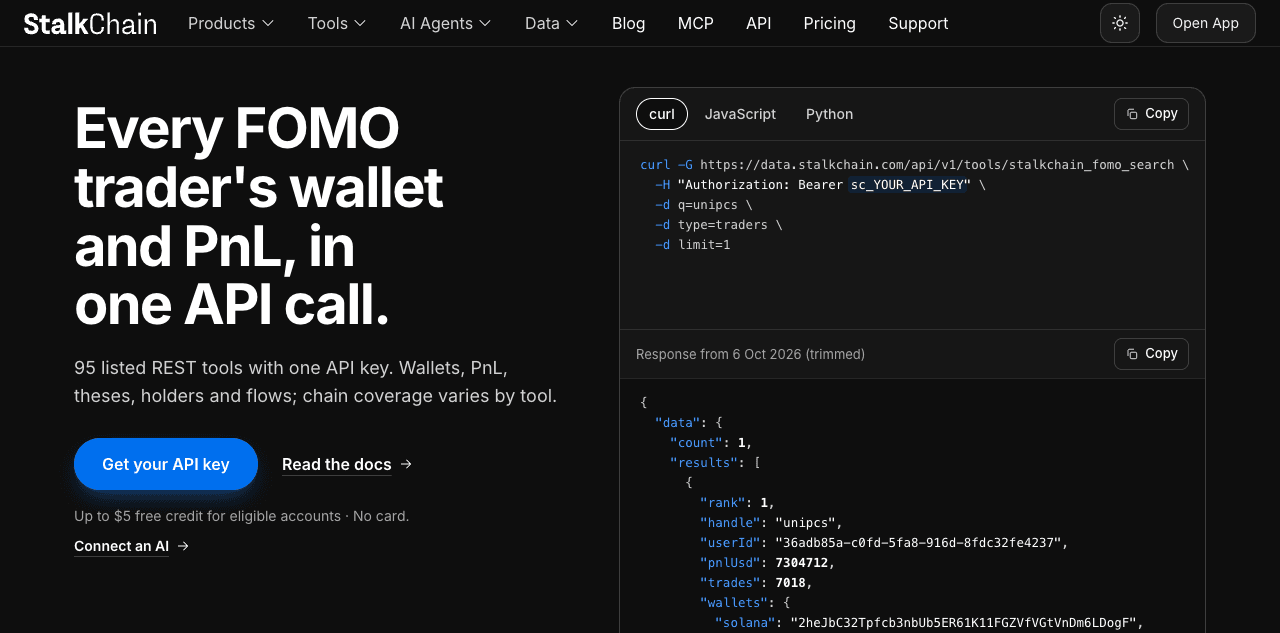
Source: StalkChain public API page, captured October 31, 2026.
This shows setup documentation, not proof of chain-wide coverage, current trader results or measured performance.
Any API response pictured is the site's dated example.
For the scope boundary, read the FOMO data coverage notes.
Use the REST authentication reference for application code or the Claude Code connection steps for an interactive agent.
Keep research access separate from trading authorization.
Final integration checklist
- Pin the chain, token and wallet identifiers.
- Record the endpoint, observation time and pagination.
- Verify material transactions with the chain explorer.
- Separate realized PnL, open exposure and transfers.
- Check account permissions and current plan limits before automation.
FAQ
Is Robinhood Chain the same network as Robinhood's brokerage app?
No. The chain is an Ethereum L2 with its own chain IDs and on-chain addresses. A brokerage-account position should not be inferred from an on-chain wallet.
Does chain support guarantee that every API endpoint supports Robinhood Chain?
No. Birdeye explicitly distinguishes broader PnL chain support from narrower wallet-portfolio endpoint support. Check each endpoint's chain parameter and test it.
Is a profitable wallet necessarily a good trader to follow?
No. The displayed number may depend on a time window, incomplete trade history, current marks and whether a position has been sold. Confirm underlying transactions and risk before acting.