Quick answer
Robinhood Chain wallet PnL is an estimate, not an audit. Stalkchain exposes caveated KOL DEX PnL and address-level wallet profiles, but every result still depends on trade classification, cost basis, related wallets, bridge accounting, and token pricing.
Simple round-trip swaps provide the clearest estimate. Record the acquisition cost, sale proceeds, gas, venue fees, and remaining inventory.
Bridges, self-transfers, liquidity positions, perpetuals, unusual token mechanics, and missing prices introduce additional uncertainty.
What PnL On-Chain Can and Cannot Show
On-chain data excels at:
- Reconstructing every outbound and inbound token transfer.
- Identifying protocol events and transfers, using the ABI for the specific venue and contract version.
- Attributing gas costs to specific transactions.
- Building a complete trade history for wallets that only swap on DEXes.
On-chain data struggles with:
- Distinguishing a real trade from a wallet rebalancing or self-transfer.
- Pricing illiquid or newly-launched tokens.
- Accounting for bridge deposits and withdrawals as capital flows rather than PnL events.
- Capturing off-chain costs like CEX withdrawal fees or failed transaction gas.
- Handling tokens with dynamic fees, rebasing, or transfer taxes.
The honest frame: think of on-chain PnL as a directional indicator, not a portfolio accounting tool.
How Stalkchain labels incomplete Robinhood PnL
The live Robinhood Chain KOL tracker displays estimated DEX PnL beside coverage labels. Those labels change how the number should be interpreted.
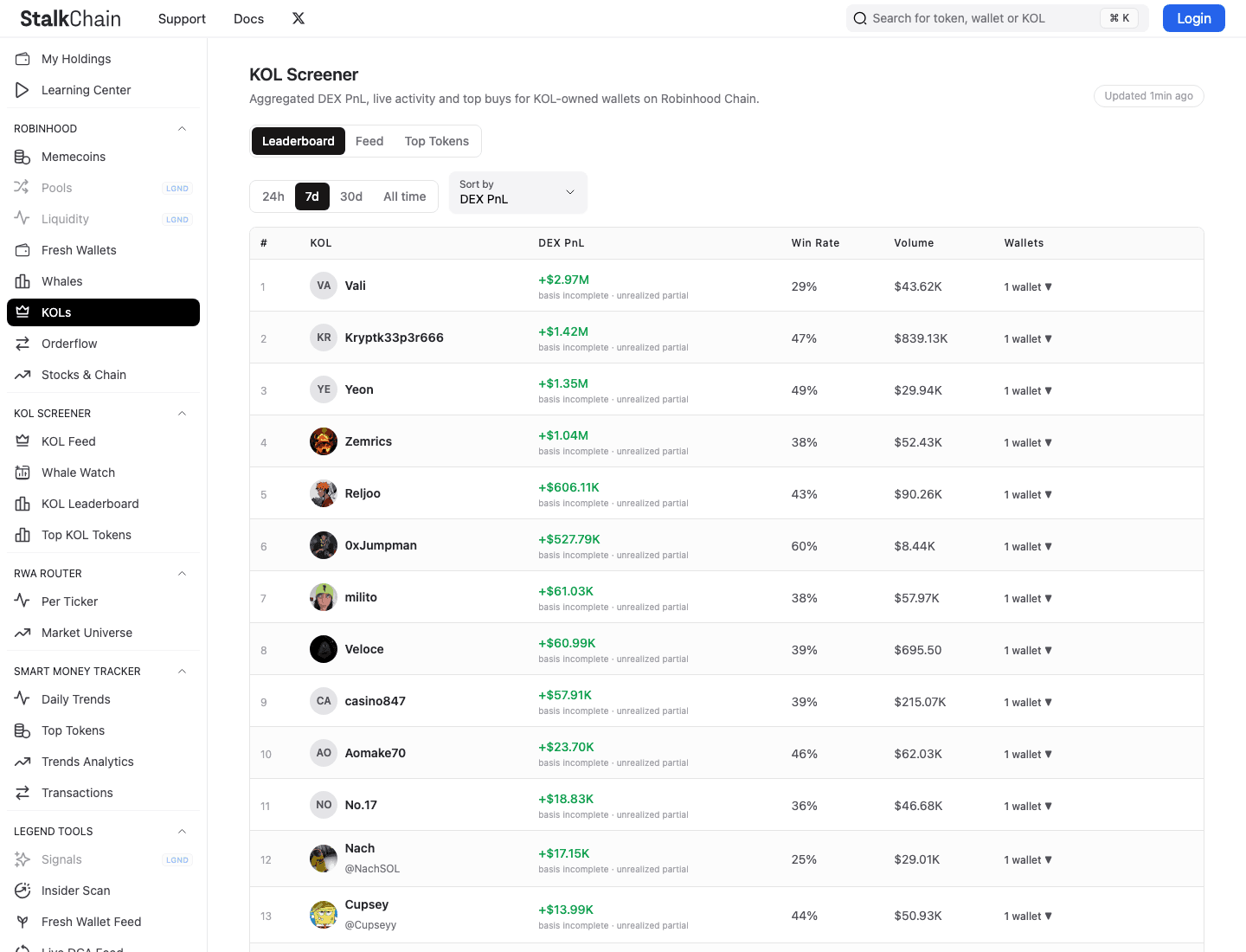
Live capture from September 4, 2026. The coverage label is part of the estimate. A positive number does not supersede missing basis or partial open-position coverage.
- Basis incomplete: one or more token lots lack a reliable acquisition cost.
- Unrealized partial: one or more open balances lack complete mark-to-market coverage.
- No label shown: do not assume audit-grade completeness. Verify the underlying swaps, transfers, and current balances.
During the September 4, 2026 product check around 00:40 UTC, the leading 24-hour row showed approximately +$2.9M DEX PnL with both basis incomplete and unrealized partial.
With both coverage labels present, the result can depend on open positions and incomplete acquisition cost rather than settled proceeds alone. That is a useful candidate for investigation, but not a verified profit claim.
Use the tracker to select a wallet. Use transaction reconstruction to decide how much confidence the estimate deserves.
Open the native wallet profile, then audit the basis
Each address linked from the Robinhood whale tracker opens a native Stalkchain wallet profile at /robinhood/w/<address>. The profile combines token-level PnL and ROI with buys, sells, unsold balance, estimated position, first and last activity, and trade count.
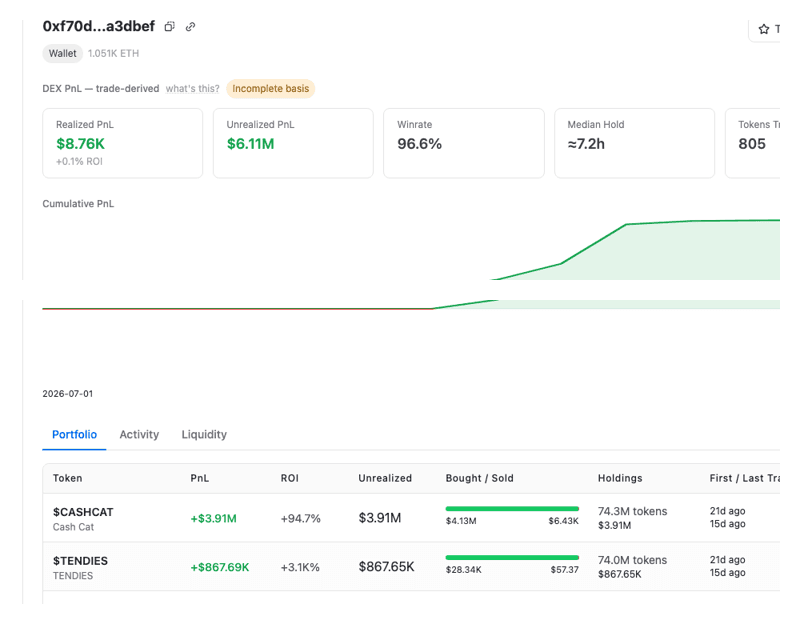
Stacked reading crops from one live product capture on July 24, 2026. The address is public on-chain. Values are analytical estimates and can change as trades, prices, and coverage update.
Read the profile in this order:
- Check whether the row has enough buys and sells to support a meaningful sample.
- Compare realized PnL with unsold balance and estimated position.
- Inspect the first and last activity dates for stale or compressed histories.
- Open the underlying address and transactions before accepting the cost basis.
- Treat missing or zero marks as incomplete pricing, not automatically as zero value.
The wallet profile is stronger evidence than a generic portfolio screenshot because it exposes token-level inputs. It is still not an accounting statement. Self-transfers, bridge activity, related addresses, LP positions, off-chain trades, and unverifiable prices can remain outside the cleanest calculation.
Step-by-Step: Building an On-Chain PnL Estimate
1. Gather All Transactions
Start with the wallet's full transaction history on Robinhood Chain (chain ID 4663). You need:
- Standard transfers: ERC-20
Transferevents and native ETH transfers. - DEX interactions: Event shapes differ by protocol and version. Uniswap v2 pair swaps expose input and output amounts, while Uniswap v3 pools use a different
Swapevent and commonly represent LP positions as NFTs. Decode against the verified contract ABI instead of applying one signature to every venue. - Internal calls: Transfers triggered by contract execution (a DEX forwarding the output token to your wallet). These show up as
CALLopcodes in the transaction trace. - Approvals: ERC-20
Approvalevents. These are not trades. - Bridge activity: Deposit and withdrawal events from the canonical bridge or third-party bridges.
- Gas costs: Every transaction's
gasUsed * gasPricein ETH.
2. Classify Transaction Intent
This is the hardest step and where most basic calculators fail. Each transaction must be classified into one of:
- Buy/Sell (swap): A DEX interaction that changes the wallet's portfolio composition.
- Self-transfer: Sending tokens to or receiving from an address you control.
- Bridge deposit/withdrawal: Moving funds between Robinhood Chain and L1 Ethereum or another chain.
- LP activity: Adding or removing liquidity from a pool.
- Perpetual position: Opening, adjusting, or closing a perp position.
- Gas only: A failed transaction or a non-financial interaction (e.g., setting an approval, deploying a contract).
- Airdrop/transfer-in: Tokens arriving from an external source, not purchased.
3. Separate Buys from Transfers
A naive PnL calculator treats every incoming transfer as a "buy" and every outgoing transfer as a "sell." This is wrong in several ways:
- Self-controlled wallets: A transfer between two wallets you control creates a false buy-and-sell pair.
- Bridge withdrawals: Receiving token X from the bridge is not buying it; it's moving existing capital.
- Airdrops and rewards: Gained tokens have zero cost basis (pure profit when sold), but only if you didn't pay gas or perform an action to earn them.
To separate properly, you need a wallet clustering algorithm that groups addresses likely owned by the same entity. Cluster addresses by:
- Common funding sources (both addresses funded from the same CEX withdrawal).
- Sequential nonce patterns ("wallet A funds wallet B, wallet B sends back, wallet A funds wallet C").
- Shared deployer contracts.
- Known labels (Binance deposit addresses, etc.).
Transactions between clustered addresses are filtered out of the PnL calculation. To trace where the wallet moved its tokens, use its transfer history before you filter any addresses out.
4. Cost Basis Method: FIFO
For each token held, apply FIFO (First In, First Out) cost basis:
- When you buy 100 UNI at $5, record lot 1: 100 UNI, cost $500.
- When you buy another 50 UNI at $7, record lot 2: 50 UNI, cost $350.
- When you sell 120 UNI at $6, close lot 1 entirely for a $100 profit, then sell 20 UNI from lot 2 for a $20 loss. Total realized PnL is $80.
FIFO is standard and defensible, but it's not the only method. LIFO and specific identification produce different results; another reason on-chain PnL is an estimate.
5. Bridge and CEX Blind Spots
When a wallet deposits tokens into a bridge and receives wrapped tokens on Robinhood Chain, the calculator sees a new token balance appearing; it doesn't know the original cost basis.
If you bridged 10 ETH ($30,000 cost) and received 10 WETH, a naive calculator might record the WETH cost as $0, inflating future sell PnL.
Solutions:
- Bridge-aware accounting: Recognise bridge deposit and withdrawal events. When WETH enters via bridge, carry forward the original token's cost basis.
- CEX withdrawal lookup: Match the wallet's CEX withdrawal transaction on L1 Ethereum to the deposited amount. This requires cross-chain queries and is often impractical at scale.
- Synthetic cost basis fallback: When cost basis cannot be determined, record the price at the time the bridged token arrived as an approximation.
6. Gas as Real Cost
Gas on Robinhood Chain is paid in ETH. Every swap, approval, and failed transaction costs ETH. A complete PnL must attribute gas to each action:
- Direct attribution: A swap transaction's gas cost reduces that swap's profit.
- Failed transaction attribution: Failed transactions are real costs; the ETH is gone with no financial event to pair it with. These should be classified as trading costs.
- Approval gas: Setting an allowance is overhead. For simplicity, spread approval gas across the subsequent trades using that approval.
A wallet that makes many small trades can lose 10-20% of its gross profit to gas, especially during network congestion.
7. Stablecoin Receipt Patterns
Stablecoin transactions create another ambiguity. When a wallet receives 1,000 USDC from a DEX swap, it's a sell (sold Token X for USDC).
When it receives 1,000 USDC from a CEX deposit via bridge, it's a capital inflow with no PnL impact.
The classifier must distinguish between:
- Swap for stablecoin: Token X is exchanged for USDC on a DEX. This is a sell event.
- Stablecoin transfer-in: USDC arriving from an external address without a swap event; this is a capital flow.
- Stablecoin-to-stablecoin swap: USDC to DAI; this is a trade with potentially small PnL.
- Stablecoin LP deposit: USDC contributed to a liquidity pool; not a trade.
8. LP and Perpetual Position PnL
Liquidity provision on Robinhood Chain DEXes does not produce a simple buy-and-sell record. An LP deposit gives you a pool token (ERC-20), not the original tokens back in fixed proportions. Unrealized PnL depends on:
- The pool's composition at withdrawal versus deposit (impermanent loss).
- Fee accumulation between deposit and withdrawal.
- The price of the pool token itself.
Perpetual positions are even harder. Opening a perp position does not transfer token balances; it creates a tracked position in the perp protocol's contract. The PnL is a function of:
- Entry price and exit price.
- Leverage multiplier.
- Funding rate payments.
- Liquidation fees.
Standard on-chain PnL calculators typically skip LP and perp positions or flag them as "PnL not available."
9. BTC/ETH Pair Treatment
Wrapped Bitcoin (WBTC) and Wrapped Ether (WETH) on Robinhood Chain introduce a special case. These are ERC-20 representations of assets that also exist natively (ETH as gas token; BTC on Bitcoin L1).
For PnL purposes:
- WETH ↔ ETH: These are equivalent. A WETH-to-ETH unwrap is not a trade; it's a format conversion. Track the combined balance.
- WBTC buys/sells: Treat as any other ERC-20 swap, but note that the cost basis on Robinhood Chain may differ from L1 Bitcoin's price due to bridging fees and market depth on the L2.
- ETH as gas: ETH spent on gas is a realized cost. If the wallet bought ETH specifically for gas, that purchase is an operating expense, not a speculative trade.
Representative Example
This example is a simplified, labeled demonstration. It is not derived from a specific real wallet.
Wallet 0xABCD tracked across 30 days on Robinhood Chain:
| Action | Token | Amount | Value (USD) | Type |
|---|---|---|---|---|
| Bridge in from L1 | ETH | 5 | $17,500 | Capital inflow |
| Hypothetical token purchase | TOKEN | 2,000 | $2,400 | Buy |
| Swap TOKEN for USDC | USDC | n/a | $2,550 | Sell (realized PnL: +$150 before costs) |
| Pay gas (15 txs) | ETH | 0.015 | $52.50 | Trading cost |
| Self-transfer to wallet B | TOKEN | 500 | n/a | Filtered only if common control is supported |
| Unsolicited token receipt | AIRDROP | 100 | n/a | Non-trade receipt; accounting policy required |
| Bridge deposit to L1 | USDC | 1,000 | $1,000 | Capital outflow |
PnL Calculation:
- Realized PnL from trades: +$150
- Airdrop sale (if sold): 100% profit
- Gas cost: -$52.50
- Unrealized PnL on remaining positions: depends on current market prices
- Estimated realized PnL: +$97.50 (excluding unrealized)
This hypothetical example treats bridge deposits as capital flows and excludes the possible self-transfer from trading PnL. The unsolicited receipt is recorded separately because analytical acquisition cost and jurisdiction-specific tax basis are different questions.
Caveats and False Precision
A single PnL figure is dangerously misleading. These factors introduce systematic uncertainty:
- Price source matters. Using the swap's execution price versus an external oracle price can produce different PnL for the same transaction. DEX prices include slippage and fees; oracle prices may not reflect what the wallet actually received.
- Clustering is probabilistic. Wallet clustering algorithms have false positives (treating unrelated wallets as one entity) and false negatives (missing controlled wallets). Both distort PnL.
- Fee-on-transfer tokens break cost basis. Some tokens charge a fee on every transfer (e.g., 2% burned on buy and sell). The on-chain
Transferevent shows the post-fee amount, so the wallet's actual entry cost is higher than the recorded transfer value. - Illiquid tokens have unreliable prices. A token with $500 daily volume may show a $10 price on CoinGecko, but a 1,000-token sale would crash the actual market price by 50%. Mark-to-market PnL for such tokens is fictional.
- MEV and sandwich attacks distort PnL. A wallet that was sandwiched received a worse execution price than the market midpoint. If you use midpoint pricing, the PnL is better than reality.
- Failed transactions are real costs. A wallet that spams failed limit orders burns gas with no trade to pair it with.
- Oracle and indexer latency. RPC nodes may be behind the canonical chain tip. PnL calculations based on slightly stale state can be off for rapidly traded positions.
The honest answer is always a range, not a single number.
Reconstruct PnL from the profile and public transactions
Start from a native wallet profile selected through the whale tracker or KOL screener. Then open the public transaction evidence. Each transaction identifies a hash, method, block, counterparties, transferred value, and fee. PnL analysis must classify those records before assigning cost or proceeds.
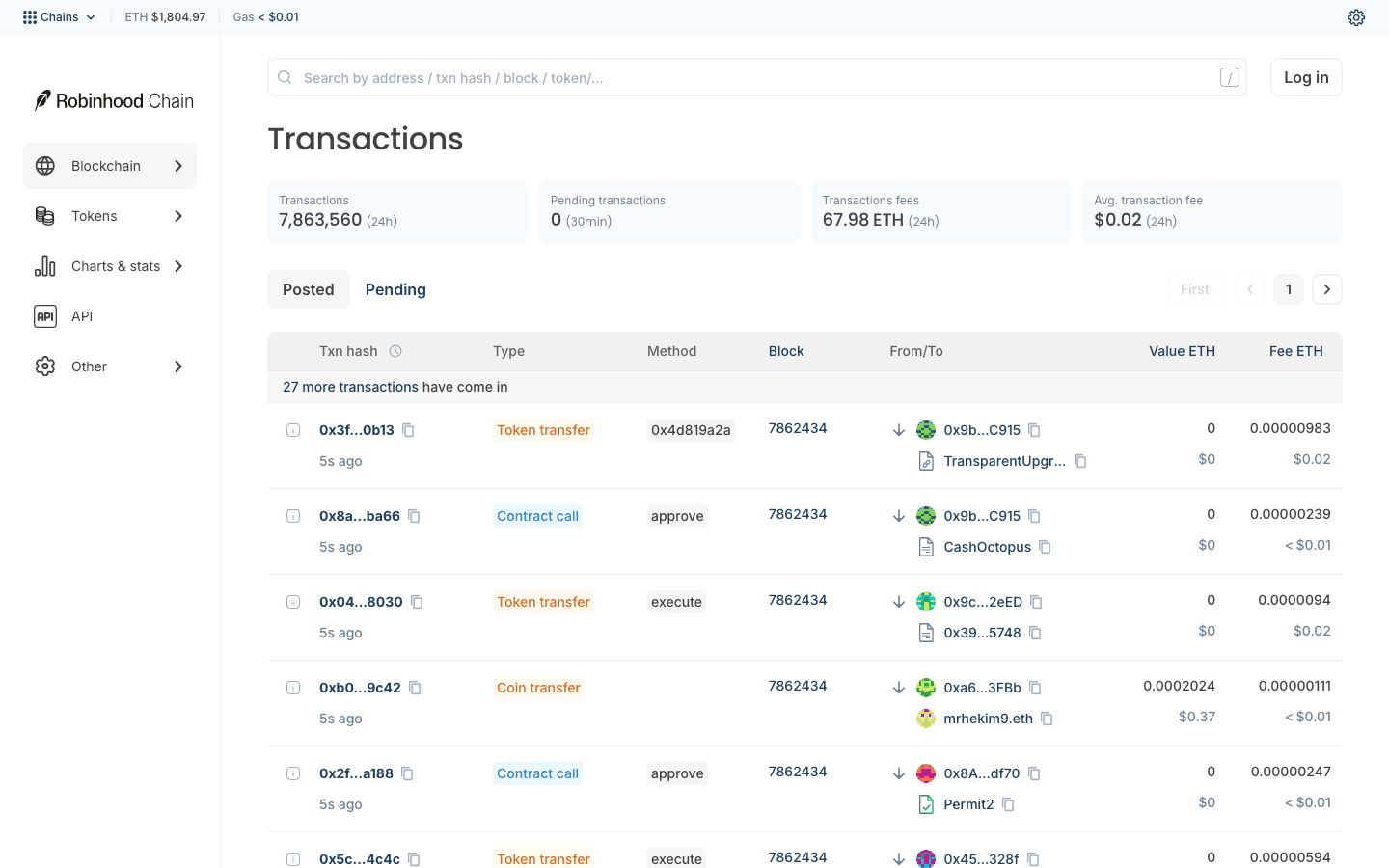
Robinhood Chain Blockscout exposes transaction evidence; it does not calculate the wallet owner's profit.
- Start with the wallet-tracking workflow.
- Exclude bridge movements using the official network documentation.
- Cluster addresses with the fresh-wallet framework.
- Separate inventory with the whale-wallet guide.
- Check whether unsold balances indicate accumulation.
- Rank behavior using the best-wallet criteria and top-trader workflow.
- Rerun the memecoin risk checks before accepting a mark price.
FAQ
What is Robinhood Chain? Robinhood Chain is an Ethereum-compatible Layer 2 with chain ID 4663 and ETH as its configured gas token. Verify current architecture and fee information against Robinhood's official documentation and the public explorer.
Its EVM compatibility supports common Ethereum wallets and development libraries. Individual applications and venues must still be verified before assuming deployment or support.
Can I calculate PnL from any Robinhood Chain wallet? You can calculate an estimated PnL for any wallet, provided you have access to a Robinhood Chain RPC endpoint or an indexed data source.
The accuracy depends on the wallet's activity patterns; simple DEX swapping is high confidence; LP, perp, and bridge-heavy wallets are low confidence.
How do I get Robinhood Chain transaction data? Use Stalkchain's native wallet profile for indexed analysis and Robinhood Chain Blockscout or a provider that explicitly lists Robinhood Chain for raw verification. EVM compatibility alone does not mean every RPC or analytics vendor supports chain ID 4663.
For programmatic access, Ethers.js or Web3.py can use a confirmed Robinhood Chain RPC endpoint. Verify the endpoint, chain ID, indexing coverage, and rate limits before relying on a large historical export.
Why does my wallet's PnL on DeBank differ from my manual calculation? Different tools use different cost basis methods, clustering heuristics, and price oracles. DeBank may cluster wallets you consider separate, or may not account for gas the same way.
The discrepancy can be material when tools use different clustering, pricing, fee, inventory, and cost-basis assumptions. Reconcile the underlying transactions instead of relying on a universal percentage range.
Does PnL include tokens that were airdropped? It depends on the purpose of the analysis. A cash-flow model may record zero purchase consideration, while accounting or tax treatment can assign a different basis depending on jurisdiction and circumstances.
Record the receipt, claim costs, market value source, and chosen policy explicitly. Do not present an analytical convention as universal tax guidance.
How do I handle wrapped ETH (WETH) in my PnL? WETH and ETH are economically equivalent for this calculation. Unwrapping WETH into ETH is not a trade. Track the combined ETH balance and count only an exchange between WETH and another ERC-20 token as a trade.
Are cross-chain DeFi positions included in Robinhood Chain PnL? No. Robinhood Chain PnL covers only activity on that chain.
If a wallet uses a cross-chain messaging protocol (LayerZero, Wormhole) to interact with another chain's protocol, those on-chain interactions on the other chain are invisible to a Robinhood Chain-only analysis.
Sources
- Robinhood Chain official connection documentation
- Stalkchain Robinhood Chain KOL screener
- Stalkchain Robinhood Chain whale tracker
- EVM Transaction Tracing; Ethereum Yellow Paper
- Wallet Clustering Algorithms; Chainalysis, "Blockchain Analysis Tools"
- Uniswap V3 Swap Event Specification
- FIFO Cost Basis Method; IRS Revenue Procedure 99-17
- ERC-20 Token Standard; EIP-20
- Arbitrum Bridge Architecture; Arbitrum Docs