Quick answer
To track a wallet on Robinhood Chain, open its native Stalkchain address profile or paste the 0x address into Blockscout. Review token-level PnL and ROI, buys, sells, unsold balances, estimated positions, activity, funding, transfers, contract calls, and approvals.
Then label recurring counterparties and create alerts for new transactions. Treat PnL as an estimate: bridges, internal transfers, airdrops, off-chain trades, and missing price data can make it wrong.
What you need before tracking a wallet
Stalkchain now publishes native address profiles at /robinhood/w/[wallet]. A populated profile can show realized and unrealized PnL estimates, ROI, win rate, median hold, token count, token-level buys and sells, unsold balances, estimated positions, first and last activity, and trade count.
Those fields shorten the first pass. They do not replace the raw transaction record. The profile explicitly labels incomplete basis where acquisition history or unrealized coverage is partial.
Robinhood Chain is an Arbitrum-based Ethereum layer 2. It uses the Ethereum Virtual Machine (EVM), ETH for gas, and chain ID 4663.
Its addresses therefore use the familiar 0x format, and its activity follows the same broad accounting model as other EVM networks.
Before you begin, collect:
- the exact wallet address;
- a Robinhood Chain-compatible explorer or analytics interface;
- the correct network selected, with chain ID 4663;
- the time range or event you want to investigate;
- a simple notes sheet for labels, transaction hashes, contracts, and hypotheses.
Do not assume that the same 0x address belongs to the same person everywhere.
An address can exist on multiple EVM chains, but activity on Ethereum, Arbitrum One, Robinhood Chain, or another network is separate unless you can connect it through bridges or other evidence.
If you are still learning the network, read what Robinhood Chain is.
If the wallet has no ETH to transact, follow the guide to add Robinhood Chain and bridge ETH.
Use a two-layer evidence rule
Wallet research is more reliable when the summary and the raw record have separate jobs.
Layer 1: discover and compare. Use Stalkchain to find active addresses and compare covered performance, volume, win rate, remaining exposure, and linked-wallet context. These fields help decide which wallet deserves attention.
Layer 2: verify the claim. Use Robinhood Chain Blockscout to inspect the exact transaction hash, signer, called contract, logs, token transfers, internal calls, status, and fee. This is where you test whether a row represents a swap, transfer, bridge action, approval, or liquidity event.
Step 1: Confirm the address and network
Paste the address into a compatible explorer and check the network before interpreting anything. The chain identifier should be 4663, and gas fees should be denominated in ETH.
Copy addresses rather than typing them. Compare the first and last several characters, especially when an address came from a social post, chat, or token page.
Address-poisoning scams rely on visually similar addresses appearing in transaction history.
Next, record a baseline:
- current ETH balance;
- current token balances;
- transaction count, if shown;
- first and most recent observed activity;
- any explorer labels attached to counterparties or contracts.
A baseline gives future alerts context. A new transfer means something different for a dormant wallet than for an address making hundreds of routine contract calls.
Step 2: Read EVM transactions correctly
An EVM transaction starts with a sender and includes a nonce, destination, value, gas settings, chain ID, signature, and optional input data.
The transaction page then adds execution results such as status, gas used, logs, and token-transfer events.
For each relevant transaction, inspect these fields:
- From: the address that signed and submitted the transaction.
- To: either another address or a contract.
- Value: native ETH sent with the transaction. This can be zero even when tokens move.
- Input data: the encoded contract function and arguments, if decoded by the explorer.
- Status: whether execution succeeded or reverted.
- Gas used: the execution cost, not the wallet's investment size.
- Logs or events: contract-emitted records, including many token transfers.
- Token transfers: ERC-20 movements produced during execution.
- Internal calls: ETH movements or contract-to-contract calls that may not appear as ordinary top-level transactions.
A zero-ETH transaction is not necessarily inactive. It may swap tokens, approve a spender, deposit into a protocol, claim an airdrop, or call another contract.
Conversely, a successful transaction does not guarantee the intended economic outcome was favorable.
A practical interpretation sequence
Read complex transactions in this order:
- Confirm the signer and transaction status.
- Identify the called contract.
- Read the decoded function name and arguments.
- Review every token-transfer event, not just the headline action.
- Check internal ETH calls where the explorer exposes them.
- Compare the wallet's assets before and after the transaction.
- Include gas and fees in any economic estimate.
This sequence helps distinguish a real swap from an approval, a bridge deposit, a liquidity action, or a multi-call bundle.
Step 3: Trace the wallet's funding source
The first meaningful inbound transfer is often the best starting point for attribution. Find the earliest ETH deposit that allowed the wallet to pay gas, then inspect the sending address.
Common funding sources include:
- a centralized exchange withdrawal wallet;
- a bridge contract;
- another personal wallet;
- a protocol distributor or faucet;
- a smart account factory or relayer;
- a contract that sent ETH during another interaction.
Funding is evidence of a relationship, not proof of common ownership. An exchange funds thousands of unrelated customers.
A bridge can connect activity across chains without revealing the user's identity. A transfer from one private wallet to another is more interesting, but it can still be payment, custody, or automation rather than self-funding.
Follow the trail one hop at a time. Record the transaction hash, source address, amount, timestamp, and source label. Stop when the evidence becomes generic or ambiguous instead of forcing a confident identity claim. You can also follow wallet transfers on Robinhood Chain to see where the funds went next.
Detect a newly funded large wallet without overstating it
Use the wallet's complete Robinhood Chain history, including internal ETH movements, to test whether a transfer is genuinely its first usable funding. “First seen in this feed” is not the same as “new on-chain wallet.”
For each candidate, preserve a compact evidence record:
- First inbound hash and timestamp: makes the claim reproducible.
- Asset and normalized amount: separates gas funding from deployable capital.
- Immediate source and source class: distinguishes private funding from shared infrastructure.
- Prior outbound activity: tests whether the wallet was operational already.
- Time to first action: separates parked capital from active preparation.
- First action and counterparties: shows whether funds were swapped, bridged, forwarded, or deployed.
- Other wallets funded by the source: reveals possible batches or clusters.
Do not force every transfer into USD. If the token lacks a defensible liquid price, retain the raw amount, decimals, supply share where known, and an explicit unpriced status.
Read multisig wallets as control systems
A multisig's signer address, execution contract, and asset recipient may be different addresses. Verify the implementation and read the full execution before deciding who initiated or received a movement.
Track value events and control events separately:
- Value events: deposits, transfers, swaps, bridge calls, and withdrawals.
- Control events: owner changes, threshold changes, module or guard changes, and new approvals.
Control events can be material even when no large transfer occurs. A threshold reduction or newly enabled module can change who is able to move treasury assets later.
For a broader network-level process, use the Robinhood Chain whale guide, which separates new-wallet funding, grouped large movements, and multisig activity into distinct lanes.
Step 4: Review balances as a portfolio snapshot
Current balances show exposure, not the full trading history. Separate the wallet's holdings into:
- native ETH used for gas or held as an asset;
- stablecoins;
- liquid tokens with observable markets;
- liquidity-provider or vault tokens;
- NFTs and position tokens;
- unsolicited, illiquid, or suspicious tokens.
Do not calculate portfolio value by multiplying every displayed balance by an unverified price. Scam tokens can use manipulated pools or fake symbols to create enormous paper values.
Confirm the contract address, decimals, liquidity, and venue before assigning value.
For token-specific research, combine wallet analysis with the framework in how to analyze Robinhood Chain memecoins.
A balance only becomes meaningful when you understand the token contract, market liquidity, holder distribution, and ability to sell.
Step 5: Audit token approvals
ERC-20 approvals authorize a spender to transfer tokens from the owner's balance up to an allowance. They are essential for swaps and DeFi, but they also create durable risk.
For each approval, record:
- token contract;
- spender address;
- allowance amount;
- approval timestamp;
- whether the spender is verified or recognized;
- whether the approval was later reduced or revoked.
An unlimited approval is not proof of compromise. Many legitimate applications request one to avoid repeated transactions.
It is still a larger attack surface if the spender contract is malicious, upgradeable, or compromised.
Also distinguish approval from transfer. An Approval event changes allowance; it does not by itself move tokens. The later movement may appear as a transferFrom call initiated by the approved spender.
Step 6: Identify contracts and recurring counterparties
Build a small address book as you investigate. Label routers, pools, bridges, token contracts, exchange deposit addresses, deployers, and frequently contacted wallets.
For an unfamiliar contract, check:
- whether source code is verified;
- contract creator and creation transaction;
- proxy or upgradeability pattern;
- decoded method names;
- recent users and transaction volume;
- emitted events;
- token approvals granted to it;
- links from an official project site or documentation.
A verified contract is easier to inspect, not automatically safe. Verification only shows that published source matches deployed bytecode. It does not prove good intent or eliminate admin risk.
Recurring counterparties can reveal behavior: a preferred exchange, bridge, trading router, liquidity venue, or secondary wallet.
Frequency strengthens a relationship hypothesis, but repeated interaction can also come from shared infrastructure.
Step 7: Reconstruct token flows
To understand what the wallet actually did, follow assets rather than relying on transaction labels.
For each event, ask:
- What assets entered the wallet?
- What assets left?
- Which contract mediated the movement?
- Did the wallet receive a receipt or position token?
- Was value bridged, swapped, deposited, borrowed, repaid, or transferred?
- Where did the output asset go next?
Representative readout
Suppose a wallet sends no ETH value to a router, emits an approval for Token A, transfers Token A out, and receives Token B from a pool. That pattern is consistent with a swap even though the top-level transaction value is zero.
If Token B is immediately sent to a second address, the first wallet's final balance understates the trade. If Token B is airdropped rather than bought, treating its receipt as a purchase would overstate cost basis.
The full event path matters more than a single explorer label.
For bridge activity, pair the source-chain deposit with the destination-chain receipt by amount, time, bridge contract, and message identifier where available. A transfer that leaves Robinhood Chain is not necessarily a sale.
Step 8: Estimate PnL without overstating precision
Wallet PnL is an accounting model, not a native field stored on-chain. A basic realized estimate for one token is:
proceeds from disposals - allocated acquisition cost - gas and protocol fees
Unrealized PnL additionally requires a defensible current price and an inventory method such as FIFO, LIFO, or weighted average cost. Different methods can produce different results.
A serious estimate should account for:
- swaps and direct transfers;
- bridge deposits and withdrawals;
- liquidity deposits, withdrawals, and fees;
- staking or vault receipt tokens;
- airdrops and rewards;
- rebasing, fee-on-transfer, or unusual token mechanics;
- gas and protocol fees;
- missing or manipulated historical prices;
- transfers between wallets that may share an owner;
- off-chain purchases, sales, and exchange activity.
Call the result estimated PnL unless you have complete cost basis and ownership mapping. A wallet that sends tokens to an exchange has not necessarily sold them at the deposit time or at the explorer's spot price.
Read the native profile in the right order
Start with the basis label before looking at the headline number. Then compare realized PnL, unrealized PnL, ROI, win rate, median hold, and tokens traded. A high win rate can coexist with incomplete basis, thin exits, or one oversized unrealized position.
Move into the token rows next. Compare bought and sold value, remaining token balance, estimated position, first and last trade, and trade count. A token with thousands of small transactions may reflect automation rather than thousands of independent decisions.
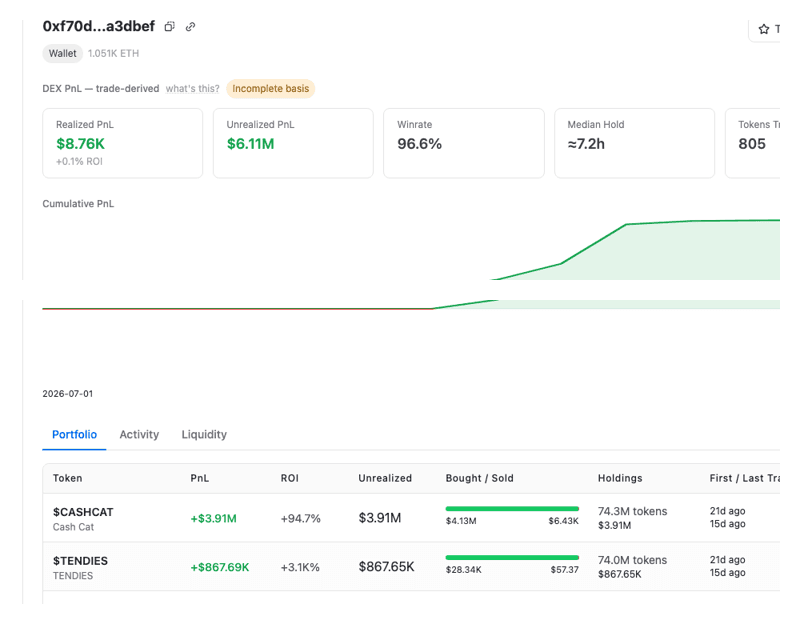
The native profile compresses wallet accounting into a research view. Incomplete basis and partial unrealized coverage remain part of the result, not footnotes to ignore.
Step 9: Create alerts that describe behavior
Alerts are useful when they are specific enough to reduce noise. Consider monitoring:
- any outbound transaction from a previously dormant wallet;
- ETH funding above a chosen threshold;
- first interaction with a new contract;
- new or unlimited token approvals;
- transfers of a watched token;
- bridge deposits or withdrawals;
- large balance changes;
- movements to known exchange addresses;
- contract deployment or ownership changes, if relevant.
Use several alert classes rather than labeling every transaction a buy or sell. A large outbound token transfer may be a sale, bridge, custody move, liquidity deposit, or migration.
When an alert fires, reopen the transaction and repeat the interpretation sequence. Alerts tell you where to look; they do not replace analysis.
Add a decision clock to every wallet thesis
A wallet thesis should expire unless new evidence renews it. Record four clocks:
- Transaction clock: the latest included successful block or transaction.
- Position clock: the latest reconciled token and protocol exposure.
- Price clock: when the valuation input was observed.
- Liquidity clock: when the executable exit quote or depth check was run.
These clocks can age at different speeds. A current transaction history does not make yesterday's price current. A fresh price does not prove that the wallet still holds the same exposure.
Set the expiry rule before watching the address. For a fast-moving memecoin, a thesis may require a new position and liquidity check after any material wallet event. For a slower research watchlist, a daily checkpoint may be sufficient.
A practical state model
Label each wallet thesis as one of four states:
| State | Evidence condition | Analyst action |
|---|---|---|
| Current | All required clocks are within the chosen tolerance | Continue monitoring |
| Changed | A material transaction altered exposure or counterparties | Reconstruct before interpreting |
| Stale | One or more required clocks expired | Refresh; do not repeat the old claim |
| Unresolved | A bridge, transfer, protocol position, or price cannot be reconciled | Narrow the conclusion and preserve the gap |
This prevents an old profitable-wallet label from surviving a later distribution, bridge exit, or collapse in executable liquidity.
Common false positives
“The first funder owns the wallet”
Not necessarily. The source may be an exchange, bridge, faucet, relayer, employer, friend, or customer.
“An inbound token transfer was a buy”
It may be an airdrop, reward, internal transfer, refund, bridge receipt, or spam token. Look for the corresponding asset outflow and contract call.
“An outbound transfer was a sell”
It may be a bridge deposit, liquidity deposit, vault deposit, payment, migration, or movement to another wallet.
“A high displayed balance means the wallet is rich”
Illiquid or malicious tokens can carry meaningless displayed prices. Verify liquidity and realizable value.
“An approval means the tokens were stolen”
An approval grants permission. Confirm whether the spender later used that permission and whether the interaction was expected.
“Similar timing proves coordinated ownership”
Bots, public launches, shared routers, and common market reactions can produce synchronized activity. Timing is a clue, not proof.
“The same address on another EVM chain is the same active wallet”
The address is cryptographically associated with the same key if controlled by an externally owned account, but contracts can exist at matching addresses for different reasons, and the observed chain histories remain distinct.
Verify cross-chain links rather than merging records blindly.
A repeatable Robinhood Chain wallet checklist
Before drawing a conclusion, confirm that you have:
- verified Robinhood Chain and chain ID 4663;
- recorded the address and investigation timeframe;
- traced the first useful ETH funding source;
- reviewed ETH, tokens, and position assets;
- read decoded input data, logs, and internal calls;
- checked ERC-20 approvals and spenders;
- labeled important contracts and counterparties;
- reconstructed complete token inflows and outflows;
- separated transfers from swaps and bridge activity;
- included fees and documented the PnL method;
- set behavior-based alerts;
- written down alternative explanations and confidence levels.
If your target is specifically a large holder or influential trader, continue with how to track Robinhood Chain whale wallets.
That workflow focuses on whale behavior; the framework above applies to any wallet.
Use discovery tools without confusing them with evidence
Use the public Robinhood Chain whale tracker to choose an active wallet, then open its address-level profile. The Robinhood Chain KOL screener provides another discovery path through linked KOL wallets and caveated performance windows.
The native profile is an analytical summary. Blockscout remains the transaction-level proof source for signatures, logs, approvals, bridge calls, and contract interactions. Use both layers: discover and summarize in Stalkchain, then verify important claims on-chain.
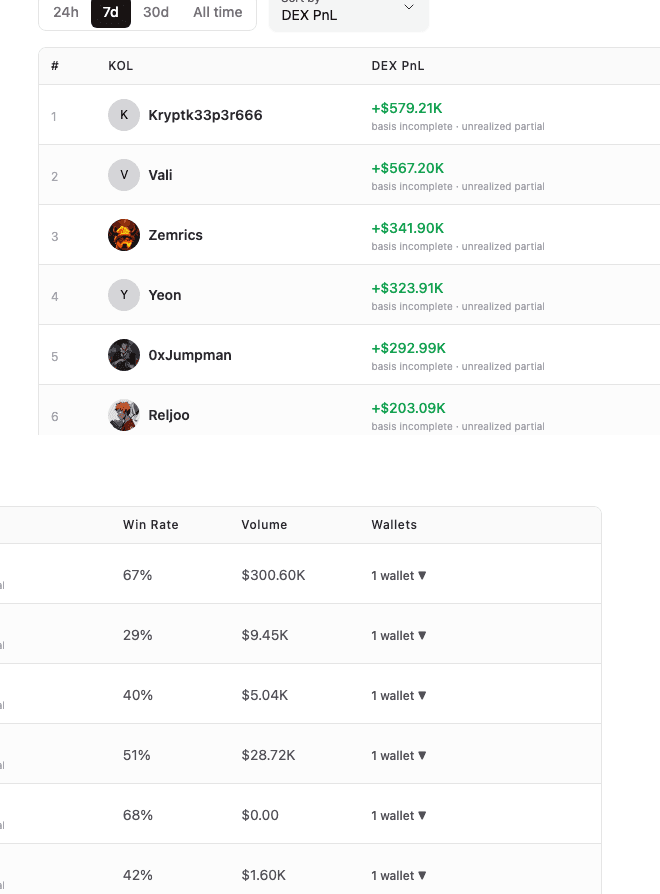
Product proof captured on August 27, 2026. Every visible leaderboard row marked its DEX PnL basis as incomplete and unrealized coverage as partial. That warning must travel with any wallet-performance claim.
Example: turn one leaderboard row into a testable claim
Suppose the 24-hour view shows one linked wallet with positive displayed DEX PnL, a high win rate, and meaningful volume. Do not write “profitable wallet” yet.
First, open the linked address and preserve the time window. Then sample its largest covered win, largest loss, and largest remaining position. Verify the swaps and transfers in Blockscout, check whether acquisition basis predates the window, and estimate whether current liquidity can absorb the unsold balance.
The defensible conclusion may be narrower: this address ranked highly on Stalkchain's covered 24-hour DEX activity, but its lifetime basis and full unrealized exposure remain incomplete.
Verify the wallet's raw transaction history
The Robinhood Chain KOL screener is a useful wallet-discovery surface with 24-hour, 7-day, 30-day, and all-time windows. Its DEX PnL rows explicitly warn when basis or unrealized coverage is incomplete.
A serious wallet investigation begins with the raw transactions. Blockscout exposes the hash, method, block, counterparties, value, and fee needed to reconstruct what happened.
- Discover a candidate through Signals, Daily Trends or another supported surface.
- Confirm the network with the official connection guide.
- Classify it as a fresh wallet, whale or top-trader candidate.
- Score repeat behavior with the best-wallet framework.
- Reconstruct results with the PnL-analysis method.
FAQ
Can I track any Robinhood Chain wallet?
You can inspect public activity for any valid address that has appeared on Robinhood Chain. You cannot see private keys, off-chain identity, exchange account records, or activity that never settles on-chain.
Is Robinhood Chain EVM-compatible?
Yes. Robinhood Chain is an Arbitrum-based Ethereum layer 2. It uses EVM-style addresses and transactions, ETH for gas, and chain ID 4663.
Does tracking a wallet reveal its owner's identity?
Usually not. Labels, funding relationships, exchange withdrawals, ENS-style records, public disclosures, and repeated counterparties may support attribution, but none should be treated as conclusive identity proof on its own.
How do I tell whether a transaction was a buy or sell?
Inspect the called contract, decoded function, token-transfer events, and net asset changes. A buy usually exchanges another asset for the token; a sell does the reverse.
Transfers, bridges, deposits, and liquidity actions can look similar without this context.
Can I calculate exact wallet PnL from on-chain data?
Only when you have complete cost basis, ownership mapping, prices, fees, and treatment of bridges, transfers, rewards, liquidity positions, and off-chain activity.
In most public-wallet research, PnL should be presented as an estimate with a documented method.
What should I alert on first?
Start with new outbound transactions, large ETH funding, watched-token movements, new approvals, first-time contract interactions, and bridge activity. Review the full transaction before assigning a buy, sell, or risk label.
Is an unlimited token approval always dangerous?
No, but it increases potential exposure to that spender. Check whether the contract is expected, verified, upgradeable, and still needed. Approval alone does not mean funds moved.