Quick answer
For identified FOMO trader research that joins handles, wallets, positions, PnL and written theses, start with StalkChain's API.
For general Solana address history and asset data, choose Helius.
For wallet-level PnL and portfolio analytics, evaluate Birdeye.
For configurable DEX trade queries and streams, evaluate Bitquery.
None is the best API for every Solana application.
A wallet address is not a trader identity. Nor does a transfer history automatically tell you whether a trade was profitable. The useful API depends on which of those questions your product needs to answer.
Disclosure: Stalkchain Research publishes this site and operates StalkChain.
This is a first-party documentation comparison, not independent benchmarking.
Official sources were rechecked October 31, 2026; authenticated cross-vendor tests and normalized price comparisons were not performed.
How this guide was evaluated
This is a documentation-based comparison, not a live latency benchmark or hands-on uptime test.
We checked the vendors' published API surfaces against four jobs: identify a trader, retrieve wallet state and history, calculate performance, and query trades across venues.
We did not compare prices or claim uniform chain coverage: entitlements, accounting methods and endpoint support vary. Validate a representative wallet and mint in your own integration before committing.
| Provider | Best fit | What you get | Main qualification |
|---|---|---|---|
| StalkChain | FOMO trader identity and research context | Handle-to-wallet lookup, positions, PnL, theses and token-holder signals | Tracked-trader universe is not every Solana wallet |
| Helius | General-purpose Solana data plumbing | Address history, transfers, account state and asset ownership | Assemble trader identity and performance logic yourself |
| Birdeye | Wallet portfolio and PnL views | PnL summary, detail, charts and portfolio endpoints | Check endpoint-specific chain coverage and calculation assumptions |
| Bitquery | Custom DEX trade analysis | GraphQL queries and subscriptions for Solana DEX trades | Query design, dataset coverage and historical access need review |
StalkChain: best for joining a known trader to wallets and theses
StalkChain's published REST API exposes stalkchain_fomo_search to resolve a handle to wallet addresses and PnL, stalkchain_fomo_trader_positions for positions and stalkchain_fomo_theses_by_trader for written trade rationales.
It also documents stalkchain_wallet_pnl for a pasted Solana address, and token-level early buyers and PnL leaders.
These are useful when the question is what did a tracked trader say, buy and continue to hold? rather than merely what transactions touched this address? See the live endpoint catalog.
A reproducible first call from the published example:
curl -G 'https://data.stalkchain.com/api/v1/tools/stalkchain_fomo_search' \
  -H 'Authorization: Bearer sc_YOUR_API_KEY' \
  -d q=unipcs -d type=traders -d limit=1
The documented example returns a trader record with a handle, Solana and EVM wallet addresses, PnL and a wallet verification flag.
It is a dated example, not a promise that its figures remain current.
Follow it with positions and swaps, then verify material trades against chain transactions.
StalkChain is not a substitute for a general Solana RPC or a complete, protocol-independent history of every wallet. Its advantage here is the tracked-trader research workflow, not universal data superiority.
Helius: best for Solana address history and asset infrastructure
Helius documents getTransactionsForAddress for address history, getTransfersByAddress for token and SOL transfers, DAS for asset ownership and a Wallet API for balances, history, identity and funding source.
Its current documentation calls Enhanced Transactions a legacy path for new builds and points developers toward the newer history method.
That makes Helius a strong starting point if you need to index arbitrary addresses or build a wallet application with your own data model. Read Helius's data API selector.
Trade-off: an address-history API gives you observations, not an independently verified social identity or a universal accounting definition of trader PnL.
Specify how you handle transfers, internal wallets, missing cost basis and open positions before showing a profit number.
Birdeye: best for packaged wallet PnL
Birdeye's wallet catalog includes portfolio views, wallet PnL summary and detail, net-worth history, first-funding information and token top traders.
Its PnL summary separates realized and unrealized values and permits time-window and calculation-method choices.
This is a closer fit than raw RPC when your application needs a ready-made wallet-performance card.
See wallet API coverage and the PnL summary specification.
Trade-off: the documentation explicitly notes that some protocol trade data is not fully backfilled, which may affect PnL.
Many portfolio V2 endpoints are Solana-only even though PnL endpoints support additional chains.
Display the time window, accounting method and coverage caveat beside any ranking.
Bitquery: best for custom trade filters and streams
Bitquery documents Solana DEX trade queries and subscriptions across venues, with filters for a transaction signer or trade account.
Choose it when the question is more specific than a wallet summary: for example, count buys by a signer over a defined window, inspect a venue, or stream a watchlist into your own pipeline.
Trade-off: its docs distinguish the recent Trading cube from older Solana archive datasets.
Historical queries need a time or slot bound, archive access differs from self-service access, and Bitquery flags coverage differences in an archive trade cube.
Do not silently combine datasets as though they were identical.
A practical two-stage evaluation
- Pick one question. “Which tracked trader still holds this mint?” favors StalkChain; “show every transfer for this arbitrary address” favors Helius; “show realized versus unrealized PnL” suggests Birdeye; “stream trades on a venue” suggests Bitquery.
- Test the same address and time window. Record transaction IDs, token mint, wallet attribution, realized/unrealized distinction, pagination and missing-data behavior. A mismatch is often an accounting or coverage difference, not proof that one provider is wrong.
- Keep evidence next to the result. A large PnL estimate without the underlying trade window, current holdings and transfer treatment is a weak signal for copying anyone.
For an example of how to investigate a new mint after identifying a wallet, use the first-buyer workflow and Solana due diligence checklist.
Open the StalkChain API catalog if your application starts from named FOMO traders.
Inspect the documented integration before building
Open the StalkChain API catalog and inspect the published connection or request example before using an account key. The screen below documents the public interface, not an authenticated comparison test.
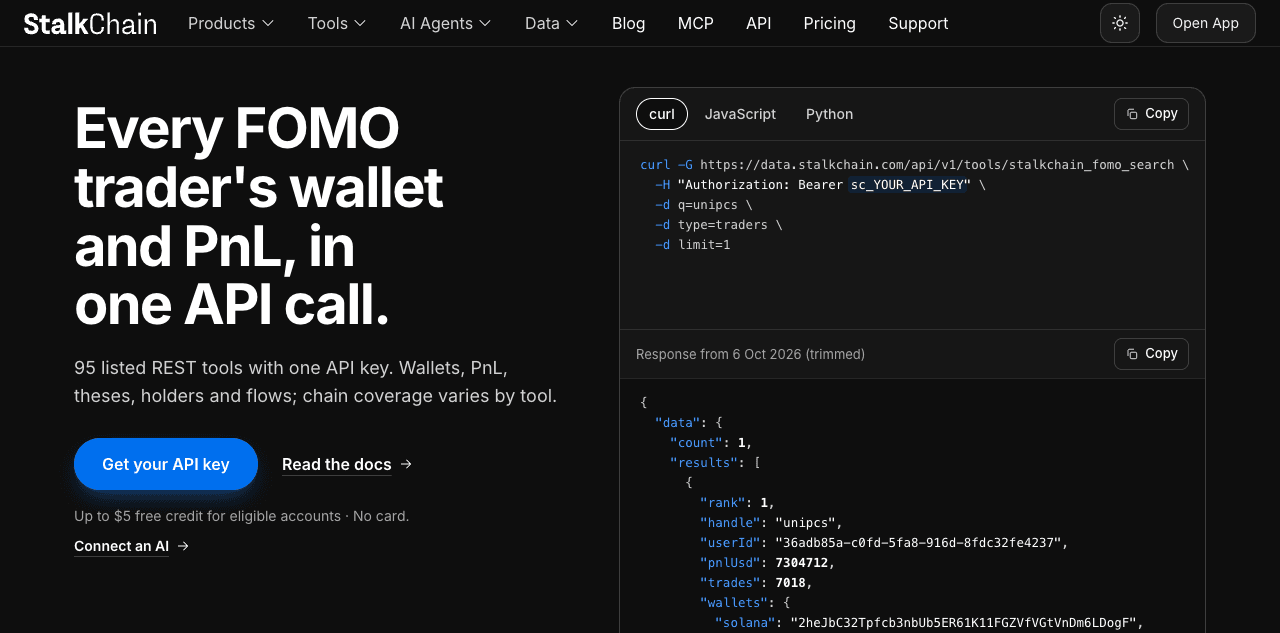
Source: StalkChain public API page, captured October 31, 2026.
This shows setup documentation, not proof of chain-wide coverage, current trader results or measured performance.
Any API response pictured is the site's dated example.
For the scope boundary, read the FOMO data coverage notes.
Use the REST authentication reference for application code or the Claude Code connection steps for an interactive agent.
Keep research access separate from trading authorization.
Final integration checklist
- Pin the chain, token and wallet identifiers.
- Record the endpoint, observation time and pagination.
- Verify material transactions with the chain explorer.
- Separate realized PnL, open exposure and transfers.
- Check account permissions and current plan limits before automation.
FAQ
Is a wallet PnL API the same as an on-chain transaction API?
No. Transaction APIs return activity; PnL requires trade interpretation, valuation and a cost-basis policy. Transfers and incomplete venue coverage can change the answer.
Does StalkChain identify every Solana trader?
No. Its named-trader workflow concerns tracked FOMO traders; its separate documented wallet PnL lookup accepts a Solana wallet address. Do not confuse those scopes.
Should I rank wallets solely by win rate?
No. Inspect realized versus open PnL, sample size, liquidity and whether the address belongs to one person or a shared service. The wallet-history guide is a useful companion.