Quick answer
To read a Solana wallet history, verify the address, open each material signature, and compare balances before and after. Classify the result as a swap, transfer, fee, account change, or protocol action. A label alone does not prove a trade, profit, or ownership.
What a Solana wallet transaction history shows
A Solana wallet history is a time-ordered record of transactions involving an address. Each successful transaction can contain several instructions, inner instructions, signers, programs, fees, and account balance changes.
The history can show what happened on-chain. It does not automatically explain the economic meaning.
A useful review separates five layers:
- Signature: the unique transaction identifier and confirmation result.
- Instructions: the programs and accounts involved.
- Balance changes: what actually increased or decreased for the wallet.
- Economic classification: swap, transfer, fee, protocol action, or administration.
- Interpretation: what the sequence may say about exposure, behavior, and relationships.
Keep those layers separate. An explorer summary is a starting point, not the final accounting record.
Before you start: define the wallet and review window
Copy the complete wallet address from a trusted source. Do not rely on a shortened address, display label, or social profile.
Set a review window before selecting interesting transactions. Record:
- complete wallet address
- first and last timestamp in the sample
- timezone used in your notes
- signatures included and excluded
- raw and normalized balance changes
- mint addresses and verified decimals
- data source and observation time
Use the broader Solana wallet tracking workflow when transactions are one part of a review that also covers funding, holdings, performance, and related addresses.
Step 1: start with successful material transactions
Begin with transactions that materially changed native SOL, token inventory, or a protocol position. Preserve failed transactions separately because they can reveal attempted behavior and paid fees without creating the intended exposure.
For every material signature, save:
- block time and confirmation status
- fee payer and signers
- invoked programs
- native SOL balance change
- token-account balance changes
- inner instructions
- log or error state
- explorer URL
Do not discard small fees or account changes too early. They often explain why a wallet's balance does not reconcile exactly.
Read the transaction from balances outward
Use this order:
- Confirm whether the transaction succeeded.
- Compare the wallet's native SOL before and after.
- Compare every token account before and after.
- Verify each mint and its decimals.
- Identify the programs that caused the changes.
- Separate fees, rent, and account creation.
- Assign an economic classification only after the balances reconcile.
This order is safer than trusting a label such as “swap” or “transfer.”
Preserve Solana-specific transaction context
A signature and timestamp are not the whole transaction record. Save the slot, commitment or confirmation state, message version, fee payer, and any address lookup tables needed to reconstruct the account list.
Versioned transactions can load accounts from lookup tables rather than listing every address directly in the message. An interface that does not resolve those tables can omit a pool, vault, token account, or authority from its summary.
For claims that may affect attribution, basis, or a large position, preserve:
- signature and slot
- processed, confirmed, or finalized state at observation time
- legacy or versioned message type
- static and lookup-table account keys
- outer and inner instructions
- pre-transaction and post-transaction balances
- log messages and execution error
Identify the authority behind each balance change
A balance change does not prove that the wallet owner directly initiated it. Solana programs can move tokens through delegated authority, program-derived addresses, vault rules, and inner instructions.
For each material debit or credit, separate these roles:
| Role | Question to answer | Common mistake |
|---|---|---|
| Fee payer | Who paid the transaction fee? | Treating fee payment as ownership of every action |
| Signer | Which private-key authority approved the message? | Assuming every changed account signed |
| Token owner | Who controls the token account? | Confusing the token account with its owner address |
| Delegate | Did another authority have permission to move tokens? | Calling a delegated movement an owner sale |
| Program authority | Did a program-derived address or contract rule cause the movement? | Assigning human intent from a program action alone |
Resolve outer and inner instructions before attributing intent. A wallet can receive output from a routed swap without signing every inner transfer. A vault can return assets under program rules even when the visible token account did not initiate a purchase.
Step 2: classify the economic result
Place each transaction in one primary category. Add secondary categories when one signature performs several actions.
Swap
A completed swap usually decreases one asset and increases another through a trading program or aggregator. Verify the actual amounts received and spent, not only the quoted route.
Record the input, output, fees, price impact where available, and minimum output. A routed swap can touch several pools without representing several independent trades.
Transfer
A transfer moves inventory between addresses. It is not automatically a purchase, sale, profit, loss, or change of beneficial owner.
Trace the sender or recipient when the transfer affects basis, exposure, or a wallet-cluster claim. The Solana funding-source guide provides a hop-by-hop method for inbound SOL. For EVM and Robinhood Chain wallets, the guide to wallet transfer history covers the outbound side.
Fee or account administration
Priority fees, network fees, token-account creation, account closure, approvals, and rent movements can change balances without changing the intended investment position.
A closed token account can return rent as SOL. That receipt is not trading revenue.
Protocol position change
LP deposits, withdrawals, staking, vault deposits, borrowing, repayment, and escrow movements can replace spot inventory with a protocol claim.
Do not call tokens sent to a vault “sold” unless the transaction also proves a disposal. Do not call tokens returned by an LP withdrawal “bought” when they are recovered underlying assets.
Failed execution
A failed swap can still pay a fee. It can show intent and timing, but it does not create the requested token exposure.
Keep failed attempts outside executed volume and position PnL. Preserve them when analyzing bot behavior, congestion, or entry competition.
Step 3: reconstruct the sequence, not isolated rows
Wallet behavior lives in sequences. Group related transactions into a position or workflow.
A practical sequence can include:
- inbound SOL funding
- token-account creation
- initial swap
- later add
- transfer to another address
- LP or vault deposit
- partial sale
- final sale or unresolved remaining exposure
The meaning of one row can change after the next rows are traced. A transfer out may preserve actor-level exposure. An LP withdrawal may return tokens that never left the actor's economic control.
Turn the history into an activity state
A transaction ledger can prove that events occurred without proving that the wallet is currently relevant. After reconstructing the newest sequence, assign one checkpoint state:
| State | Required evidence | What you can say |
|---|---|---|
| Dormant in the chosen window | No verified signature inside the pre-defined period | No covered recent activity |
| Administratively active | Fees, rent, account changes, or failed attempts only | The address or authority path was used |
| Economically active | A successful event changed assets or a protocol position | Exposure changed inside the window |
| Strategy-consistent | The sequence matches a fixed historical behavior sample | Recent behavior resembles the covered strategy |
| Decision-fresh | Event, source, balances, and liquidity are still timely | The observation remains usable for the stated decision |
Record the event time and observation time separately. The newest successful signature can still be irrelevant to a launch strategy, and a valid swap can already be too old or too illiquid to follow.
Use the dedicated Solana wallet activity workflow to define the review window, measure cadence, group signatures into operating sessions, and distinguish address activity from strategy activity.
Use a transaction ledger
Keep one row per material signature.
| Field | What to record | Why it matters |
|---|---|---|
| Time | Block time and timezone | Establishes order and delay |
| Signature | Complete identifier | Makes the claim reproducible |
| Balance effect | Raw SOL and token changes | Proves what moved |
| Classification | Swap, transfer, fee, protocol, admin, failed | Separates economics from labels |
| Basis treatment | New cost, carried basis, proceeds, unresolved | Prevents invented PnL |
| Coverage | Complete, partial, unresolved | Keeps missing evidence visible |
A ledger should reconcile to the wallet's balances at the end of the review window. An unexplained difference is a coverage failure, not an invitation to force the numbers.
Freeze an evidence packet before interpreting intent
Explorers can change labels and indexers can backfill parsed data. Keep a small evidence packet for every material sequence so another analyst can reproduce the conclusion later.
The packet should contain:
- The complete wallet address and fixed review window.
- Signatures, slots, statuses, and observation times.
- Raw native and token-account balance changes.
- Verified mints, decimals, owners, and token programs.
- Resolved lookup-table accounts and relevant inner instructions.
- The economic classification and basis treatment.
- Coverage limits, source disagreements, and unavailable records.
Store interpretation separately from raw evidence. “Likely partial sale” can change after a sibling transfer is found. The preserved balances and signatures should not.
Step 4: distinguish transfers from trades
Transfers are the most common source of bad wallet analysis.
Treat a movement as a trade only when the same successful transaction or a defensibly linked sequence shows an exchange of economic value. Check the wallet's quote-asset and token changes.
Use three transfer states:
- Same actor supported: evidence supports carrying quantity and basis to a related address.
- Different actor supported: reliable context supports a disposal, distribution, or external receipt treatment.
- Ownership unresolved: record the movement without assigning profit, loss, or conviction.
A shared exchange hot wallet is weak common-ownership evidence. Repeated direct funding, token transfers, synchronized entries, and return flows are stronger.
Step 5: reconcile transaction history with current holdings
The final ledger quantity should match the wallet's controlled inventory at the review checkpoint.
Check native SOL, wrapped SOL, every token account for the mint, and protocol-held positions. The Solana wallet holdings guide explains how to group accounts and separate marked value from executable value.
If the ledger says 10 million tokens remain but visible accounts contain 6 million, resolve the difference before calculating unrealized PnL. The missing amount may have been transferred, burned, deposited, frozen, or omitted by the data source.
Step 6: use the history for PnL only after coverage checks
Transaction history supplies inputs for wallet accounting. It does not guarantee complete PnL.
Before calculating profit, verify:
- every covered acquisition
- every covered disposal
- transferred-in and transferred-out lots
- network, priority, and venue fees
- remaining raw quantity
- historical price or quote amounts
- current valuation and liquidity assumptions
The Solana wallet profitability method explains realized PnL, unrealized PnL, ROI, win rate, and basis coverage.
If transferred-in basis is unresolved, report observed sale proceeds instead of exact profit. If a position remains open, separate realized cash flow from marked or executable remaining value.
Prove that the transaction history is complete enough
A wallet interface can show a clean timeline while omitting older pages, unparsed signatures, failed requests, or transactions outside the provider's retention window. Treat history coverage as a separate result.
Record these boundaries before interpreting behavior:
- newest and oldest verified signatures
- newest and oldest block times
- pages or cursors requested
- provider limits and timeouts
- signatures returned without parsed details
- failed and dropped transactions included or excluded
- earliest balance that remains unexplained
The oldest visible row is not automatically the wallet's first transaction. Compare it with the opening native and token balances. Existing inventory proves that earlier funding, acquisition, transfer, or protocol history is missing from the reviewed window.
Paginate without gaps or duplicates
Solana address-history APIs commonly return signatures in reverse chronological order. Save the complete signature at every page boundary and use the documented cursor for the next request.
After collection:
- Deduplicate by complete signature.
- Sort by block height or block time, preserving transaction order where available.
- Check that each requested boundary appears in the expected adjacent page.
- Retry transient provider failures without advancing the cursor.
- Record null block times and unavailable transaction bodies instead of silently dropping them.
- Re-read the newest page if the wallet remained active during collection.
A duplicate signature is usually harmless after deduplication. A skipped boundary can hide a buy, transfer, or disposal and materially change basis or behavior.
Deduplicate by signature, not by a similar-looking row
Two transactions can share the same displayed second, token pair, and rounded USD amount. They are separate events when their signatures differ. One transaction can also appear twice after pagination, cache refresh, or provider retry.
Use the complete signature as the transaction identity. Keep slot and transaction index where available to preserve order. Never deduplicate by:
- displayed timestamp
- abbreviated wallet address
- rounded token or USD amount
- token pair
- human-readable action label
When the same signature appears with different parsed fields, keep one identity and record a source disagreement. Re-read the raw transaction and verified balances before selecting a classification.
Do not merge transactions by token symbol or canonical asset
Transaction accounting belongs to the exact mint. Two tokens can share a ticker without any relationship, while two verified variants of one canonical asset can still have different pools, authorities, redemption mechanics, and prices.
Use three identity fields in the ledger:
- Exact asset: mint, token program, decimals, and token-account owner.
- Canonical mapping: a supported relationship to a broader asset, when available.
- Variant path: wrap, unwrap, bridge, redemption, or ordinary market swap.
The Solana Foundation's open-source Tokens registry can help resolve curated variants. Keep the mint and transaction evidence even when the canonical mapping is known. The mapping does not prove that an observed movement was a one-for-one conversion or that the variant remained redeemable.
Treat a verified wrap or unwrap as a representation change when the transaction and balances reconcile. Treat a swap between variants as a trade when it went through a market and created price, fee, or execution exposure. If the conversion path is unclear, keep the economic classification unresolved.
| Event | Ledger treatment |
|---|---|
| Verified native SOL to wrapped SOL conversion | Preserve quantity path; account for fees and rent |
| Verified bridge or redemption | Carry basis only when the source lot and conversion reconcile |
| Market swap between related variants | Record disposal and acquisition at actual execution amounts |
| Same ticker, unrelated or unresolved mints | Keep separate positions and prices |
Reconcile provider disagreements explicitly
An explorer, RPC provider, and analytics indexer can disagree because of parsing, archival coverage, caching, or observation time. Do not silently choose the source with the most convenient label.
For each material disagreement, save:
| Field | Reconciliation rule |
|---|---|
| Signature status | Re-read from a compatible RPC and record the commitment level and observation time |
| Native balance | Compare raw pre-balances and post-balances, then account for fees and rent |
| Token balance | Match account index, mint, owner, raw amount, and decimals |
| Action label | Derive from verified balance effects and invoked programs |
| Timestamp | Preserve block time and note null, delayed, or provider-generated values |
| Missing body | Keep the signature in coverage counts and mark classification unavailable |
Add authority fields when the disagreement concerns who acted. Preserve the fee payer, message signers, token-account owner, delegate state, and program authority separately. A parser that labels the fee payer as the trader can create a false wallet relationship even when its token amounts are correct.
If the disagreement changes direction, quantity, basis, or ownership, the position remains partial until resolved. Source agreement raises confidence, but several interfaces can still depend on the same upstream parser.
Reconcile concurrent collection with a closing checkpoint
An active wallet can transact while older pages are being collected. This creates a moving boundary: the newest page at the end of the review may differ from the page that started it.
Save the newest signature before pagination. After the historical walk finishes, request the newest page again and append only signatures that appeared after that opening checkpoint. Deduplicate by complete signature, then set a closing observation time.
This does not turn a live address into a perfectly static dataset. It makes the review window explicit and prevents newly arriving transactions from being mistaken for pagination gaps.
Cross-check the ending quantity
Use the collected history to calculate expected ending raw quantities. Compare them with native SOL, every token account for each mint, and any included protocol position at the final checkpoint.
Classify every mismatch:
| Mismatch | Likely checks | Safe conclusion |
|---|---|---|
| History ends with less inventory than current accounts | Missing inbound transfer, buy, reward, or earlier opening balance | Acquisition history is incomplete |
| History ends with more inventory than current accounts | Missing sale, transfer, burn, or protocol deposit | Disposal or custody path is incomplete |
| Native SOL differs by small amounts | Fees, priority fees, rent, account closure | Reconcile administration before PnL |
| Parsed labels disagree with raw changes | Inner instructions, routing, wrapped SOL | Trust verified balances over the summary label |
Expand the search beyond the owner address
An owner-address signature query is not automatically a portfolio history. A material action can touch an owned token account, position account, vault account, or delegated account without producing the complete sequence you expected from the owner address alone.
Build an account-scope manifest at the opening and closing checkpoints:
| Account scope | Why it belongs in the search | Coverage warning |
|---|---|---|
| Owner address | Native SOL, signatures, and authority roles | Does not guarantee every owned account event appears in one feed |
| Token accounts | Mint-level debits, credits, closes, and reopens | Accounts can be created or closed inside the review window |
| Position accounts | LP, stake, vault, escrow, or lending state | Receipt-token movement may not explain the underlying position |
| Delegated accounts | Actions approved to another authority | Owner intent cannot be inferred from the delegate action alone |
Collect signatures for every material account supported by the protocol and data source. Merge them by complete signature.
Then reconstruct each transaction once from raw balances and instructions. Do not add the same economic event several times merely because it appeared under the owner, token account, and position account.
Account discovery also needs a time boundary. An account visible today may not have existed at the opening checkpoint, while a closed account may disappear from a current account list. Use transaction evidence to add created accounts and preserve closed accounts in the manifest.
Example: reading a representative wallet sequence
Consider an anonymized wallet with this covered history:
- received 25 SOL from an established wallet
- created a token account and paid rent
- swapped 18 SOL for 4 million tokens
- transferred 1.5 million tokens to a second address
- deposited 1 million tokens into an LP position
- sold 1 million tokens for 11 SOL
- retained 0.5 million tokens in the visible account
A naive history can report a 25 SOL buy, a 1.5 million token sale, another 1 million token sale, and 11 SOL of profit.
The defensible reading is different. The covered buy used 18 SOL. The direct sale produced 11 SOL. The transfer's ownership is unresolved, the LP inventory remains exposed, and 0.5 million tokens remain visible.
Exact total PnL is not available until the transferred lot, LP claim, fees, and remaining value reconcile.
Test parser provenance before trusting a decoded history
Two transaction pages can look independent while repeating the same upstream parser. Agreement between them is useful for presentation checks, but it is not independent confirmation of direction, quantity, or authority.
For every material claim, record the evidence layer that produced it:
| Evidence layer | What it contributes | Failure to watch for |
|---|---|---|
| Signature history | Candidate transaction identities | Pagination or archival gaps |
| Raw transaction | Message, accounts, instructions, status | Unsupported transaction versions or unavailable bodies |
| Balance metadata | Native and token pre/post amounts | Missing owners, decimals, or account indexes |
| Parser | Human-readable action and protocol label | Simplified routes or wrong actor attribution |
| Price source | Historical or current USD conversion | Wrong mint, timestamp mismatch, or illiquid mark |
Run a raw-balance spot check
Select the largest acquisition, largest disposal, first visible transaction, last visible transaction, and at least one transfer or protocol action. Reconstruct those signatures from raw balances and instructions without using the parser's action label.
If any sample changes economic direction, quantity, authority, or basis treatment, widen the raw review. Keep the affected position partial until the discrepancy is resolved.
Attach freshness to each evidence layer
A current page can contain an old indexed history, and a current balance can be paired with an older price. Save separate observation times for signature collection, transaction bodies, balances, prices, and route quotes.
Use the oldest material input as the effective freshness of the conclusion. If signatures are current but the price is six hours old, the quantity review may be current while the valuation is not.
What Stalkchain shows in the transaction workflow
The public Smart Money Transactions page is a discovery surface. On August 29, 2026, it showed populated rows with date, time, wallet, sold asset, bought asset, and USD value fields.
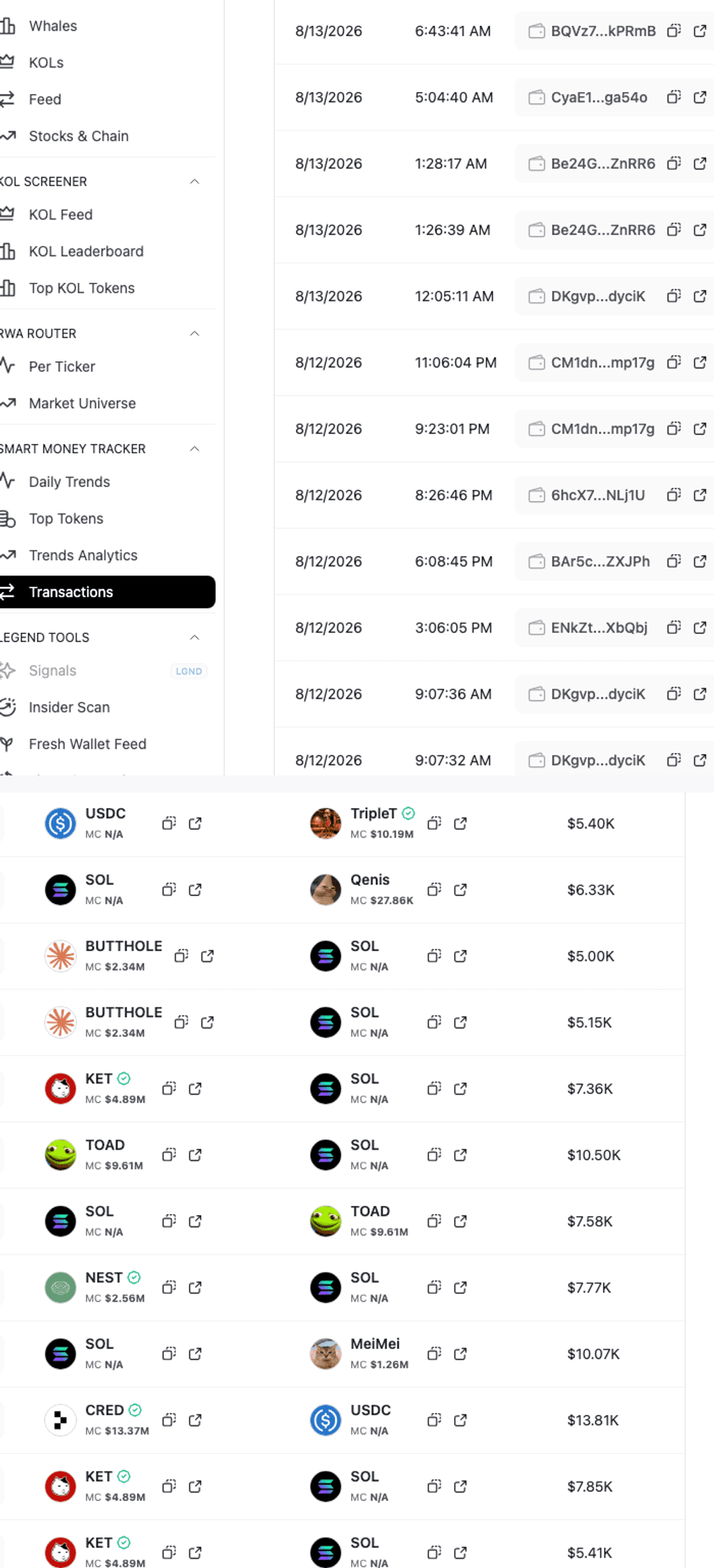
This production capture uses stacked, unaltered interface crops so the fields remain readable on a phone. It can help find an active wallet and preserve trade direction. It does not prove the address's complete transaction history, transferred inventory, protocol exposure, cost basis, or current balance.
Open the full wallet and material signatures in a compatible Solana explorer. Use Fresh Wallets Feed when wallet age and funding context matter, and KOL Feed when a public trader attribution is part of the lead.
The product surfaces shorten discovery. The transaction ledger supplies the proof.
Stronger and weaker transaction evidence
Stronger evidence
- The complete address and fixed review window are saved.
- Every material signature opens and succeeded or failed as recorded.
- Raw balance changes reconcile before labels are assigned.
- Mints, decimals, signers, and programs are verified.
- Transfers keep an explicit ownership and basis state.
- Protocol positions are decoded or marked unresolved.
- The ending ledger quantity matches controlled holdings.
Weaker evidence
- A screenshot or explorer label substitutes for the signature.
- Transfers are counted as buys or sells.
- Failed swaps are included as executed trades.
- Account closure rent is treated as profit.
- One routed swap is counted as several positions.
- The visible address is treated as the whole actor without relationship evidence.
- A zero balance is treated as a full exit.
False positives to avoid
Explorer summaries: Human-readable labels can omit inner instructions or simplify a routed transaction.
Token symbols: Different mints can share a symbol. Verify the mint before joining history or prices.
Wrapped SOL: Counting wrapped and native SOL incorrectly can create a false inflow or duplicate balance.
Associated token accounts: Account creation and closure are administrative events, not entries and exits.
Shared infrastructure: Common aggregators, exchanges, relayers, and vaults do not prove common ownership.
Transfer timing: A transfer near a sale can be related without being sale proceeds. Trace the balances.
Partial history: Pagination, archival gaps, or provider errors can hide earlier basis and later disposals.
Final checklist
- Confirm the full Solana wallet address.
- Fix the time window before selecting transactions.
- Save every material signature and block time.
- Check success, signers, instructions, and inner instructions.
- Reconcile native SOL and token-account balance changes.
- Verify mints and decimals.
- Record canonical mappings separately and classify each wrap, bridge, redemption, or variant swap.
- Classify swaps, transfers, fees, protocol actions, administration, and failures separately.
- Carry basis through transfers only when supported.
- Reconcile the ledger with current holdings.
- Mark incomplete history and unresolved ownership explicitly.
- Calculate PnL only after basis, fees, and inventory pass coverage checks.
- Record pagination boundaries, provider gaps, and unavailable transaction bodies.
- Save slots, finality state, message version, and resolved lookup-table accounts.
- Separate fee payer, signer, token owner, delegate, and program authority.
- Freeze raw evidence separately from interpretation.
- Re-read the newest page and set a closing checkpoint for active wallets.
- Record parser provenance and raw-check the material signatures.
- Timestamp history, balances, prices, and route quotes separately.
- Search material token and position accounts, then deduplicate the merged history by signature.
FAQ
How do I find a Solana wallet's transaction history?
Open the complete address in a compatible Solana explorer or wallet-analysis interface. Set the review window, inspect material signatures, and compare pre-transaction and post-transaction balances instead of relying only on activity labels.
Does every Solana transaction involving a wallet change its balance?
No. An address can appear as a signer, authority, program account, or referenced account without receiving or sending the asset you care about. Verify the balance changes.
Is a token transfer the same as a sale?
No. A transfer moves inventory. A sale requires evidence that the wallet disposed of the asset for economic value. Ownership may also remain with the same actor after a transfer.
Can failed Solana transactions charge fees?
Yes. A failed transaction can consume network or priority fees even though the intended swap or protocol action did not complete. Keep the fee and failed intent separate from executed exposure.
Can transaction history show exact wallet profit?
Only when acquisitions, disposals, transfers, fees, remaining inventory, decimals, and prices have sufficient coverage. Otherwise report observed cash flows and partial PnL rather than an exact result.
Why does my wallet history not match the current token balance?
The difference may come from transfers, several token accounts for one mint, wrapped SOL, LP or vault deposits, burns, account closures, missing pagination, or provider lag. Resolve the quantity before valuing it.
Does the oldest visible Solana transaction show when a wallet was created?
Not necessarily. The data source may paginate, limit retention, omit unparsed records, or begin after the wallet already held assets. Treat the oldest visible signature as a coverage boundary unless complete history is proven.