Quick answer
Use the token mint to list the earliest completed swaps. Inspect each buyer's age, funding, size, later sells, and holder links. The real signal is whether the wallets represent independent demand, automated snipers, coordinated insiders, or buyers who already exited.
What first buyers actually tell you
First buyers are the wallets that acquired a token in its earliest trading window. That might mean the first block, the first minute, or the first 25 completed swaps, depending on the question you are researching.
They matter because launch structure is visible before a price chart has enough history to be useful. Early wallets show who had access, how aggressively they sized, whether demand was independent, and who received the best liquidity before later buyers arrived.
But first does not mean informed. A wallet can be early because it is a sniper bot, a team-controlled address, a liquidity provider, or a retail trader who happened to find the token quickly. Treat first-buyer status as the start of the investigation.
Before you start: define the sample
Use the token mint, not the ticker. Duplicate symbols are common, and the wrong mint produces a convincing but irrelevant wallet list.
Choose one sample before drawing conclusions:
- First block: useful for sniper and privileged-access research, but sensitive to failed transactions and ordering.
- First five minutes: captures immediate launch demand without pretending every trade shared the same opportunity.
- First 25 completed buyers: easier to compare across launches with different activity levels.
- First meaningful buyers: excludes dust swaps, program accounts, and infrastructure wallets.
Record the pool and venue too. A token can trade in more than one pool, and looking at only one venue can omit an earlier market or double-count routed activity.
Verify the token identity before ordering buyers
Save the exact mint from the pool account or completed swap. Do not rely on the symbol shown by a screener. A copycat mint can reuse the same ticker, name, logo, and social links while producing a completely different first-buyer history.
Next, check whether the mint is a known variant of a canonical asset. The Solana Foundation's open-source Tokens project documents mint-to-canonical resolution for native, wrapped, bridged, stablecoin, liquid-staking, and tokenized-equity variants. This is an identity-enrichment step, not proof that a launch is legitimate.
Keep each variant's launch ledger separate. First buyers of one mint are not first buyers of another mint, even when both map to the same canonical asset. Pool creation time, authorities, liquidity, and buyer access can differ completely.
Step 1: find the earliest completed swaps
Open the token's transaction history through a compatible Solana explorer or data interface. Sort chronologically from the pool's first successful swap and keep only completed token acquisitions.
Exclude failed transactions. Also separate swaps from transfers, LP deposits, migrations, airdrops, and program-owned movements. A wallet that received tokens from the deployer is important, but it is not an open-market first buyer.
For each completed acquisition, record:
- wallet address
- block time and transaction signature
- token amount received
- SOL or quote asset spent
- venue or pool
- position size relative to pool liquidity
This creates the factual launch ledger. Interpretation comes later.
Lock the comparison before inspecting the outcome
First-buyer research becomes unreliable when the sample changes after you see who won or sold. Write down the comparison rule before following wallets forward.
Use the same rule for the token and its peers:
- the first successful pool swap that defines time zero
- the fixed window or fixed number of completed buyers
- the minimum acquisition size
- the pools and venues included
- the checkpoint used for later exposure
- the supply and liquidity snapshot used for concentration
If you inspect the first 25 buyers for one launch, do not switch to the first five minutes for another launch simply because that view looks cleaner. Save both when both matter, but label them as separate cohorts.
This also prevents hindsight leakage. A wallet should qualify because it met the launch-time rule, not because it later became profitable or appeared in a top-holder table.
Deduplicate routed swaps and retried transactions
One economic entry can appear as several instructions, inner swaps, or venue legs. Failed attempts can also sit beside the successful transaction. Count the buyer once per completed acquisition decision, not once per instruction or log line.
For each candidate record, reconcile the wallet's pre-transaction and post-transaction token balances. Keep the successful signature that increased exposure, then attach routed legs to that record. Preserve separate transactions when the wallet deliberately added again at a later block time.
Use three counts in the launch ledger:
- Completed acquisition transactions: successful signatures that increased buyer exposure.
- Unique buyer wallets: addresses after duplicate transactions are collapsed.
- Estimated independent actors: wallets after evidence-backed clustering.
This stops a router from inflating transaction count and a funded wallet cluster from inflating independent demand.
Attribute the acquired balance to the controlling owner
The recipient token account is not always the buyer wallet. Solana's official token documentation distinguishes the token account that stores a mint balance from the owner authority that can transfer it. One owner can control multiple token accounts for the same mint.
For every acquisition, resolve the post-transaction token account owner. Aggregate all covered accounts for that owner before counting unique buyers.
Preserve signer and fee-payer fields separately. A payer can fund an account creation or transaction without becoming the beneficial owner of the received tokens.
This produces four useful launch counts:
- completed acquisition transactions
- recipient token accounts
- controlling owner wallets
- estimated independent actors
A large gap between account and owner counts can come from routing or account structure. A large gap between owner and actor counts requires relationship evidence such as direct funding, transfers, shared signers, or synchronized behavior.
Report a clustering sensitivity range
Actor counts depend on how aggressively wallets are grouped. Publish three views when the ownership evidence is incomplete:
- Raw: every unique buyer wallet remains separate.
- Supported: only wallets with direct funding, transfer, signer, or strongly matched behavior evidence are combined.
- Stress case: plausible but unproven relationships are combined to show the highest defensible concentration risk.
Do not present the stress case as ownership fact. Use it to test whether the conclusion survives uncertainty.
If a launch looks broadly distributed only in the raw view but one actor dominates both the supported and stress views, the independence claim is fragile. If the conclusion stays similar across all three views, clustering uncertainty is less likely to change the decision.
How to identify snipers and possible bundles
A sniper is a trader or bot optimized to land near the start of trading. A bundle is a submission method, not a wallet type. Jito's official bundle documentation defines a bundle as a group of up to five transactions that execute sequentially and atomically. Every transaction succeeds, or the bundle does not land.
Those concepts can overlap, but they are not interchangeable. A fast buyer may use an ordinary transaction. Several wallets in one slot may be unrelated. A project-controlled cluster may buy without using a Jito bundle.
Reconstruct execution before assigning a label
For every suspicious early entry, save the slot, signature, signer, fee payer, programs invoked, outer and inner instructions, pre/post token balances, and SOL balance changes.
Solana's transaction introspection guide explains why inner CPI instructions and address-lookup-table accounts must be resolved before the full execution path is visible.
Then compare the evidence:
| Observation | Defensible interpretation | What it does not prove |
|---|---|---|
| One wallet lands in the first tradable slot | Very early execution | Project affiliation or bundle use |
| Several buys share a slot | Same-slot competition or coordination candidate | One owner or one bundle |
| Wallets share a direct funder and matching sizes | Stronger actor-level relationship | The exact submission path |
| Entries and a tip-like transfer appear close together | Possible low-latency or bundle workflow | A confirmed Jito bundle by itself |
| Wallets later sell in sync | Coordinated behavior becomes more plausible | Beneficial ownership as a fact |
The chain confirms transactions, account changes, and ordering. It does not add a universal "this was a bundle" label to every landed transaction. Use possible bundle unless provider-specific evidence establishes the submission relationship.
Score the launch cohort on four dimensions
Use a simple framework instead of a yes/no sniper badge:
- Speed: how close the successful acquisition was to the first tradable transaction.
- Control: whether wallets share funders, signers, fee payers, or direct transfer paths.
- Supply: how much liquid float the estimated actor acquired and still controls.
- Exit behavior: whether the cohort held, added, transferred, or sold into later demand.
Speed without control evidence describes competition. Control without meaningful supply may be operational batching. Supply plus synchronized exits creates the strongest exit-liquidity concern, even when the submission method remains unknown.
Promote only evidence-backed sniper claims
Use a claim ladder so the wording never outruns the transaction record:
- Early buyer: a completed acquisition falls inside the fixed launch window.
- First-slot buyer: the acquisition lands in the first tradable slot.
- Repeat sniper candidate: comparable early execution appears across a fixed sample of launches.
- Coordinated sniper cluster: funding, signing, transfers, or later behavior support grouping several fast wallets.
- Privileged participant: separate evidence supports access unavailable to ordinary traders.
Each level needs its own evidence. Do not promote a wallet from first-slot buyer to coordinated cluster because several addresses share a public router or exchange.
Use the dedicated Solana token sniper workflow to reconstruct lookup-table accounts, compare raw and actor-adjusted buyer counts, preserve possible-bundle uncertainty, and reconcile the cluster's later supply.
Step 2: check wallet age and funding
A first buyer with months of unrelated activity is different from an address funded two minutes before launch. Open each wallet's first inbound transfer and classify the origin.
Existing active wallet: Review prior tokens, average holding time, and whether the wallet repeatedly appears early. A credible history is stronger evidence than one lucky entry.
CEX-funded fresh wallet: The visible trail stops at the exchange. This remains ambiguous unless several wallets receive similar amounts from the same source and then behave alike.
Wallet-funded fresh address: Follow the parent wallet. If one address funds several first buyers, collapse them into one economic actor instead of counting them as independent demand.
Bridge-funded wallet: Check whether the wallet immediately concentrated into this token. A bridge transfer shows deliberate movement of capital, but it does not reveal identity by itself.
The fresh-wallet analysis guide explains these funding patterns in detail. For a broader wallet-history workflow, use the Solana wallet tracking guide.
Step 3: group coordinated wallets
Early buyer counts become misleading when one operator spreads capital across many addresses. Look for repeated features:
- wallets funded within the same short window
- identical or near-identical funding amounts
- the same parent wallet or fresh intermediary
- matching buy sizes and transaction cadence
- synchronized sells
- no unrelated history before or after the launch
Five coordinated wallets are not five independent buyers. Report both the raw wallet count and the estimated actor count whenever clustering evidence is strong.
Step 4: measure what happened after the buy
The first transaction only records entry. Follow each wallet forward and classify its current state:
- still holds most of the initial position
- added across separate sessions
- took partial profit but retained exposure
- sold completely into the first expansion in demand
- transferred tokens to another linked wallet
- deposited into liquidity rather than selling
This is where a superficially strong launch can fail. If nearly every early wallet has exited while later holders remain concentrated, the first-buyer cohort may have functioned as supply waiting for exit liquidity.
By contrast, several unrelated early wallets that keep exposure, add during weakness, and have credible histories deserve deeper research. They still do not guarantee a good trade.
Preserve one lifecycle row per estimated actor
Do not keep separate launch and current-holder spreadsheets that cannot reconcile. Build one actor-adjusted lifecycle ledger and update it at fixed checkpoints.
| Field | Launch checkpoint | Current checkpoint |
|---|---|---|
| Actor identity | Raw wallet plus supported cluster ID | Same cluster ID, with new links documented |
| Acquired quantity | Successful swap balance increase | Original quantity plus covered adds |
| Disposed quantity | Usually zero at entry | Covered sells only |
| Transferred quantity | Destination and signature | Current owner unresolved until traced |
| Protocol quantity | LP, vault, or escrow deposit | Decoded claim or unresolved exposure |
| Controlled quantity | Address-level token accounts | All verified actor-controlled accounts |
| Executable value | Quote near the entry time, if saved | Fresh quote for the reviewed sell size |
The quantities should satisfy a conservation check:
covered acquisitions + covered receipts = covered disposals + covered transfers out + current controlled or protocol quantity
An unexplained gap is a coverage failure. Do not patch it with a zero-cost assumption or call the missing tokens sold.
Use the wallet holdings and token-balance workflow to verify current token accounts and protocol claims. This separates an early buyer who still controls exposure from one whose address merely looks empty.
Step 5: compare early buyers with current holders
Open the current holder distribution and check whether quality early wallets remain visible. Exclude burn addresses, LP vaults, program accounts, lockers, and known exchange custody before calculating concentration.
Then ask:
- Do early buyers overlap with current top holders?
- Is supply spread among unrelated wallets or one funded cluster?
- Are early wallets accumulating while insiders distribute?
- Can the intended position exit against current liquidity?
Run the full Solana token due-diligence checklist before treating a first-buyer pattern as actionable. Holder concentration and exit depth can override an otherwise promising cohort.
Convert the early cohort into an actor-adjusted supply share
Do not stop at overlap counts. Add the current balances of strongly linked early wallets, divide by the defensible supply basis, and report their combined actor-level share.
Keep infrastructure separate. A first buyer that later moved tokens into a pool, locker, or custody address needs destination verification before you call the movement a hold or exit.
Compare the raw top-holder share with the actor-adjusted result using the Solana holder-distribution workflow. This reveals whether a launch that began with many addresses has actually diversified or merely redistributed one cluster across more accounts.
Use Stalkchain to surface fresh-wallet context
The Stalkchain Fresh Wallets Feed shows newly activated Solana wallets and their swaps with buy or sell direction, time, wallet, amount, assets, funding age, funding source, and transaction links. Filters cover source, trade type, minimum amount, and CEX-funded wallets.
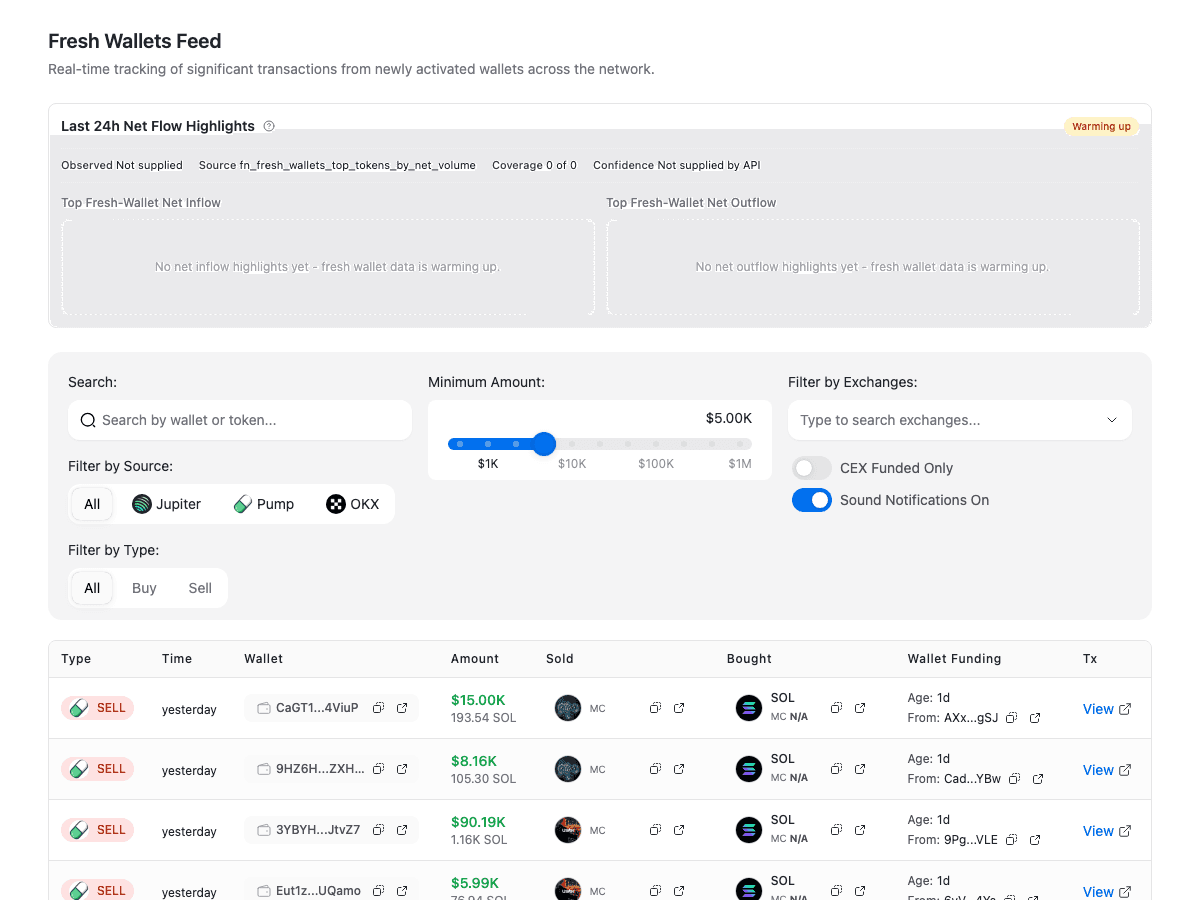
The production view above was captured on July 25, 2026. It is useful for finding early fresh-wallet activity and inspecting funding context. It is not a complete chronological first-buyer ledger for every token.
On September 26, 2026, the public route loaded the same research controls but reported zero covered rows and a warming-up state. Treat that as a coverage limitation, not a zero-activity result. A first-buyer investigation still requires the mint's earliest successful pool transactions when the discovery feed has no usable records.
Start with a token or wallet found in the feed, verify the exact transaction, then compare the cohort with Insider Scan, wallet histories, and the token's live holder data. Stalkchain shortens discovery; transaction verification and judgment remain part of the workflow.
Example: reading a representative first-25 cohort
Consider this representative, anonymized launch readout:
- 25 buyer wallets completed swaps in the sample.
- 9 were fresh addresses with no prior swap history.
- 5 fresh wallets traced to one parent funder.
- 4 existing wallets had previously traded multiple launches.
- 7 wallets sold their full position during the first major expansion.
- 3 unrelated early wallets still held meaningful exposure after two hours.
- 2 early wallets overlapped with current top non-infrastructure holders.
The raw headline is "25 first buyers." The more honest interpretation is roughly 21 discernible actors, one coordinated five-wallet cluster, heavy early selling, and only a small group of independently credible holders.
That profile is mixed. It is not proof of an insider launch, but it is not clean enough to call broad organic demand. The next check is whether the remaining quality wallets are still accumulating and whether current liquidity can absorb their exits.
Healthier vs riskier first-buyer patterns
Healthier pattern
- Several unrelated, established wallets enter early.
- Funding sources and position sizes vary naturally.
- Some early buyers retain exposure or add across separate sessions.
- No single cluster dominates early circulating supply.
- Current holder concentration falls as independent demand grows.
Riskier pattern
- Most early buyers are newly created wallets.
- Multiple wallets share a parent funder or synchronized behavior.
- Early wallets sell into the first retail demand.
- One cluster controls a large share through many addresses.
- Pool depth is too thin for current holders to exit safely.
False positives to avoid
A launch bot is not automatically an insider. Public snipers compete for early execution without project affiliation. Funding links and repeated team adjacency matter more than speed alone.
A transfer is not a buy. Team distributions, airdrops, migrations, and LP operations can all create early token balances without open-market demand.
A profitable wallet can be survivorship bias. Check the full history, including losing and abandoned tokens, before assigning skill.
A top holder may be infrastructure. Identify LP vaults, lockers, program accounts, burn addresses, and custody wallets before measuring concentration.
Holding is not permanent conviction. A wallet can sell in the next block. First-buyer research describes observed behavior, not future intent.
An empty address is not a verified exit. Tokens can move to a sibling wallet, LP position, vault, escrow, or custody account. Trace the destination before classifying the actor as fully sold.
A current holder can hide earlier disposal. A wallet may retain a small remainder after recovering basis or selling most of the position. Compare current quantity with the acquired lot instead of treating any nonzero balance as conviction.
Final checklist
- Confirm the token mint, pool, and venue.
- Check canonical-asset and variant context without merging mint-level cohorts.
- Define the launch window or buyer count.
- Keep completed swaps separate from transfers and LP events.
- Record wallet, time, amount, quote spent, and transaction signature.
- Check wallet age and first funding source.
- Collapse linked addresses into estimated actors.
- Show raw, supported-cluster, and stress-case actor counts.
- Separate sniper speed from bundle and ownership claims.
- Save outer and inner instructions before interpreting routed execution.
- Follow buys through later sells, transfers, and current holdings.
- Reconcile acquired, disposed, transferred, protocol-held, and controlled quantity.
- Compare early wallets with current holder concentration.
- Test exit depth before treating the cohort as bullish.
- Preserve uncertainty when attribution or price basis is incomplete.
FAQ
Can Solscan show the first buyers of a token?
A Solana explorer can show early transactions, but you still need to distinguish successful swaps from transfers, liquidity events, routed trades, and failed transactions. The explorer supplies evidence; the analyst builds the buyer cohort.
Can two mints with the same symbol share one first-buyer list?
No. Build the cohort from the exact mint and pool. Even verified variants of one canonical asset have separate transactions, liquidity, authorities, and launch histories. A shared symbol is weaker evidence than a shared canonical mapping, and neither lets you merge buyer ledgers.
How many first buyers should I check?
The first 25 completed buyers is a practical starting sample. For very active launches, also inspect the first block and first five minutes. For thin launches, prioritize meaningful trade size over an arbitrary count.
Are fresh first buyers always insiders?
No. They may be new users, security-separated trading wallets, public snipers, or independent traders. Shared funding, synchronized behavior, and deployer links make insider coordination more plausible.
Does an early profitable wallet count as smart money?
Not by itself. Review its complete token history, realized and unrealized coverage, position sizing, entry timing, and repeat behavior. One successful launch can be luck.
What is the biggest first-buyer red flag?
A cluster of fresh wallets funded by one parent, buying in the same window, controlling meaningful supply, and selling into later buyers is a strong risk pattern. Even then, describe the evidence rather than claiming identity as fact.