Tokens tied to agentic AI projects generated more than $10 billion in value during 2024, mostly in the fourth quarter, while industry projections estimated Web3 could surpass 1 million AI agents by the end of 2025, according to TechRT's decentralized AI statistics. Those figures show how quickly capital and developer attention flooded into AI agents in crypto, even though forecasts never prove that every deployed bot is autonomous or profitable.
Most traders evaluating crypto AI tools focus on the wrong component. They compare language models as if a higher benchmark score guarantees safer wallet decisions.
In practice, the language model is rarely the biggest point of failure. Risk concentrates in two places: the data layer feeding observations to the model and the authorization architecture deciding what the software can sign. A sharper model fed stale balances, wash-traded social chatter, or selectively sampled wallet histories doesn't become more cautious. It acts on bad information with higher confidence.
Understanding how crypto agents pull live blockchain state, verify noisy signals, and stay boxed inside strict spending limits separates useful research automation from automated losses. Every method below is designed for research and operational safety, not investment advice.
Table of Contents
- What AI Agents Do in Crypto and Why They Matter Now
- Why AI Agents Need Live On-Chain Data
- A Research Workflow From Question to Verdict
- Automation Levels From Alerts to Trade Execution
- Access Levels an Agent Can Hold and What Each Allows
- Safety Checks Before an Agent Acts on a Signal
- Start Read-Only and Verify Before You Trade
What AI Agents Do in Crypto and Why They Matter Now
Wallet activity confirms that agent-linked software moved beyond theory in 2025. According to DappRadar data cited by CryptoWeekly, on-chain activity associated with AI applications rose 86% during 2025, reaching an estimated 4.5 million daily unique active wallets or related activity sources. Over the same period, AI applications expanded their share of the blockchain application market from 9% to 19%, approaching blockchain gaming at 20%, while AI-agent projects raised roughly $1.39 billion, 9.4% above all of 2024.
Earlier snapshots show the baseline that fueled that acceleration. A VanEck report cited by Cointelegraph counted approximately 10,000 AI agents operating across Web3 in December 2024, and Crypto.com Research recorded a crypto AI-agent sector market capitalization of $15.3 billion in January 2025.
| Indicator | Figure | Source |
|---|---|---|
| Web3 AI agents operating | About 10,000 (December 2024) | VanEck via Cointelegraph |
| Sector market capitalization | $15.3 billion (January 2025) | Crypto.com Research |
| On-chain activity of AI applications | Up 86% in 2025 | DappRadar via CryptoWeekly |
| Estimated active users | About 4.5 million daily unique active wallets or activity sources | DappRadar via CryptoWeekly |
| AI share of blockchain applications | 9% to 19%, close to gaming at 20% | DappRadar via CryptoWeekly |
| AI-agent project funding | About $1.39 billion, 9.4% above all of 2024 | CryptoWeekly |
Note that the 2025 activity and funding numbers reflect reported cut-offs during 2025 rather than full-year totals. They measure adoption and capital formation across wallets and protocols, not positive investment returns or proof that every counted app runs autonomously without human oversight.
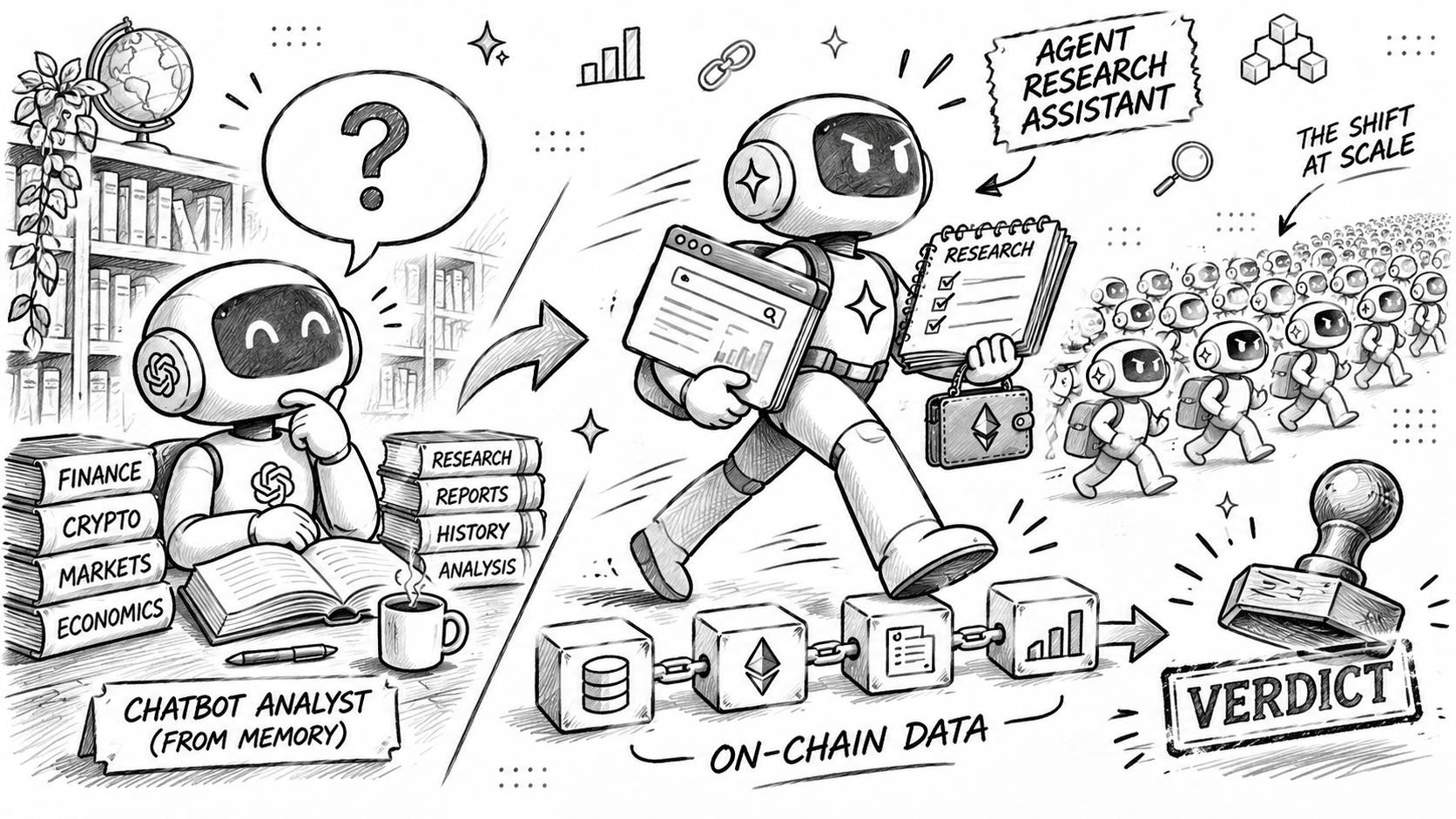
To see why crypto-native agents differ from everyday chat interfaces, compare how each handles a market question. A standard chatbot works like a well-read analyst answering from memory after the market closed. A crypto AI agent works like a research assistant sitting at a desk with a live browser, a structured notebook, and, if you allow it, a funded wallet.
Four Components Inside Every Crypto Agent
Every functional agent combines four moving parts that you can inspect separately:
- The language model: Interprets your prompt, plans which checks to run, and synthesizes conflicting findings into a readable answer.
- External data tools: Fetch live wallet holdings, token flows, and historical trader behavior through standardized connectors such as the Model Context Protocol so the model isn't guessing from outdated training weights.
- Persistent state: Acts as the assistant's working notebook, tracking prior queries, watched wallets, and baseline metrics between steps.
- The signing component: An optional execution layer that builds and submits blockchain transactions for staking, swapping, or using AI agents to earn yield on decentralized protocols.
Separating those components lets you divide agents into three clear operational roles before you ever connect a wallet. Research agents only read public data and summarize what happened. Analysis agents score signals, track wallet clusters, and flag discrepancies across sources. Execution agents hold narrow signing rights to move funds under strict rules.
Why AI Agents Need Live On-Chain Data
A standalone language model can't browse live blockchain state, inspect mempool updates, or read gated trader dashboards on its own. Without tool calls routed through a dependable crypto data API, the model either refuses to answer or invents plausible numbers from old training data.
Different on-chain questions also expire at different speeds. A stale wallet balance from an hour ago can invalidate a liquidity check immediately, whereas a 30-day profitability metric only needs a clearly declared time window.
| Data type | Example question | Typical source | Freshness needed |
|---|---|---|---|
| Wallet holdings | What does this wallet hold right now? | Block explorers and node data | Current block |
| Token flows | Who bought and sold this token in the last hour? | DEX trade logs | Minutes |
| Trader PnL | Is this trader profitable over 30 days? | Wallet trade history | Daily or live, with window stated |
| KOL and whale holdings | Which tracked traders hold this token? | Tracked wallets and profiles | Minutes to hours |
| Social signals | What are traders saying about this coin? | Social posts and threads | Minutes, verified against on-chain activity |
Why Fragmented Data Breaks Confident Models
Crypto activity doesn't sit inside one clean ledger. Liquidity, pricing, and sentiment splinter across centralized exchanges, decentralized exchanges, cross-chain bridges, smart-contract vaults, self-custody wallets, and social platforms. When an agent merges answers from two feeds that index different chains or refresh on different schedules, the output can look coherent while hiding a major contradiction.
As Bitsgap's comparison of AI trading agents and bots points out, stronger model reasoning doesn't automatically translate into safer trading. If the observation layer is delayed or selectively sampled, an advanced model can turn partial inputs into automated losses at machine speed.
Better reasoning does not fix a broken observation layer. Judge the timestamps, sources, and completeness of an agent's inputs before you trust a single sentence of its conclusion.
Before acting on any AI-generated wallet or token read, test the output against three verification questions:
- Balance completeness: Does the wallet figure count staked tokens, liquidity pool positions, or bridged assets on another chain, or only idle spot tokens in one address?
- PnL methodology: Is a trader's profit-and-loss figure realized from closed exits, unrealized on open bags, or mark-to-market using thin DEX liquidity that would slip sharply on sale?
- Noise filtering: How did the data pipeline filter out sybil wallet clusters, copy-traded entries that arrived late, and wash-traded social hype designed to manufacture urgency?
When an agent can't state its source, timestamp, and calculation method for those three items, treat the output as an unverified lead rather than usable evidence.
A Research Workflow From Question to Verdict
Suppose you spot a newly launched memecoin trending across crypto social feeds and want to know whether real buyers are accumulating or bots are manufacturing noise. An agent can accelerate that check dramatically, provided you force it through a repeatable sequence instead of asking open-ended questions.
At a high level, the research path moves from a tightly scoped prompt to a documented verdict, and in day-to-day analysis it breaks cleanly into six operational steps.
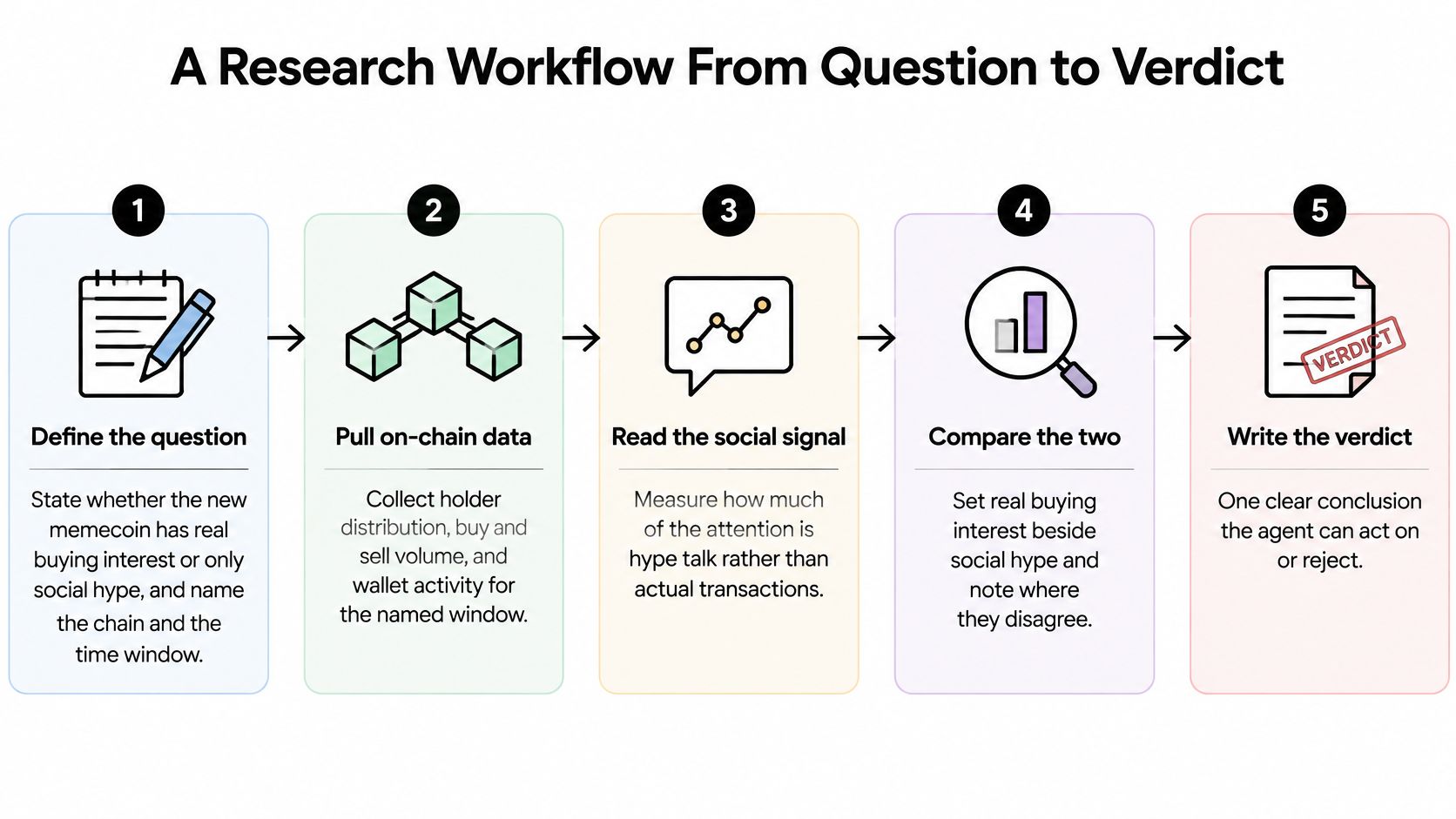
- Frame one narrow question with chain and window. Write a single sentence naming the chain and timeframe, such as whether a new Solana memecoin saw net accumulation from independent wallets over the past two hours. A one-hour window and a seven-day window often point in opposite directions. Skipping the time boundary is the easiest way to let an agent blend yesterday's launch spike with today's distribution.
- Pull core on-chain metrics with timestamps intact. Have the agent query top holder concentration, buy versus sell volume, and tracked smart-money entries, attaching a block timestamp to every figure. Never accept a neat paragraph summary that strips out when each endpoint was sampled.
- Cross-check flow against deployer and insider behavior. Pull a second independent feed covering deployer wallets, early sniper addresses, and insider balances to see whether insiders are selling into retail bids. Log every discrepancy between feeds instead of letting the model smooth it over. Writing a bullish summary before this cross-check finishes is a classic analyst error.
- Audit the social signal against distinct wallets. Count how many separate traders are putting capital on-chain, then trace their funding sources to confirm they aren't one linked cluster splitting trades across fresh addresses. Treating five wallets funded from the same origin as five independent buyers turns coordinated staging into fake conviction.
- Compile an evidence-backed memo. Instruct the agent to output every claim alongside its data source, exact timestamp, and an explicit list of what remains unknown, such as unattributed centralized-exchange inflows or locked liquidity terms.
- Assign one concrete disposition. End every run with one of three outcomes: archive the memo as background research, set a conditional watch alert, or escalate to manual human review.
Sample Research Memo Format
Keep a fixed template so your agent produces scannable, auditable records every time instead of meandering essays:
- Question and scope: Does Token X on Solana show organic buying interest or mostly social hype over the last 4 hours?
- On-chain flow (Source A, UTC timestamp): Net buy volume, unique buyers versus unique sellers, and top-10 holder percentage.
- Insider check (Source B, UTC timestamp): Deployer balance change, linked early-buyer wallets, and any conflict with Source A.
- Social versus wallet check (Source C, UTC timestamp): Mention velocity compared against funded-wallet independence checks.
- Open unknowns: Unverified liquidity lock duration, unlabeled top-five wallet, or missing bridge transfers.
- Verdict: Watchlist only; escalate for human review only if independent buyer count rises while insider holdings stay flat.
Automation Levels From Alerts to Trade Execution
Automation in crypto isn't a binary switch between manual spreadsheets and autonomous trading bots. It sits along three tiers, and every step up trades human review for speed while expanding the consequences of an upstream data glitch.
Alerts and dashboards form the safest starting tier. Alert bots and dashboards can watch tracked traders, token flows, and new launches on a schedule and push changes straight to where you already look. Because nothing moves on-chain until you inspect the notification, a bad trigger only costs a few seconds of attention.
Scheduled reports sit in the middle. An agent runs the exact same diagnostic checks every morning, compares fresh readings against yesterday's baseline, and writes a structured briefing. You save hours of repetitive lookups, though a subtle risk creeps in: if an API schema shifts or a wallet label goes stale, the agent will faithfully repeat the same flawed calculation every single morning until someone audits the raw data.
Trade execution sits at the top. Here the software constructs and submits blockchain transactions within defined guardrails, which requires a dedicated permission architecture and an explicit human approval gate before you ever grant routine autonomy.
| Automation level | What runs without a person | Human checkpoint | Best fit |
|---|---|---|---|
| Alerts and dashboards | Watching tracked traders, token flows and launches | Reviewing each alert before acting | Beginners and researchers |
| Scheduled reports | Daily checks, comparison with the previous run and a written summary | Reviewing the summary and checking for data drift | Portfolio managers and analysts |
| Trade execution | Submitting transactions within set limits | Approving every trade above a threshold, and reviewing all activity | Experienced developers with tested controls |
Managing Alert Fatigue and Graduating Between Tiers
Many operations fail at automation by jumping straight to execution or by wiring up fifty noisy triggers on day one. When an alert channel pings every three minutes for routine micro-buys, alert fatigue sets in quickly. Analysts mute the feed or skim past notifications, which trains them to miss the single high-conviction liquidity drain or whale exit that required fast action.
Practical rule: Move up one automation tier only after the current level runs cleanly for several weeks with a measured, low false-positive rate.
Start by pruning noisy triggers until each alert corresponds to a clear follow-up check. Once your daily scheduled reports match manual block-explorer spot checks without drifting, you have a baseline worth trusting for higher-stakes workflows.
Access Levels an Agent Can Hold and What Each Allows
Consider two hypothetical setups running the exact same trading agent. In the first setup, you approve an unlimited ERC-20 token allowance on a main wallet holding $10,000. In the second, you fund a dedicated agent wallet with $500 and keep your main holdings untouched. If a prompt injection, compromised dependency, or contract exploit hijacks the agent, the first setup risks $10,000 while the second physically caps the blast radius at $500.
That gap explains why the authorization and integration layer matters more than model sophistication when capital is on the line. As Coincub's analysis of crypto AI agent security notes, an honest model holding excessive privileges can inflict far more damage than a weaker model operating inside tight boundaries. Session keys can grant scoped, temporary signing authority while users retain self-custody, yet security and regulatory responsibility for delegated actions remain unresolved.
| Access type | Can move funds? | Limits that matter | How to revoke |
|---|---|---|---|
| Read-only research access | No | No keys shared; data reads only | Disconnect the link in the AI assistant |
| Exchange API key | Yes, depending on permissions | Withdrawals off, IP allowlist, trade-only scope | Delete the key on the exchange |
| Smart-contract token allowance | Yes, for the approved spender | Exact amount, expiry where supported, specific contract | Revoke the allowance in the wallet |
| Session key | Yes, within its scope | Spending cap, transaction-frequency limit, expiry, contract allowlist | Let it expire or revoke the session |
| Separately funded agent wallet | Only what the user deposits | The deposited balance is the cap | Withdraw the remaining funds |
Clean operational separation starts with a simple distinction: research tools only read public data and never ask for your private keys, whereas trading tools run from a separate agent wallet that you fund explicitly. Never paste a seed phrase or main-wallet private key into an AI chat window or plugin config.
Practical Rules for Permission Hygiene
Whenever you move past read-only research, lock down permissions with controls you can audit and reverse in seconds:
- Default to least privilege: Give research agents zero signing capability, and restrict execution agents with spending caps, margin limits, transaction-frequency limits, and explicit contract allowlists.
- Require human sign-off on outliers: Just as security teams place human approval gates on agent email before software sends irreversible outbound messages, require manual confirmation whenever a crypto agent proposes a new contract, an unusual trade size, or an unfamiliar token.
- Set expiry dates and rehearse revocation: Never grant open-ended allowances or immortal API keys. Practice revoking a session key or draining an agent wallet on a small test balance before funding it seriously.
- Keep a dated permission ledger: Record every grant, spending limit, and revocation with dates. Because legal and operational liability for delegated agent actions isn't settled, assume you remain responsible for every permission you issue.
Safety Checks Before an Agent Acts on a Signal
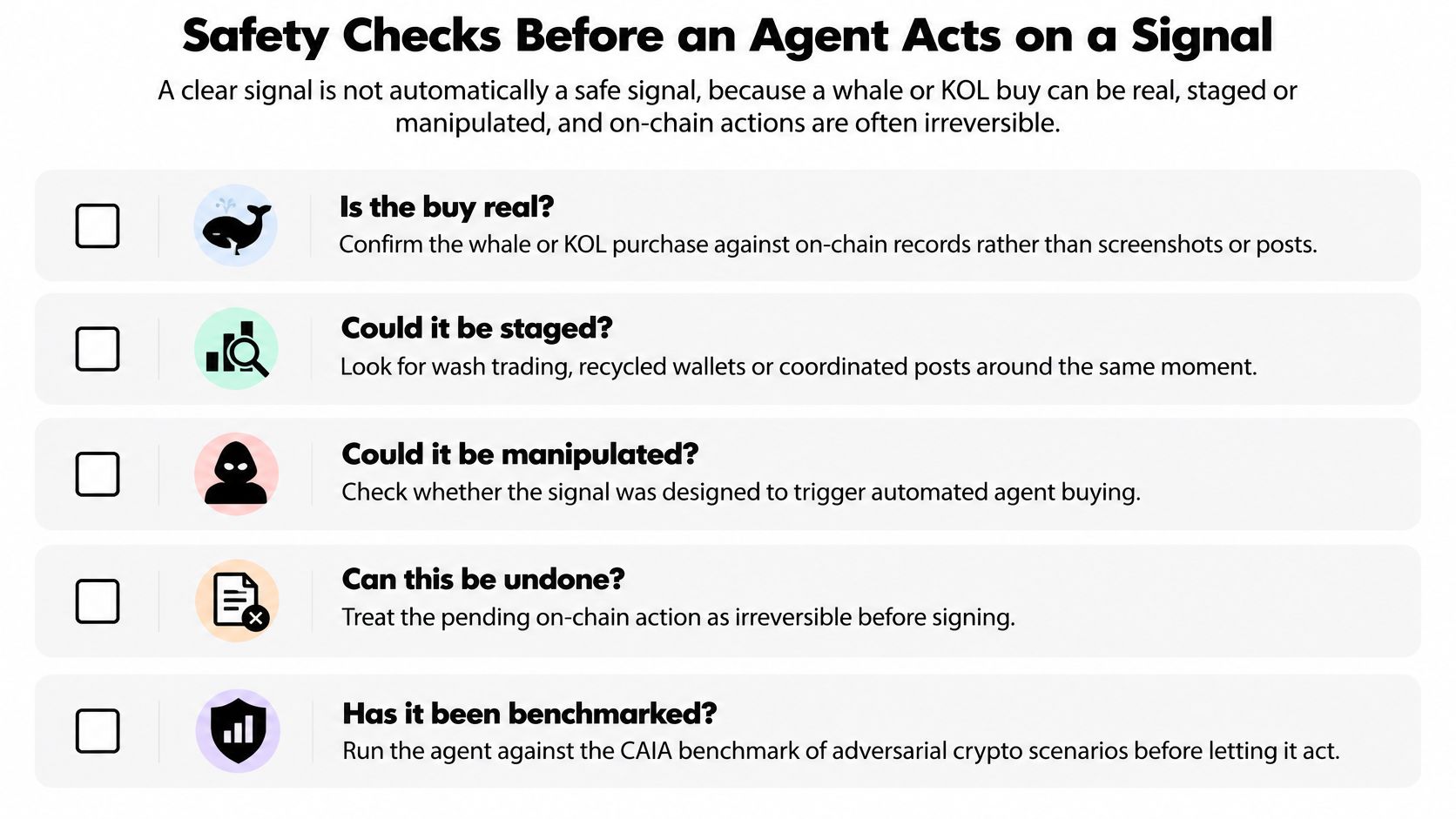
A clean, unanimous on-chain signal isn't automatically a safe signal. Whale buys and KOL entries can be genuine conviction, staged marketing, or deliberate traps engineered to bait automated momentum buyers, and once a blockchain transaction confirms, you can't call a bank to reverse it.
Adversarial testing highlights how brittle unguarded agents remain. The CAIA benchmark evaluates 17 leading models across 178 time-anchored cryptocurrency tasks requiring agents to separate truthful data from manipulation across fragmented feeds, motivated in part by its cited estimate of approximately $30 billion in cryptocurrency exploit losses during 2024. That means testing an agent on simple question accuracy misses the point. Real evaluation has to measure false-positive alerts, stale-state decisions, resistance to adversarial social content, and the discipline to abstain when sources contradict each other.
Smart-contract execution adds a second layer of technical danger. EVMbench tests smart-contract security across 117 curated vulnerabilities from 40 repositories in a local Ethereum execution environment, demonstrating that frontier agents can already discover and exploit vulnerabilities end-to-end against live blockchain instances. If autonomous software can exploit live contract bugs at machine speed, any agent submitting transactions needs strict pre-execution sandboxing.
Before an agent escalates a market signal toward an irreversible on-chain action, run it through a five-point verification checklist.
The Five-Point Pre-Execution Gate
- Verify provenance and block height. Confirm every wallet balance, token flow, and social quote carries an exact source label, timestamp, and block height so stale reads are automatically discarded.
- Enforce cross-feed agreement. Require at least two independent data sources to corroborate a trend before a signal moves from research log to execution queue.
- Validate exact transaction parameters. Check the proposed transaction against current contract bytecode, ABI, chain ID, nonce, gas limit, slippage cap, and expected post-trade state change before signing.
- Simulate on a local fork first. Run static security checks and execute the transaction inside an isolated fork or simulator to catch hidden transfer taxes, honeypots, or unexpected revert conditions.
- Isolate keys from the language model. Keep private keys completely outside the model context and delegate signing to a narrowly scoped policy signer or multisig, following strict crypto agent security controls.
Consider how that gate stops a common trap. Suppose five tracked KOL wallets buy the same micro-cap token within ten minutes. On the surface, it looks like broad smart-money consensus. When the agent checks funding provenance, three of those wallets trace back to the same funding address. The independent buyer count drops from five to two, falling below the confidence threshold, and the agent abstains instead of buying into a staged pump.
No unverified whale alert or social post should ever convert directly into an autonomous trade. Abstaining on conflicting data is a feature, not a failure.
Start Read-Only and Verify Before You Trade
The fastest way to build real intuition for AI agents in crypto is to start completely read-only. Connect one live on-chain data source to your AI assistant, ask a factual question about a wallet or token whose history you already know, and verify every figure against a block explorer before letting the tool inform a live decision.
If you want a hosted setup for that test, you can connect StalkChain's hosted MCP server directly to your AI client. To access our service, you connect a supported Solana-compatible crypto wallet, copy our MCP endpoint, and paste that same link into whichever AI assistant you already use, including Claude, ChatGPT, Grok, or Cursor.
Once your read-only link is live, put the workflow through a disciplined three-step trial:
- Log two weeks of read-only research on one token. Run the same structured query daily and save every claim with its exact source and timestamp so you can spot drift or missing context.
- Score the log against your safety gate. Count how many alerts turned out to be false positives, how often stale inputs appeared, and whether the agent properly abstained when on-chain flow and social chatter disagreed.
- Introduce a capped agent wallet only after accuracy stabilizes. If the log holds up cleanly across two full weeks, test small execution experiments using a separately funded agent wallet whose balance equals your maximum acceptable loss, with expiry dates and revocation steps tested upfront.
Keep the boundary between software and judgment clear. Our tools and any AI research workflow exist to support analysis, not financial advice, and every trade or risk decision remains your own responsibility.
StalkChain delivers live on-chain wallet holdings, realized and unrealized PnL, token flows, and KOL and whale tracking across seven chains through a single MCP endpoint and REST API, built so you can run read-only research without sharing private keys. If you want to verify signals with real on-chain receipts before putting capital at risk, explore the tools and connect your AI assistant at StalkChain.