Quick answer
For FOMO trader discovery, handle-to-wallet resolution, positions, tracked holders and written trade theses, start with StalkChain's REST API.
For custom historical SQL across blockchain datasets, choose Dune.
For Solana holder cohorts and wallet-level positions, inspect Birdeye. For Solana event ingestion, use Helius.
Price-and-pool discovery is a different job: CoinGecko or DEX Screener may be a better first request.
A token's price, its holders and the reasons influential traders bought it are different datasets. An API that excels at one can leave the others unanswered. This comparison is organized around research jobs rather than a single league table.
Disclosure: Stalkchain Research publishes this site and owns StalkChain.
We include our product, identify where it fits, and recommend competitors where their documented capabilities better match the job.
No provider was performance-benchmarked or paid for placement in this article.
How we compared the APIs
We read the vendors' public product pages and official endpoint documentation on October 31, 2026.
We compared question answered, input and output model, and implementation trade-off.
We did not run authenticated calls across vendors, test latency, audit completeness, or calculate normalized cost.
“Best for” below is an editorial fit judgment, not a benchmark. Features and access tiers can change; confirm the linked docs before implementation.
| API | Best starting question | Documented route or capability | Main boundary |
|---|---|---|---|
| StalkChain | Who is this FOMO trader, what do they hold, and what thesis did they post? | REST tools for search, trader positions, token holders and theses | FOMO-centered cohort; not a universal trader census |
| Dune | What happened across a custom historical cohort? | Execute saved SQL queries or fetch latest results | Query design and freshness are your responsibility |
| Birdeye | Which labeled Solana wallets hold this token? | Holder positions with labels, holdings, trade volumes and PnL | The cited endpoint supports Solana and Robinhood; labels differ by chain |
| Helius | Which Solana address events should reach my app? | Webhooks with parsed or raw transaction payloads | Event plumbing, not a prewritten investment thesis |
| CoinGecko | What are market, token and pool conditions? | Crypto market and on-chain token/pool data | Market context is not trader intent |
| DEX Screener | Which DEX pairs exist and how liquid are they? | Pair search, token-pair lookup and pair metrics | Pair data alone cannot establish wallet quality |
StalkChain: best fit for FOMO trader-to-wallet research
The live API page documents these research tools:
stalkchain_fomo_search: find a trader and associated wallets/PnL.stalkchain_fomo_trader_positions: inspect entries and outcomes.stalkchain_fomo_kol_holders: inspect tracked token holders.stalkchain_fomo_theses_by_trader: read written trade reasoning.
The REST reference specifies GET or POST under https://data.stalkchain.com/api/v1, bearer-key authentication, JSON-schema tool discovery and an OpenAPI document.
These are unusually direct primitives when the question starts with a FOMO handle rather than a bare address.
Where another tool wins: If you need arbitrary SQL across long historical windows, Dune is a more natural starting point. Do not extrapolate StalkChain's tracked-trader data to all wallets or infer causation from a trader's thesis.
The wallet-profitability guide covers why PnL needs context.
Dune: best fit for custom historical analysis
Dune's execution and results guide distinguishes fetching the latest result of a saved query from running that query again for fresher data.
Its API supports query execution and result retrieval, making it appropriate for repeatable cohort studies and bespoke SQL definitions. A cached result is not equivalent to a fresh execution; record execution time in downstream reports.
Where another tool wins: For a quick handle → wallet → thesis lookup, designing a query is more work than calling a purpose-built StalkChain tool.
Birdeye: best fit for labeled Solana holder inspection
Birdeye's holder-positions reference exposes per-wallet holdings, supply share, buy/sell activity, first-trade time, PnL and labels such as bundler or sniper for a Solana token.
This is useful when an address cohort matters more than a social-trader identity. Labels are classifications, not proof of coordination or wrongdoing; inspect underlying activity before publishing an allegation.
Where another tool wins: StalkChain is better aligned when the starting identifier is a FOMO trader handle and the desired output combines that trader's positions with their written thesis.
Helius: best fit for Solana event infrastructure
Helius webhooks push parsed or raw Solana transactions to an application when watched activity occurs.
That beats periodic manual lookup for event-driven ingestion.
Helius warns deliveries may be duplicated, so consumers should deduplicate and handle retries.
Its docs also point new parsed-stream builds to Parsed Streams.
Where another tool wins: A webhook event tells you what occurred, not whether a named FOMO trader's public rationale matches current holdings. That requires enrichment.
CoinGecko and DEX Screener: best fit for market context
CoinGecko's official MCP documentation describes current/historical prices, market intelligence, and on-chain token and pool data.
The DEX Screener API reference lists pair search and token-pair endpoints whose pair objects include price, transactions, volume and liquidity.
Both are reasonable market-context checks before interpreting a holder signal.
Neither pair metrics nor price appreciation proves that a trader is skilled.
A research workflow that does not confuse the signals
- Resolve the exact chain and token contract, not just a ticker. Check pair liquidity and volume using a market-data endpoint.
- Form a holder hypothesis: inspect distribution, labeled wallets or tracked trader exposure. Distinguish all holders from a provider's tracked subset. For a Solana-specific baseline, read our holder-distribution guide.
- Trace behavior: compare entry, current position and sells. A high unrealized PnL is not realized profit; a visible wallet is not necessarily every wallet a person controls.
- Read the thesis only after checking activity. A written rationale is evidence of what was posted, not evidence the market will agree.
- Save source timestamps and the exact endpoint/query so a later reader can reproduce the question, while respecting provider access rules.
For example, an analyst investigating a FOMO trader can resolve the handle with StalkChain, check positions and theses, then validate token liquidity through a pair-data API.
If the question changes to “how did comparable launches behave over two years?”, move to a defined Dune query instead of forcing a trader-profile endpoint into a historical study. This is a workflow illustration, not a tested live trader result.
Which should you choose?
- FOMO handle, wallet, current position and posted rationale: StalkChain.
- Custom cross-dataset cohort or reproducible SQL: Dune.
- Labeled Solana token holders: Birdeye.
- Production Solana transaction notifications: Helius.
- Price, pool and DEX-pair context: CoinGecko or DEX Screener.
Combining an identity/behavior API with market context is often more defensible than declaring a single vendor sufficient. None of these endpoints constitutes a buy signal or financial advice.
Inspect the documented integration before building
Open the StalkChain API catalog and inspect the published connection or request example before using an account key. The screen below documents the public interface, not an authenticated comparison test.
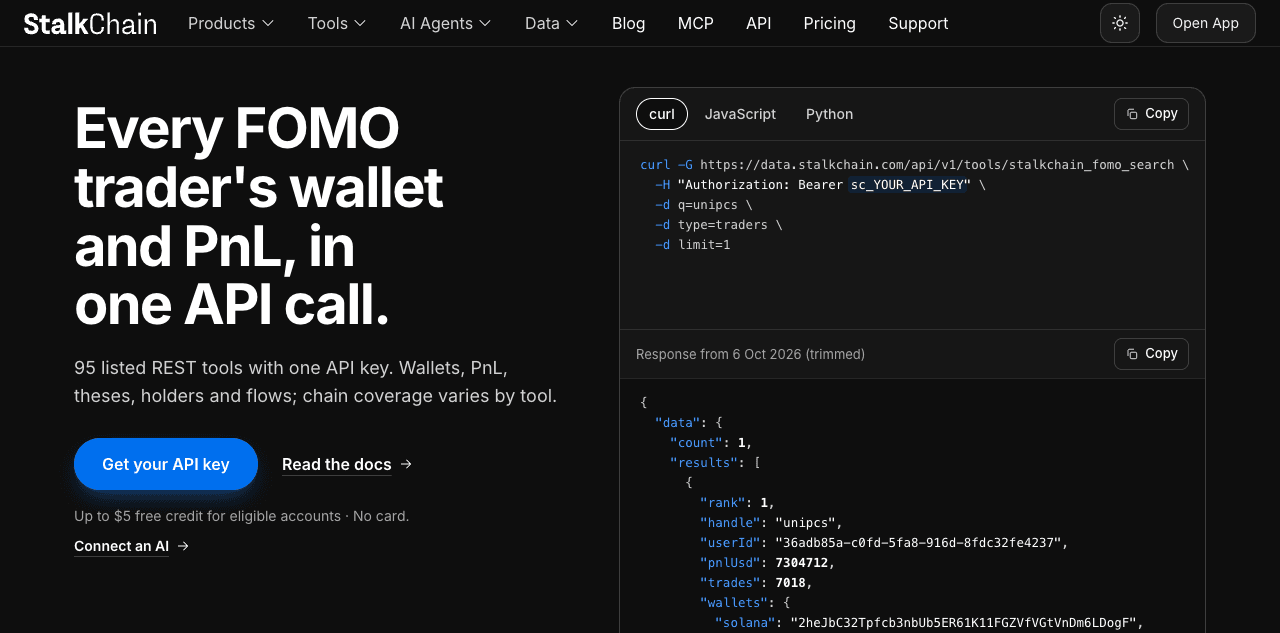
Source: StalkChain public API page, captured October 31, 2026.
This shows setup documentation, not proof of chain-wide coverage, current trader results or measured performance.
Any API response pictured is the site's dated example.
For the scope boundary, read the FOMO data coverage notes.
Use the REST authentication reference for application code or the Claude Code connection steps for an interactive agent.
Keep research access separate from trading authorization.
Final integration checklist
- Pin the chain, token and wallet identifiers.
- Record the endpoint, observation time and pagination.
- Verify material transactions with the chain explorer.
- Separate realized PnL, open exposure and transfers.
- Check account permissions and current plan limits before automation.
FAQ
Is an on-chain analytics API the same as a market-data API?
No. Market data describes prices and liquidity; on-chain analytics may describe addresses, transfers, positions or cohorts. Some vendors cover both, but verify the specific endpoint rather than assuming coverage from the brand.
Does a profitable wallet prove a token is safe?
No. PnL definitions, open positions, liquidity and address attribution can all change the interpretation. Check the contract, trading conditions and the wallet's actual transaction history.
Can one provider cover every chain and every trader?
Do not assume so. Confirm chain and endpoint scope in the current docs, and treat a tracked trader set as a subset rather than a chain-wide census.