Quick answer
Find Solana smart money wallets from recent meaningful transactions. Test repeatability, PnL coverage, funding independence, exits, and executable liquidity. Verify signatures, transfers, open inventory, and related addresses before adding a wallet to your watchlist.
What smart money means on Solana
Smart money is not a wallet label or a single profitable trade. It is an address, or an evidence-backed group of addresses, whose covered decisions show a repeatable edge under realistic execution conditions.
That definition has five parts:
- Fresh evidence: the wallet is active inside the period you care about.
- Repeatability: results survive a sample containing losses and open positions.
- Complete enough accounting: basis, transfers, fees, and inventory are not silently omitted.
- Independent behavior: one operator is not being counted as several confirming wallets.
- Executable edge: the wallet's entries and exits are not impossible to reproduce after detection.
A wallet can be early without being profitable. It can be profitable without being copyable. It can also appear diversified while several addresses belong to the same actor.
Before you start: define the research job
Decide whether you want to find launch traders, accumulators, momentum traders, KOL wallets, or long-horizon holders. Comparing all of them with one score produces bad rankings. If you are choosing a tool, see StalkChain vs Nansen for memecoin and KOL research.
Record the review window, minimum transaction size, minimum number of mature positions, and liquidity standard before inspecting results. This prevents one spectacular wallet from changing your criteria after the fact.
Use the Solana wallet tracking workflow for the full address history. Use the wallet profitability method when PnL, ROI, or win rate becomes part of the claim.
Step 1: shortlist wallets from recent transactions
Open Smart Money Transactions. The public table exposes date, time, wallet, sold asset, bought asset, and USD value. Start with meaningful recent swaps rather than an old leaderboard snapshot.
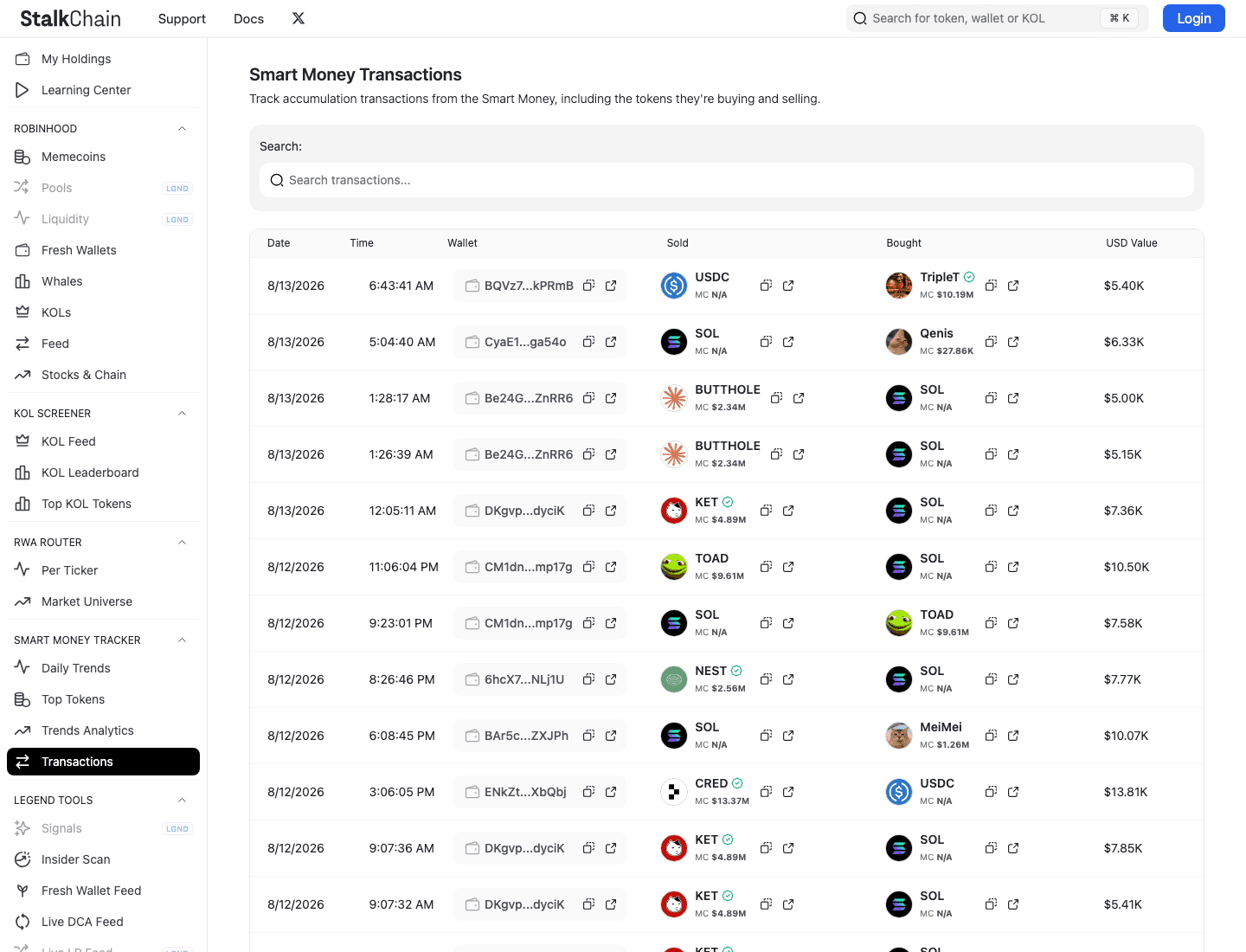
This production capture from August 13, 2026 shows populated transaction rows. It is evidence of a discovery surface, not proof that every listed address still has an edge.
Read direction carefully. Selling a token for SOL or USDC may reveal disciplined distribution. Buying after a large price move may reveal momentum chasing rather than early insight.
For each candidate, save:
- the complete wallet address
- the transaction signature and block time
- the sold and bought mints
- normalized token amounts
- approximate USD size and its price timestamp
- the token's liquidity near the trade
Do not rank an address from the abbreviated wallet label alone. Open the wallet and signature links before carrying the candidate forward.
Wait for the live table before classifying freshness
On September 6, 2026, the initial server-rendered extraction of Smart Money Transactions exposed rows ending on September 3. A real browser check at 01:04 UTC then hydrated the table with multiple transactions from the prior one to 23 hours.
The two observations came from the same public route. The difference shows why initial HTML, a cached extraction, and the hydrated live table must not be treated as interchangeable evidence.
Use a four-part freshness check:
- Page observation time: when you opened and recorded the route.
- Rendered state: whether the evidence came from initial HTML or the hydrated client table.
- Newest source transaction: the latest complete timestamp visible after the live refresh settles.
- Verified signature time: the block time confirmed for the candidate's exact transaction.
If the hydrated table remains older than your strategy window, downgrade every row to research-only. If it refreshes, use the refreshed rows but still verify the candidate's signature.
Classify activity before scoring wallet quality
A recent row proves only that a candidate entered the discovery queue. Open the address and classify the latest verified event as administrative, economic, strategy-consistent, or decision-fresh.
Record the newest successful signature, the newest economic balance change, the previous economic event, and the inactivity gap between them. A wallet that returns after 30 dormant days is a reactivated candidate, not a continuously active trader.
Use the Solana wallet activity workflow to separate fees, account changes, transfers, failed attempts, and actual exposure changes. Do not reward raw transaction count. Several routed legs or retries can represent one decision, while a single swap can materially change the position.
Keep activity and quality as separate states. A historically strong wallet can be dormant. A highly active wallet can remain unprofitable, coordinated, or impossible to follow.
Step 2: classify the wallet's operating style
A useful shortlist groups comparable behavior.
Early-launch trader
Enters near launch and often exits quickly. Test failed launches, abandoned wallets, sniper competition, and whether followers would arrive after the edge disappears.
Accumulator
Adds across separate sessions or uses scheduled orders. Compare the pattern with whale accumulation on Solana and Jupiter DCA activity.
Do not infer persistence from the opening amount alone. Check the DCA order's last fill, remaining balance, and lifecycle state. Completed flow is historical, canceled flow is withdrawn, and overdue flow needs a fresh transaction before it counts as current intent.
Momentum trader
Buys after volume and attention expand. Speed, slippage, and exit discipline matter more than being first.
KOL-linked trader
Has a public attribution. Evaluate the wallet separately from the audience with the Solana KOL tracker workflow.
Liquidity operator
Moves inventory through pools, vaults, or LP positions. Transfers and liquidity actions must not be misclassified as ordinary buys or sells.
Step 3: test performance across a fixed sample
One visible winner is not repeatability. Review every closed, mature, open, and unresolved position in the chosen period.
Measure:
- total covered PnL
- median return per mature position
- average winner and average loser
- win rate with its denominator
- largest winner as a share of total profit
- drawdown and losing streaks
- holding period
- entry and exit liquidity
Keep realized and unrealized PnL separate. A wallet can realize gains while retaining a larger illiquid loss.
A practical evidence scorecard
| Dimension | Stronger evidence | Weaker evidence |
|---|---|---|
| Freshness | Recent verified signatures | Old rows or unclear timestamps |
| Sample | Many mature positions with losses included | One winner or selected tokens |
| Basis | Buys, sells, transfers, fees, and inventory reconcile | Transferred basis or open bags omitted |
| Independence | Distinct funding and behavior | Shared funder or synchronized siblings |
| Execution | Your size fits current depth | Thin pool after the wallet already moved it |
| Exposure | Raw balances, accounts, and exit quote reconcile | Headline USD balance with missing accounts or no full-size route |
A wallet should be strong across the scorecard before it earns a watchlist slot. There is no reliable universal threshold that converts a score into “smart money confirmed.”
Add a payoff matrix before ranking candidates
Win rate and total PnL can each hide a different weakness. Rank the candidate only after placing frequency and payoff in the same matrix.
| Pattern | Win rate | Payoff | Research interpretation |
|---|---|---|---|
| Frequent small wins, rare large losses | High | Weak | Fragile until drawdown and tail losses are covered |
| Fewer wins, controlled losses, large winners | Lower | Strong | Potential positive expectancy, but test concentration |
| High rate, high payoff, tiny sample | Attractive | Attractive | Promising lead, not repeatability evidence |
| Positive PnL, one dominant winner | Mixed | Concentrated | Genuine result may exist, but the edge is not broadly proven |
For each candidate, save average winner, average loss, median return, maximum covered drawdown, and the largest winner's share of total profit. Recalculate the sample without the largest winner. If the conclusion changes from profitable to losing, mark the edge as concentrated.
The Solana wallet win-rate guide explains break-even rates, sample-size ladders, and denominator choices. Use it before giving a performance score any weight in the smart-money ranking.
Require a follower-adjusted validation result
The source wallet's outcome and the observer's opportunity are different records. Reprice each validation trade at the first realistic observation time and intended follower size.
Preserve:
- source execution and confirmation time
- Stalkchain observation time
- realistic review and quote time
- follower input size and minimum output
- route price impact and fees
- source-wallet sales during the delay
- full-size exit quote at the checkpoint
Calculate a follower-adjusted win rate and PnL from those quotes. Keep unavailable routes as uncopyable observations rather than forcing them into a zero-slippage model.
Keep discovery and validation samples separate
If the same winning trades both reveal the wallet and prove its edge, the score is circular. Use one period to discover the candidate and a later, untouched period to test whether the behavior repeats.
A practical split is:
- Discovery sample: the transactions that caused the wallet to appear on the research desk.
- Validation sample: every qualifying position after the wallet was first recorded.
- Live observation: the current action, evaluated against the style proven in the validation sample.
Do not remove losing validation trades because the wallet changed tokens or market conditions. Instead, classify the regime and show where the edge held or failed.
| Validation result | Safe interpretation |
|---|---|
| Positive after costs in the same style | Repeatability strengthened |
| Positive only in one liquidity or launch regime | Narrow, regime-dependent edge |
| Flat or negative after detection | Discovery may reflect selection bias or decay |
| Coverage incomplete | Candidate remains unresolved |
This out-of-sample check is more useful than adding more historical winners to the discovery story.
Step 4: trace funding and related wallets
Open the earliest meaningful inbound SOL transfer. Then inspect parent addresses, sibling recipients, repeated co-entry, synchronized sizing, and transfers between wallets.
Strong relationship evidence includes one parent wallet funding several new addresses that buy the same token in a narrow window. Weak evidence includes unrelated users withdrawing from the same exchange hot wallet.
The fresh-wallet analysis guide explains how to separate a new address from a new actor. Collapse strongly linked addresses before counting independent confirmation or calculating actor-level exposure.
Follow the full Solana wallet funding-source workflow when independence affects the ranking. It shows how to preserve each upstream hop and distinguish exchange payouts, established parents, intermediaries, protocol withdrawals, and unresolved origins.
Score independence separately from performance
Do not let attractive PnL weaken the relationship standard. Give each candidate one of three independence states:
- Plausibly independent: no material shared funding or coordinated behavior found in the reviewed window.
- Related or coordinated: several evidence types connect the addresses, so combine them at actor level.
- Unresolved: exchange funding, incomplete history, or ambiguous intermediaries prevent a defensible conclusion.
“Plausibly independent” is not proof of separate ownership. It means the review found no material relationship under its stated coverage. Show the state beside the profitability score so three wallets in one unresolved cluster do not become three confirmations.
Step 5: inspect current exposure and exits
Historical results do not tell you what the wallet risks now. Check current token balances, open positions, partial sells, transferred inventory, and pool depth.
Ask:
- Is the wallet still exposed?
- Has it recovered basis through partial sells?
- Did inventory move to another controlled address?
- Could the displayed position exit near the marked value?
- Did the wallet sell while public attention was rising?
A wallet that enters well but distributes into followers may be skilled for itself and dangerous to copy.
Do not confuse a wallet balance with conviction
A large current balance can mean an intentional hold, an illiquid remainder, transferred inventory, vesting, LP collateral, or a position the wallet cannot exit efficiently. A small balance can mean a disciplined partial exit, a transfer to a sibling wallet, or only the fee-paying address of a larger operation.
For every material holding, record:
- raw quantity and verified mint decimals
- every token account and protocol position included
- acquisition and transfer coverage
- last economic action and its signature
- marked value with price timestamp
- fresh executable quote for the reviewed size
- position share of current pool depth
- related-wallet inventory that may belong to the same actor
The holding becomes evidence of current exposure only after account ownership and quantity reconcile. It becomes evidence of conviction only when the transaction sequence supports that interpretation. Balance size by itself proves neither skill nor intent.
Add an exposure-quality grade to the candidate scorecard
Use one of three states:
- Reconciled: controlled quantity matches the covered ledger and a current route can price the reviewed size.
- Partial: quantity is visible, but basis, related-wallet inventory, protocol exposure, or full-size liquidity is incomplete.
- Unresolved: token accounts, transfers, decimals, or routes materially contradict the displayed balance.
Keep this grade beside the PnL and independence states. A wallet with strong closed-trade history but unresolved current exposure can remain a research candidate, but its open balance should not support a copy decision.
Measure edge decay after the wallet becomes visible
Record the delay between the source wallet's confirmed entry, Stalkchain observation, your review, and a realistic follower quote. Then compare source execution with follower execution.
Track:
- price move before detection
- quote deterioration at your intended size
- pool depth before and after public attention
- source wallet sales during the follower window
- how often the original setup remains valid after the delay
A wallet can retain genuine skill while losing all copyable edge for observers. Keep wallet quality and follower opportunity as separate outputs.
Distinguish a current schedule from an old plan
If the candidate uses Jupiter DCA, compare two layers on Live DCA Feed: the token pressure summary and the individual order table. A quiet 24-hour pressure window can coexist with recent completed orders or overdue balances because the summary measures significant net flow, not whether any order exists.
On August 15, 2026, the public feed marked updates current and showed a recent completed SOL-to-House order. It also showed a separate House order with remaining balance in an overdue state.
The first was recent history with no future commitment. The second was unresolved potential flow, not confirmed active demand.
For smart-money classification, reward verified fills and disciplined completion. Do not reward a large abandoned or overdue schedule as if it were successful accumulation.
Use order outcomes to test execution discipline
Revisit the same wallet across completed, canceled, and overdue orders. A wallet that completes schedules, controls size, and exits weak plans can show process discipline. A wallet that repeatedly leaves unfunded or overdue orders may only be experimenting.
On August 21, 2026, the public feed was delayed by about one day and two hours. Its visible history included three USDC-to-MET rows from one wallet: one completed, one canceled, and one overdue without fills. All three displayed $2,000 opening amounts, but only the overdue row retained a displayed balance.
This is not enough to rank the wallet as smart money. The completed order proves past execution. The cancellation proves a plan ended without remaining commitment. The overdue order needs a fresh signature before its balance counts as current intent.
Add these fields to the wallet scorecard:
- completion rate across a fixed set of schedules
- canceled orders with zero fills
- overdue orders and time since last fill
- average price and slippage on verified fills
- whether later token exits were disciplined
- repeated schedules split across related addresses
Order creation measures stated intent. Fill quality and later position management measure execution.
Step 6: test the token independently
A good wallet can buy a bad token. Run the Solana token due-diligence checklist before treating wallet quality as token quality.
Inspect holder concentration, deployer links, first buyers, liquidity, mint controls, and current distribution. Use the first-buyer workflow when launch order matters.
Reconstruct material LP withdrawals and request fresh executable quotes before assuming the wallet's marked position can exit. The Solana liquidity-removal workflow explains how to separate extraction, migration, and ordinary LP management.
Wallet evidence and token evidence should remain separate until they converge. Three wallets in one funded cluster do not provide three independent confirmations.
Use a decision-time evidence bundle
Before promoting a wallet from research-only to an active watchlist, freeze the evidence that existed at the decision time. This prevents a later winner from making an earlier, weak decision look better than it was.
Save one compact bundle:
- candidate address and any evidence-backed sibling addresses
- discovery signature and confirmed block time
- fixed discovery and validation windows
- covered PnL, win-rate denominator, and unresolved-position count
- funding-independence state and last graph-review time
- controlled inventory checkpoint and open-exposure grade
- follower entry and exit quotes for the intended size
- the exact rule that would invalidate the candidate
The bundle should produce two separate outputs: wallet quality and current follower opportunity. A wallet can remain a strong historical research source after its current trade becomes too late, too crowded, or too illiquid to follow.
Example: three candidates from one transaction feed
Consider a representative shortlist:
- Wallet A has 31 mature positions, complete basis on 27, positive median return, and modest current exposure.
- Wallet B has a 78% displayed win rate across nine selected positions, two unresolved transfers, and one winner producing most profit.
- Wallet C entered four launches early, but two sibling wallets shared its funder and bought before the visible address.
Wallet A has the strongest repeatability evidence, though four incomplete positions still need qualification. Wallet B has an attractive headline but weak coverage and concentration. Wallet C may represent one capable actor, not three independent smart-money wallets.
The correct output is not a buy signal. It is a ranked research queue with explicit reasons and unresolved evidence.
Define invalidation rules before the next alert
A watchlist needs removal rules as well as entry rules. Otherwise old winners accumulate permanent “smart money” status while the evidence decays.
Pause or reject a candidate when:
- the validation sample no longer supports positive results after costs
- current behavior falls outside the style that earned the ranking
- transferred inventory or related wallets make basis materially incomplete
- several supposedly independent confirmations collapse into one actor
- the follower quote fails the predefined liquidity or slippage limit
- source freshness falls outside the strategy's decision window
- the wallet repeatedly distributes before observers can enter
Record the failed rule and checkpoint time. A rejected candidate can return only after new evidence satisfies the same published standard, not because another isolated winner appears.
Maintain an evidence-decay register
Different parts of a smart-money thesis expire at different speeds. A confirmed signature remains historical fact, while a copyable quote, current exposure, and wallet relationship can change quickly.
| Evidence | Durable conclusion | Conclusion that needs a fresh check |
|---|---|---|
| Confirmed transaction | The address executed the observed movement | The setup is still actionable |
| Covered historical PnL | The stated sample produced the covered result | The edge still persists |
| Funding graph | The reviewed transfers connected the addresses | No later relationship changed actor exposure |
| Token balance | The wallet controlled the quantity at the checkpoint | The wallet still holds it now |
| Executable quote | The route priced the stated size at that moment | The same size can enter or exit now |
For every watchlist candidate, record the last verified time for activity, accounting, funding independence, inventory, and liquidity. Set the candidate to research-only when any decision-critical field expires. Do not refresh the whole record merely because one new transaction appears.
This creates a cleaner alert rule: a fresh transaction can reopen investigation, but the wallet returns to copy consideration only after the stale evidence is revalidated.
Healthy and risky smart-money patterns
Healthier pattern
- Recent activity is verified by signatures.
- Results repeat across a fixed sample with losses included.
- Median return remains positive after fees and realistic slippage.
- Funding and behavior support independent ownership.
- Exits are disciplined and compatible with pool depth.
- Current exposure is visible and not dominated by illiquid bags.
Riskier pattern
- One old or exceptional winner drives the reputation.
- Win rate omits open losses or unresolved positions.
- Transfers are treated as zero-cost inventory.
- Several “wallets” share a funder and trade together.
- The address buys immediately before public promotion.
- Followers would materially crowd the same exit.
Use Stalkchain as a research loop
Start with Smart Money Transactions for recent wallet leads. Use Fresh Wallets Feed for newly activated addresses, KOL Feed for attributed traders, Insider Scan for token-level relationships, and Live DCA Feed for scheduled accumulation or distribution.
Each surface answers a different question. None replaces transaction-level verification, complete accounting, or liquidity analysis.
False positives to avoid
- CEX siblings: unrelated wallets share an exchange source.
- Transferred winners: the visible address receives inventory with hidden basis.
- Transferred losers: bad positions leave the reviewed address.
- Airdrops: zero purchase cost is mistaken for trading skill.
- Illiquid marks: spot price is treated as executable exit value.
- Survivorship bias: only wallets discovered after success are reviewed.
- Copy-trade crowding: the follower's entry and exit differ from the source wallet.
- Stale evidence: an old transaction is presented as current intent.
Final checklist
- Define the wallet style and review window.
- Start with recent, meaningful transactions.
- Compare the initial page state, hydrated table, and newest source transaction.
- Save complete addresses and signatures.
- Include wins, losses, open positions, and unresolved positions.
- Reconcile buys, sells, transfers, fees, and inventory.
- Show the PnL and win-rate denominators.
- Trace funding and collapse related wallets.
- Inspect current exposure and partial exits.
- Grade open exposure as reconciled, partial, or unresolved.
- Test the token independently.
- Model your own entry and exit against current liquidity.
- Verify scheduled orders from fills and remaining balances, not opening size.
- Compare completed, canceled, and overdue outcomes for the same wallet.
- Validate performance on transactions observed after discovery.
- Measure detection delay and follower quote deterioration.
- Apply explicit pause and rejection rules when the edge decays.
- Keep unresolved evidence visible.
- Track separate freshness times for activity, accounting, independence, exposure, and liquidity.
FAQ
What is a smart money wallet on Solana?
It is an address or evidence-backed wallet group with repeatable covered results, understandable funding, disciplined behavior, and trades that remain plausible after fees, slippage, and liquidity constraints.
Where can I find smart money transactions?
Stalkchain's Smart Money Transactions page provides recent wallet, asset-direction, time, and USD-value leads. Open each wallet and transaction link before interpreting the row.
Is a high win rate enough?
No. Check the denominator, review period, median result, average loss, open positions, transfer coverage, and whether one winner dominates total profit.
Should I copy profitable Solana wallets?
Not blindly. Detection delay, price impact, related wallets, partial exits, and limited liquidity can make your execution materially worse than the source wallet's trade.
How many trades prove a wallet is smart money?
There is no universal number. A larger fixed sample with complete coverage is stronger than a small selected sample, but strategy type, token liquidity, holding period, and changing market regimes still matter.
Can several wallets confirm the same token?
Only if they are plausibly independent. Shared funding, synchronized entries, transfers, and repeated co-trading can reveal one actor split across several addresses.