Quick answer
To check a Solana wallet's profitability, reconstruct buys, sells, transfers, fees, and remaining inventory. Calculate realized and unrealized PnL, ROI, and win rate across a fixed sample. Treat results as partial when basis, transferred tokens, prices, decimals, or open positions are missing.
What profitable means for a Solana wallet
A wallet is profitable when the value it has received and still holds exceeds its covered acquisition cost and fees. That sounds simple, but the chain records balance changes, not a ready-made accounting statement.
A useful profitability review separates four measurements:
- Realized PnL: proceeds from disposed inventory minus the assigned cost basis and fees.
- Unrealized PnL: current value of remaining inventory minus its assigned cost basis.
- ROI: covered profit divided by covered capital invested.
- Win rate: profitable positions divided by all mature positions in the stated sample.
These numbers answer different questions. A wallet can have positive realized PnL while holding a large unrealized loss. It can also have a high win rate but lose money overall when one loss is much larger than many small wins.
Before you start: define the sample
Copy the full address from a trusted source. Then define the period and positions you will review.
Record:
- the start and end timestamp
- every token included in the sample
- whether open positions count toward total PnL
- the cost-basis method used
- the price source and timestamp
- which transfers remain unresolved
- whether network, priority, and platform fees are included
Do not choose only the wallet's visible winners. Selection bias can turn an ordinary or losing history into an impressive screenshot.
Build a coverage scorecard before calculating PnL
Mark each material input as complete, partial, or unresolved. Do this before looking at the headline result.
Buys: Complete only when every acquisition and quote amount is covered. Missing buys understate acquisition cost.
Sells: Complete only when every disposal and proceeds amount is covered. Missing sells understate realized proceeds.
Transfers: Complete only when sources, destinations, ownership, and carried basis are resolved. Otherwise exact PnL is not defensible.
Fees: Complete only when network, priority, and venue costs are included. Missing fees overstate profit and ROI.
Inventory: Complete only when remaining raw quantity and decimals reconcile. Otherwise unrealized exposure is unreliable.
Price: Complete only when a timestamped value reflects usable liquidity. Otherwise marked value may not be executable.
The final claim inherits the weakest material input. Complete sales with unresolved transferred-in basis support an observed-proceeds figure, not exact realized PnL.
Use a PnL reconciliation waterfall
Calculate profitability in a fixed order so a later estimate cannot hide an earlier evidence gap.
| Stage | Add or subtract | Stop condition |
|---|---|---|
| 1. Covered acquisitions | Quote assets spent and entry fees | Missing or unverified acquisition basis |
| 2. Covered disposals | Quote assets received, less exit fees | Missing sale proceeds or unresolved disposal quantity |
| 3. Transfers | Carried quantity and basis only when ownership is supported | Unresolved source, destination, or beneficial owner |
| 4. Remaining inventory | Raw quantity across controlled accounts | Ledger quantity does not match the checkpoint |
| 5. Valuation | Timestamped marked value and a fresh executable quote | Wrong mint, stale price, or no route for the reviewed size |
| 6. Summary metrics | Realized PnL, unrealized PnL, ROI, and win rate | Denominator or position set is incomplete |
The first material stop condition sets the strongest safe claim. For example, covered sales with missing acquisition basis can support proceeds. They cannot support realized profit, ROI, or a profitable-position label.
Keep the waterfall for every material position, then aggregate only compatible evidence states. Do not combine exact covered PnL for one position with a marked-value guess for another and present the sum as one precise wallet result.
Do not rank smart-money candidates by headline PnL
A wallet with the largest displayed profit is not automatically the strongest research candidate. Large capital, one exceptional winner, transferred inventory, and thin-token marks can all inflate the total.
For wallet comparison, place these beside total PnL:
- percentage of mature positions with complete basis
- median return and average loss
- largest winner as a share of total profit
- unresolved and open positions
- entry and exit liquidity
- performance after realistic fees and slippage
- funding links to other candidate wallets
Use the smart-money wallet workflow to combine accounting quality with freshness, independence, and executability. Profitability is one gate in that workflow, not the final verdict.
Step 1: build the wallet's token ledger
Start with the Solana wallet tracking workflow. For each relevant transaction, record the signature, block time, token amount, quote amount, direction, venue, fee, and post-transaction balance.
Separate economic trades from other balance changes:
- swaps
- transfers in and out
- LP deposits and withdrawals
- staking or vault movements
- airdrops
- token account creation and closure
- failed transactions
A transfer into the wallet is not automatically a zero-cost buy. A transfer out is not automatically a sale. Follow the destination or source before assigning economic meaning.
Make every ledger row reconcile to raw balance changes
For each signature, preserve the wallet's raw token quantities before and after execution. Normalize them only after verifying the mint's decimals. Then reconcile the quote asset, token asset, fees, and any protocol position created or closed.
A useful row has four separate conclusions:
- Observed movement: the exact raw balance changes.
- Economic classification: swap, transfer, LP movement, airdrop, fee, or administrative action.
- Basis treatment: acquired cost, carried basis, disposal proceeds, or unresolved.
- Coverage state: complete, partial, or unresolved.
This keeps observation separate from accounting. The chain can prove that tokens arrived while leaving their acquisition cost unknown.
Group related signatures before assigning position PnL
One economic action can span several signatures. A wallet may fund an account, create token accounts, wrap SOL, swap, transfer inventory, and deposit into a protocol in a short sequence.
Do not calculate a separate position from every parsed row. Group signatures when they share a defensible workflow, then preserve each balance effect inside the group.
For every group, record:
- opening and closing timestamp
- signatures and confirmation states
- quote asset spent or received
- token quantity acquired, disposed of, or moved
- fees, rent, and wrapped-SOL changes
- resulting spot or protocol exposure
A failed swap belongs in the attempt history and fee total, but not in executed token quantity. A routed swap can touch several pools while remaining one economic trade.
The Solana wallet transaction-history guide shows how to classify these signatures before basis is assigned. This prevents administrative rows and internal route legs from inflating trade count or win-rate denominators.
Step 2: reconstruct acquisition cost
Add the quote value spent on covered buys, plus transaction costs that belong to those entries. Use raw token amounts and verified decimals before converting to a display value.
If tokens arrived by transfer, trace their origin. There are three common outcomes:
Basis found: The source wallet bought the tokens and appears to belong to the same actor. Carry the defensible acquisition basis forward.
External receipt: The tokens came from an unrelated sender, airdrop, vesting contract, or treasury. Label the source and use a suitable accounting treatment rather than inventing a market buy.
Basis unresolved: Ownership or acquisition history cannot be established. Mark the position partial and avoid presenting exact PnL.
Cost-basis methods such as FIFO, LIFO, and weighted average can produce different realized results. State the method and use it consistently across every wallet being compared.
Carry basis across related wallets only with evidence
Funding and transfer paths can reveal that the visible address is one part of a larger operation. Follow the Solana funding-source workflow before combining ledgers.
Use an actor-level ledger only when repeated funding, transfers, synchronized behavior, or return flows support common control. A shared exchange hot wallet is not enough. Combining unrelated users invents basis; failing to combine strongly linked wallets can hide basis, losses, or inventory.
Keep a transfer decision beside each lot:
Same actor: A defensible address relationship and traceable lot support carrying acquisition basis and quantity.
Different actor: A reliable external source or distribution context supports recording the receipt under the chosen accounting policy.
Unresolved: When ownership or source cannot be established, exclude exact PnL and show partial coverage.
This decision should be made before inspecting whether the result improves or harms the wallet's headline return.
Step 3: calculate realized PnL
Realized PnL applies only to inventory that has been disposed of.
A practical calculation is:
realized PnL = covered sale proceeds - assigned cost basis of sold tokens - covered fees
Do not subtract the cost of tokens that remain in the wallet from realized proceeds. Their basis belongs in the unrealized calculation.
Partial sells need special care. If a wallet bought at several prices, the basis assigned to the sold portion depends on the selected accounting method.
Step 4: value remaining inventory
Unrealized PnL depends on both remaining token quantity and a defensible current price.
Check:
- whether the wallet still controls the tokens
- whether tokens moved into another wallet or protocol
- whether the price source reflects executable liquidity
- whether token decimals and supply are normalized correctly
- whether the pool can absorb the position near the displayed price
A thin token can show a high mark-to-market value that the wallet could never realize. Compare the position with pool depth and modeled price impact before treating quoted value as available profit.
Prove the remaining quantity before applying a price
Start from raw balances, not a portfolio total. Sum every token account owned by the address for the verified mint, normalize with the mint's decimals, and reconcile the result with the ledger's acquired quantity minus covered disposals and transfers.
Then inspect positions outside the ordinary token list:
- wrapped SOL accounts that have not been closed
- LP, vault, staking, or escrow receipts
- delegated or frozen token accounts
- inventory transferred to a related address
- recently closed accounts whose rent returned as SOL
If the ledger says 12 million units remain but the controlled accounts contain 7 million, the missing 5 million units must be resolved before unrealized PnL is presented as complete. They may have been transferred, burned, deposited into a protocol, or omitted by the data source.
Keep three inventory values instead of one
Use three separate values for every material open position:
- Marked value: remaining quantity multiplied by a timestamped reference price.
- Executable value: output from a fresh sell quote for the reviewed quantity after price impact and route fees.
- Covered basis: acquisition cost assigned to the same remaining quantity under the stated basis method.
Unrealized PnL should use a clearly named value assumption. The marked result is useful for comparison, while the executable result is more conservative and can expire quickly. If no route can quote the full size, report the quoted size and leave the remainder unvalued.
Step 5: calculate ROI without hiding capital
For a covered position:
total PnL = sale proceeds + current value - covered acquisition cost - covered fees
ROI = total PnL / covered acquisition cost
Use capital actually assigned to the covered position as the denominator. Do not divide by the wallet's current balance or by only the last buy.
When basis is incomplete, report the observed cash flows and current exposure instead of forcing an exact ROI.
Build a quote-asset bridge before converting everything to USD
A wallet can buy with SOL, sell into USDC, receive tokens by transfer, and still hold inventory. Converting every row to today's USD price can manufacture profit that did not exist at execution time.
Keep the economic flows in their original assets first:
| Ledger layer | Preserve | Convert only when |
|---|---|---|
| Entry | Raw token received, SOL or USDC spent, fees | The execution-time quote or price is defensible |
| Exit | Raw token sold, SOL or USDC received, fees | The execution-time proceeds are covered |
| Transfer | Raw quantity, source, destination, ownership state | Basis and beneficial ownership are resolved |
| Open inventory | Raw quantity across controlled accounts | A timestamped mark or fresh exit quote exists |
Then create a USD reporting layer with one conversion timestamp or an explicitly documented execution-time conversion for each flow. Do not combine historical SOL amounts with today's SOL price while valuing sale proceeds at their execution-time USD value.
For a wallet that trades against several quote assets, publish both the native-asset bridge and the normalized result. A USD headline without the bridge is difficult to audit and can hide price exposure in SOL itself.
Keep PnL by mint before grouping canonical exposure
A wallet can hold several mints tied to one broader asset. Wrapped, bridged, liquid-staking, stablecoin, and tokenized-equity variants may look economically similar, but they can have different acquisition paths, redemption rights, fees, pools, and executable prices.
Build profitability at two levels:
| Level | Accounting rule | What it answers |
|---|---|---|
| Exact mint | Reconcile buys, sells, transfers, fees, inventory, and quotes for one mint | Did this specific position make money? |
| Canonical asset | Aggregate only covered mint-level results under a supported mapping | What broad asset exposure drove the result? |
The Solana Foundation's open-source Tokens project can supply curated canonical and variant relationships. Treat that mapping as enrichment, not as proof of issuer authorization, one-for-one redemption, or equal market value.
Carry basis across variants only when the conversion transaction reconciles the input lot, output quantity, and fees. A verified wrap or unwrap can preserve economic basis.
A market swap between variants realizes one position and opens another at the actual execution amounts. An unexplained bridged or transferred receipt leaves basis unresolved.
For wallet-level reporting, show mint-level PnL first. Then add canonical-asset attribution as a secondary rollup. This prevents a liquid variant's price from valuing an illiquid one and stops a profitable SOL-linked position from hiding a loss in another mint with the same ticker.
Step 6: calculate a defensible win rate
First define a position. A practical token-level definition groups related buys and sells until exposure reaches zero or the review window ends.
Then separate:
- closed profitable positions
- closed losing positions
- break-even positions
- open positions
- positions with unresolved basis
A closed-position win rate excludes open and unresolved positions but must state those exclusions. A total-sample win rate can include marked open positions, but it becomes sensitive to the current price and liquidity assumptions.
Always show the denominator. “70% win rate” means little without the number of positions, review period, and coverage rules.
Add payoff ratio and break-even rate
Win rate measures frequency, not economic value. Place the average covered winner and average covered loser beside it.
sample expectancy = (win rate × average win) + (loss rate × average loss)
Treat losses as negative values and calculate from net position outcomes after covered fees. A wallet that wins 70% of positions with an average gain of 8% and loses 30% with an average loss of 22% has a sample expectancy of -1%.
A wallet that wins only 40% with 35% average winners and 8% average losses has a sample expectancy of +9.2%.
These examples do not forecast the next trade. They show why the higher win rate can belong to the worse sample.
Record the payoff ratio, break-even win rate, median return, and longest losing streak. Then compare the result with the wallet's actual rate after fees, slippage, and failed-transaction costs.
The dedicated guide to judging a good Solana wallet win rate covers sample-size ladders, position maturity, out-of-sample validation, and follower-price adjustment.
Run a denominator sensitivity check
Publish how the rate changes under defensible classification choices:
| Denominator rule | Include | Use when |
|---|---|---|
| Closed covered positions | Winners and losers only | Comparing settled trading outcomes |
| Mature covered positions | Winners, losers, and declared break-even positions | The maturity horizon is fixed |
| Marked total sample | Mature positions plus priced open inventory | Price, quantity, and liquidity coverage are explicit |
Keep unresolved positions outside the rate but beside the result. For example: “16 wins from 26 covered closed positions; four open and three basis-unresolved positions excluded.” If including break-even positions as non-wins changes the rate materially, show both calculations rather than selecting the more flattering one.
Example: one representative wallet position
Consider an anonymized position with this covered history:
- first buy: $1,200
- second buy: $600
- partial-sale proceeds: $1,100
- current defensible value of remaining inventory: $900
- covered fees: $20
- no unresolved transfers
The covered acquisition cost is $1,800. Total covered value is $2,000 before fees. After $20 of fees, total PnL is $180 and ROI is 10%.
The wallet has recovered most of its basis, but the position is still open. If the remaining inventory sits in a thin pool, $900 may overstate the amount it could actually receive. Realized PnL and unrealized PnL should remain separate until the rest is sold.
Example: why an unresolved transfer blocks exact PnL
Consider a second wallet that sells transferred-in tokens for $4,000. The visible address paid $20 in transaction costs but has no covered acquisition transaction. A naive calculator can report $3,980 of profit.
The defensible result is $4,000 of observed proceeds, $20 of covered fees, and unresolved acquisition basis.
If a related wallet bought the lot for $3,200 and common control is supported, carrying that basis would produce $780 of covered realized PnL. If ownership cannot be established, exact profit remains unresolved.
This is why a high proceeds total is not a profitability result. Basis coverage can change both the size and the sign of PnL.
What the Stalkchain KOL feed proves and does not prove
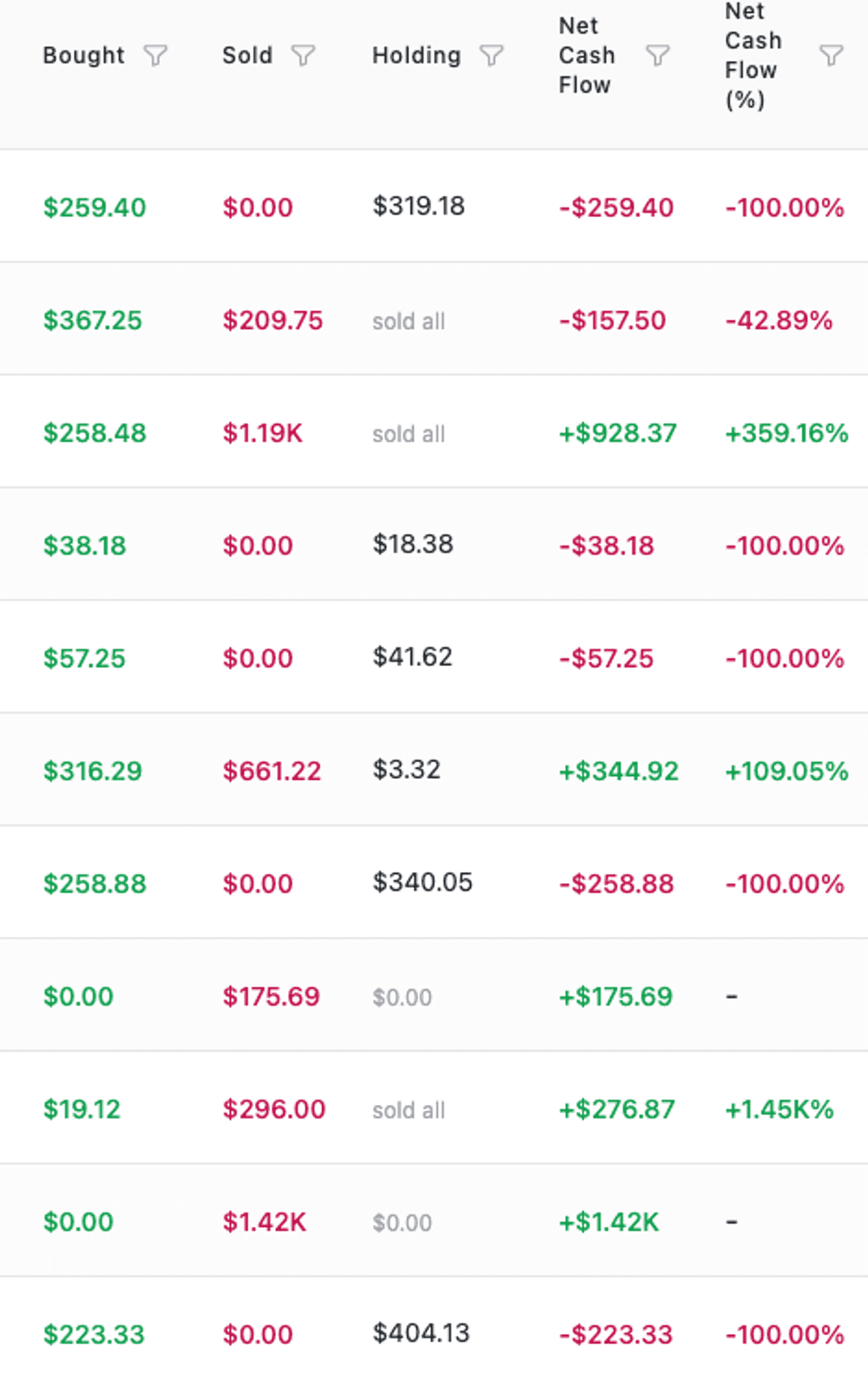
This production capture from July 26, 2026 shows why profitability cannot be read from one column. Bought, sold, holding, and net cash flow describe different parts of the position.
A negative cash-flow figure on an open buy is not automatically a realized loss. Cash has left the wallet while unsold inventory may still have value. Conversely, positive sale proceeds do not prove total profit when the original basis or transferred-in inventory is incomplete.
Use the Solana KOL tracker guide to interpret attributed-wallet rows, then verify the address and transaction history independently.
Stronger and weaker profitability evidence
Add an evidence-age ledger to every headline
A profitability result can be internally consistent and still be too old for the decision at hand. Keep a separate timestamp for each material input rather than assigning one generic “updated” time to the wallet.
| Input | Timestamp to preserve | What can go stale |
|---|---|---|
| Transactions | Newest verified signature and review cutoff | Later buys, sells, transfers, and fees |
| Controlled inventory | Balance checkpoint or slot | Current quantity and account ownership |
| Reference price | Price observation time | Marked unrealized value |
| Exit quote | Quote time, input size, and route | Executable value, impact, and route availability |
| Wallet relationship | Last graph review | Actor-level basis and combined exposure |
The wallet-level result is current only to the oldest material input needed for that claim. A fresh price does not refresh an inventory checkpoint, and a fresh balance does not repair an old or incomplete transaction ledger.
Use three labels:
- Current: every material input falls inside the decision window.
- Historical: the ledger is reproducible, but at least one required input is older than the decision window.
- Unresolved: a required timestamp, source, or reconciliation step is missing.
Stronger evidence
- The review includes every token position in a fixed period.
- Buy, sell, transfer, and fee coverage is complete.
- Open inventory has a timestamped, liquidity-aware value.
- The cost-basis method is stated and consistent.
- ROI, win rate, median return, and drawdown are shown together.
- Results repeat across enough mature positions.
Weaker evidence
- Only winning tokens appear in the sample.
- Transfers are treated as zero-cost receipts or sales.
- Unrealized bags are excluded while unrealized winners are included.
- One extreme winner drives nearly all PnL.
- Win rate has no denominator or review period.
- Thin-token spot prices are treated as executable exit value.
Match the claim to the evidence coverage
Use the narrowest claim the ledger can support:
| Evidence state | Safe output | Unsafe output |
|---|---|---|
| Complete basis, disposals, fees, and no open inventory | Covered realized PnL for the stated sample | Lifetime wallet profit |
| Complete covered ledger plus priced open inventory | Realized PnL plus marked or executable unrealized estimate | Guaranteed total PnL |
| Sale proceeds known, acquisition basis unresolved | Observed proceeds and unresolved basis | Realized profit |
| Current quantity known, price or route unavailable | Controlled quantity with unvalued exposure | Zero value or exact loss |
| Selected positions only | Results for the selected sample | Wallet win rate |
Record a coverage count beside the headline, such as “27 of 31 mature positions have complete basis.” The count does not repair the other four positions, but it stops readers from mistaking a bounded estimate for complete history.
Separate trading edge from inventory windfalls
A wallet can be economically profitable without demonstrating a repeatable trading strategy. Airdrops, vesting receipts, treasury distributions, referral rewards, and transfers from related wallets can create value without a market entry.
Tag every acquisition as one of these states:
- Market entry: the wallet exchanged a covered quote asset for the token.
- Carried basis: the lot arrived from an evidence-backed related wallet.
- External receipt: the lot came from an airdrop, vesting, reward, or distribution.
- Unresolved receipt: the economic source or basis is unknown.
Show external receipts separately from trade-selection PnL. They can belong in an actor's total economic result, but they should not increase the win-rate numerator for market entries.
Also check for self-directed volume. Swaps between related wallets, circular transfers, or repeated activity through the same controlled cluster can inflate volume and trade count without proving independent profitable exits.
How to judge whether the edge repeats
Total profit alone does not show a repeatable process. Compare:
- median return per mature position
- average winner and average loser
- largest win as a share of total PnL
- maximum covered drawdown
- holding period
- entry liquidity and market cap
- profit after realistic fees and slippage
- performance before and after public attention
Then classify the behavior. An early-launch trader, patient accumulator, momentum trader, and liquidity operator should not be benchmarked as if they use the same strategy.
Publish a reproducible wallet snapshot
A profitability headline should be reproducible from a dated evidence snapshot. Keep the source ledger immutable, then attach revisions instead of silently replacing earlier classifications.
The snapshot should include:
- full wallet and mint addresses
- review-window start and end times
- included signatures and confirmation states
- raw token and quote-asset changes
- transfer ownership and basis decisions
- cost-basis method and covered fees
- remaining quantity, balance slot, and protocol positions
- marked price and executable-quote timestamps
- covered, partial, open, and unresolved position counts
Hash or otherwise version the exported ledger when several analysts review it. If a late transfer or corrected decimal changes the result, preserve both versions and explain which input changed. This makes a revised PnL an auditable correction rather than an unexplained dashboard swing.
For repeated accumulation, compare wallet performance with whale accumulation patterns. For launch entries, inspect the first buyers of the Solana token.
Common false positives
Transferred-in winners: Tokens arrive after an earlier address bought them, making the visible wallet's basis look artificially low.
Transferred-out losers: Bad positions leave the address and disappear from a naive current-holdings review.
Airdrops and distributions: Zero purchase cost does not mean the token has no economic or vesting context.
Illiquid marks: A displayed spot price cannot support the wallet's full exit.
Corrupt decimals or supply: A normalization error can inflate token value by orders of magnitude.
Open-position exclusion: Counting closed winners while ignoring open losses overstates both PnL and win rate.
Related-wallet fragmentation: One actor spreads trades across addresses, so one wallet shows sales while another holds the basis.
Survivorship bias: Analysts notice wallets after an exceptional result and ignore the larger population that used the same approach and failed.
Use Stalkchain for the research loop
Use the Solana wallet tracker guide to organize the investigation. It explains the workflow but is not a live address-input calculator. Use Transactions to discover activity and the KOL Feed when a public trader is attributed to the address, then reconstruct the address in a compatible Solana explorer.
Use Fresh Wallets Feed to investigate recently activated addresses and Insider Scan to inspect token concentration. These surfaces shorten discovery. They do not replace transaction-level basis reconstruction.
Final checklist
- Confirm the full Solana address.
- Fix the review period before selecting positions.
- Include wins, losses, open positions, and unresolved positions.
- Reconstruct buys, sells, transfers, and fees.
- State the cost-basis method.
- Separate realized and unrealized PnL.
- Use liquidity-aware prices for remaining inventory.
- Reconcile remaining raw quantity across token and protocol accounts.
- Keep exact-mint PnL separate before adding any canonical-asset rollup.
- Show marked value separately from a fresh executable exit quote.
- Show the ROI denominator and win-rate sample size.
- Separate market-entry results from airdrops, rewards, distributions, and unresolved receipts.
- Check whether one winner dominates the result.
- Trace related wallets before judging the actor.
- Verify important signatures on-chain.
- Publish the transaction, inventory, price, quote, and relationship timestamps separately.
FAQ
Can you see a Solana wallet's exact PnL?
Sometimes the covered on-chain history supports a strong estimate. Exact PnL is not defensible when basis, transfers, fees, off-chain activity, historical prices, or remaining inventory are incomplete.
What is a good Solana wallet win rate?
There is no universal threshold. Compare win rate with sample size, median return, average win versus loss, drawdown, liquidity, and total PnL. A lower win rate can be profitable when winners are much larger than losses.
Is realized PnL more reliable than unrealized PnL?
It usually depends less on current pricing, but it still requires complete acquisition basis, sale proceeds, transfer treatment, and fees. Realized does not automatically mean exact.
Do wallet transfers count as profit?
No. A transfer is a movement of assets. Trace its source or destination and establish ownership and basis before treating it as income, a purchase, or a disposal.
Can I combine PnL for wrapped or bridged versions of the same asset?
Only after calculating each exact mint separately. Aggregate them in a secondary canonical-asset view when the mapping is supported, and carry basis between variants only when the conversion or redemption path reconciles. Never apply one variant's price or liquidity to another by assumption.
Can I copy a profitable Solana wallet?
You can monitor public activity, but your execution will differ. Detection delay, price impact, liquidity, position size, related wallets, and partial exits can make a profitable source trade unprofitable for followers.
Which metric matters most?
No single metric is enough. Total PnL, ROI, win rate, median return, drawdown, sample size, and liquidity reveal different parts of the wallet's performance.