Quick answer
A good Solana holder distribution has no non-infrastructure actor able to overwhelm liquidity and concentration that improves as the token matures. There is no universal safe percentage. Exclude pools, burns, programs, lockers, and custody, then group linked wallets and test their combined exit.
What holder distribution means
Holder distribution describes how a token's supply is spread across token accounts and the wallets or programs that control them. The raw holder count is only the starting point.
One person can control many wallets. One program can custody tokens for many users. A pool vault can appear beside ordinary holders even though its balance supports trading rather than discretionary selling.
The useful question is not, "How many addresses hold this token?" It is, "How much liquid supply can each independent actor control, and what could happen if the largest actors sell?"
Why there is no universal safe percentage
A fixed rule such as "the top 10 must hold less than 20%" ignores the token's age, circulating supply, liquidity, vesting, and account types.
A five-minute-old launch may naturally have few buyers. A mature token with broad usage should usually have a more distributed liquid float. The same concentration percentage can therefore mean normal price discovery in one token and persistent control in another.
Judge distribution with five dimensions:
- Adjusted concentration: supply held by the largest non-infrastructure actors.
- Independence: whether top addresses have different funders and behavior.
- Trajectory: whether concentration is rising, falling, or moving sideways.
- Liquidity: whether large balances can exit without crushing the pool.
- Control: whether the deployer, team, or connected wallets retain special influence.
Step 1: verify the mint and supply basis
Use the full mint address, not a ticker. Duplicate symbols and copycat tokens make symbol-level research unreliable.
Record total supply, decimals, circulating assumptions, and the checkpoint time. If a dashboard reports percentages against total minted supply while you reason about circulating float, your conclusion may be wrong even when the arithmetic is correct.
Do not subtract locked or unavailable supply without verifying the controlling account and unlock conditions. A marketing page calling tokens "locked" is not on-chain proof.
Keep canonical assets separate from mint-level distribution
One economic asset can have native, wrapped, bridged, stablecoin, liquid-staking, or tokenized-equity variants. Canonical grouping is useful when summarizing a wallet's exposure, but holder distribution must be calculated for the exact mint and pool under review.
The Solana Foundation's Tokens API documentation distinguishes canonical asset groups from chain-specific mint variants. Use that mapping to catch lookalikes and understand relationships between known variants.
Do not add holder counts or top-holder percentages across those mints as if they shared one supply ledger.
For every distribution snapshot, save:
- exact mint and token program
- decimals and total-supply source
- canonical asset ID or unresolved singleton reference
- variant type when known
- pool and quote mint
- block or checkpoint time
If a mint resolves to a known canonical asset, that says what it is grouped with. It does not certify that its current liquidity, custody, authorities, or holder distribution are healthy.
Step 2: remove infrastructure from the holder list
Classify the largest accounts before calculating concentration. Common exclusions or separate categories include:
- liquidity-pool vaults and LP accounts
- burn or provably inaccessible addresses
- token and program-owned accounts
- vesting or locker contracts
- bridge and wrapped-asset infrastructure
- known centralized-exchange custody
- staking or protocol treasury accounts
Exclusion does not mean ignoring risk. An LP vault affects exit depth. A locker affects future supply. An exchange wallet can represent many users whose balances cannot be separated on-chain.
Report the raw top-holder share and the adjusted non-infrastructure share. Keeping both prevents a clean-looking adjusted number from hiding a dominant pool or unlock risk.
Calculate three concentration views
Do not compress the holder table into one top-10 percentage. Keep three views side by side:
- Raw address concentration: the share held by the largest token accounts before classification.
- Adjusted actor concentration: the share held by independent non-infrastructure actors after supported wallet grouping.
- Exit overhang: the quote output and price impact if the largest actor or linked cluster sells against current routes.
Use the same supply denominator for the first two views and state whether it is total minted supply or verified circulating supply. If circulating supply is uncertain, show both rather than choosing the result that looks safer.
The third view is not a percentage-of-supply statistic. It is an execution test. A 2% actor can be the dominant risk when the liquid pool is small, while a larger holder in a deep market may have a manageable staged exit.
Add a denominator-confidence grade
A concentration percentage is only as reliable as its supply denominator. Grade the denominator before comparing tokens or checkpoints:
- Verified: mint supply, decimals, excluded accounts, and circulating adjustments are reproducible at a saved checkpoint.
- Partial: total supply is verified, but one material lock, vesting account, burn claim, or custody label is unresolved.
- Unknown: decimals, supply, or major account classifications conflict across sources.
Do not rank a partial 18% adjusted concentration as safer than a verified 22%. Preserve the raw balances and show a range when an unresolved account could materially change the result.
For example, if the top actors hold 18% after excluding a claimed 12% locker, report both cases until the lock is verified. The adjusted result is 18% if the exclusion is valid and 30% if the account remains discretionary. That range is more honest than choosing one headline number.
Reconcile the snapshot before calculating percentages
Holder tables can mix cached account rows, a newer supply value, and labels observed at another time. Build one checkpoint that can be reproduced before comparing concentration.
- Record the mint, token program, slot or block time, and supply at that checkpoint.
- Sum raw token-account balances in base units before applying decimals.
- Preserve zero-balance, closed-account, delegated, frozen, and program-owned classifications separately.
- Compare the covered account total with the chosen supply denominator.
- Record the uncovered amount and the reason, such as pagination, provider caps, or an unresolved account class.
Do not silently scale a partial holder table to 100%. If only part of supply is covered, show concentration against both covered balances and the verified denominator. Label the first as sample concentration, not token-wide ownership.
Step 3: group linked wallets into actors
Wallet splitting is the main reason raw holder counts overstate decentralization. Trace funding and compare behavior among the largest addresses.
Stronger relationship evidence includes:
- direct transfers between the wallets
- one parent funding several fresh addresses
- matching funding amounts through fresh intermediaries
- synchronized buys and sells
- identical position sizes and transaction cadence
- repeated overlap across related launches
Shared funding from a major exchange is weak evidence by itself. Thousands of unrelated users can withdraw from the same hot wallet.
Aggregate token accounts by owner before clustering wallets
A Solana holder row may identify a token account rather than the wallet that controls it. Solana's official token documentation explains that one wallet can own multiple token accounts for the same mint.
The token account's owner field identifies the authority that can transfer its balance. This is different from the account's program owner.
Normalize the holder export in two passes:
- Sum every token account for the exact mint by its controlling owner.
- Only then test whether several owner wallets belong to one estimated actor.
Do not count an associated token account, another token account for the same owner, and a verified protocol position as three independent holders.
Also preserve delegated amounts, frozen state, close authority, and unresolved program custody. Those fields can change who can move the balance and whether the owner-level total is directly executable.
The fresh-wallet guide explains how to distinguish shared infrastructure from a plausible coordinated cluster. The Solana funding-source workflow shows how to preserve each transfer hop and stop at exchange or protocol boundaries. The first-buyer workflow adds launch-order evidence.
Example: raw holders versus independent actors
Consider this representative, anonymized holder snapshot:
- 1,840 token accounts hold a nonzero balance.
- The raw top 10 addresses control 31% of total supply.
- Two addresses are pool or program accounts holding 12%.
- Four top wallets received funding from one fresh parent and hold 9% combined.
- Three unrelated established wallets hold 6% combined.
- One address holds the remaining 4% and has incomplete attribution.
The raw headline is "top 10 control 31%." After classification, the more useful read is one 9% coordinated cluster, three independent holders totaling 6%, one unresolved 4% holder, and 12% in infrastructure.
That is still a concentrated profile. It is not accurate to say one wallet owns 31%, nor is it safe to dismiss the 12% infrastructure balance without checking pool and program controls.
Step 4: measure distribution over time
A single holder table is a snapshot. Healthy distribution is usually a process.
Capture the same adjusted metrics at consistent checkpoints, such as launch, 24 hours, seven days, and 30 days. Then ask:
- Is the largest actor's share falling as independent buyers arrive?
- Are new holders retaining exposure or flipping immediately?
- Are insiders distributing faster than liquidity grows?
- Did supply move to new addresses without changing actor control?
- Are large balances entering exchanges, pools, or lockers?
Rising holder count is weak when the top actor keeps the same control or one wallet seeds many dust accounts. Falling concentration is also not automatically healthy if it comes from insiders selling into thin liquidity.
Example: interpret a four-checkpoint distribution ledger
Consider this representative series after infrastructure is classified and linked wallets are grouped:
| Checkpoint | Holders | Largest actor | Top five actors | Quote liquidity |
|---|---|---|---|---|
| Launch + 1 hour | 146 | 12.0% | 31.0% | $82,000 |
| 24 hours | 620 | 10.8% | 27.5% | $140,000 |
| 7 days | 1,480 | 9.9% | 24.0% | $225,000 |
| 30 days | 2,030 | 9.7% | 23.8% | $118,000 |
The first week shows improving breadth: actor concentration falls while holder count and quote liquidity rise. The 30-day snapshot is mixed. Holder count increases and concentration barely changes, but quote liquidity nearly halves.
The later distribution is not automatically safer. The largest actors now represent a larger practical exit overhang relative to the pool, even though their supply percentages did not increase. Re-run sell quotes before describing the trajectory as healthy.
Separate redistribution from genuine holder growth
Holder count can rise while economic ownership barely changes. Reconcile each checkpoint into four buckets:
- balances transferred between already linked wallets
- dust or airdrop recipients below a stated materiality threshold
- genuinely new funded buyers with independent transaction history
- custody or program accounts whose underlying users are not visible
Only the third bucket directly supports broader independent ownership. The others may change the address count without reducing actor concentration.
Track retained new buyers as well as gross new holders. A wallet that receives or buys tokens and exits before the next checkpoint increased the temporary holder count, but did not widen the persistent holder base.
Use a cohort bridge between checkpoints
Explain why concentration changed by reconciling the largest actor set from one checkpoint to the next. For each material actor, separate swaps, direct transfers, protocol deposits, withdrawals, burns, mints, and unresolved balance changes.
The bridge should answer three questions:
- Did an existing actor reduce economic exposure, or only move tokens to another controlled address?
- Did a new independent buyer acquire supply, or did a custodian or protocol aggregate balances?
- Did the denominator change through minting, burning, rebasing, or a corrected supply classification?
A falling largest-wallet percentage is not genuine distribution when the tokens reappear in linked wallets. Conversely, a wallet balance can fall while economic exposure remains inside a verified LP or vault position. Keep raw address movement and estimated actor movement as separate series.
Keep a revision ledger when labels change
Actor grouping is an estimate that should improve as new transfers, funding hops, or custody evidence appears. Do not overwrite the old concentration result without showing what changed.
For each revision, record:
- the original account or actor classification
- the new transaction or ownership evidence
- whether addresses were merged, split, excluded, or restored
- the affected raw balance and supply share
- the old and revised concentration figures
- the checkpoint from which the new classification is valid
For example, two wallets may initially look independent and later return funds to one parent. Revise the actor view from the first checkpoint where the relationship is supported. Do not silently rewrite earlier observations as though the link was known at the time.
This makes distribution claims auditable and prevents a changing label system from looking like genuine decentralization or concentration.
Reconcile the first-slot cohort with current ownership
Launch concentration can disappear at the address level while remaining at the actor level. Build a bridge from every material first-slot buyer to the current checkpoint:
- original acquired quantity
- covered additions and disposals
- direct transfers and unresolved destinations
- balances in supported sibling wallets
- LP, vault, escrow, or custody movements
- current actor-adjusted quantity and supply share
Then compare three values: the first-slot cohort's raw current share, its supported actor-adjusted share, and a clearly labelled stress-case share for plausible but unproven links.
This prevents two opposite mistakes. An empty sniper address does not prove the actor exited, and a current top holder does not prove it retained the whole launch lot.
The Solana token sniper guide explains how to define the launch boundary, separate same-slot buyers from possible bundles, and follow fast wallets through later sales and transfers.
Step 5: compare concentration with exit depth
Supply percentage and pool liquidity must be read together. A 3% holder may be harmless in a deep market and catastrophic in a shallow one.
Model at least three exits:
- your intended position
- the largest independent actor's position
- the combined position of a plausible linked cluster
Use current executable liquidity, not market cap, as the constraint. Repeat the estimate under a drawdown assumption because liquidity often disappears when holders most want to sell.
Add an LP-controller scenario to the model. A concentrated holder is more dangerous when the same actor, or a linked actor, can also remove quote liquidity before selling. Record the relevant LP position and compare fresh quotes before and after any material withdrawal.
Use the Solana liquidity-removal workflow to verify the controlling position, destination accounts, replacement pools, and remaining route-level depth. This separates a genuine migration from an event that leaves holders competing for a much smaller exit.
Healthier and riskier holder patterns
Healthier pattern
- No single non-infrastructure actor dominates liquid supply.
- Top wallets have varied funding sources, ages, and trade histories.
- Concentration declines as genuine activity grows.
- Early buyers and insiders do not continuously sell into new holders.
- Pool depth grows with holder count and position size.
- Large transfers have explainable destinations and transaction evidence.
Riskier pattern
- Many top wallets trace to one parent or fresh intermediary chain.
- Similar balances create the appearance of broad ownership.
- Holder count rises through dust accounts while actor control stays flat.
- Team or first-buyer wallets distribute into later demand.
- The top cluster can overwhelm the pool with a modest sale.
- Unverified lockers, custody accounts, or unlabeled programs dominate supply.
Use Stalkchain as the investigation layer
Start with Insider Scan to surface tokens with insider-wallet activity and investigate concentration signals. Its public route is a beta ranking interface; an empty ranking state is possible and should not be treated as proof that a token has no insiders.
The route returned an empty public ranking during the September 26, 2026 verification pass. That is product proof for the interface and its empty state, not current evidence about any token.
Bring the mint-specific holder and transaction evidence into the workflow rather than treating absence from a ranking as a clean result.
For token-level research, Stalkchain's Solana interface includes holder overview, distribution classes, KOL holders, and top-holder analysis behind a free-account login boundary.
The distribution classes separate whales, dolphins, shrimps, CEX wallets, KOLs, and programs. These labels organize the review; they do not replace wallet attribution or transaction verification.
Use the Fresh Wallets Feed to investigate funding age, visible funders, buy or sell direction, and transaction links when a top or early holder appears newly activated.
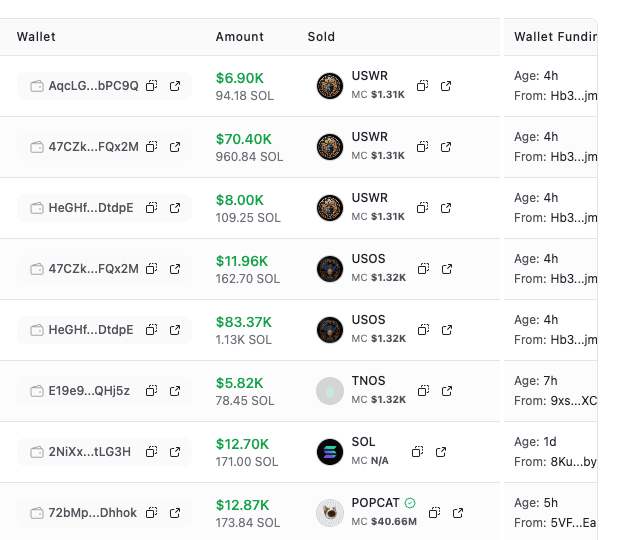
The production example above shows why address counts need actor-level review. Several rows can represent fewer independent wallets, and several wallets can still represent one funder. Verify full addresses and signatures before collapsing them into a cluster.
For a complete token review, combine holder work with the 10-step Solana due-diligence checklist, wallet profitability analysis, and whale accumulation framework.
False positives to avoid
A pool vault is not an ordinary whale. It supports liquidity, but its ownership and withdrawal rights still matter.
An exchange wallet is not one trader. Custodied users share the address, and their individual balances are unavailable on-chain.
Many wallets do not guarantee many owners. Funding and behavior can reveal one actor split across addresses.
A transfer is not necessarily a sale. It may be custody migration, staking, liquidity provision, or movement between linked wallets.
A lower top-10 share is not automatically improvement. Insiders can distribute into weak demand, or seed many small accounts without giving up control.
A holder label is not identity proof. Classification errors and incomplete attribution are normal. Preserve unresolved accounts in the analysis.
Final checklist
- Confirm the mint, decimals, supply basis, and checkpoint time.
- Keep canonical grouping separate from mint-level holder calculations.
- Separate infrastructure from discretionary holders.
- Report raw and adjusted concentration.
- Trace funding among the largest wallets.
- Collapse strongly linked addresses into estimated actors.
- Compare launch, current, and later checkpoints.
- Preserve classification revisions and their effect on concentration.
- Check what early buyers and insiders did after entry.
- Model exits against current and stressed liquidity.
- Verify large transfers before calling them buys or sells.
- Record unresolved custody, programs, pricing, and attribution.
FAQ
What is a good top-10 holder percentage on Solana?
There is no universal safe percentage. Remove or separately classify pools, burns, programs, lockers, and custody accounts, then group linked wallets. Compare the resulting actor concentration with token age and executable liquidity.
Should liquidity pools count as holders?
They should appear in the raw ledger but not be treated like ordinary discretionary wallets. Analyze the pool balance, LP ownership, withdrawal rights, and exit depth separately.
Should I combine holders across wrapped or bridged variants?
No. Group variants only when describing broader economic exposure. Calculate holder concentration, supply control, pool depth, and exit risk for each exact mint. A well-distributed canonical asset can still have a thin or concentrated variant.
Does a high holder count mean a token is decentralized?
No. Dust accounts, airdrops, wallet splitting, and custodial addresses can distort the count. Independent economic actors and their supply control matter more.
How often should holder distribution be checked?
New launches may require checkpoints within hours. Mature tokens can be reviewed daily or weekly. Use consistent intervals so balance changes are comparable.
Can holder distribution predict price?
No. It describes supply control and potential selling pressure. Price also depends on demand, liquidity, execution, market conditions, and holder behavior.
What is the biggest holder-distribution red flag?
A linked cluster controlling enough liquid supply to overwhelm the pool is a strong risk signal, especially when those wallets entered early and are selling into later buyers. Describe the evidence without claiming real-world identity as fact.