What good is a blockchain data API that covers every chain you need if it can't tell you whether a wallet label is reliable or a failed request looks like a successful one?
Getting ledger records is only part of the job. For dashboards, trading research and AI agents, you also need answers you can reproduce, errors you can classify and costs you can control. Choose a provider by the questions it can answer faithfully, not just the networks on its coverage page.
Table of Contents
- Blockchain Data API Types Compared
- Common Endpoints and the Data They Return
- Supported Chains and Their Data Models
- Connect, Handle Errors and Paginate Safely
- Cross-Chain Wallet Identity and Attribution
- Example Use Cases for Builders and Agents
- Quick Reference Questions for Any Provider
Blockchain Data API Types Compared
Start with a simple test: Do you need current state, historical analysis or live events? A balance check, a historical fund-flow investigation and a trade alert may concern the same wallet, but they require different infrastructure.
A blockchain data API provides machine-readable access to ledger information. The important distinction is how much work the provider performs before returning it. A raw node exposes chain-native methods; an indexed service organizes records so you can search, aggregate and retrieve history without building that infrastructure yourself.
Blockchain data API types and what each does best
| API type | What it returns | Historical queries | Best for |
|---|---|---|---|
| Raw node RPC | Individual blocks, transactions and current state | Limited, requires scanning the ledger | Validating chain state |
| Indexed data API | Decoded transfers, balances, pagination and pricing | Strong, pre-processed | Dashboards, compliance and portfolio tools |
| Streaming feed | Live on-chain events as they occur | Usually limited to a recent window | Alerts and live monitoring |
| Analytics API | Holdings, realized and unrealized PnL, trader profiles | Strong when indexed | Leaderboards and trader research |
| AI agent tool endpoint | Tool-callable lookups wrapping the underlying APIs | Inherits the underlying API's historical coverage | Chat-based research and reports |
Bitcoin's January 2009 launch established the foundational ledger structures of blocks, transactions, inputs, outputs and unspent transaction outputs, or UTXOs, described in Bitquery's Bitcoin API documentation. That documentation also illustrates the practical transformation: providers make ledger records queryable rather than requiring each application to reconstruct the indexing layer.
Choose where the computation belongs
A node can retrieve a transaction or validate chain state. Asking for an address's balance at an earlier height, or following funds across several hops, introduces a different workload. Someone must scan, organize and relate the underlying records.
With raw RPC, your team owns more of that work. With an indexed API, you pay the provider to maintain searchable history, pagination and useful joins. An analytics endpoint goes further by calculating derived results, but then its methodology becomes part of your dependency.
A dashboard might read indexed balances. A monitoring bot might subscribe to a feed. An analyst might request realized PnL, while an agent invokes the same capability through a tool interface.
Practical rule: Buy the lowest-level interface that answers your question without forcing you to rebuild the provider's missing infrastructure.
Compare contracts, not interface labels
REST, GraphQL and SQL describe access patterns, not guarantees of completeness or correctness. A friendly interface can still hide missing history or undocumented calculations.
For teams defining ownership of these contracts, Blockchain Jobs' description of an API-focused product manager role in Web3 is a useful companion to the technical evaluation. Someone needs to own developer-facing behavior as deliberately as the underlying ingestion pipeline.
Before choosing, answer the original test explicitly: current state, history or live events. If you need all of them, evaluate each path separately rather than assuming one successful lookup proves the whole service.
Common Endpoints and the Data They Return
The endpoint family determines what question you can answer. A transaction lookup describes execution, a transfer endpoint describes asset movement, and a PnL endpoint applies accounting assumptions to activity. Those aren't interchangeable views.
Use this map to identify the smallest useful request.
Common endpoint families and their data
| Endpoint family | Typical request input | Returns | Typical use |
|---|---|---|---|
| Balances | Wallet address and chain | Native and token balances | Portfolio checks |
| Transactions | Address and block or time range | Transactions with status and fees | Wallet history |
| Token transfers | Token contract and time range | Transfers with decimals and USD value where priced | Token flow tracking |
| Contract events | Contract address and event topic | Decoded event logs | Application activity |
| Blocks | Block height or slot | Block header and included transactions | Chain monitoring |
| Prices | Token mint or contract address | Price, daily change and pool liquidity where supported | Valuation |
| Wallet holdings and PnL | Public wallet address | Open positions, realized and unrealized PnL | Trader research |
| Alerts and live feed | Chain, type, minimum USD value, trader or token | Newest matching trades | Monitoring |
Ethereum interactions expand the data surface beyond simple payments: a single application interaction can produce a transaction, internal calls and multiple event logs, each requiring decoding and normalization before analysis. Reading only the top-level transaction can therefore miss the activity your product cares about.
Batch behavior matters as much as field shape. A price endpoint that accepts up to 50 Solana mints in one call, returning current USD price, 24h change and pool liquidity per mint, changes your polling budget compared with one-mint-per-request designs. An alerts endpoint capped at the newest 100 matching items per request tells you that backfills need a different path than the live feed.
Translate the question into request fields
Suppose you want transfers of a particular token during a reporting window. An illustrative request shape, not a provider-specific method, is:
{"chain":"ethereum","token_contract":"<contract_address>","from_time":"<inclusive_start>","to_time":"<exclusive_end>","cursor":null}
A useful response item would contain:
{"transaction_hash":"<hash>","from":"<sender>","to":"<recipient>","raw_amount":"<integer_string>","decimals":"<integer>","timestamp":"<chain_time>","usd_value":null}
Keep the raw amount alongside decimals. Don't convert large token quantities through floating-point arithmetic, and don't turn an unavailable USD valuation into zero. Missing price and zero value mean different things.
For an alert, the request changes because you're asking for new activity rather than a historical export:
{"chain":"solana","type":"buy","minimum_usd_value":"<threshold>","token_address":"<mint>","since":"<checkpoint>"}
The expected output should identify the matching trade, its chain, wallet, token, timestamp and valuation basis. These examples show field intent only; use the actual names and types in the StalkChain REST API reference.
Inspect meaning as well as JSON
Fetchin's JSON data API guide is useful background when implementing request and response handling. For blockchain work, extend that structural inspection to units, nullability and record identity.
A field called amount isn't enough. You need to know whether it's raw or decimal-adjusted, whether fees are included and whether its price represents execution time or the latest quote. Treat these questions as part of the provider's error contract: how does the API behave when a price is unavailable, when a wallet attribution is uncertain, when a result is cached? A provider that states cache windows and marks data stale only when its upstream source fails to answer gives you something you can monitor. A provider that serves old values leaves you guessing.
Attribution deserves the same scrutiny. A wallet label tells you what an address did, not who controls it or why they traded. When a response assigns activity to a known trader, ask what evidence backs that link and how confident it is, because your downstream logic will inherit that confidence.
Likewise, an open position isn't realized trade history. A holdings endpoint answers what remains; a realized-PnL endpoint answers what was closed under a stated accounting method.
Start with the question, then choose the endpoint that returns the required field with the fewest transformations. Every extra reconstruction step is another place your application can disagree with the provider.
Supported Chains and Their Data Models
A shared response schema doesn't make every blockchain behave alike. The chain's data model limits what a query can mean, especially when you combine balances, application activity and trading positions.
Bitcoin uses unspent outputs, so a balance represents a sum over relevant UTXOs. EVM chains use accounts, contract state and logs. Solana uses accounts with slot-based ordering, while a perpetuals feed exposes trading concepts that don't map neatly onto a simple token-transfer table.
Our coverage includes the chains below, but endpoint-level fields still need validation before you build a multi-chain feature.
Chains, data models and the data readers use most
| Chain | Data model | Commonly needed data | Coverage |
|---|---|---|---|
| Bitcoin | UTXO | Inputs, outputs and UTXO set | Reference model, not in StalkChain list |
| Ethereum | Account with EVM logs | ERC-20 transfers, contract events, internal calls | Covered |
| Solana | Account, slot-based | Token mints, transfers, DCA orders | Covered |
| Base | EVM-compatible account | EVM logs and token transfers | Covered |
| BNB Chain | EVM-compatible account | EVM logs and token transfers | Covered |
| Monad | EVM-compatible account | EVM logs and token transfers | Covered |
| Hyperliquid | Perpetuals trade feed | Perpetual trades and positions | Covered as perps feed |
| Robinhood Chain | Verify chain-native schema per endpoint | Tokenized stock flows and launches | Covered |
The table distinguishes coverage from a promise that every listed field exists in every tool. In particular, treat Robinhood Chain's native schema and the availability of protocol-specific fields as endpoint verification items, not assumptions.
Reuse decoding without erasing differences
EVM compatibility lets you reuse event-signature handling and much of a log decoder across Ethereum, Base, BNB Chain and Monad. It doesn't prove that every application emits the same events or that the provider indexes every contract.
On Solana, identify assets by mint rather than ticker and inspect the instruction-level context needed by your feature. A DCA order is application-specific activity, not merely a differently named transfer. For Hyperliquid, preserve position and trade semantics rather than forcing them into spot-wallet fields.
Keep these distinctions explicit in your internal schema:
- Chain identity: Store the network with every address, asset and transaction reference.
- Native ordering: Preserve block, slot or feed-specific ordering information.
- Asset identity: Use chain plus contract or mint, not a display symbol.
- Source semantics: Retain whether a record represents a transfer, order, fill or position.
Normalize only what you can defend
A common envelope can standardize identifiers, timestamps and provenance. Inside it, chain-native details should remain available for debugging and reconciliation.
Don't populate unsupported fields with plausible substitutes. If an endpoint doesn't expose an equivalent concept, use an explicit unavailable state.
Before implementing multi-chain totals, validate each chain's units, asset identifiers, ordering and position model. A clean table is useful only when its rows remain meaningfully comparable.
Connect, Handle Errors and Paginate Safely
A reliable integration starts with a small, observable request. Don't begin with a broad wallet-history backfill and then discover that authentication, billing or retries behave differently from your assumptions.
The connection path is straightforward; production safety requires additional controls around it.
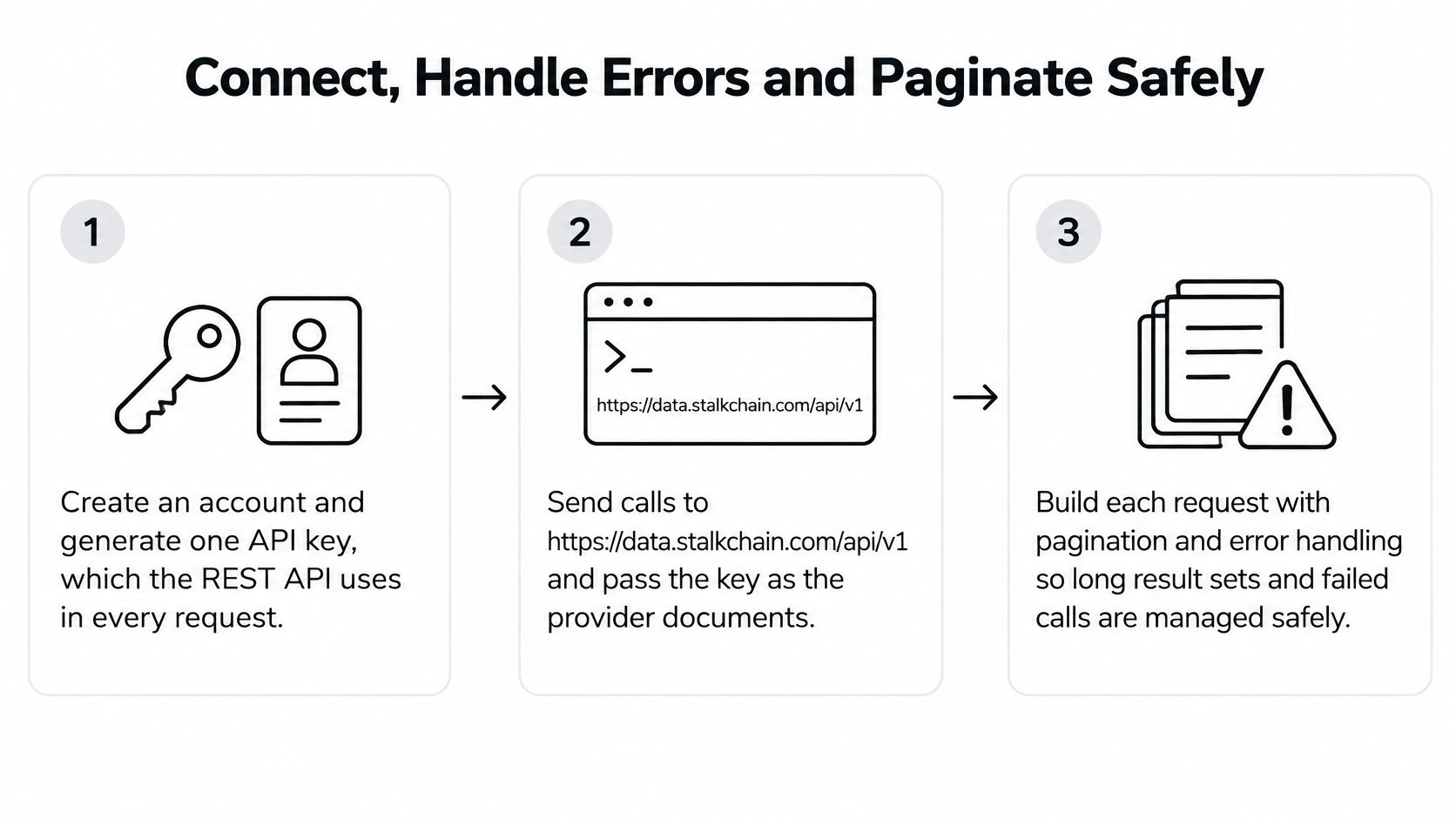
Establish a verified first request
Create credentials securely. Generate an API key and store it in a secret manager or environment variable. Keep it out of source control, notebooks shared publicly and application logs.
Configure the documented base address. Our REST API base is the StalkChain Data API endpoint. Pass the key exactly as the authentication documentation specifies rather than guessing a header name.
Choose a narrowly scoped operation. Use a known public wallet or a bounded token query. Validate required parameters locally before sending the request.
Confirm the response contract. Record the transport status, request identifier, result or error, and usage accounting. Verify actual field names against the schema.
Save evidence safely. Persist the raw response and relevant chain, block or slot, retrieval time and query parameters. Redact credentials before writing any diagnostic record.
You can use plain HTTPS without an MCP client for this connection. Don't assume that a REST transport automatically means JSON-RPC, however: REST and JSON-RPC describe different interface choices. Use the envelope required by the documented operation.
Ethereum's EIP-1474 RPC specification requires JSON-RPC request and response objects for Ethereum RPC methods, with failures represented by an error object containing a numeric code and descriptive message. For those methods, validate jsonrpc, id, method and params.
An illustrative Ethereum RPC request is:
{"jsonrpc":"2.0","id":"balance-check","method":"eth_getBalance","params":["<wallet_address>","latest"]}
A successful response has a corresponding id and result. A method-level failure instead contains error, so your client must inspect the body rather than relying only on the HTTP status.
Separate transport failures from operation failures
An HTTP success is not proof of a successful query. Your response parser should reject malformed envelopes, identify method-level errors and prevent failed reads from entering the application as empty datasets.
An empty holdings list means something very different from an unavailable holdings service. If you collapse both into the same array, your dashboard may report that a wallet sold everything when the query failed.
JSON-RPC and HTTP error codes and the client action each needs
| Code | Meaning | Client action |
|---|---|---|
| HTTP 429 | Rate limit exceeded | Wait for Retry-After, then back off with jitter |
| HTTP 200 with error object | Method-level failure inside a successful transport | Inspect the error object and do not treat the response as success |
Use the error-handling guide to map documented failures into your client's categories. Keep authentication failures, invalid parameters, unavailable resources and transient service failures distinct.
If you add another decision service, such as Akinda's REST API for Islamic compliance checks, give its responses a separate adapter. A blockchain read and a compliance assessment shouldn't inherit each other's status meanings.
Make batches independently recoverable
Batching can reduce connection overhead, but don't treat a batch as an atomic operation. Correlate each response by id, inspect each item and retain successful results when another item fails.
Use identifiers that map back to the requested wallet, chain and operation. Never pair request and response arrays by position. Completion order isn't a safe association rule.
Retry only the failed, retryable items. Repeating the whole batch wastes successful work and can add charges, because connection count and billable method count aren't necessarily the same.
A retry policy should recover missing work, not repeat every piece of work surrounding it.
Apply backpressure before the server rejects you
Solana's rate-limit conventions describe tier-based per-minute quotas, remaining-capacity information and HTTP 429 responses with Retry-After. Treat those signals as scheduling inputs, not merely errors to log.
Use a token-bucket or leaky-bucket scheduler and cap concurrency per endpoint. After a rate-limit response, honor Retry-After, then apply bounded exponential backoff with jitter where further retries are appropriate.
Don't retry deterministic failures such as invalid parameters. Put a deadline and retry budget around transient failures so a degraded provider can't create an endless background workload.
Track both request volume and monetary usage. A client can remain under its rate limit while exceeding its spending budget through expensive queries or repeated pages.
Paginate against a stable boundary
Offset pagination is fragile during live ingestion because new rows can shift later pages. Prefer a documented cursor or deterministic block or slot ranges.
For a backfill, capture the upper boundary before starting. Save the continuation cursor only after the page's records are durably written, ideally in the same transaction as your ingestion checkpoint.
Require enough response context to answer:
- Where did this page end? Preserve the continuation cursor or next range boundary.
- What chain state was queried? Retain the queried height and available finality information.
- Can records repeat? Define a stable deduplication key using native record identity.
- Is the result complete? Distinguish exhausted pagination from interrupted retrieval.
A client request identifier helps trace repeated attempts, but it doesn't create server-side idempotency unless the provider documents that behavior. For read-only ingestion, make your own writes idempotent with unique keys and upserts.
For agent access, follow the supported OAuth setup rather than pasting credentials into prompts. Keep the connector's secrets outside the model-visible conversation and retain the same audit trail you'd require from a scheduled job.
Cross-Chain Wallet Identity and Attribution
The expensive mistake is counting the same trader twice, then building a leaderboard that looks precise. The reverse mistake is equally serious: merging unrelated wallets into one supposed whale because their activity looks similar.
A wallet address is an observable identifier. A trader profile is an attribution claim, and a cross-chain profile combines several claims that may have different levels of support.
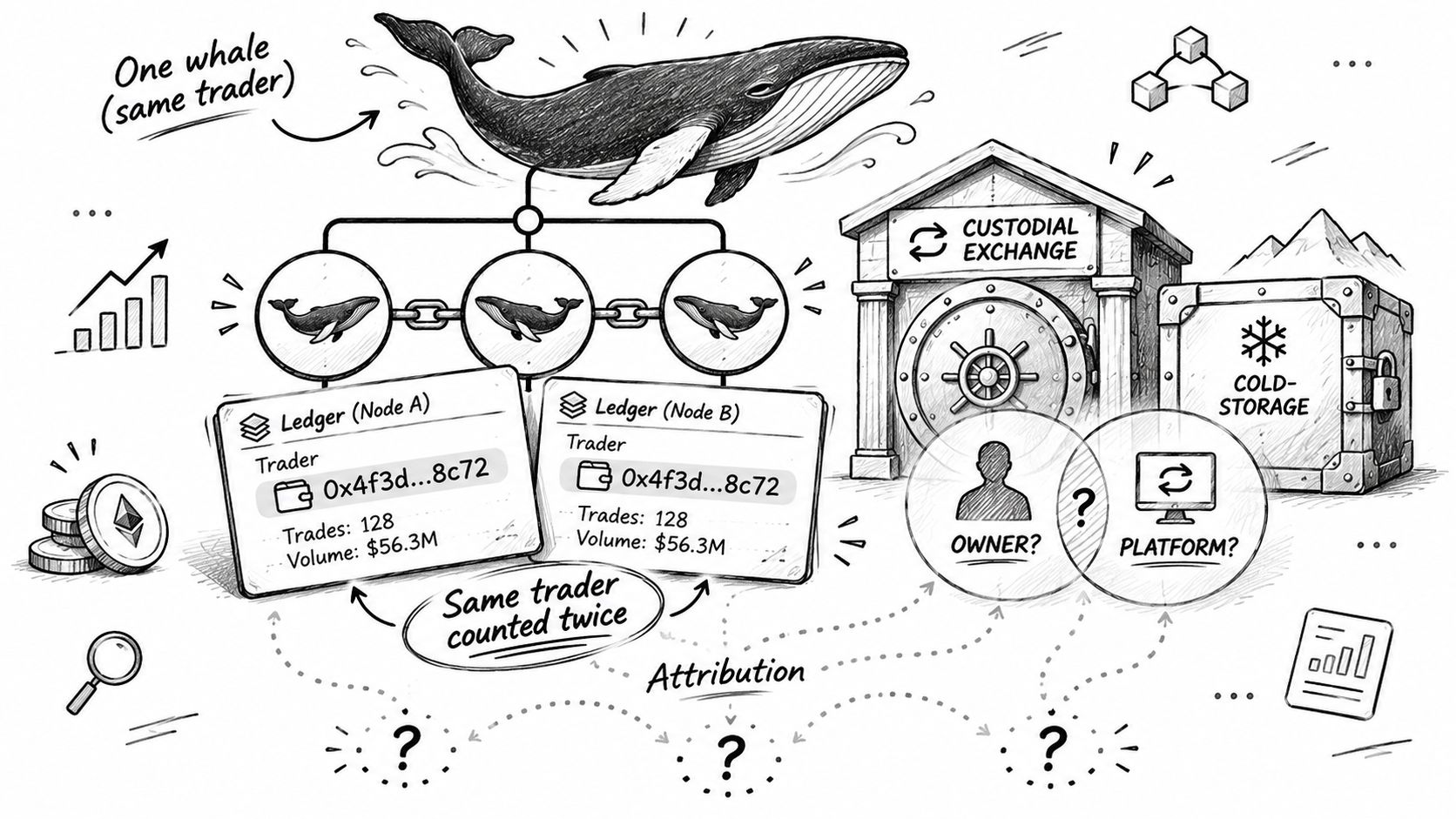
The methodology questions raised in OpenChainBench's crypto data API report provide a useful evaluation framework: entity resolution, attribution confidence, transfer classification and PnL reconciliation must be examined together. Treat those as requirements to test, not as proof that any particular profile is correct.
Keep observed activity separate from inferred identity
Say a trader moves assets between personal wallets, bridges them and later sells. A naive pipeline might classify the outgoing transfer as a disposal, the bridge receipt as a new acquisition and the eventual sale as another independent trade.
That creates incorrect activity counts and potentially misleading PnL. A custodial address introduces a different problem: many users' activity may appear under infrastructure controlled by an exchange or service.
Bridged assets, airdrops and liquidity-provider positions require explicit treatment. Don't assume every inbound transfer establishes a purchase price or every outbound transfer realizes a gain.
Our on-chain activity shows transactions and balances. It doesn't prove who controls a wallet, why someone traded or what happens next.
Require evidence alongside the profile
A useful attribution record should make the following inspectable:
- Entity-resolution rules: Explain which evidence links wallets and which evidence merely suggests a relationship.
- Confidence and provenance: Attach confidence to each association, with its source and observation time.
- Transfer classification: Distinguish internal movement, bridging, airdrops and trades, while preserving unknown classifications.
- Cost-basis method: State the accounting method, fee treatment and handling of missing acquisition history.
- Reconciliation evidence: Make it possible to trace a calculated position or realized result back to native records.
The cross-chain tool documentation is the place to begin matching a proposed feature to the available inputs. Don't infer identity guarantees from the fact that multiple networks appear behind one interface.
Attribution rule: Unknown ownership is a valid result. Hiding that uncertainty is a product decision, not a data improvement.
Test a deliberately difficult sample before publishing rankings. Include a bridged position, an internal transfer, an airdrop and a position with incomplete acquisition history.
Reconcile those cases against explorer records and document unresolved differences. If a provider's confidence score has no stated meaning, treat it as an uncalibrated ranking signal rather than a probability.
For product teams, the display rule is simple: put attribution confidence beside every profile or leaderboard entry, not in a methodology page that users rarely open.
Example Use Cases for Builders and Agents
A portfolio dashboard, alert bot, historical export and research agent can use similar source records while needing different reliability controls. The useful design question is what each workflow must preserve when a call fails or returns incomplete information.
A portfolio dashboard that preserves valuation context
A nightly job reads balances for a configured wallet list, requests prices and writes a dated snapshot. Join by chain plus asset identifier, not ticker, and store the balance observation time separately from the price observation time.
The output is a reproducible portfolio snapshot with explicitly unpriced assets. If the price request fails, retain the balance and mark valuation unavailable rather than overwriting the position with zero.
A whale-alert bot that can catch up
A bot polls matching trade activity on a schedule or consumes a supported feed. Its inputs include chain, tracked wallet, token and minimum USD value; its output is a notification tied to the underlying trade.
Deduplicate by chain, transaction identity and event or trade identity where needed, because a transaction can contain multiple relevant actions. Advance the checkpoint only after processing succeeds, and test whether the retrieval window can cover an outage without dropping activity.
An export that another analyst can reproduce
A compliance or tax-preparation workflow requests historical transfers over a fixed chain range and follows pagination to completion. It writes timestamps, raw quantities, decimals, available historical valuations and source references into an export.
The result supports investigation and reconciliation; it isn't automatically a legal or tax conclusion. Save the query scope, extraction time and accounting assumptions with the file so another analyst can understand its boundaries.
An agent that reports evidence rather than conviction
A user asks which KOLs hold a token and how much. The agent requests holdings, separates observed balances from identity labels and includes the chain and observation time in its answer.
If sources conflict or a label lacks support, the agent should say so. A confident narrative isn't a substitute for a fresh, attributable response.
Builders can call the same data from their own app or agent over REST using one API key, and every response states what it cost. Use that accounting to stop further tool calls when a workflow reaches its budget, while reserving enough capacity for necessary completion or cleanup.
- Freshness gate: Reject or qualify information older than the workflow permits.
- Uncertainty handling: Preserve unavailable fields and conflicting observations.
- Execution boundary: Keep research read-only and require separate approval for funded-wallet actions.
A research agent should produce an evidence-backed observation. Transaction execution requires a different permission model, not merely another tool in the same unrestricted loop.
Quick Reference Questions for Any Provider
Put these questions into your requirements document before committing to an integration. A useful answer includes documentation, a testable example and a clear statement of limitations.
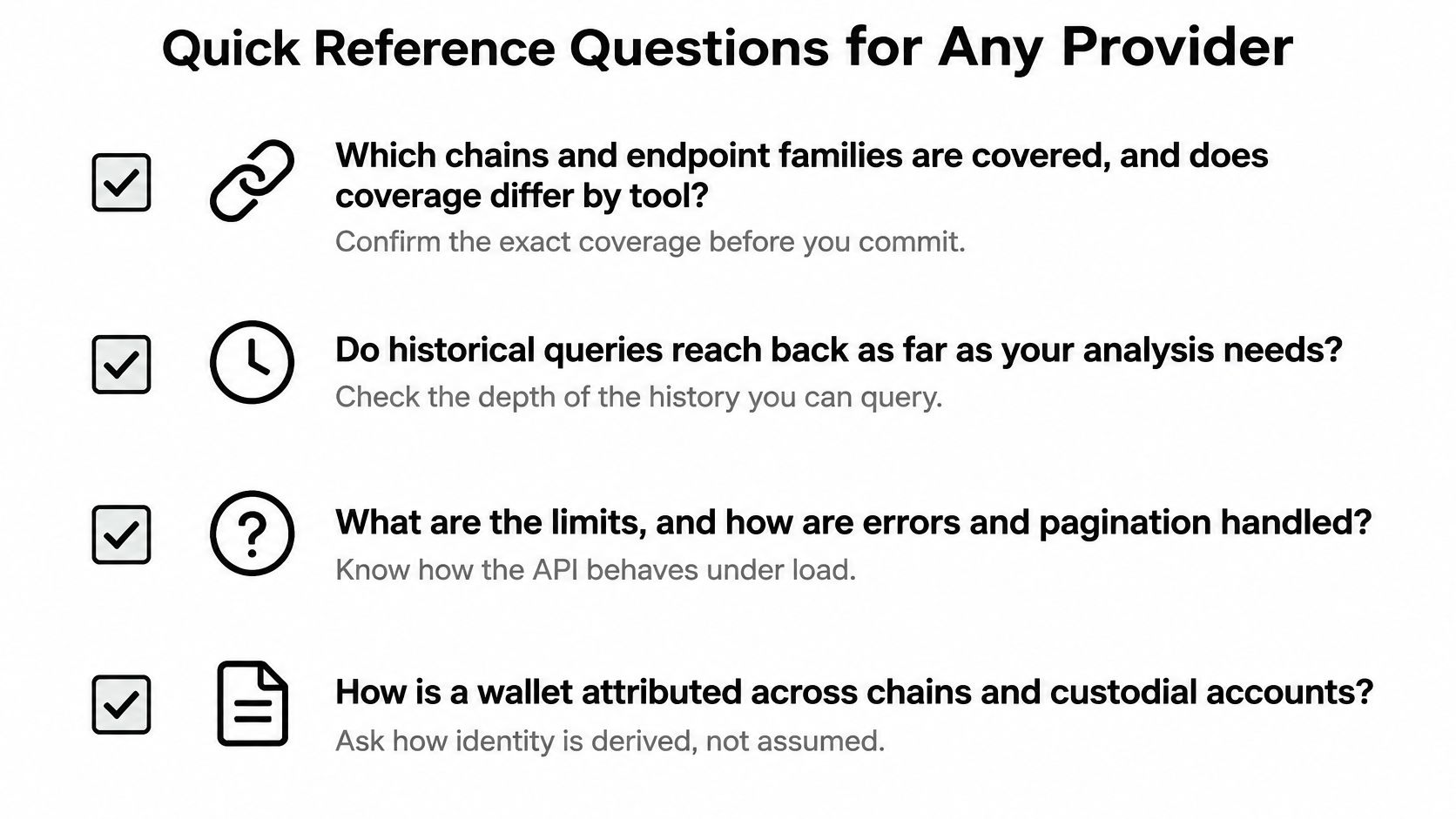
Evaluate documented behavior
- Coverage: Which chains and endpoint families are available? A good answer distinguishes network coverage from tool-specific support.
- Historical depth: Does each dataset reach genesis or a stated starting point? Require explicit gaps and retention boundaries.
- Pagination: Are cursors stable, and can a query use a fixed upper boundary? Look for reproducible traversal, not just a next-page example.
- Rate limits: What quotas apply, and how does
Retry-Afterbehave? Require enough detail to configure your scheduler. - Errors: Can a successful HTTP response contain a failed operation? Obtain the documented error envelope and retry categories.
- Provenance: Does each record expose chain, block or slot, timestamp and finality context? Missing context should be explicit.
- Attribution: How are wallet labels derived, and what does confidence mean? Require evidence rules rather than an unexplained score.
- PnL: Which cost-basis and transfer-classification methods apply? Test difficult positions before trusting rankings.
- Accounting: What does each operation cost, including batches, retries and pagination? Establish how quota expiration or rollover works.
- Auditability: Can you correlate requests, raw responses and derived outputs? Require identifiers that survive your ingestion pipeline.
Score what you can verify
Mark each answer documented, tested or unresolved. Give unresolved requirements an owner before production, particularly when they affect money, identity or historical completeness.
A provider with fewer chains and reproducible answers can be a better engineering choice than one with broad coverage and unstated methods. Select for trustworthy answers under failure, not just attractive results during a demo.
StalkChain offers MCP and REST access to wallet holdings, PnL, token flows and trader activity for applications and AI research workflows. Visit StalkChain to explore the available tools, then test a bounded wallet query against the error, attribution and cost requirements your application needs.