Quick answer
Identify possible Solana token snipers by ordering successful launch swaps from the first tradable transaction. Verify balances, funding, linked buyers, supply control, and exits. Speed alone does not prove insider access, bundle use, ownership, or profit.
What a Solana token sniper is
A token sniper is a trader or automated system designed to acquire a token near the start of trading. The defining observation is execution speed relative to a verifiable launch boundary.
That definition is intentionally narrow. A sniper can be public, independent, and unprofitable. An insider can buy later. A same-slot buyer may have used an ordinary transaction rather than a private bundle.
Keep four claims separate:
- Early: the successful acquisition landed near the first tradable transaction.
- Automated: repeated timing or transaction structure supports bot-like execution.
- Coordinated: several wallets have evidence-backed funding, signing, transfer, or behavior links.
- Privileged: evidence supports access or information unavailable to ordinary participants.
The chain can strongly support the first claim. The other three require additional evidence.
Before you start: define the launch boundary
Sniper analysis fails when “early” has no fixed starting point. Save the exact mint, pool, venue, and first successful transaction that made trading possible.
Choose one comparison rule before checking outcomes:
- first successful tradable slot
- first five completed acquisitions
- first minute after the initial successful swap
- first 25 completed buyers
Record block time, slot, signature, observation time, and every pool included. A token can trade through several pools, migrations, or routes. Looking at only one market can create a false first buyer.
Use the first-buyer workflow when you need the full launch cohort rather than only the fastest wallets.
Step 1: reconstruct successful acquisitions
Start from transaction evidence, not a screener badge. For each candidate, open the complete signature and record:
- success or failure state
- slot and block time
- signer and fee payer
- static and lookup-table accounts
- outer and inner instructions
- pre-transaction and post-transaction token balances
- SOL or quote-asset balance changes
- fees and priority fees
Exclude failed swaps from acquired quantity. Separate account creation, transfers, LP deposits, migrations, and airdrops from open-market buys.
A routed swap can touch several pools and emit several inner movements while remaining one economic acquisition. Deduplicate by complete signature, then reconcile the controlling owner's net token increase.
Resolve the buyer, not only the token account
The account receiving tokens may be an associated token account rather than the owner's main address. Aggregate covered accounts by controlling owner before counting buyers.
Keep recipient account, token owner, signer, and fee payer as separate fields. They can be different addresses.
Step 2: measure execution speed
Measure distance from the launch boundary in slots, successful acquisitions, and elapsed time. Do not rely on a rounded “seconds after launch” label when slot order is available.
| Observation | Safe interpretation | Unsupported leap |
|---|---|---|
| Buyer lands in the first tradable slot | Extremely early execution | Insider access |
| Wallet submits failed attempts before success | Aggressive or automated attempt pattern | Guaranteed bot ownership |
| Several wallets land in one slot | Same-slot cohort | One bundle or one owner |
| Similar priority fees and instructions repeat | Shared tooling becomes plausible | Shared beneficial owner |
| Wallet repeats early entries across launches | Repeat sniper behavior becomes plausible | Future profitability |
A useful sniper classification states the rule. For example: “successful acquisition in the first tradable slot” is reproducible. “Obvious insider bot” is not.
Distinguish same-slot buying from bundle evidence
Jito defines a bundle as a group of transactions submitted to execute sequentially and atomically. Same-slot placement alone does not expose that submission relationship in ordinary transaction history.
Use same-slot cohort for the observable fact. Use possible bundle only when transaction structure, related transfers, tips, or provider-specific evidence supports the hypothesis. Use confirmed bundle only when the submission relationship is actually established.
Step 3: trace funding and wallet age
Open the candidate wallet's first usable inbound funding transaction. Record the source, amount, time, and number of hops before the acquisition.
Classify the path:
- Established wallet: review prior launches, failures, exits, and holding periods.
- Direct parent wallet: check whether the parent funded other early buyers.
- Fresh intermediary chain: preserve every hop and compare first actions.
- CEX withdrawal: stop attribution at the shared service boundary unless stronger evidence exists.
- Bridge or protocol withdrawal: verify the contract and originating context.
A fresh wallet funded minutes before launch and immediately deployed most of its balance into one token is a stronger sniper candidate than an old wallet making an ordinary small trade. It is still not proof of team control.
Use the Solana funding-source guide to preserve the hop-by-hop evidence. The fresh-wallet guide explains why common exchange funding is weak ownership evidence.
Step 4: test coordination across wallets
Several fast wallets can be competitors or one distributed operator. Test relationships before collapsing them into a cluster.
Stronger coordination evidence includes:
- one direct parent funding several buyers
- near-identical funding amounts and timing through fresh intermediaries
- shared signers or fee-paying infrastructure
- direct token or SOL transfers among the wallets
- matched position sizing and instruction structure
- synchronized transfers or exits
- repeated overlap across separate launches
Shared use of Jupiter, the same pool, or a major exchange does not prove common control.
Publish a clustering sensitivity range
Keep three counts:
- Raw wallets: every unique controlling wallet remains separate.
- Supported actors: only strongly linked wallets are combined.
- Stress-case actors: plausible but unproven relationships are combined to test concentration risk.
Do not present the stress case as ownership fact. Its purpose is to show whether the risk conclusion depends on uncertain clustering.
Step 5: calculate supply control
Speed matters more when a fast wallet or supported cluster controls meaningful liquid supply.
For each actor, calculate:
- acquired raw quantity
- share of the selected launch cohort
- share of verified supply
- current controlled quantity
- transferred or protocol-held quantity
- covered disposals
- executable sell value at the checkpoint
Reconcile the lifecycle:
acquisitions + covered receipts = sales + transfers out + protocol quantity + current controlled quantity
An unexplained gap is a coverage failure. Do not call the missing tokens sold or assign them zero value.
Compare actor-adjusted supply with the Solana holder-distribution workflow. Exclude or separately classify pool vaults, burns, lockers, custody, and programs before describing concentration.
Step 6: follow exits and later behavior
The first buy identifies timing. The later sequence determines whether the wallet retained exposure, distributed into new buyers, or simply moved inventory.
Classify each material event:
- add through a successful swap
- partial sale
- completed covered sale
- transfer with ownership unresolved
- LP or vault movement
- current controlled balance
- unavailable transaction body
A fast wallet that sells most of its covered lot into the first demand expansion presents a different risk from a repeat early wallet that retains exposure across separate checkpoints.
A zero address balance does not prove a completed exit. Trace transfers and protocol deposits before deciding that actor-level exposure disappeared.
Example: a representative same-slot cohort
Consider an anonymized launch sample:
- 18 unique controlling wallets acquired tokens in the first minute.
- 6 landed in the first tradable slot.
- 4 of those 6 were funded within eight minutes of launch.
- 3 fresh wallets traced directly to one parent and used closely matched sizes.
- The supported three-wallet cluster acquired 7.4% of verified supply.
- Two unrelated same-slot wallets had older trading histories.
- The supported cluster sold 68% of its covered quantity during the next demand expansion.
- One transferred remainder could not be attributed at the checkpoint.
The defensible conclusion is one fast, funded cluster with material supply and heavy covered distribution, plus two independent early traders. The evidence supports sniper and coordination risk for the cluster.
It does not prove project affiliation or the exact transaction-submission method. The unresolved transfer also prevents a complete actor-level exit claim.
Healthier and riskier launch patterns
Healthier pattern
- Fast buyers have varied funding sources and established histories.
- No supported cluster controls meaningful liquid supply.
- Early wallets retain or add exposure across separate sessions.
- Independent buyer count grows after the first slot.
- Current liquidity can absorb the largest reviewed exit.
Riskier pattern
- Several fresh wallets share a direct funder.
- Position sizes, instructions, and timing are closely matched.
- One supported cluster controls a large share of liquid supply.
- The cluster transfers or sells into later demand.
- Full-size exit quotes show shallow or fragile liquidity.
Neither pattern predicts price. It describes launch structure and potential exit pressure.
Use Stalkchain for leads, then verify signatures
The public Fresh Wallets Feed exposes filters for source, transaction type, minimum amount, CEX funding, and exchanges. Its wallet, funding, direction, and transaction fields can surface candidates for this workflow.
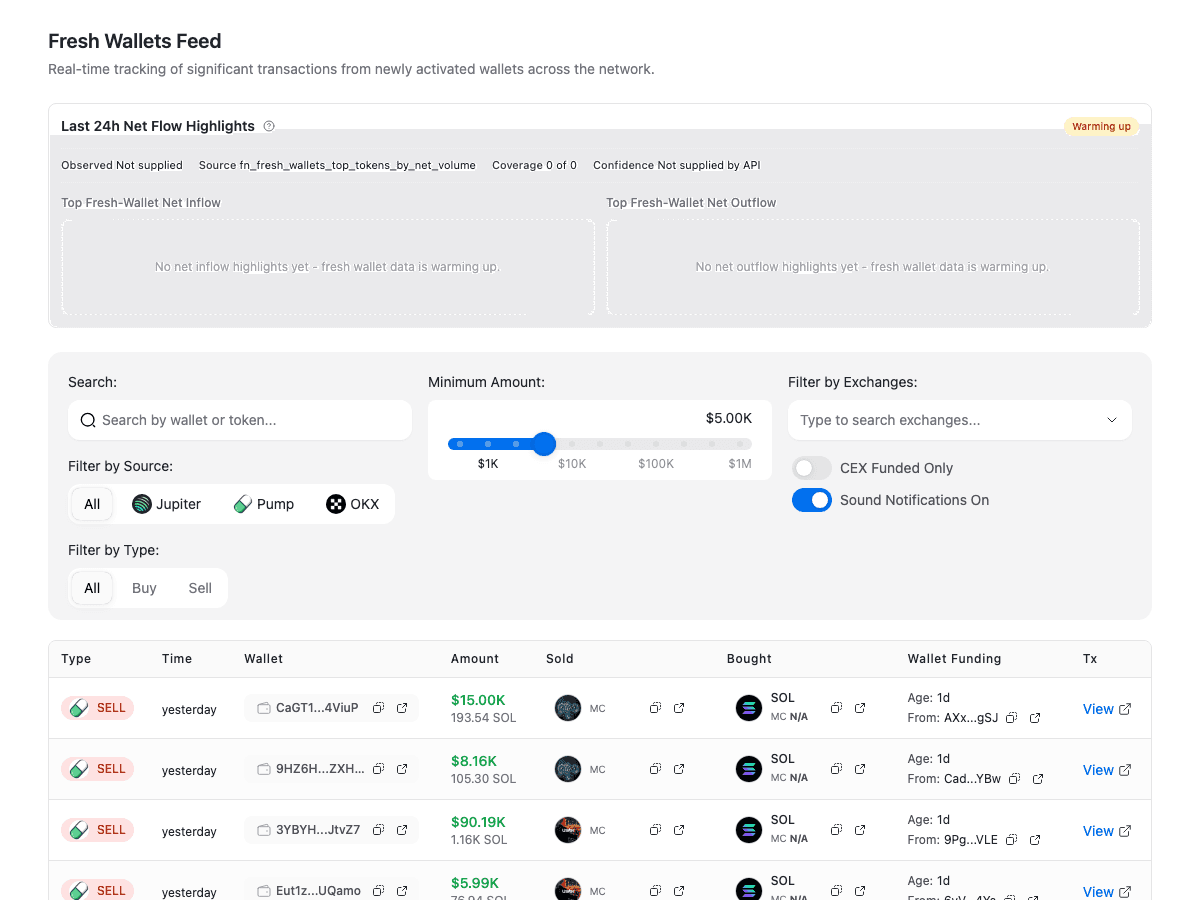
This production capture from July 25, 2026 shows the research controls and fields. It is historical evidence of the interface, not a current sniper verdict.
On September 28, 2026, the public route loaded but returned a warming-up summary and no qualifying rows under the displayed state. That proves an empty coverage state, not zero fresh-wallet activity.
Use Insider Scan to investigate token-level holder and insider leads. Its public beta route can also return an empty ranking. Absence from either discovery interface is not proof that a launch was clean.
For every material claim, open the exact mint, wallet, pool, and signatures in a compatible explorer or raw transaction source.
False positives to avoid
- First slot equals insider: speed does not establish affiliation.
- Same slot equals one bundle: ordering does not prove the submission path.
- Shared CEX funder equals one owner: exchanges fund unrelated users.
- Several rows equal several buyers: routing and duplicate presentation can inflate counts.
- Transfer out equals sale: beneficial ownership may be unchanged.
- Empty feed equals no snipers: it can be a filter, freshness, source, or coverage state.
- Early profit equals repeatable skill: include losing launches and unresolved positions.
- High marked value equals sellable value: test the full reviewed quantity against current routes.
Final checklist
- Confirm the exact mint, pool, venue, and launch boundary.
- Save successful signatures, slots, balances, fees, signers, and inner instructions.
- Exclude failed swaps and non-purchase token movements.
- Resolve recipient token accounts to controlling owners.
- Measure speed with a fixed slot, time, or buyer-count rule.
- Keep early, automated, coordinated, and privileged as separate claims.
- Trace first funding and preserve attribution boundaries.
- Compare raw wallet, supported actor, and stress-case actor counts.
- Calculate acquired and current actor-level supply.
- Follow sales, transfers, and protocol movements to a fixed checkpoint.
- Request fresh exit quotes for the reviewed sizes.
- Preserve empty states, source freshness, and missing transaction bodies.
- State uncertainty instead of turning a pattern into an identity claim.
FAQ
Are all first-slot buyers token snipers?
They are extremely early buyers under a slot-based definition. The sniper label is stronger when repeated timing or automation evidence exists. First-slot placement alone does not prove insider access, profitability, or common ownership.
Can Solscan prove that a transaction used a Jito bundle?
Ordinary transaction history can prove signatures, slots, instructions, balances, and fees. Same-slot placement alone does not prove the private submission relationship. Use bundle language only when specific evidence supports it.
How do I find sniper wallets before a token moves?
Monitor newly activated and early-buying wallets, then verify the launch's first successful swaps. Trace funding, compare linked wallets, and measure supply control. Discovery speed does not remove the need for transaction and liquidity checks.
Does a fresh wallet mean the buyer is an insider?
No. Fresh wallets are used for security, privacy, bot operations, strategy separation, and ordinary onboarding. Direct funding links, synchronized behavior, meaningful supply, and repeated project adjacency make coordination more plausible.
What is the strongest sniper risk pattern?
A supported cluster of fresh wallets that lands near the first tradable transaction, acquires meaningful liquid supply, and sells into later independent demand is a strong launch-risk pattern. It still does not establish real-world identity without separate evidence.
Should I copy a profitable sniper wallet?
Not blindly. Its execution advantage may disappear before detection, and your entry can face worse price impact, fees, liquidity, and exit priority. Test a prospective fixed-size shadow sample rather than relying on historical screenshots.