Quick answer
Trace a Solana wallet's funding source from its earliest meaningful inbound SOL transfer. Follow each upstream hop to an exchange, bridge, established wallet, or unresolved origin. Funding is relationship evidence, not proof of ownership. Shared exchange hot wallets are weak identity clues.
What a Solana wallet funding source means
A wallet's funding source is the address or protocol that supplied the SOL needed for its first meaningful activity. That first transfer often pays for swaps, token accounts, priority fees, or rent.
Funding analysis can help answer three different questions:
- Origin: where did the wallet's usable SOL come from?
- Relationship: did another wallet directly enable its activity?
- Timing: how long after funding did the wallet trade?
These questions are useful, but they do not establish legal identity. A transfer proves that value moved between accounts. It does not prove who signed both sides or why the transfer happened. For EVM and Robinhood Chain wallets, see where a wallet sent its funds, which follows outbound transfers instead of inbound ones.
Before you start: save the evidence
Copy the full wallet address from a trusted source. Then define what you mean by “first funding.” A wallet may receive spam tokens or tiny transfers before it receives usable SOL.
Save these fields for each hop:
- transaction signature
- block time
- sender and recipient
- raw and normalized SOL amount
- sender's account type or label
- wallet balance before and after the transfer
- time from funding to first swap
- explorer URL and observation time
Use the Solana wallet tracking workflow when the funding path is one part of a broader history. Use the fresh-wallet guide when wallet age and first action are the primary signal.
Separate capital funding from transaction sponsorship
The wallet that pays a transaction fee is not necessarily the wallet that supplied the trading capital. Solana transactions can use a separate fee payer, while program authorities, token-account owners, and transfer recipients can all be different addresses.
Record four roles independently:
| Role | Evidence | What it can establish |
|---|---|---|
| Fee payer | Transaction message and SOL fee debit | Who paid for that transaction |
| Signer or authority | Required signatures and instruction accounts | Which address authorized a covered action |
| Capital source | Reconciled inbound SOL or token balance change | Where usable inventory came from |
| Beneficiary | Post-transaction balance or protocol position | Which account received the economic exposure |
A sponsor paying a fee can enable a wallet's first action without transferring position capital. Conversely, a parent can fund the wallet once and never appear as a fee payer again. Preserve both relationships instead of forcing them into one “funder” label.
Step 1: find the earliest meaningful inbound SOL
Open the target address in a compatible Solana explorer and move to the oldest available activity. Look for the first inbound SOL transfer large enough to support the wallet's initial transactions.
Do not automatically select the first visible row. Exclude irrelevant events such as:
- spam-token receipts
- dust transfers
- token account creation without usable funding
- failed transactions
- rent returned from a closed account
- rewards or protocol movements unrelated to trading capital
Record the wallet's balance change. An instruction can mention an address without economically funding it.
What counts as meaningful funding?
There is no universal SOL threshold. The amount is meaningful when it plausibly enabled the wallet's next actions.
A small transfer may be meaningful for transaction fees. A larger transfer followed immediately by a swap may represent trading capital. Keep fee funding and position funding separate when the evidence permits it.
Step 2: inspect the funding transaction
Open the full signature rather than relying on a transfer summary. Confirm:
- the transaction succeeded
- the target wallet's SOL balance increased
- the apparent sender actually lost SOL
- the transfer was not a program withdrawal or account closure
- the signer and invoked programs match the interpretation
Solana transactions can contain several instructions and inner instructions. A simple label may hide a swap, bridge withdrawal, exchange payout, or protocol redemption.
If a program account or vault supplied the funds, identify the protocol before following an arbitrary account upstream. The economically relevant source may be the withdrawal request or depositing user rather than the vault address itself.
Reconcile both sides of the transfer
A credible funding record should explain the sender's decrease and the target's increase in the same successful transaction. Record fees separately because the sender's total SOL decrease can exceed the target's receipt.
Use this compact check:
- Confirm the target's SOL balance increased by the stated amount.
- Confirm the source's SOL balance decreased by the transfer plus attributable fees.
- Identify every signer and invoked program relevant to the movement.
- Separate direct system transfers from bridge, exchange, vault, and account-closure flows.
- Save the signature and block time before following the source upstream.
- Separate fee sponsorship from position-capital funding.
- Check native SOL, wrapped SOL, and token inflows independently.
If the two sides do not reconcile, keep the source unresolved. An address appearing in an instruction list is not enough to call it the funder.
Check native SOL, wrapped SOL, and token funding separately
The first useful inventory may not arrive as native SOL. A wallet can receive wrapped SOL, USDC, another SPL token, or a protocol withdrawal and then trade without a large inbound system transfer.
Build one opening-balance record for each asset that enabled the first action:
- native SOL before and after the transaction
- wrapped SOL token-account changes
- quote-token inflows such as USDC
- transferred target-token inventory
- protocol withdrawals or claim receipts
- fees and rent paid by the wallet or a sponsor
Do not merge wrapped SOL and native SOL movements until the wrap or unwrap instructions reconcile. Otherwise the same capital can appear once as an inbound asset and again as newly funded SOL.
Test whether the wallet acted before it held native SOL
The first visible inbound SOL is not always the event that enabled the first economic action. A sponsor can pay the fee, a program can create an account, or an owned token account can receive inventory before the owner address receives a conventional SOL transfer.
Compare three timestamps independently:
- First covered account activity: the earliest verified signature involving the owner or a material owned account.
- First usable inventory: the first reconciled native SOL, wrapped SOL, quote token, target token, or protocol claim available to the wallet.
- First economic action: the first successful swap, transfer, deposit, withdrawal, or other position-changing event.
If the first economic action predates the supposed funding event, the funding theory is incomplete. Search the fee payer, owned token accounts, position accounts, and inner instructions before calling the later SOL transfer the origin.
| Observed sequence | Defensible interpretation |
|---|---|
| Sponsor pays fees, target receives swap output | Fee sponsorship is verified; capital source still needs reconstruction |
| Token inventory arrives before native SOL | Token funding may be the opening capital path |
| Protocol withdrawal supplies the first spendable assets | Trace the withdrawal claim or deposit history, not only the vault address |
| Later SOL transfer appears first in an owner-only feed | Treat it as the first covered owner-address funding, not proven lifetime origin |
Step 3: classify the immediate source
Most funding paths fit one of five practical categories.
Known centralized exchange
An exchange withdrawal can explain how SOL reached the wallet, but a shared hot wallet does not identify the customer. Two wallets funded by the same exchange are not siblings by default.
Useful follow-up evidence includes a distinctive withdrawal amount, narrow timing, repeated deposits back to the same service, and independent behavioral overlap. Even then, keep ownership unresolved unless stronger evidence exists.
Established parent wallet
An older wallet with a substantial history can be a meaningful parent candidate. Check whether it funded other new addresses, received proceeds back, or traded the same tokens.
One parent funding several fresh wallets shortly before coordinated buys is stronger cluster evidence than a one-off transfer.
Fresh intermediary
A new wallet may receive SOL and forward most of it to the target. Follow the chain upstream while preserving every hop.
Intermediaries can be used for privacy, operations, bots, team treasury management, or ordinary wallet hygiene. A longer chain is not proof of malicious intent.
Bridge or protocol withdrawal
Verify the program, official contract references, and the target chain or protocol context. A bridge withdrawal can show that capital entered Solana, but it does not automatically reveal the original cross-chain owner.
Unknown address
If the sender cannot be classified confidently, label it unknown. An honest unresolved origin is better than a false exchange, insider, or KOL attribution.
Step 4: follow the path upstream without skipping hops
Repeat the same process on the immediate source. Stop when you reach:
- a defensibly labeled exchange or custodian
- a verified bridge or protocol boundary
- an established parent wallet relevant to the investigation
- an origin that cannot be resolved with available evidence
Do not jump from the target wallet to a famous address merely because both interacted with the same service. Preserve the exact transfer chain.
A compact path can list each verified hop in order:
- exchange hot wallet
- intermediary A
- target wallet
- first swap
A stronger research note includes signatures, timestamps, amounts, and confidence for every hop.
Keep a chain-of-custody table
Funding investigations become unreliable when the conclusion is detached from the transfers that support it. Keep one row per hop rather than summarizing the path from memory.
| Hop | Required evidence | Defensible conclusion |
|---|---|---|
| Source to intermediary | Signature, balances, amount, time | Verified movement between two addresses |
| Intermediary to target | Signature, balances, amount, time | Direct funding of the target |
| Target to first action | Successful signature and balance changes | Capital was used for the observed action |
| Service attribution | Official program, service, or reliable label evidence | The path reached a service boundary |
Add a separate ownership column with supported, contradicted, or unresolved. A verified transfer path and an unresolved ownership conclusion can coexist. This prevents a clean movement trace from being overstated as proof that one person controls every address.
Preserve the amount in raw lamports as well as SOL. Rounded display values can make two different transfers look identical, while fee deductions can make a forwarded amount look slightly smaller even when the path is related.
Give each hop its own confidence grade
Do not assign one confidence score to the entire path. A direct transfer into the target can be certain while an upstream exchange or actor attribution remains weak.
- Verified movement: signature, balances, amount, and direction reconcile.
- Verified service boundary: the source is supported by official program or service evidence.
- Corroborated wallet relationship: repeated funding, shared inventory, synchronized behavior, or return flows connect addresses.
- Unresolved attribution: the transfer is real, but ownership or service identity is not defensible.
The final conclusion should inherit the uncertainty of the hop needed to support it. A verified three-hop transfer path can still end with an unresolved actor.
Resolve conflicts between explorers and indexers
Two interfaces can disagree because one has not indexed the newest signature, one omits inner instructions, or one applies a different account label. Do not choose the result that best fits the thesis.
Use this conflict protocol:
- Save the complete signature, slot, and observed status from each source.
- Compare raw native and token balance changes for the same transaction.
- Verify the mint, token program, decimals, and account owner.
- Check whether address lookup tables or inner instructions explain missing accounts.
- Revisit the signature after it is finalized when the conclusion is time-sensitive.
- Keep the hop unresolved if the transaction body or balances remain unavailable.
Source agreement increases confidence in the readout. It does not create a second independent funding event.
Know when to stop tracing
Stop at a verified exchange, bridge, or protocol boundary unless the investigation has independent evidence that identifies the user on the other side. Shared infrastructure mixes many users and usually destroys the address-level ownership trail.
Also stop when pagination, archival coverage, or account history is incomplete. Record the oldest verified point and the coverage limit. Do not label it the wallet's original funding source when earlier history may be missing.
Step 5: compare funding time with the first trade
The interval between funding and action can reveal operating style.
Seconds or minutes: compatible with automation, preplanned execution, or a launch workflow.
Hours or days: compatible with staged preparation, ordinary wallet setup, or delayed decision-making.
Repeated fund-and-trade cycles: stronger evidence of an operating pattern than one isolated event.
Timing alone does not prove a bot, insider, or coordinated buyer. Compare it with trade instructions, token launch time, other funded wallets, and later behavior.
Distinguish activation from reactivation
The first covered funding event and the newest activity can belong to different operating periods. Measure both the funding-to-first-action delay and the inactivity gap before the latest economic event.
Use four labels:
- Newly activated: the first usable inventory and first economic action fall inside the review window.
- Reactivated: a previously used wallet resumes economic activity after a pre-defined inactivity gap.
- Administratively active: recent signatures pay fees, change accounts, or fail without changing exposure.
- Continuously active: separate economic sessions recur without breaching the inactivity threshold.
A wallet funded months ago can still be a fresh research lead if it has just reactivated. It is not a fresh wallet, and its old funding relationship may no longer explain the current strategy.
Apply the Solana wallet activity test to the newest sequence. Save the inactivity threshold before reviewing the address, group routed signatures into one session, and verify whether current exposure actually changed.
Use the first-buyer workflow when the target bought near launch. First-buyer order becomes more informative after related wallets are collapsed into likely actors.
Reconcile funding with the wallet's current balances
The opening transfer sets an upper bound on visible starting capital, not on current exposure. After tracing the first action, compare the funded amount with native SOL, wrapped SOL, token accounts, protocol positions, fees, transfers, and related-wallet inventory at a fixed checkpoint.
Use a simple capital disposition ledger:
| Funded capital | Evidence to find | Interpretation |
|---|---|---|
| Still native | Current lamport balance | Uncommitted or fee-paying capacity, subject to reserves |
| Swapped into tokens | Successful swap balance changes | Covered spot exposure |
| Moved into a protocol | Deposit plus protocol position state | Open LP, vault, stake, or collateral exposure |
| Transferred onward | Direct transfer and recipient balance | Capital left the address, ownership unresolved |
| Spent on fees or rent | Fee and account-creation records | Operating cost, not investment loss |
| Unreconciled | Gap between covered inputs and outputs | Coverage failure that must stay visible |
Suppose a wallet receives 50 SOL, buys with 38 SOL, retains 6 SOL, forwards 4 SOL, and spends 0.3 SOL on covered fees and rent. The remaining 1.7 SOL is not automatically profit, hidden inventory, or theft. It is an unresolved reconciliation gap until the transaction and account coverage explains it.
The Solana wallet holdings workflow shows how to group token accounts by mint, separate native and wrapped SOL, decode protocol claims, and compare marked value with a current full-size exit quote. This check prevents a clean funding trace from being paired with an incomplete exposure claim.
Step 6: test whether two wallets are actually related
Treat relationship evidence as a stack.
Stronger relationship evidence
- one established wallet repeatedly funds both addresses
- the wallets transfer tokens or proceeds between each other
- they enter the same tokens in narrow windows with similar sizing
- they use the same unusual sequence of programs or destinations
- one wallet consistently funds fees while another holds inventory
Weaker relationship evidence
- both wallets withdrew from the same exchange
- both bought a popular token
- both used Jupiter or another common venue
- both were created around the same market event
- their amounts are merely round numbers
Collapse wallets into one actor only when several independent clues align. Otherwise keep them separate and label the relationship unresolved.
Test equal funding amounts without overcounting them
Equal amounts are useful only inside a wider sequence. Compare raw amounts, transfer times, intermediary balances, first actions, and return flows.
For example, three wallets receiving exactly 42 SOL from one personal parent within two minutes, then buying the same mint and returning proceeds, form a coherent relationship pattern. Three wallets receiving a common exchange withdrawal preset over several days do not.
Treat the amount match as one evidence type, not several. The same transfer cannot independently prove common funding, common control, and coordinated trading.
Example: representative funding trace
Consider an anonymized fresh wallet with this history:
- received 42 SOL from intermediary B at 09:14:08 UTC
- bought a new token 96 seconds later
- intermediary B was created that morning
- B received 126 SOL from established wallet A
- B funded three fresh wallets with 42 SOL each
- all three bought the same token within four minutes
- two later returned sale proceeds to A
This is stronger than a shared-exchange clue. The equal split, narrow timing, common token, and return path support treating the three fresh addresses as one coordinated cluster for exposure analysis.
It still does not prove the actor's real-world identity or intent. The defensible conclusion is coordinated control or operation with high confidence, not “insider confirmed.”
Separate funding path confidence from actor confidence
A funding investigation produces at least three different conclusions. Grade each one independently instead of assigning one confidence label to the entire diagram.
| Conclusion | Minimum supporting evidence | Safe wording |
|---|---|---|
| Movement | Reconciled source debit, target credit, signature, and time | “Wallet A funded wallet B” |
| Operational relationship | Repeated funding, fee sponsorship, synchronized actions, shared inventory, or return flows | “The wallets show a repeated operating relationship” |
| Common control | Several independent behavioral and custody clues with no strong contradiction | “Common control is supported” |
| Real-world identity | Reliable external attribution tied to the exact address | Name the actor only with the attribution and source |
One verified transfer can establish movement. It cannot establish the last three conclusions by itself.
Look for contradictory evidence
Do not collect only links that support the cluster theory. Search for evidence that the addresses behave independently:
- unrelated withdrawals from a high-volume service
- conflicting active times or strategies
- no return flow across repeated cycles
- different long-term destinations and custody patterns
- a relay, payroll, airdrop, or market-maker operation that explains the shared source
Record contradictions beside supporting clues. A relationship score that cannot decrease is not a research method.
Build an actor graph without double-counting capital
Represent wallets and verified services as nodes. Add one directed edge per reconciled transfer, with signature, raw amount, asset, time, and confidence. Keep suspected ownership as a separate edge type.
When estimating cluster capital, count external inflows once. Transfers between included wallets only move capital inside the graph. This prevents a 50 SOL path through three intermediaries from becoming 150 SOL of apparent funding.
Use Stalkchain to find funding leads
The public Fresh Wallets Feed exposes wallet, trade direction, amount, sold asset, bought asset, wallet age, funding address, CEX-only filtering, and transaction links. On August 18, 2026, the route rendered populated historical rows while its 24-hour highlight module said the current summary was warming up.
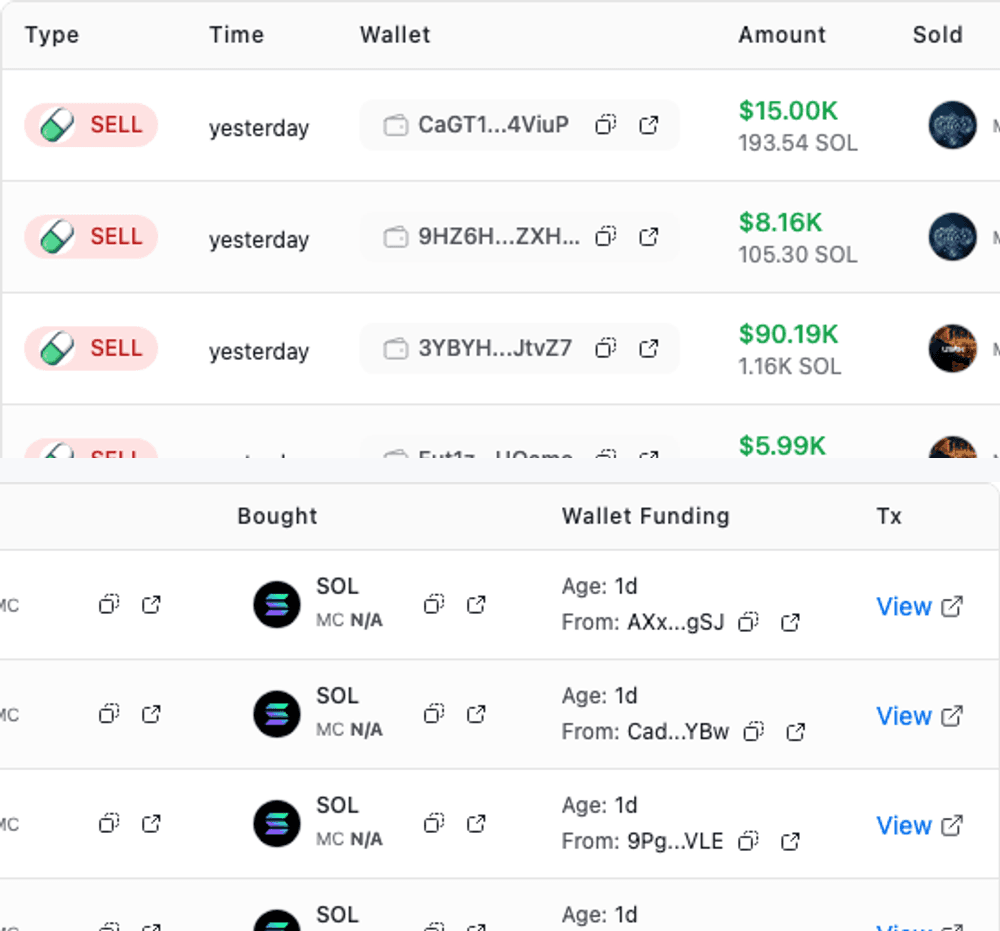
The screenshot shows why the feed is a discovery surface. “From” provides an immediate funding lead, while the wallet and transaction links let you verify the path. The row does not prove who controls the funder or whether the wallet remains active.
Use Smart Money Transactions for broader recent wallet leads and Insider Scan when the research question is token-level concentration. When profitability becomes part of the claim, apply the wallet PnL coverage method rather than assigning zero basis to transferred inventory.
False positives to avoid
Shared exchange funder: thousands of unrelated users can receive withdrawals from one hot wallet.
Account closure: returned rent can look like inbound funding without representing new trading capital.
Protocol vault: the visible sender may be infrastructure, not the economic source.
Transfer chain ownership: forwarding SOL does not prove that every address has one owner.
Timing coincidence: several wallets can react to the same public launch without coordinating.
Round-number matching: standard withdrawal presets and bot sizing can create similar amounts.
Transferred token basis: a wallet funded with SOL may also receive tokens whose acquisition cost sits elsewhere.
Stale rows: historical feed entries are evidence of past activity, not current intent.
Final checklist
- Confirm the complete target address.
- Find the earliest meaningful inbound SOL balance change.
- Open and save the full signature.
- Separate fee funding from position funding.
- Classify the source as exchange, parent, intermediary, protocol, or unknown.
- Follow every upstream hop without skipping infrastructure boundaries.
- Compare funding time with the first economic action.
- Test relationships with transfers, timing, behavior, and return paths.
- Treat shared exchanges as weak ownership evidence.
- Preserve unresolved origins and confidence levels.
- Reconstruct transferred token basis before calculating PnL.
- Grade movement, operational relationship, common control, and identity separately.
- Search for contradictory evidence before collapsing wallets.
- Deduplicate internal graph transfers when estimating cluster capital.
- Compare first account activity, first usable inventory, and first economic action before naming the origin.
FAQ
Can you find who owns a Solana wallet from its funding source?
Usually not. Funding traces addresses and services, not legal identity. A known exchange can identify the service but not the customer. Public attribution needs separate, reliable evidence.
Does the first transaction show the funding source?
Not always. The oldest visible event may be spam, dust, rent, a protocol action, or a failed transaction. Confirm the first meaningful SOL balance increase and inspect the full signature.
Are two wallets related if the same address funded them?
Sometimes, but context matters. A shared personal parent plus coordinated behavior is useful evidence. A shared exchange hot wallet is weak because it serves many unrelated customers.
What does CEX-funded mean?
It means the immediate or traced source is associated with a centralized exchange. It does not mean the exchange owns the receiving wallet or that two exchange-funded wallets have one owner.
Can funding prove a wallet is an insider?
No. Funding can reveal relationships and coordination. Insider claims require additional evidence connecting the wallets to privileged access, a deployer, a team, or non-public information.
Why does funding matter for wallet PnL?
Funding helps locate related addresses and transferred inventory. If a position's tokens or capital came from another controlled wallet, reviewing only the visible address can omit acquisition basis, losses, or remaining exposure.