
Learning how to trace stolen crypto starts with a hard truth: the blockchain records every transfer, but nobody hands you a map. When funds leave your wallet, you get a transaction hash and little else, while the thief moves the assets through wallets and bridges within minutes.
The trail does not disappear, though. It stays public and permanent, waiting for someone to read it methodically.
This guide walks through the same six steps we use to follow stolen funds: securing what remains, identifying the theft transaction, tracing hops across wallets and chains, locating cash-out points at exchanges, packaging findings into evidence that platforms and law enforcement act on, and recognizing recovery scams. You will learn which free and paid tools fit each stage, where AI-assisted on-chain queries help, and where traces hit real limits.
This is educational material, not financial or legal advice.
Key takeaways
- Act fast: secure remaining funds, preserve evidence, and report the theft to police and exchanges immediately.
- Trace the money hop by hop using block explorers and analytics tools; document every transaction hash and address.
- Exchanges are the most actionable choke points, notify them with a police report to request a freeze.
- Beware of recovery scams; legitimate firms charge for traces, not upfront fees with guaranteed returns.
- For complex cases, hire a forensic firm and work with a crypto-savvy lawyer to build a court-admissible case.
On this page
- Step 1: Secure What's Left and Gather Your Evidence
- Step 2: Identify the Theft Transaction and the First Hop
- Step 3: Follow the Money Across Wallets and Chains
- Step 4: Identify Cash-Out Points and Notify Exchanges
- Step 5: Build a Court-Admissible Evidence Package
- Step 6: Avoid Recovery Scams and Know What's Realistic
- Frequently asked questions
- Final thoughts
Step 1: Secure What's Left and Gather Your Evidence
Speed matters most in the early stages. Everything else in this guide depends on what you capture now.
What to save before you do anything else
Move any remaining funds out of the compromised wallet first. Assume the private key or seed phrase is burned: create a fresh wallet, generate new keys offline, and send whatever is left to it.
Do not reuse the old seed phrase, even if you think only one device was affected. If the drain came from a token approval rather than a key leak, revoke the outstanding approvals as well.
Then collect and preserve the following:
- The theft transaction hash (TXID) and the address that received the funds.
- The compromised wallet address and every address that interacted with it.
- Timestamps, amounts, token types, and the chain or chains involved.
- Timestamped screenshots of the theft transaction and your before/after balances.
- CSV transaction history exports, if your wallet or block explorer supports them.
On-chain records are permanent, which is what makes tracing possible at all. Recovery odds are highest when the trail is fresh and the evidence is complete, as forensic practitioners note in industry guidance on tracing stolen Bitcoin.
Why a written timeline matters later
Write a plain-language timeline while your memory is fresh: when you noticed the loss, what you clicked, which sites or contracts you signed, and who you spoke to. This becomes the backbone of every report you file. Report the theft to your local police and your national cybercrime portal.
In the US, that is the FBI's IC3. Most exchange freeze requests require a police report number, so file early even if the amount seems small.
Step 2: Identify the Theft Transaction and the First Hop

Reading a theft transaction on a block explorer
Open a block explorer for the chain where the theft occurred: Etherscan for Ethereum and EVM networks, Blockchain.com for Bitcoin, Solscan for Solana. Paste the transaction hash (TXID) from your wallet history, or search your own address and find the outgoing transfer you did not authorize.
Confirm three things on that page:
- The output address or addresses that received your funds. This is the first hop, and it anchors everything that follows.
- The block height and timestamp. These establish the starting point of your trace and help exchanges correlate the movement with their internal logs.
- The asset and amount moved. Note whether the thief took one token, several, or an NFT in the same transaction.
Save the TXID, the first-hop address, and the block number. Investigators and compliance teams work from these records, and the trail stays public and permanent, as forensic recovery firms note about Bitcoin and other ledgers.
Spotting drainer patterns vs. manual theft
Check the timing and scope of the outgoing transfers. A single sweep of many tokens or NFTs, or a rapid burst of transactions within seconds, usually indicates a scripted drainer rather than a person moving funds by hand. That pattern matters: it suggests an automated tool and often a known malicious contract.
If the theft involved an approval exploit, identify the contract that pulled the funds and revoke any remaining approvals with a tool like Revoke.cash. Unrevoked approvals let the attacker return for whatever is left. For Solana-specific funding analysis, our guide on tracing a Solana wallet's funding source covers the equivalent steps.
Step 3: Follow the Money Across Wallets and Chains
Step 3: Follow the Money Across Wallets and Chains
Follow the flow hop by hop, starting from the initial address identified in Step 2. Document every transfer.
Manual tracing vs. API-assisted tracing
Manual tracing involves using public block explorers to observe the flow of funds. While these tools provide visibility, they often lack comprehensive labeling. Dedicated analytics tools offer greater insight.
- Manual Method: You manually review transaction history for each address. This is time-intensive.
- API-Assisted Method: Using an API allows for programmatic tracing. This saves time by enabling automated queries across multiple chains. StalkChain's MCP server enables AI assistants to query on-chain data directly, supporting questions like "Where did this wallet send funds in the last 24 hours?" across seven chains.
| Tracing Feature | Public Explorer | Dedicated Analytics Tool |
|---|---|---|
| Address Labeling | Basic | Advanced (Exchanges, Mixers) |
| Cross-Chain View | Limited | Comprehensive |
| Automation | Manual | API-driven |
Handling bridges, swaps, and mixers
The trail often becomes complex when funds interact with specific services. You must monitor for these activities:
- Consolidations: Multiple smaller amounts arriving at one address are often aggregated.
- Splits: A single incoming amount may be sent to several different addresses.
- Known Services: Watch for interactions with exchanges, mixers, or decentralized finance (DeFi) protocols.
Cross-chain movement is a key area to watch. Funds may move via bridges (e.g., Wormhole, Stargate, Thorchain) or decentralized swap services. If a fund moves across a bridge, the trace must continue on the destination chain.
Document every hop meticulously. Record the transaction hash, receiving address, timestamp, and amount for each step. This documented sequence forms the evidence chain.
Step 4: Identify Cash-Out Points and Notify Exchanges
Cash-out points are where stolen funds touch an entity that can act. Centralized exchange (CEX) deposit addresses are the most actionable. These platforms verify user identity and can freeze funds when presented with proper legal process. Everything else in this step serves that outcome.
How to write an effective freeze request
Start by identifying the destination. Many block explorers and analytics tools label known CEX wallets, so a deposit address often resolves to a named exchange. Record the label, the deposit address, and the transaction hash.
Then contact the exchange's compliance or fraud team through its published law enforcement or security channel. Include:
- Your police report number and the reporting agency.
- A short trace summary: origin address, theft transaction, hops, and the deposit address.
- Transaction hashes for every material transfer.
- Your contact details and any case reference.
Time is the constraint. Funds can be withdrawn or moved again within hours. Send the request as soon as the deposit is confirmed, and follow up in writing.
What to do if funds hit a mixer
If the trail enters a mixer such as Tornado Cash, or converts to a privacy coin, tracing becomes materially harder. It is not always impossible, but the heuristics weaken and the evidentiary bar rises. Document every hop, timestamp, and address before the funds enter, then consult a forensic firm.
For funds on chains with public validators, compare options. A freeze request to the receiving exchange is usually more practical than attempting on-chain recovery, which depends on validator coordination and carries no assurance of success. Freezing depends on the exchange's jurisdiction, its policies, and how quickly it acts; terms and outcomes vary.
Step 5: Build a Court-Admissible Evidence Package
A court or exchange compliance team will not review your raw wallet history. They review a report. Compile one document that reads chronologically:
- The theft transaction: hash, timestamp, asset, amount, and the address funds left.
- Each hop: sending address, receiving address, hash, timestamp, and amount.
- The exchange deposit: receiving address, exchange name, and date.
- All communication with services: support tickets, emails, case numbers, and replies.
For every claim, attach a block explorer screenshot showing the full URL and a visible timestamp. Export CSV or JSON of the same data where the explorer or your tracing tool allows it.
Screenshots can be disputed; raw exports are harder to challenge. Our methodology page explains how we handle sourcing and verification: https://stalkchain.com/blog/about
When to hire a forensic firm
If the amount is material, hire a blockchain forensics firm such as Elliptic or Chainalysis, or a specialist lawyer who retains one. Their expert report carries weight that a self-compiled spreadsheet does not, and it is often what persuades a judge or an exchange's compliance department to act.
Working with law enforcement and lawyers
A lawyer experienced in crypto recovery can tell you whether a civil suit, a John Doe subpoena against the exchange, or a referral to law enforcement is the better path. File an IC3 complaint as well: https://www.ic3.gov/CrimeInfo/Cryptocurrency
Keep the package updated as the thief moves funds. Exchanges and investigators may act on new information weeks or months later.
This is educational information, not legal or financial advice.
Step 6: Avoid Recovery Scams and Know What's Realistic
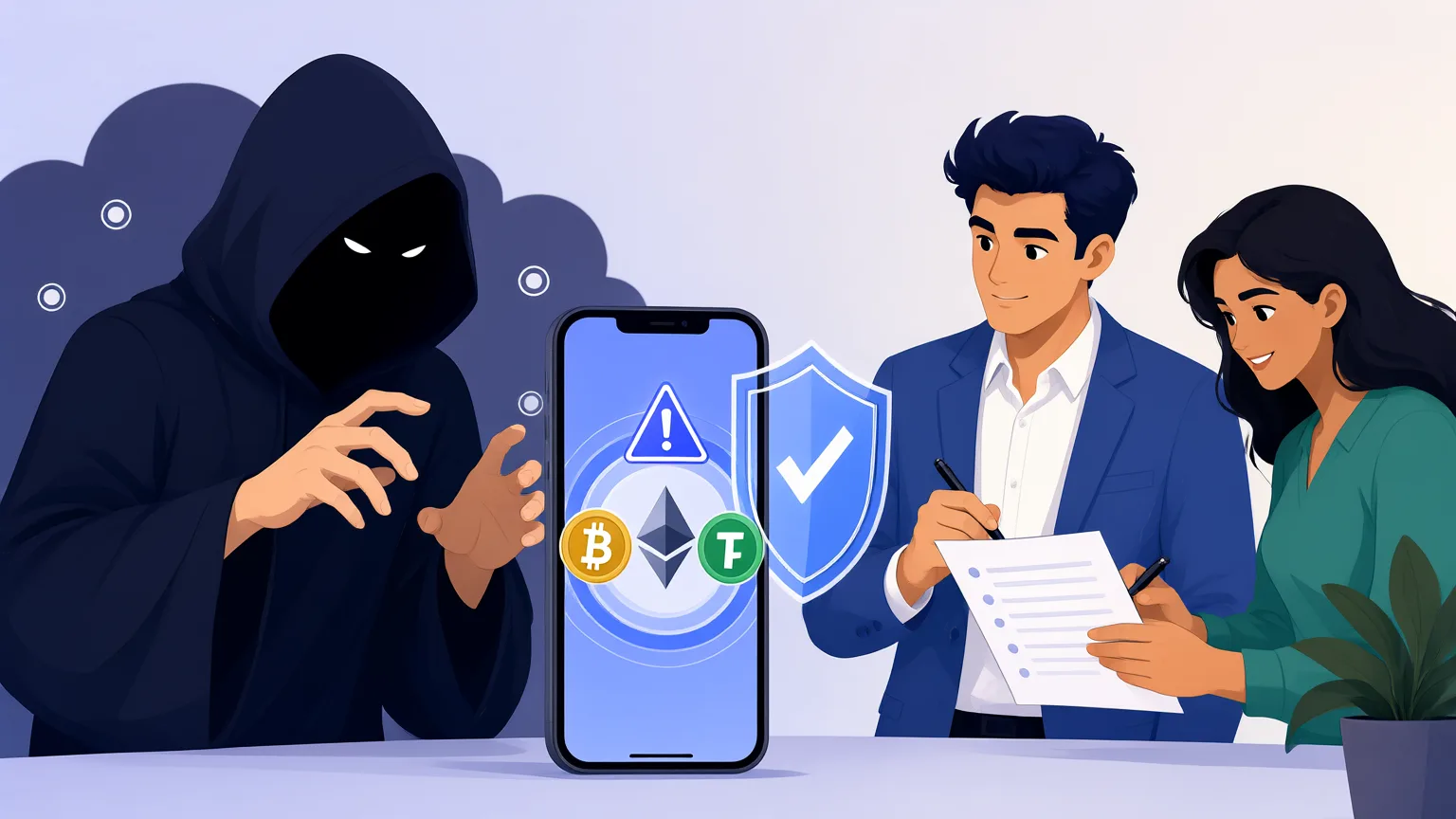
Victims of crypto theft are often targeted a second time. Recovery scams are a known category of follow-on fraud: someone contacts you, claims they can retrieve your funds, and asks for an upfront payment. The fee is the theft. Treat any unsolicited offer of recovery as hostile until verified.
Red flags of a recovery scam
- Upfront fees. Payment requested before any work is described in writing.
- Recovery guarantees. No legitimate tracer can promise a specific outcome.
- Percentage-of-recovery pricing. This model rewards delay and discourages honest case assessment.
- Pressure and secrecy. Urgency, private channels, and refusal to document the engagement.
- Impersonation. Claims of insider exchange contacts or law-enforcement relationships you cannot check.
Legitimate firms typically charge for the trace and the report, priced before work begins. They will state limits, coverage gaps, and unknowns rather than a recovery figure.
Realistic outcomes: trace vs. recover
Tracing and recovery are different results. Tracing is often successful because public ledgers are permanent.
Recovery depends on two conditions outside the tracer's control: whether funds are frozen at a regulated exchange, and whether law enforcement acts on the evidence. Freezes are possible but not automatic, and exchange policies vary.
If the thief moved funds through a decentralized mixer into a privacy coin, recovery may be effectively impossible. In that case, documentation still has value for legal claims, insurance, and tax treatment of the loss.
Report recovery scams to the same authorities handling the original theft, and warn others in the communities where you were contacted. In the US, crypto fraud complaints go to the FBI's IC3.
This article is educational and is not legal or financial advice.
Frequently asked questions
Can stolen crypto be traced?
Yes, in most cases. Bitcoin, Ethereum, and other public blockchains record every transfer permanently, so investigators can follow funds from your wallet to exchanges, mixers, and bridges.
Tracing shows movement, not ownership. It cannot force a return or identify a person behind an address without off-chain data such as exchange records or court orders.
How do I start tracing stolen crypto?
Record the theft transaction hash, your address, the asset, and the exact time. Then follow the outgoing transfers hop by hop using a block explorer or tracing tool.
Label each address you recognize, note exchange deposit addresses, and export the flow as a timeline. Preserve everything as evidence before contacting exchanges, police, or a tracing firm.
How long does crypto tracing take?
A simple single-hop theft to a known exchange can be mapped quickly. Complex cases involving mixers, bridges, or many hops take longer.
Exchange subpoena responses and law enforcement coordination often add significant delay. Timelines depend on chain coverage, data quality, and how quickly counterparties respond to requests.
What are the limits of crypto tracing?
Tracing proves fund movement, not intent or identity. Privacy coins, cross-chain bridges, and mixers create coverage gaps. Off-ramp data depends on exchanges cooperating, and jurisdictional rules vary.
Treat every result as an estimate with stated confidence, not a guaranteed recovery. Tracing supports legal and recovery efforts; it does not replace them.
Final thoughts
Tracing stolen crypto comes down to following public ledger records, documenting each hop, and labeling exchange deposit addresses. The limits are real: mixers, bridges, and off-chain cash-outs create coverage gaps, and no method recovers funds on its own. Your next step is to assemble the evidence trail before contacting anyone. StalkChain's tracing tools map wallet flows and cluster addresses from public data, so you can build a verified report. Pair that report with a police filing and an exchange compliance contact. This article is educational and not financial or legal advice.