The usual advice for how to track whales buying crypto is simple. Coins leave an exchange, so someone is buying. Coins arrive at an exchange, so someone is selling. That shortcut is how most false alerts get born.
A large transfer is usually custody or routing until you prove otherwise. Exchanges reshuffle hot and cold wallets. Bridges move the same exposure to another chain. One entity sends coins between addresses it already controls. None of those events is a purchase, and none of them tells you what the next candle will do.
A useful alert starts as a question, not a headline. Who sent it, who received it, was it a swap or a shuffle, and did the same wallet keep doing it? Hold that bar, and most "whale buys" fall out before they reach your feed.
Table of Contents
- How to Spot a Whale Purchase Step by Step
- What Each Large Transfer Usually Means
- Verify the Transaction Before You Trust the Label
- Track What the Whale Does Next
- Set Alerts and Keep Them Honest
- Start With One Whale Alert Rule
How to Spot a Whale Purchase Step by Step
Say a wallet buys a mid-cap token at 3 a.m. Nothing is announced. The only evidence sits on-chain, and a size filter alone will misread it.
A practical detector combines size, direction, entity attribution, and market context. An academic treatment of address clustering is blunt about the limits: the multi-input heuristic can identify more than 69% of addresses in wallets represented by lightweight clients, and it still throws false positives when privacy techniques are used. Treat grouping as a clue, not a verdict.
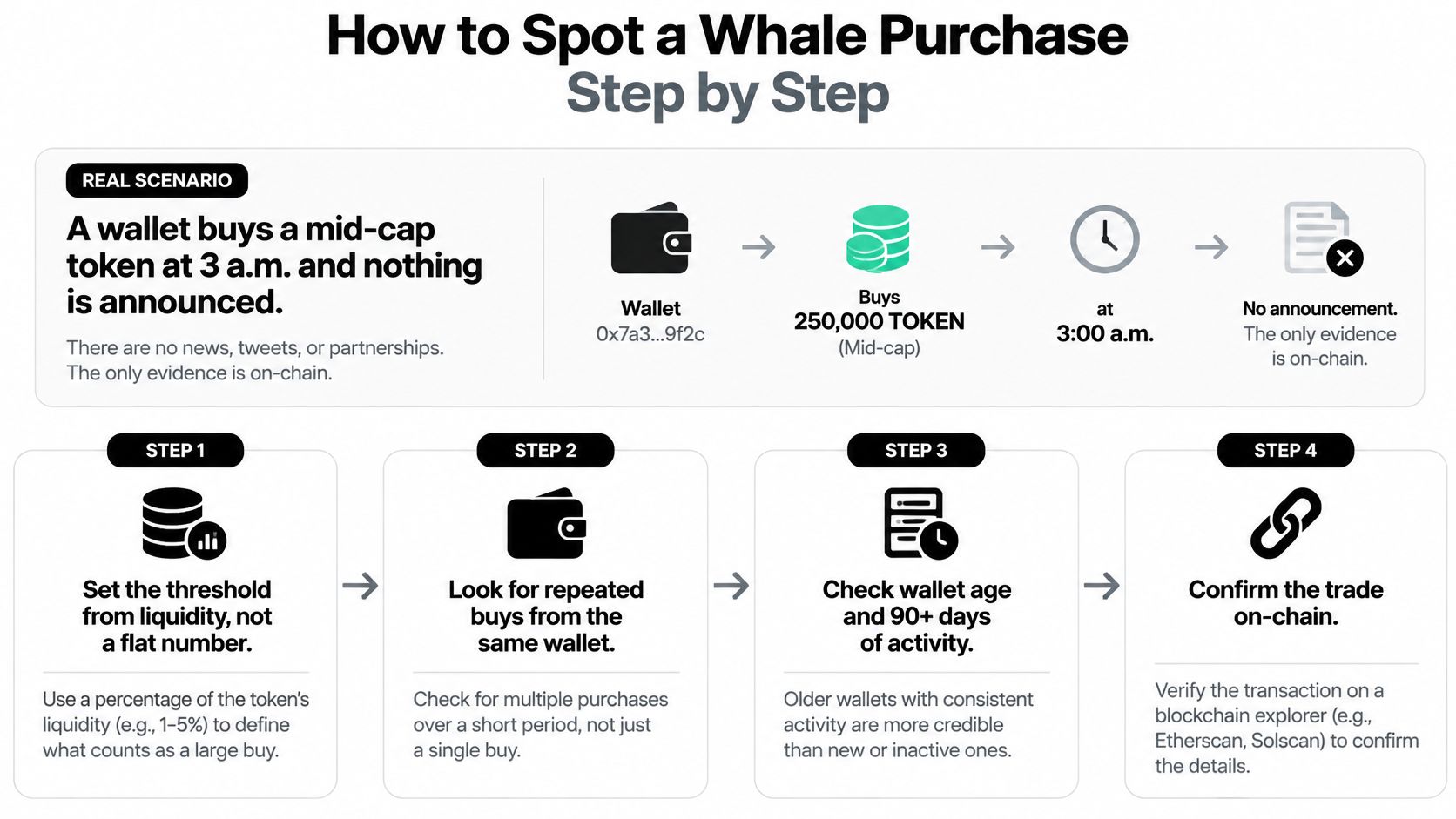
Six checks before you call it a buy
Set the threshold from liquidity, not a flat dollar figure. A $1 million swap is material for a small token and negligible for a large-cap asset. Compare trade notional with pool depth on that chain. The common slip is one cutoff for every token, which floods you with noise on liquid pairs and misses real size on thin ones.
Pull confirmed swaps and transfers for the last 24 hours on one chain. Use a block explorer transaction feed, or an indexer that exports confirmed swaps and transfers by token and wallet. Pending routes and failed swaps don't count. The slip is treating a mempool sighting as a filled trade.
Remove transfers between wallets the same entity controls, and routine exchange hot-wallet shuffles. Those classes are defined by where coins sit, not by size. A self-transfer is not a trade. The slip is counting a bridge hop or an internal exchange move as a purchase.
Group activity by wallet and token, not by a single address. Known exchange labels, repeated counterparties, contract interactions, timing, and balance continuity each add a point. Assign a confidence score. On UTXO chains, co-spend clustering helps until CoinJoin shows up. The slip is trusting one label as certain.
Compare the net buy with that wallet's prior 30-day pattern. A rolling baseline shows whether the buy is unusual for this holder. Backtest later against price-adjusted returns, and score precision, recall, false-alert rate, and detection latency separately by chain and token. The slip is calling any large print "unusual" because it looks large to you.
Flag the event only when it repeats or persists across several independent transactions and several blocks. A single exchange withdrawal can be cold-storage migration, collateral movement, or OTC settlement. The slip is inferring intent from one transfer.
Practical rule: If you can't name the token, the chain, the net USD change, and a reason the move isn't a shuffle, you don't have a buy yet.
On Solana, the same logic applies to smaller, faster prints. Public chain data can be rolled up to spot smart money trends and whale accumulation patterns. If you want a chain-specific starting list, find Solana smart money wallets and then run those addresses through the six checks instead of copying the first large swap.
A sample alert card, after the filters, looks like this.
| Field | Example |
|---|---|
| Wallet | Clustered set, confidence medium |
| Token | Mid-cap, named |
| Chain | One chain only |
| USD value | Net buy after self-transfers removed |
| Share of supply | Balance as a percent of circulating supply |
| Time window | Last 24 hours, repeated across blocks |
| Confidence tier | Medium until a second independent buy lands |
That card is a candidate. It is not a trade.
What Each Large Transfer Usually Means
A wallet can sit on a huge share of supply and barely trade. A Chainalysis analysis of Ether activity from 2016 to 2019 identified 376 whale entities that controlled 33% of circulating Ether in 2019, down from 47% in 2016. Those wallets were only about 7% of total economic transaction activity. More broadly, whales held 25% to 40% of circulating supply and accounted for roughly 5% to 18% of transaction volume. Track current holdings and balance changes. One without the other mixes inactive treasuries with active buyers.
The same analysis found that Ether sent by whales to exchanges did not directly produce a statistically significant price effect. A transfer worth $1 million was associated with a 0.1-unit increase in subsequent intraday volatility. An exchange inflow is a risk or attention signal, not proof of a sell-off.
How far each movement deserves your trust
| Movement | Usual reading | How far to trust it | What to check first |
|---|---|---|---|
| Exchange outflow to a private wallet | Possible accumulation or cold storage | Low to medium | Whether the wallet later sells or sends coins back to an exchange |
| Exchange inflow from a whale wallet | Possible distribution or sell preparation | Low | Whether the deposit address is a known hot wallet or a consolidation address |
| DEX swap from stablecoin into a token | Direct buying | High if repeated across blocks | Liquidity size and whether the buyer keeps holding |
| Transfer between wallets owned by one entity | Not a trade | None for buy intent | Balance continuity and funding source |
| Bridge transfer to another chain | Moves exposure, may not be a purchase | Low | Destination wallet activity on the target chain |
| OTC settlement or large private transfer | Unknown buyer and price | Low | Matching token inflows and price drift over the following hours |
| Repeated buys by a tracked trader over several days | Accumulation pattern | Medium to high | Holdings change against the prior 30 to 90 days |
Read a row on its own and you will over-weight it. Read two or three that agree and the story tightens. An exchange outflow, a stablecoin-to-token swap, and a rising buy count inside the same six hours is a stronger case than any one of those prints. Still check liquidity and whether the coins stay put.
Fields worth storing on every event are wallet identity, token balance, percentage of circulating supply, exchange destination, transfer value, and time since the last major movement. Those fields separate influential holders from large, quiet addresses.
If you are choosing software, compare crypto whale wallet trackers on whether they separate those movement types, not on how fast they ping. A fast alert that can't tell a shuffle from a swap just trains you to ignore it. Before you copy anyone's position, read the trader's thesis and see whether the on-chain path matches what they claim they were doing.
Verify the Transaction Before You Trust the Label
A large transfer is evidence of movement, not intent. Most alerts that look like buys are custody moves until you check them, because alert engines tag by direction and size: a transfer into an exchange reads as distribution, a transfer between large wallets reads as buying, and a cold-storage consolidation can read as either. Strip the internal shuffles out of the feed and the apparent story can flip from accumulation to distribution.
Major exchanges use many deposit addresses and later consolidate funds into fewer storage wallets.
Raw size is not buying.
A five-step check you can run in minutes
Match the alert to the chain. Open the transaction on a block explorer. Confirm sender, receiver, token amount, and USD value. If any field disagrees with the alert, drop it.
Wait for several blocks. A route that appears in one block and vanishes is not a settled buy. Reorgs and failed routes imitate purchases for anyone watching a single confirmation.
Score the label. Check the address against exchange lists, repeated counterparties, and funding history. Give it a confidence tier. A yes-or-no whale tag hides how weak the evidence is.
Test for custody before you read intent. Classify deposits, withdrawals, cold-wallet reshuffles, OTC settlement, and ordinary reorganization separately. This split is where most mislabeled whale buys get caught, because consolidation flow and accumulation flow look identical until you check the counterparties.
On UTXO chains, distrust grouped addresses when CoinJoin appears. Fall back to the raw transactions. Clustering that assumes shared control will invent a whale that isn't there.
| Alert looks like | Common explanation | Check before acting |
|---|---|---|
| Buy appears in one block then disappears | Failed route or chain reorganization | Confirmation across several blocks |
| Coins moved through a mixer or CoinJoin | Obscured ownership, so wallet grouping may be wrong | Discard wallet grouping and rely on raw transactions |
| Wallet labeled whale but holds little of this token | Label from another chain or old activity | Token-specific balance and recent history |
| Several large wallets buy at the same time | Airdrop, market maker or bot flow | Shared funding source or contract |
| Deposit address matches an exchange list | Exchange consolidation address mistaken for a holder | Cross-check exchange lists and counterparties |
On-chain data shows transactions and balances. It does not prove who controls a wallet, why someone traded, or what happens next.
Fewer alerts can be the better product. A score that explains itself, built from attribution, funding-source history, token flows, and realized and unrealized PnL, beats a binary "whale buy" flag. The verification step belongs inside the alert rule itself, so a custody shuffle never reaches your screen dressed as conviction.
When a transfer still looks odd after the explorer check, trace the wallet's transfer history across the next hops before you decide the label is earned.
Track What the Whale Does Next
A suspected buy opens the record rather than closing it. A Federal Reserve Bank of Philadelphia working paper found that large ETH holders tended to increase holdings before price increases, while smaller holders tended to reduce holdings before those increases. The same paper concluded that ETH-return volatility appeared to be driven more by small retail investors than by whales. Accumulation and turbulence are different events, and only the follow-up windows separate them.
Most large transfers resolve into custody moves, routing, or internal shuffles once you watch what happens next, so the flagged print is the first line of a timeline that later windows complete. Compare the transfer with the wallet's prior holdings and its exchange exposure, then measure price, flow, and cross-asset reactions at fixed windows: 15 minutes, 6 hours, 24 hours, 7 days, and out to 30 to 90 days. Fixed windows matter because a buyer who distributes within the day reads differently from one who adds for a month, and mixing windows makes the two look identical.
What each window is for
| Window | What to measure | What it tells you |
|---|---|---|
| 15 minutes | Price and volume change right after the buy | Whether the market reacted at all, a short-horizon volatility signal |
| 6 hours | Net accumulation and any exchange deposits | Whether the buyer kept adding or began to take profit |
| 24 hours | Wallet balance against the pre-buy level and cross-asset moves | Whether the purchase held and whether similar wallets followed |
| 7 days | Realized and unrealized PnL and average entry price | Whether the position is in profit and whether a sell-off is starting |
| 30 to 90 days | Holding duration and prior accumulation pattern | Whether this wallet is a repeat buyer or a one-off |
Historical concentration alone can't establish intent. Repeated accumulation, exchange deposits, realized profit, and the market's response can.
The wallet's history reads as a graph. Nodes are wallets, exchanges, bridges, routers, and token contracts. Edges are transfers or swaps, each carrying a time, an asset, a USD value, and a type. From that graph you compute net accumulation over the window, concentration, holding duration, and the share of flows moving through known service addresses. A high service share usually means plumbing. A rising balance across several independent edges usually means a position.
Say a wallet buys $300,000 of a token, sends 40% to an exchange within six hours, and holds the rest for a week. That pattern is partial profit-taking: one tranche sold into strength, the remainder still exposed. The 15-minute print may show a volatility bump. The 6-hour window shows the deposit. The 7-day window shows whether the remainder is still there. No single number carries the thesis on its own.
For a Solana wallet, check the wallet's activity history across those same windows before you treat one green swap as a position worth following.
Set Alerts and Keep Them Honest
Every rule needs the same fields: wallet group, token, chain, dollar threshold, time window, minimum number of independent buys, and confidence tier. Leave one out and the alert can't be audited later.
Keep two messages apart. "Large transfer detected" reports a fact. "Probable whale purchase" is a judgement, and it should fire only after the judgement tests pass. Mixing them is how a custody shuffle becomes a buy signal in someone else's chat.
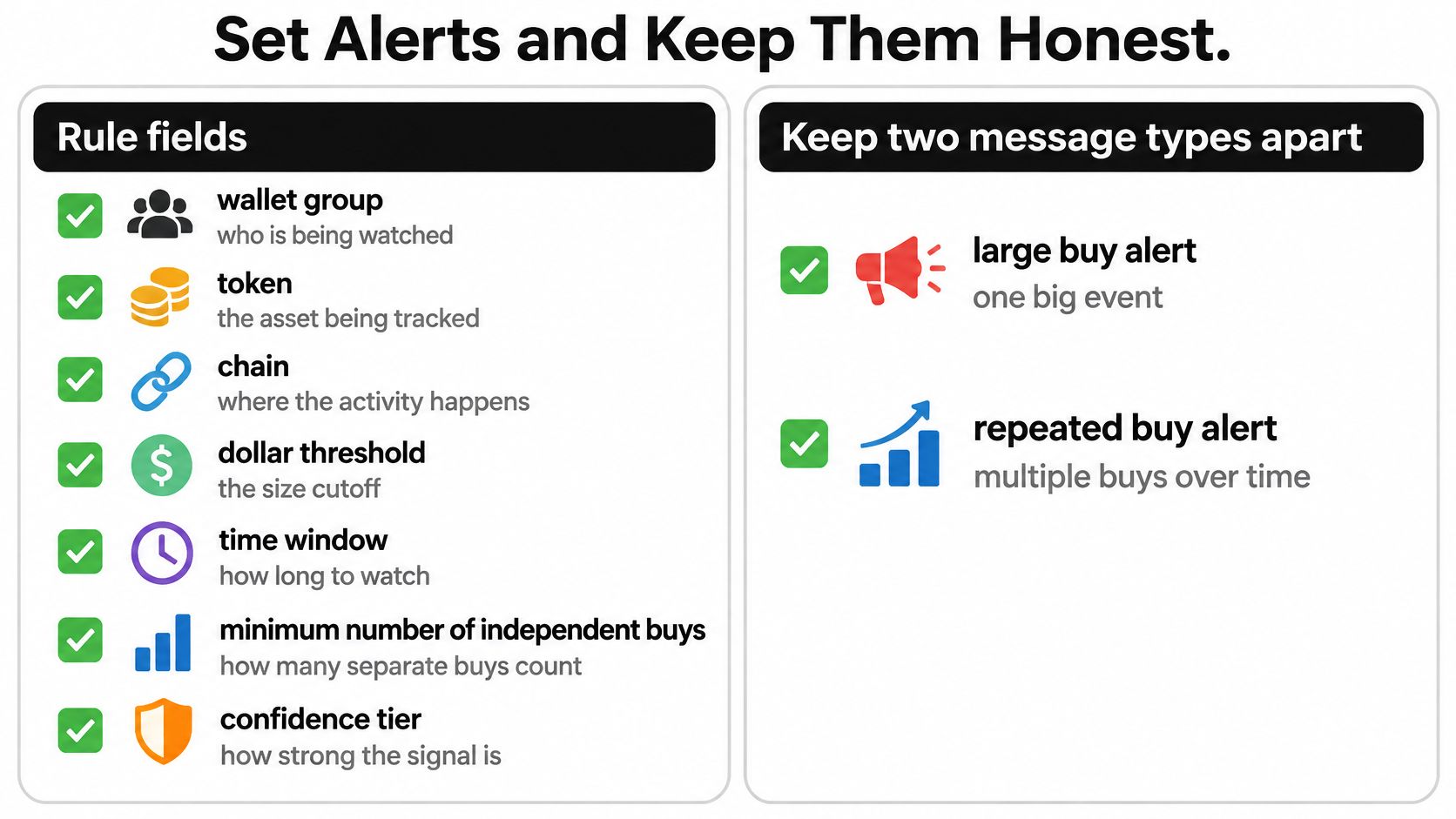
The working checklist
- Thresholds follow liquidity. Set them per chain and per token. A dollar figure copied from Bitcoin will mis-fire on a thin pool.
- Require at least two independent buys inside the window before you alert. One print stays in the "large transfer" bucket.
- Exclude bridges, market makers, airdrop claims, and internal transfers. Those are the usual false positives once you start scoring top alerts.
- Attach the raw transaction link and the confidence tier to every message. Cross-chain identity is weaker than same-chain identity, so the tier has to travel with the text.
- Flag unusual buying against that wallet's own past. A jump in buy volume or balance versus its prior 30- or 90-day distribution is the change that matters. Then require the move to persist.
A validation study of address clustering shows why grouping stays provisional. Clustering 241 addresses and 20,016 transactions produced 16,974 false-positive clusters under the tested conditions. Co-spend logic assumes inputs share control. CoinJoin breaks that assumption. Deterministic grouping is not ground truth.
Benchmark with precision at your top alerts, recall of buys you verified by hand, median lead time before a material price move, and a separate count of false positives from bridges, market makers, airdrops, and internal transfers. For each candidate, also keep net accumulation, realized and unrealized PnL, average entry price, concentration, holding duration, and the percentage of flows through known service addresses.
Alert bots and dashboards can watch tracked traders, token flows, and new launches on a schedule and push changes to where you already look. The schedule doesn't fix a bad rule. It only delivers it faster.
The weekly review
Log every alert with what the wallet did 24 hours later. Backtest against price-adjusted returns, and measure precision and recall per chain and token. Don't chase the whale's entry price. Check whether the buy landed in thin liquidity before you assume a bullish intent. Thin books turn a modest swap into a candle that looks like conviction.
Count four numbers each week: alerts sent, confirmed buys, false alerts, and missed moves. Tighten or retire the rule that produced the most noise before you add another. A quieter book that separates facts from judgements will outperform a feed that pings on every large hop.
Start With One Whale Alert Rule
Pick one token you already follow. Set the size cutoff from that token's liquidity, not from a number you saw on another asset. Alert only on repeated buys by wallets with at least 90 days of history. For three weeks, open every alert on a block explorer and confirm sender, receiver, and amount before you trust the system. That single rule teaches you the failure modes without a pile of dashboards.
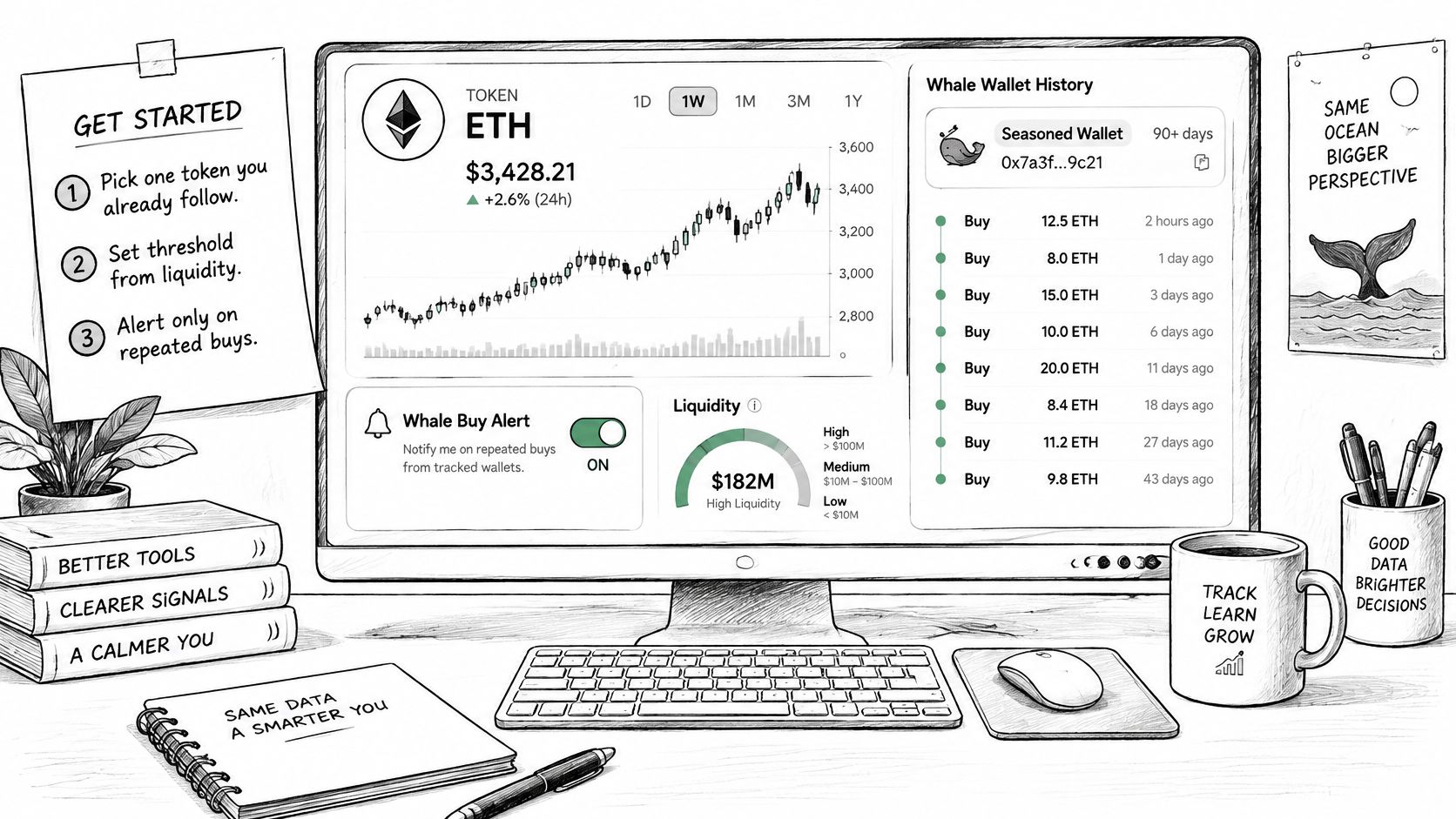
You can build that rule by hand, or you can let a feed do the first pass. Whale Watch follows live Solana trades above a volume threshold. The token holders view lists tracked traders holding a token, ranked by USD value, and it shows nothing when no data has been captured for that token yet. Traders who already use an AI such as Claude, ChatGPT, or Grok can ask who is buying, holding, or selling a token and get wallets, PnL, and receipts back.
That feed is research support, not a recommendation. We report what wallets did, such as who bought, who sold, and what they wrote. You make the decision. The number to check first, whether you build the rule yourself or use a tool, is the confirmed buy count over a week. If that count is mostly shuffles, the rule isn't ready.
StalkChain turns public on-chain activity into wallet holdings, buy and sell flows, and whale signals you can question inside the tools you already use. If you want to track whales buying crypto without treating every large transfer as a purchase, start with one token and a volume threshold, then verify the receipts yourself. Visit StalkChain and run the first lookup on a wallet you already watch.