Quick answer
A Jupiter DCA order schedules repeated swaps between two tokens. Read direction, per-cycle amount, interval, remaining balance, and status together. A large opened order is not guaranteed future pressure because it can complete, become overdue, or be canceled.
What a Jupiter DCA order is
A Jupiter DCA order divides an input amount into scheduled swaps on Solana. The wallet chooses what to sell, what to buy, how much to execute per cycle, and the time between cycles.
The public record can reveal:
- the wallet that opened the order
- total input amount
- selling and buying assets
- amount per cycle
- execution interval
- progress and remaining balance
- last observed fill
- completed, canceled, active, or overdue state
This is useful because it exposes planned execution rather than only a completed market buy. It is still a revocable plan, not a promise.
How to read a DCA order in five fields
1. Direction
Read the selling and buying assets before calling an order bullish or bearish.
SOL or stablecoin sold for a token can indicate accumulation. A token sold for SOL or stablecoins can indicate distribution. Token-to-token orders may be portfolio rotation rather than a directional view on either asset.
2. Remaining balance
Headline size describes what was deposited when the order opened. Remaining balance describes potential future execution.
A $100,000 order with $2,000 left is mostly historical. A $20,000 order with nearly all capital remaining can exert more future pressure.
3. Status
Completed means the schedule finished. Canceled means the unused balance was withdrawn or the order closed before completion. Overdue means the expected schedule has not advanced recently enough to treat the remaining amount as reliable near-term pressure.
The status can change the interpretation more than the original size.
Read the feed-level delay separately from order status
The page can be delayed even when an individual row says active, completed, canceled, or overdue. These are different clocks.
On August 15, 2026, the public Live DCA Feed marked its updates current. Its 24-hour pressure card still reported a quiet window, while the lifecycle table included an order opened about ten hours earlier and filled about three hours earlier.
Those statements answer different questions. The pressure card asks whether token-level net scheduled flow crossed its significance rules. The table shows individual order lifecycles. A quiet aggregate window does not mean there were no DCA orders or fills.
Read the pressure summary and order table separately
Use the pressure summary to find tokens with notable net scheduled flow inside 1-hour, 6-hour, or 24-hour windows. Use the order table to inspect the underlying wallets, direction, cadence, progress, and remaining balances.
An order can appear in the lifecycle table without producing a pressure card because it is too small, completed, offset by opposite flow, outside the selected window, or below the summary's significance threshold. Conversely, one pressure card can summarize several orders that must still be checked individually.
Live check: the September 6 feed is historical, not current pressure
On September 6, 2026 at 01:04 UTC, the public Live DCA Feed reported a quiet 24-hour pressure window and an update delay of about 17 days and two hours. The newest visible lifecycle row had opened and last filled about 17 days earlier.
The first visible sample included:
- a $2,000 order marked completed with no remaining balance
- an $8,330 WEN-to-SKR order marked canceled with no remaining balance
- a $2,000 order marked overdue with no fills and the full amount remaining
- another $2,000 order marked canceled with no remaining balance
- a $3,990 USDT-to-pippin order marked completed with no remaining balance
This is useful lifecycle history. It is not evidence of current 24-hour buying or selling pressure. The overdue balance is also not automatically executable because the source has not observed a recent fill or state transition.
Confirm the indexed Jupiter program version
DCA indexers can support more than one Jupiter order instruction or account generation. Solana Tracker's June 2026 changelog says its existing DCA endpoints and streams added Jupiter DCA V2 records, identified by the openDcaV2 instruction.
When completeness matters, save the program ID and opening instruction with the order. A feed that covers one account generation but misses another can undercount buyers, sellers, remaining flow, and lifecycle changes without displaying an obvious arithmetic error.
Program coverage and source freshness are separate checks. A feed can understand V2 records but still be delayed, or it can be current while omitting an unsupported account type.
4. Per-cycle amount and interval
A large per-cycle amount every minute behaves differently from a small clip every hour. Compare each cycle with pool depth and normal traded volume.
Short schedules often manage execution cost. Longer schedules can indicate patient accumulation or distribution, but duration alone does not prove intent.
5. Wallet context
Trace the wallet's funding, prior positions, related addresses, and later transfers. The Solana wallet guide explains this verification loop.
A fresh wallet funded only for one order is different from an established wallet that repeatedly accumulates across independent tokens.
Step 1: open the lifecycle view
Use the Stalkchain Live DCA Feed to compare status, progress, remaining capital, assets, and schedule in one table.
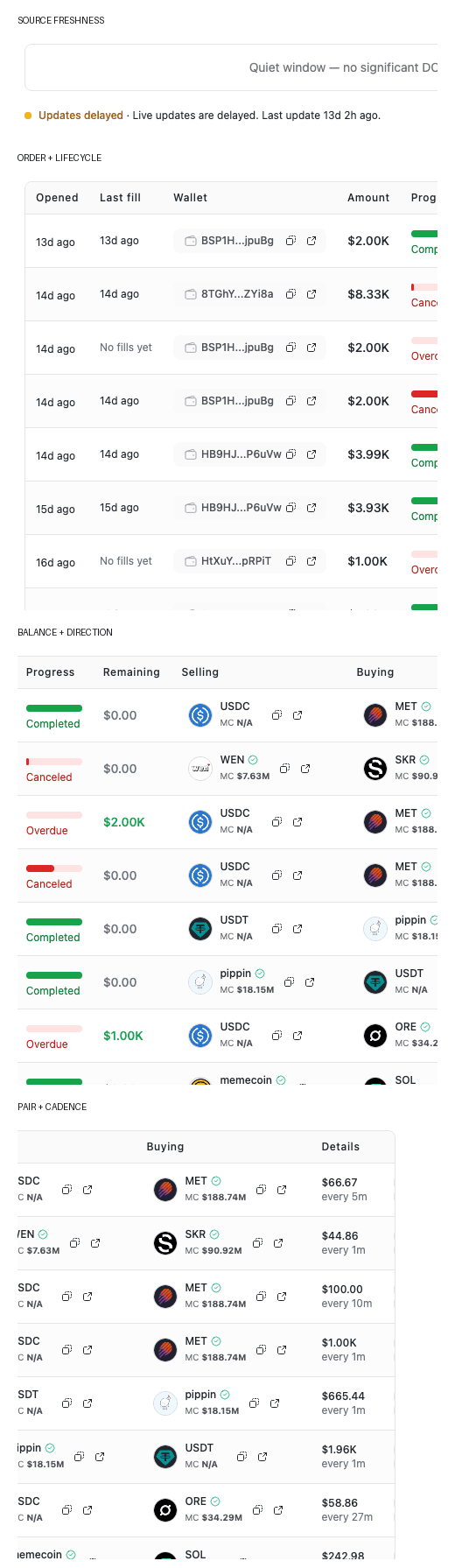
This production capture from September 2, 2026 shows why freshness belongs at the top of the workflow. The page reported no significant 24-hour pressure and warned that updates were delayed by about 13 days and two hours. Its first rows were historical lifecycle records, not a current order book.
The visible sample included one completed $2,000 USDC-to-MET order, one canceled $2,000 order from the same abbreviated wallet, and one overdue $2,000 order with no fills and the full balance displayed as remaining. Counting the three rows as $6,000 of live MET demand would overstate both capital and buyer breadth.
The correct read is narrower: one wallet created several order records, $4,000 of opening size had already reached terminal states, and the remaining $2,000 lacked both a fill and a fresh source observation. The sample proves historical DCA behavior. It does not prove current MET pressure.
This production view was captured on July 29, 2026. It showed an active $5,000 USDC-to-PUMPCADE order at 90% progress with $500 remaining. The same visible sample included a canceled $1,070 order with no fills, a completed $1,100 order, and an overdue Cupsey-to-USDC order.
The lifecycle comparison is the evidence. The active order still had executable inventory, while the canceled and completed rows showed zero remaining.
The overdue row displayed about $96,890 remaining against a $93,070 opening-value label. That mismatch warns that displayed USD values can move with pricing or normalization. Use raw token amounts and transaction records when exact accounting matters.
Step 2: separate historical size from future pressure
For each order, record:
- original amount
- amount already executed
- remaining balance
- last fill time
- current status
- next expected execution, when available
Do not sum original amounts across completed and canceled orders and call the result live DCA demand. Aggregate only defensible remaining amounts from currently executable orders.
Live readout: an 11-day delay changes the conclusion
On August 30, 2026, the public feed reported a quiet 24-hour pressure window and warned that live updates were delayed by about 11 days and two hours. The first visible rows included three USDC-to-MET records from the same abbreviated wallet:
- a $2,000 order marked completed with no remaining balance
- a $2,000 order marked overdue with no fills and the full $2,000 remaining
- a $2,000 order marked canceled with no remaining balance
The three rows do not support $6,000 of current MET demand. Two are historical lifecycle outcomes. The overdue row preserves a displayed commitment, but the long source delay and absence of fills make it research-only until a fresh Jupiter transaction proves that execution resumed.
The wallet overlap also matters. These are not three independent buyers. Before counting breadth, open the full address and signatures, then determine whether the rows are separate order attempts from one actor.
The same sample contained completed, canceled, and overdue orders for other pairs. That breadth does not repair the freshness failure. A large historical table can be useful for lifecycle research while proving nothing about current 24-hour pressure.
This readout supports a narrow conclusion: the visible history contains scheduled-order activity and mixed lifecycle outcomes, but the page did not prove live net buy pressure at the observation time.
Apply a two-clock rule
Every DCA interpretation needs two clocks:
- Source clock: when the feed or indexer last updated.
- Order clock: when the order opened and last filled relative to its cadence.
An order can look active on the order clock while the source clock is too old to support a live claim. It can also appear in a fresh feed but be overdue against its own one-minute or ten-minute schedule.
Use the weaker clock for the conclusion. If either clock falls outside the strategy's decision window, downgrade the row to research-only until the program account and recent signatures are verified.
Estimate pressure decay across the remaining schedule
Remaining balance is not one instant market order. Convert it into a time profile before comparing it with current liquidity.
For each still-executable order, calculate:
- verified raw balance remaining
- scheduled amount per cycle
- expected cycles remaining
- expected completion time from the last confirmed fill
- current executable depth for one cycle and for several overlapping cycles
Then group projected flow into the same fixed windows used by your research, such as 15 minutes, one hour, and six hours. Do not place the entire remaining amount into every window.
For example, a representative order has $24,000 remaining and schedules $1,000 every 30 minutes. Its nominal remaining size is $24,000, but only $2,000 is scheduled during the next hour. If two confirmed cycles execute, the one-hour forecast falls as time passes even though the original order size stays unchanged.
This projection is conditional. A cancellation, missed cadence, insufficient balance, route failure, or stale source invalidates it. Preserve the last confirmed fill separately from the forecast.
Step 3: normalize buy and sell pressure
Order count is a weak metric. Ten small buys can be outweighed by one large sell.
Convert comparable orders to a common value using timestamped prices, then calculate:
- remaining buy-side commitment
- remaining sell-side commitment
- net scheduled flow
- number of distinct wallets on each side
- concentration of remaining flow by wallet or related cluster
Keep low-liquidity tokens separate from majors. The same dollar amount has very different market impact in a $20,000 pool and a $20 million pool.
Assign a pressure confidence level
Classify each order before adding it to a token total:
- Higher confidence: active state, recent fill, defensible raw remaining balance, and a fresh feed.
- Medium confidence: active state and remaining balance, but the latest fill or page update is near the edge of the decision window.
- Research-only: completed, canceled, overdue, or sourced from a delayed page without fresh transaction proof.
- Exclude: wrong mint, unresolved decimals, no defensible balance, or a row that cannot be tied to the expected Jupiter account.
Aggregate higher-confidence and medium-confidence flow separately. Never make an old overdue order look current by combining it with recently filled orders.
Use a reproducible DCA evidence ledger
Save one row per order observation rather than copying the headline card into a note. At minimum, record:
| Field | Why it matters |
|---|---|
| Full wallet and order account | Prevents abbreviated labels from merging unrelated records |
| Selling and buying mints | Establishes direction without relying on symbols |
| Original and raw remaining amounts | Separates historical commitment from possible future execution |
| Opened time and last-fill signature | Shows whether the schedule actually advanced |
| Interval and lifecycle state | Lets you test whether an order is overdue |
| Page observation and source-update time | Preserves the source clock independently |
| Wallet-cluster ID | Stops one actor from inflating buyer or seller breadth |
| Verification outcome | Marks the row higher-confidence, medium-confidence, research-only, or excluded |
Take a second checkpoint before publishing or acting. If the remaining balance, status, or last fill changed, preserve both observations. A screenshot without the order account, full wallet, and observation time is not a reproducible pressure calculation.
Step 4: check whether wallets are independent
Several wallets can belong to one actor. Look for shared funding, synchronized opening times, identical schedules, transfer links, and coordinated cancellations.
Three orders from one funded cluster are one source of intent, not three independent confirmations.
Shared exchange funding alone is weak evidence because exchange hot wallets serve unrelated users. Direct parent funding plus synchronized behavior is stronger.
Step 5: compare DCA with holder and whale behavior
DCA evidence becomes more useful when another independent dataset supports it.
Compare the order with:
- whale accumulation patterns
- first buyers
- fresh-wallet activity
- current non-infrastructure holder concentration
- KOL entries and exits in the KOL Feed
- pool depth and recent liquidity changes
A buy-side order plus independent large-wallet accumulation is stronger than either observation alone. A buy-side order while top holders distribute can be exit liquidity wearing an accumulation label.
Example: large remaining value that is not confirmed pressure
The July 29 production sample included this observed order:
- about $93,070 shown as the opening value
- Cupsey sold for USDC
- about $1,110 scheduled every 30 minutes
- about $96,890 shown as remaining
- last fill displayed as the previous day
- status is overdue
The headline suggests substantial future selling. The overdue state weakens that interpretation because the schedule is not advancing as expected. The remaining USD label also exceeds the opening USD label, so the two display values should not be treated as a raw-unit conservation equation.
The correct next step is to verify the program account, token-denominated balance, pricing timestamp, and recent transactions. Do not count the displayed remaining value as active pressure until execution resumes.
Example: current fills inside a quiet pressure window
The August 15 production view showed a SOL-to-House order with about $3,390 deposited. It opened roughly ten hours earlier, last filled roughly three hours earlier, and displayed completed with no remaining balance. A second House order showed about $11,890 deposited, about $2,950 remaining, and an overdue state.
This is not contradictory. The completed order is recent historical buying, not future commitment. The overdue order retains displayed inventory, but its schedule needs transaction-level confirmation before it counts as current demand. Neither row alone establishes significant net 24-hour House pressure.
The correct read is: recent DCA activity exists, confirmed remaining buy pressure is unresolved, and the feed-level window did not classify the net flow as significant at the observation time.
Common false positives
Canceled orders: The order was visible but unused capital no longer represents scheduled demand.
Overdue orders: Remaining balance exists, but recent execution does not support near-term pressure.
Inventory rebalancing: A market maker or treasury can run offsetting orders without a directional thesis.
Related-wallet duplication: One actor can split an order across addresses to make demand look broad.
Stale screenshots: A large order can circulate after completion or cancellation.
Thin pricing: Estimated USD value can be unstable when the buying asset lacks defensible liquidity.
Ordinary DCA cadence: Jupiter DCA activity is naturally sparse. A quiet interval is not proof that the feed is broken.
Quiet summary mistaken for zero activity: The aggregate pressure card can stay quiet while lifecycle rows open, fill, complete, or become overdue.
Repeated orders mistaken for buyer breadth: Several rows from one wallet are one actor unless funding and ownership evidence shows otherwise.
Delayed source mistaken for a live order book: A populated table can contain valid historical records while its update warning makes current-pressure claims unsafe.
Use Stalkchain for the monitoring loop
Start with Live DCA Feed. Filter by status and minimum amount, inspect remaining balance, then open wallet and transaction links.
Use Fresh Wallets Feed to inspect newly funded actors, Insider Scan for token concentration, and the KOL tracking guide when public traders overlap with the order flow.
The tool compresses discovery. On-chain verification, price sanity checks, and liquidity analysis still determine whether the order is meaningful.
Final checklist
- Confirm selling and buying assets.
- Record original and remaining amounts.
- Read lifecycle status before interpreting size.
- Check the page-level update delay separately from row status.
- Record the program ID and opening instruction when comparing V1 and V2 coverage.
- Compare the selected pressure window with the underlying lifecycle rows.
- Check whether the page is current before treating any remaining balance as live.
- Assign a pressure confidence level before aggregation.
- Check last fill and expected cadence.
- Compare each cycle with pool depth.
- Project only the cycles that fall inside the chosen pressure window.
- Cluster related wallets.
- Separate completed and canceled history from active pressure.
- Compare scheduled flow with holders and large-wallet behavior.
- Verify important program accounts and transactions.
- Recheck the order before acting on an old screenshot.
FAQ
Are Jupiter DCA orders public?
Their on-chain accounts and transactions can expose the wallet, asset direction, schedule, progress, and lifecycle. Interfaces may normalize those fields for easier comparison.
Does a large buy-side DCA order guarantee buying pressure?
No. The order can be canceled, completed, overdue, or offset by sell-side orders. Remaining executable balance and recent fills are more useful than opening size alone.
What does overdue mean?
It means the observed order has not progressed within the expected schedule window. Verify recent transactions before counting the remaining balance as near-term pressure.
Is DCA always bullish?
No. Selling a token on a schedule is systematic distribution. Token-to-token orders can also represent rebalancing rather than a market view.
What is the best DCA metric?
Net remaining scheduled flow from currently executable orders, adjusted for wallet relationships and liquidity, is more useful than raw order count or original deposited size.