Quick answer
Solana whale accumulation is sustained net buying by a large actor or several independent wallets. Confirm it with repeated buys, funding links, current holdings, DCA flow, and top-holder changes. One large buy or rising holder count can still be distribution or wallet reshuffling.
What whale accumulation actually means
Whale accumulation is a position growing over time. It is not simply one large transaction or one green candle.
The clearest evidence combines five dimensions:
- Net exposure: token balance increases after accounting for sells and transfers.
- Cadence: buys repeat across separate blocks or sessions.
- Independence: several wallets are not secretly funded by one actor.
- Persistence: exposure remains after volatility and public attention.
- Exitability: the pool can support the position without making every later buyer exit liquidity.
A whale can be wrong. Accumulation describes behavior, not future price direction.
Use a sequential confirmation rule
Accumulation claims are often made after one visible burst and then defended with whatever happens next. Replace that moving standard with a rule set before monitoring starts.
Define three checkpoints:
- Candidate: one actor crosses the size threshold or several independent actors buy inside the window.
- Confirmation: actor-level exposure is higher at a later checkpoint after transfers, sells, and protocol positions reconcile.
- Invalidation: the actor distributes, the wallets collapse into one funded cluster, the source becomes stale, or executable exit depth fails the minimum you recorded.
Choose the checkpoint spacing from the market. A launch may need 15-minute and two-hour checks. A mature token may need daily and weekly checks. Do not shorten the interval after seeing a favorable move.
Record the rule beside the first observation. This separates a prospective accumulation test from a retrospective story fitted to the chart.
Build a time-aligned evidence window
Whale research often combines feeds that update on different schedules. Signal convergence is valid only when the observations overlap in time.
Record four fields for every source:
| Source | What to timestamp | When to downgrade it |
|---|---|---|
| Wallet transactions | Signature and block time | Signature is outside the research window |
| Fresh-wallet feed | Source state and row time | Summary is warming up or rows are historical |
| DCA feed | Page update, last fill, and status | Updates are delayed or the order is overdue |
| KOL feed | Source state and last transaction | Source is stale or attribution is unresolved |
On August 12, 2026, the public Fresh Wallets Feed summary was warming up with zero covered 24-hour rows, while its table contained older historical records.
The Live DCA Feed reported delayed updates, and the KOL Feed marked its source stale. Those views did not form a current three-source accumulation confirmation.
By August 15, the Live DCA Feed marked updates current. Its 24-hour pressure summary was quiet, while the lifecycle table contained recent completed activity and an overdue order with remaining balance. This improved the DCA source's freshness, but it still did not prove token-level whale accumulation.
On August 21, the same public DCA surface had changed again. It warned that updates were delayed by about one day and two hours. The 24-hour pressure summary remained quiet, while visible rows included completed, canceled, and overdue orders.
On September 2, the delay had widened to about 13 days and two hours. The first visible rows included a completed, canceled, and overdue USDC-to-MET order from the same abbreviated wallet. The overdue row showed $2,000 remaining but no fills.
That observation is not current whale evidence. It is a useful stress test for the method: repeated rows can belong to one wallet, terminal orders contain no future commitment, and an overdue balance from a delayed source cannot support a live accumulation claim.
That state is useful evidence about coverage, not current whale intent. It shows why an analyst must re-read source freshness on every visit instead of carrying an August 15 “current” label into a later report.
Source state can change faster than an article. Read the live page, selected time window, row times, and lifecycle states before combining evidence. Preserve each observation separately when the clocks or confidence levels do not align.
Why large buyers split their flow
A single market order can move the pool and attract copy traders. Large actors often reduce that cost by splitting execution across time, wallets, venues, or scheduled orders.
That creates several detection surfaces:
- repeated moderate buys instead of one large swap
- several fresh wallets funded by the same parent
- recurring purchases through Jupiter DCA
- tokens transferred into a long-term holding address
- growing non-infrastructure holder balances
- reduced selling during drawdowns
The hiding method creates the evidence. Wallet splitting leaves funding links. Time slicing leaves cadence. Position consolidation leaves transfers.
Step 1: define the whale and the time window
Avoid an arbitrary dollar threshold without liquidity context. A $20,000 wallet can dominate a tiny pool, while a $500,000 order can be routine in a major asset.
Define a whale using at least two measures:
- position or net spend relative to pool liquidity
- share of circulating supply after excluding infrastructure
- size relative to the wallet's known portfolio
- percentile rank among active buyers in the selected window
Then choose a time window that matches the token. Hours may be enough for a new launch. Mature assets often require several days or weeks.
Step 2: reconstruct buys, sells, and transfers
Start with balance-changing transactions. Separate swaps from transfers, LP deposits, staking, account migrations, and airdrops.
For every candidate wallet, record:
- starting and ending token balance
- quote spent on buys
- quote received from sells
- tokens transferred in and out
- current estimated value with a timestamp
- related wallets that may hold the rest of the position
A wallet that buys five times and transfers everything to a sibling address may still be accumulating at the actor level. A wallet that buys five times and sells six times is not.
Reduce every actor to a conserved exposure ledger
Transaction counts are easy to inflate. Net exposure is harder to fake when every balance-changing event must reconcile.
For each estimated actor and checkpoint, calculate:
ending exposure = starting exposure + buys + transfers in - sells - transfers out ± protocol position changes
Keep every term in raw token units before applying prices. Then label transfers and protocol movements separately from economic buys and sells.
Use four parallel measurements:
- Address exposure: token quantity in the reviewed wallet's accounts.
- Actor exposure: quantity across strongly linked wallets.
- Protocol exposure: decoded quantity in LP, vault, stake, or escrow positions.
- Executable value: fresh quote output for the intended sell size.
If the ledger does not conserve, mark the actor unresolved. A missing token balance can be an omitted transfer, a closed account, a protocol deposit, a burn, or incomplete indexer coverage. It is not evidence of a sale by default.
The Solana wallet holdings guide provides the account-level reconciliation needed before an address-level buy sequence becomes an actor-level accumulation claim.
Step 3: map funding and related wallets
One actor can look like many independent whales. Follow each wallet's first or relevant funding transfers.
Strong cluster evidence includes direct parent funding, fresh intermediary chains, synchronized transaction timing, matching order sizes, and transfers between the candidate wallets.
Shared exchange funding alone is weak because a hot wallet serves unrelated users. The fresh-wallet analysis guide covers this distinction.
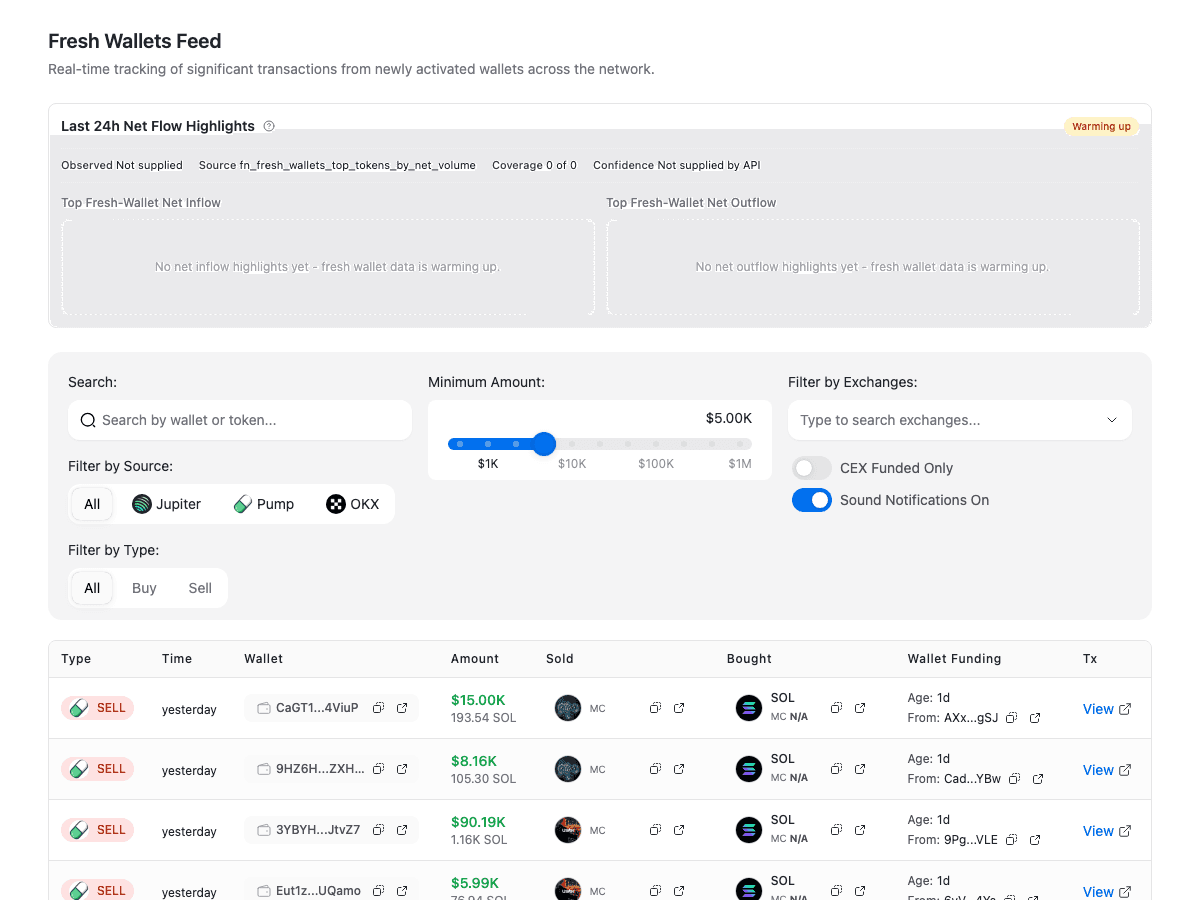
This production view provides the inputs for a funding-first pass. It helps identify newly activated wallets and their first observed activity. It does not prove that several addresses share an owner.
Step 4: compare repeated buying with scheduled DCA
Repeated manual buys and public DCA schedules can reveal patient execution.
Use the Live DCA Feed to check selling asset, buying asset, remaining balance, interval, last fill, and lifecycle status. A completed or canceled order is historical. An overdue order needs verification before its remaining balance counts as live pressure.
The full Jupiter DCA guide explains how to distinguish opening size from current executable commitment.
DCA plus repeated buying is useful only when the wallets are independent and top holders are not distributing into the same demand.
Reconcile quiet pressure with visible orders
The pressure summary and lifecycle table are not interchangeable. The summary surfaces notable net token flow inside the selected window. The table can include smaller, offsetting, completed, canceled, or overdue orders that do not qualify for a pressure card.
For each token, build a small reconciliation ledger:
| Field | Accumulation use |
|---|---|
| Recent completed buys | Historical evidence of executed demand |
| Active remaining buys | Potential future demand after a fresh-fill check |
| Overdue remaining buys | Unresolved until the schedule advances |
| Token sell orders | Offset against buy-side commitment |
| Distinct wallet clusters | Breadth after related wallets are collapsed |
This prevents a recent completed buy from being counted twice as historical execution and future commitment. It also prevents a quiet pressure card from being misread as proof that no scheduled activity exists.
Apply a source-freshness veto before combining signals
Do not average a stale source into a multi-signal confidence score. Veto it from the current window and keep it in a separate historical column.
| DCA source state | Whale-analysis treatment |
|---|---|
| Fresh source, recent fill, active balance | May support current scheduled accumulation |
| Fresh source, completed buy | Historical execution only |
| Fresh source, canceled order | No remaining commitment |
| Overdue order | Unresolved until a new fill or account update |
| Source delayed beyond the research window | Historical lead only, regardless of displayed state |
This rule avoids false precision. Three independent current sources plus one stale source is a three-source conclusion, not a four-source conclusion with a small freshness penalty.
Example: three MET rows from one wallet are not three whales
The August 21 visible table included three USDC-to-MET rows from the same abbreviated wallet. Each displayed a $2,000 opening amount, but their lifecycle states differed:
- one completed with zero remaining
- one canceled with zero remaining
- one overdue with no fills and $2,000 remaining
A raw order count suggests three buy schedules and $6,000 of interest. The actor-level and lifecycle-aware read is narrower. One wallet created three records, $4,000 of opening size no longer represented future execution, and the remaining $2,000 lacked a recent fill on a delayed source.
This is historical order behavior with unresolved future pressure. It does not establish multiple independent whales, sustained accumulation, or a currently executable $2,000 bid.
Step 5: inspect top-holder balance changes
Current concentration is a snapshot. Accumulation requires change over time.
For the top non-infrastructure holders, compare balances at consistent checkpoints. Exclude:
- LP vaults and pool accounts
- burn addresses
- lockers and vesting contracts
- program-owned accounts
- known exchange custody
- wrapped-token infrastructure
Then ask whether credible holders gained supply, insiders reduced supply, or tokens merely moved between linked addresses.
Use Insider Scan and the Solana due-diligence checklist to investigate concentration and deployer-linked clusters.
Track actor concentration, not only wallet balances
For each checkpoint, calculate the raw share held by top token accounts and a second share for independent non-infrastructure actors. Exclude or separately classify pools, burns, programs, lockers, and custody accounts, then combine wallets only when funding and behavior support the relationship.
This distinguishes broad accumulation from one whale spreading the same exposure across addresses. Follow the Solana holder-distribution guide for the full raw-to-adjusted workflow and the liquidity test that determines whether a concentrated position is a practical overhang.
If total holder count rises while actor concentration stays flat, the token has gained addresses without necessarily gaining independent demand.
Normalize accumulation by market capacity
Raw dollars do not travel well across tokens or market regimes. Compare each actor's net spend with the liquidity available when the trades occurred.
Keep three ratios:
- Net spend to quote liquidity: how large the buying was relative to available quote-side depth.
- Exposure to circulating supply: the actor's reconciled token balance against a stated supply denominator.
- Executable exit to current depth: the fresh quote output for the actor's position, not its marked value.
A $25,000 net buy can be routine in a deep market and dominant in a shallow pool. Likewise, a large marked position may have little realizable value if its full sell overwhelms the route.
Do not add the ratios into a synthetic conviction score. Read them together: the first describes market influence while buying, the second describes supply control, and the third describes present exit risk.
Step 6: check who is selling into the accumulation
Buy pressure can be exit liquidity for larger sellers.
Compare the accumulating cohort with:
- deployer and team wallets
- first buyers
- current top holders
- tracked KOL wallets
- LP removers
- wallets with unlock or vesting exposure
If small wallets are steadily buying while two dominant holders reduce exposure, the market may be distributing supply despite rising holder count.
The first-buyer workflow helps identify whether early wallets are still exposed or already selling into later demand.
Step 7: test realistic exit depth
A whale position is also an overhang. Estimate how much the wallet could sell against current liquidity and what that would do to price.
Use several scenarios:
- a quiet-market partial exit
- the full tracked position
- several linked whales exiting together
- a drawdown with thinner liquidity
- LP removal before the sale
A concentrated accumulator can support price while buying and overwhelm the pool while leaving. Accumulation is not automatically a safer holder structure.
Treat LP control as part of the whale's exit capacity
Check whether the accumulator, its funder, or a related wallet controls a material LP position. If the actor can remove quote liquidity before selling, a reserve snapshot taken before the withdrawal overstates everyone else's exit capacity.
Reconstruct material pool withdrawals and request new sell quotes instead of carrying the old depth forward. The Solana liquidity-removal guide provides the transaction ledger, migration test, and quote ladder for this check.
Check whether the accumulator has a profitable process
Large size does not prove skill. Reconstruct the actor's mature positions and compare total PnL, ROI, win rate, median return, drawdown, and entry liquidity.
Use the Solana wallet profitability workflow to carry basis across related wallets, separate realized from unrealized results, and mark thin-token valuations as partial. This is especially important when the accumulator consolidates tokens into a holding address or distributes exits across siblings.
A useful accumulator has repeatable execution and risk control across a complete sample. A wallet with one enormous winner and several transferred-out losses may look profitable in a surface-level review while offering little evidence of a durable edge.
Example: representative accumulation readout
Consider this anonymized token:
- 12 wallets each made at least three buys over 48 hours
- 5 wallets traced to one parent funder
- 4 unrelated established wallets increased balances
- 3 wallets sold most of their purchases within two hours
- one active DCA order had $18,000 remaining
- two top holders reduced a combined 4% of circulating supply
- selling the tracked cohort would cause severe modeled price impact
The raw read is 12 repeat buyers plus scheduled demand. The actor-level read is less bullish: one five-wallet cluster, four credible accumulators, three short-term traders, and material top-holder distribution.
This is mixed flow with meaningful exit risk, not clean whale confirmation.
Compare accumulation with the counterparty cohort
Every accumulated token came from another holder, a liquidity pool, or newly issued supply. Build a matched flow table for the same window:
| Cohort | What to measure | Interpretation |
|---|---|---|
| Candidate accumulators | reconciled net token increase | demand that remained exposed |
| First buyers and insiders | reconciled net token decrease | possible distribution into later demand |
| Other top holders | balance change and transfer destinations | concentration improving or shifting |
| LP controllers | quote reserve and active-liquidity change | whether exits became easier or harder |
Accumulation is stronger when independent buyers retain exposure while no concentrated early cohort is exiting and liquidity expands. It is weaker when new wallets absorb supply from insiders while quote depth falls.
This counterparty view prevents a common mistake: calling visible buy flow bullish without identifying who supplied the tokens and whether that seller still controls more inventory.
Add confidence after interpretation
Label the final readout with the weakest material source:
- Higher confidence: time-aligned transactions, current balances, independent actors, active DCA fills, and defensible exit depth.
- Medium confidence: most evidence aligns, but one supporting source or price input is partial.
- Research-only: key feeds are stale, delayed, or historical, even if the old pattern is interesting.
- Unresolved: wallet relationships, mint identity, balance conservation, or liquidity cannot be verified.
Confidence describes evidence quality. It does not estimate the probability that price will rise.
Keep an invalidation ledger
For every live thesis, write the condition that would weaken it and the evidence needed to test that condition.
| Thesis component | Invalidation evidence | Required response |
|---|---|---|
| Actor keeps accumulating | Reconciled exposure falls at the next checkpoint | Reclassify as distribution or partial exit |
| Buyers are independent | Direct funding or transfer links connect them | Recalculate breadth and concentration |
| DCA adds future demand | Order completes, cancels, becomes overdue, or stops filling | Remove unsupported remaining pressure |
| Position is exit-capable | Fresh full-size quote breaches the recorded impact limit | Downgrade tradeability even if marked value rises |
| Sources are current | Source clock falls outside the research window | Move the affected evidence to historical |
An invalidation ledger prevents a thesis from surviving by definition. It also shows exactly which observation changed the final label.
Healthier and riskier patterns
Healthier accumulation
- Several unrelated established wallets add over separate sessions.
- Funding sources and buy sizes vary naturally.
- Balances rise without matching hidden transfers out.
- Active DCA orders continue filling and retain meaningful balance.
- Insider and top-holder supply is stable or falling for defensible reasons.
- Pool depth grows with the position base.
Riskier accumulation
- Most buyers are fresh wallets funded by one parent.
- Buys synchronize around public promotion.
- Top holders sell into the flow.
- DCA orders are canceled or overdue.
- Tokens circulate between related wallets.
- One cluster controls a large share of supply.
- The pool cannot support the tracked cohort's exit.
Minimum evidence for an accumulation label
Use confirmed accumulation only when net actor exposure increased across at least two separate checkpoints. Material transfers and protocol positions must reconcile, and current liquidity must be observable.
Use possible accumulation when buys repeat but one material coverage input remains partial.
Use unresolved flow when related wallets, destination accounts, or source freshness prevent a conserved ledger.
These labels describe evidence strength, not trade quality. Confirmed accumulation can still be a poor setup when one actor controls the float or cannot exit without overwhelming the pool.
Use Stalkchain for supporting evidence
Stalkchain currently provides public supporting surfaces for this workflow rather than a dedicated public Solana whale-accumulation ranking.
Start with Fresh Wallets Feed, Live DCA Feed, KOL Feed, and Insider Scan. Verify important signatures and calculate actor-level exposure before calling a pattern accumulation.
If DCA is part of the thesis, use the Jupiter DCA order workflow to record the source clock, order clock, remaining raw balance, lifecycle, and wallet cluster before combining it with whale evidence.
This distinction matters. A route shell, redirect, or isolated buy does not prove a complete whale-tracking product or a bullish signal.
Final checklist
- Define the whale threshold relative to liquidity.
- Set a defensible time window.
- Predefine candidate, confirmation, and invalidation checkpoints.
- Timestamp every source and require overlapping evidence windows.
- Reconstruct buys, sells, transfers, and remaining exposure.
- Require the actor exposure ledger to conserve across checkpoints.
- Trace funding and collapse linked wallets.
- Compare repeated buys with active DCA schedules.
- Reconcile pressure summaries with completed, active, canceled, and overdue rows.
- Collapse repeated orders from the same wallet before measuring buyer breadth.
- Measure top-holder balance changes over time.
- Identify sellers on the other side.
- Exclude infrastructure from concentration.
- Model the cohort's realistic exit.
- Preserve uncertainty around identity, pricing, and basis.
FAQ
What is whale accumulation on Solana?
It is sustained growth in token exposure by a large actor or several independent large wallets. The evidence should include net balance change, repeated execution, wallet relationships, and later behavior.
Is one large buy whale accumulation?
No. It is one transaction. The wallet may sell immediately, transfer the tokens, provide liquidity, or be rebalancing inventory.
Do fresh wallets prove a whale is accumulating?
No. They can be independent users, bot infrastructure, team-controlled addresses, or one actor split across wallets. Funding and synchronized behavior determine whether a cluster is plausible.
Does a DCA buy prove conviction?
No. DCA orders can be canceled, completed, overdue, or offset by sell orders. Check remaining balance, lifecycle state, and recent fills.
Can whale accumulation be bearish?
Yes. One cluster controlling more supply increases exit overhang. Accumulation can also occur while insiders or earlier holders distribute into the demand.
What is the strongest confirmation?
Several unrelated wallets increasing net exposure across separate sessions, while active scheduled buying continues, top holders are not distributing, and liquidity can support realistic exits.