Quick answer
A Solana KOL tracker connects attributed traders to public wallet activity. Use it to find research candidates, not automatic entries. Verify the transaction, holding, exit behavior, wallet history, token concentration, and liquidity before giving the signal weight.
What a Solana KOL tracker shows
A KOL tracker converts attributed wallet activity into a readable research feed. KOL means key opinion leader, but the useful unit is still the wallet, not the follower count.
A strong feed should expose both sides of the position:
- whether the latest transaction was a buy or sell
- the tracked trader and token
- market cap near the observed transaction
- total bought and sold in the covered position
- estimated current holding
- net cash flow and percentage result
- time from first buy to first sell
- transaction and wallet links for verification
The feed does not prove that every attributed wallet is controlled by the named person today. It also does not turn estimated PnL into audited accounting.
Check freshness before you check the trader
A populated table can still be too old for a trading decision. Read the page-level freshness state, the row observation time, and the transaction timestamp before comparing wallets.
On August 30, 2026, the public KOL Feed showed buy and sell observations timestamped within minutes of the live review. It also labeled each card as a decision brief and stated that alerts were not sent.
The page explicitly withheld confidence, liquidity, concentration, execution quality, and outcome eligibility when those inputs were not supplied. That is the correct boundary.
A fresh observed action can support discovery, but it does not qualify a buy or sell recommendation. Freshness answers when the row was observed. It does not answer whether the trade is liquid, independent, repeatable, or still open.
Use three freshness classes:
- Decision-fresh: the source and transaction fall inside the window required by your strategy.
- Research-only: the row is valid historical evidence, but too old to infer current exposure or intent.
- Unresolved: the source timestamp, transaction, or current holding cannot be verified.
Do not hide stale rows by sorting for the largest buy. A large historical entry is still historical.
Separate address activity from KOL strategy activity
An attributed wallet can remain on-chain active without repeating the behavior that made the trader relevant. A fee payment, transfer, NFT action, or unrelated protocol movement can update the address's last-seen time without confirming a new token thesis.
For every KOL candidate, preserve three checkpoints:
- newest verified signature of any kind
- newest successful economic balance change
- newest event matching the strategy being evaluated
Measure the inactivity gap before the current event. A wallet returning after a long pause is a reactivation that needs a new validation sample, not automatic continuation of its historical edge.
The Solana wallet activity workflow explains how to classify signatures and cadence. Keep attributed identity, address activity, trading activity, and decision freshness as separate fields in the KOL record.
Separate market-pulse freshness from KOL-row freshness
On September 6, 2026, an initial extraction of the public KOL Feed rendered a current-looking Market Pulse, then reported that the latest request had failed and last-good KOL rows would remain visible. A later browser check at 01:04 UTC rendered populated buy and sell cards with no page error.
Those are two data layers. A fresh market pulse does not prove the KOL observations refreshed successfully. Likewise, retained last-good KOL rows do not make the broader market pulse stale.
Record freshness by component:
- Market pulse: Save its update time and source state. Use it only for broad market context.
- KOL observation: Save the row observation time and source state. Use it to discover a candidate.
- Transaction: Save the exact signature and confirmed block time. Use it to verify what the wallet did.
- Position: Reconcile buys, sells, transfers, and inventory before evaluating exposure or covered performance.
The two observations show that a transient component failure can recover between checks. If the KOL request fails, keep retained rows historical and verify the exact address elsewhere. If it recovers, record the new observation time and still verify the signature before calling a row current.
Do not combine a fresh market card with an old KOL row to manufacture a current attributed trade. Do not keep calling the feed unavailable after a later browser check proves that current rows rendered.
Separate the observation card from the position table
The current public route can expose two useful layers. Observation cards summarize the latest action and a cautious watch state. The position table adds trader, token, market cap, bought value, sold value, remaining holding, result, and holding time when those fields are available.
Do not merge the layers into a stronger claim than either supports. A recent card can lack complete position accounting. A position row can contain useful historical bought and sold values while its current holding or basis remains partial.
Use this order:
- Save the observed time and latest action.
- Open the position detail and complete wallet address.
- Verify the successful signature and raw balance changes.
- Reconcile earlier buys, partial sells, transfers, and remaining quantity.
- Test current liquidity for your own size.
Why copying a KOL buy usually fails
The KOL wallet and the follower rarely receive the same trade.
Your entry arrives later
A visible buy can move a thin pool before the feed renders. The original wallet may have a lower basis and better liquidity. A follower who arrives seconds later can be buying the price impact created by the signal.
The exit is easier to miss
Entries attract attention. Partial sells often do not. A trader can recover basis across several small exits while followers still think the original position is intact.
The visible wallet may be only one part of the position
An attributed wallet can buy after related addresses accumulated. It can also transfer inventory to another address. Review funding and related wallets with the Solana wallet tracking workflow before treating one address as the whole actor.
Measure signal decay before judging the trader
A correct observation can become a bad follower trade while you are still verifying it. Separate the trader's result from the result available after detection, research, quote preparation, and confirmation.
Record four checkpoints for any KOL signal you might act on:
| Checkpoint | What to save | What it tests |
|---|---|---|
| Wallet execution | Confirmed time, input, output, and pool state | The trader's actual entry |
| Feed observation | Time the row became visible to you | Detection delay |
| Decision | Time verification finished and the candidate passed your rules | Research delay |
| Executable quote | Input size, minimum output, impact, fees, and expiry | The trade available to you |
Compare the wallet's effective price with the fresh executable quote, not the chart's last price. The difference is the copy gap. It includes price movement, route changes, fees, slippage, and any advantage the original wallet received by arriving first.
Set the allowed gap before reviewing the signal. If the quote exceeds that limit, reject the copy even when the wallet thesis remains valid. This prevents a good wallet from becoming an excuse to chase a bad entry.
Step 1: start with the latest transaction
Open the Stalkchain KOL Feed and read the latest transaction type first. A sell can be more informative than a buy because it shows what the wallet did after attention and price movement arrived.
If the KOL Feed is loading, stale, or outside your decision window, do not promote the last visible row into a current alert. Cross-check the address in Smart Money Transactions, which exposes date, time, wallet, sold asset, bought asset, and USD value for recent qualifying activity.
The two surfaces answer different questions. The KOL Feed supplies attribution and position context. The transaction table supplies a fresher market-wide lead. Neither proves the wallet's current balance or profitability by itself.
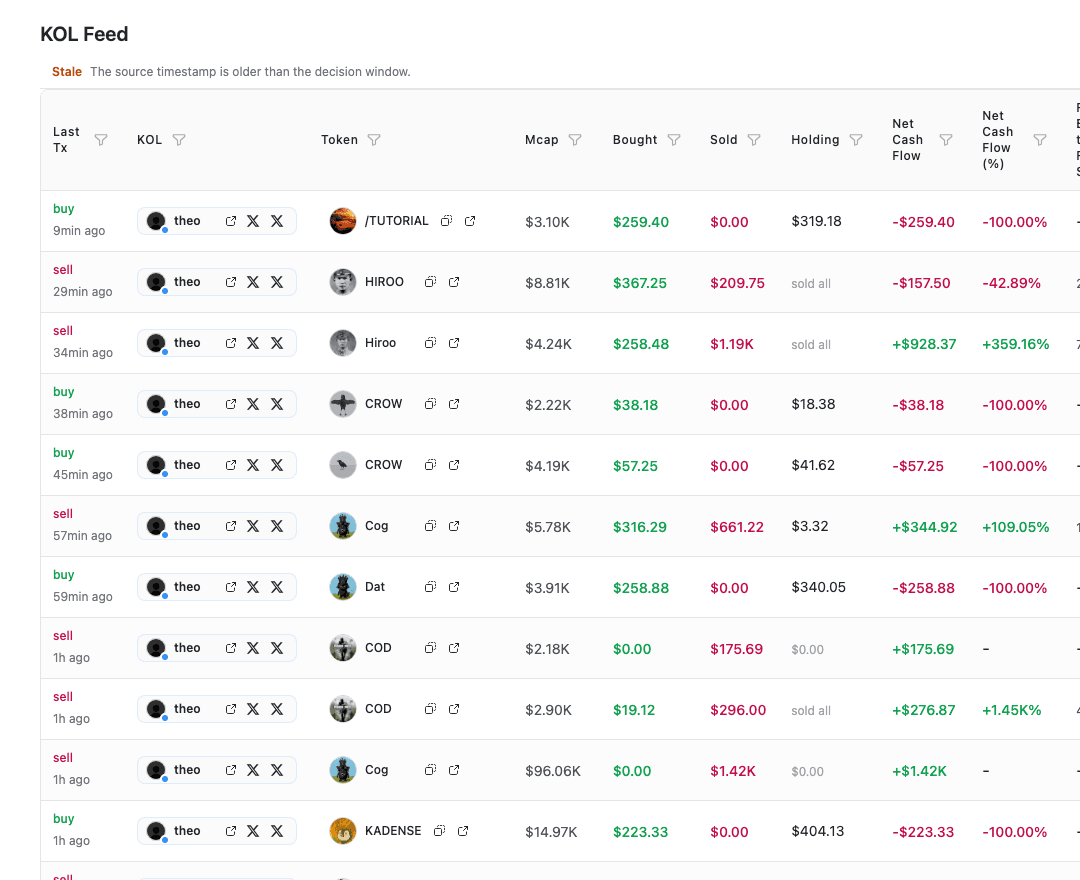
This production view was captured on July 26, 2026. It contained populated rows and displayed a stale-source warning at capture time. That warning matters: current-looking rows can still sit outside the decision window. Always read the freshness state before interpreting the table.
The screenshot also shows why a negative cash-flow figure on an open buy is not automatically a realized loss. Bought value can appear before a later sell, while current holding valuation and cost basis may be incomplete.
Step 2: verify the wallet and transaction
Open the wallet and transaction links. Confirm that the row represents a completed swap rather than a transfer, failed transaction, LP action, or routing artifact.
Then answer five questions:
- Does the public attribution still have supporting evidence?
- Was this the wallet's first position in the token?
- Did related wallets enter earlier?
- Is the displayed holding still in the same address?
- Does the transaction timestamp fall inside a fresh decision window?
A label saves discovery time. It does not remove the need to inspect the chain.
Step 3: read bought, sold, holding, and cash flow together
No single column describes the position.
Bought estimates covered acquisition flow. It may miss transferred-in inventory or older basis.
Sold estimates covered disposal flow. A zero can mean no covered sell, not permanent conviction.
Holding estimates remaining token value. Thin-token prices can make that value unstable or temporarily unavailable.
Net cash flow compares covered inflows and outflows. It should not be called profit when acquisition basis, transfers, fees, or remaining inventory are incomplete.
Use the broader wallet-performance checklist to compare the full sample rather than one row. When profitability is the research question, reconstruct the address with the Solana wallet PnL method instead of ranking traders from cash flow alone.
A four-state read for open and closed positions
Classify each feed row before comparing traders:
- Open with defensible value: covered buys, unsold inventory, and a usable liquidity-aware price.
- Open with partial value: inventory remains, but basis or current value is incomplete.
- Closed with defensible basis: covered disposal and acquisition records support a realized result.
- Closed with incomplete basis: proceeds are visible, but transferred-in or older inventory prevents exact PnL.
This prevents an open buy with negative cash flow from being ranked as a realized loser. It also prevents a completed sale with missing acquisition history from being called a confirmed winner.
Build a position-lot ledger before comparing KOLs
A feed row is an observation, not a complete position. Group every covered buy, sell, transfer, and protocol movement for the same mint into one position ledger.
For each lot, preserve:
- the successful signature and block time
- raw token and quote-asset balance changes
- verified mint decimals
- acquisition basis or carried basis state
- destination of transferred inventory
- fees and remaining controlled quantity
- marked value and a fresh executable sell estimate
Keep observed, partial, and unresolved coverage explicit. If the wallet sold transferred-in tokens, the proceeds may be observed while acquisition basis remains unresolved. If inventory moved to a sibling address, address-level exposure fell but actor-level exposure may not have changed.
Use the Solana wallet holdings workflow to reconcile native SOL, token accounts, wrapped SOL, and protocol positions. A KOL ranking should inherit the weakest material coverage state in its underlying lots.
| Feed pattern | Defensible ledger reading |
|---|---|
| Buy with no covered sell | Open cash outflow; total PnL depends on remaining inventory |
| Partial sells with inventory remaining | Realized and unrealized components must stay separate |
| Tokens transferred out | Disposal and ownership remain unresolved until traced |
| Zero visible holding after LP deposit | Spot balance fell; protocol exposure may remain |
| Sale of transferred-in tokens | Proceeds observed; acquisition basis may be incomplete |
Step 4: test whether the trader has repeatable behavior
A useful KOL wallet should show an edge across many mature or closed positions.
Review:
- sample size and coverage window
- median result, not only the largest winner
- average gain versus average loss
- holding period and entry liquidity
- losses, abandoned positions, and open bags
- behavior before and after public posts
- whether results survive fees and realistic slippage
A high win rate with tiny wins can be worse than a lower win rate with disciplined losses and larger winners. One extreme outcome can dominate total PnL.
Score the evidence, not the smart-money label
Use a compact scorecard before adding a wallet to a watchlist:
| Dimension | Stronger evidence | Weaker evidence |
|---|---|---|
| Freshness | Recent source and verified signature | Stale source or unresolved timestamp |
| Repeatability | Many mature positions with losses included | One visible winner |
| Independence | No credible pre-positioned sibling cluster | Related wallets entered first |
| Executability | Your size fits current pool depth | Followers would crowd the exit |
A wallet needs strength across all four dimensions to qualify as a serious research lead. No scorecard turns it into an automatic entry.
For an unattributed address, follow the broader smart-money wallet research workflow. It adds fixed-sample performance, funding independence, actor-level clustering, and follower execution to the review.
Keep attribution quality separate from trading quality. A public name can be correctly linked to an ordinary wallet, while an unattributed wallet can have a strong covered record.
Step 5: check the token before the trader influences you
A skilled wallet can still buy a weak token. Run the Solana token due-diligence checklist before acting.
At minimum, inspect:
- current non-infrastructure holder concentration
- deployer and insider-linked wallets
- first buyers and fresh-wallet clusters
- pool depth and realistic exit price impact
- current large-holder accumulation or distribution
- scheduled DCA buying and selling
The first-buyer guide helps establish launch context. The fresh-wallet guide helps separate newly activated independent buyers from coordinated addresses.
Example: interpreting one feed sequence
Consider a representative sequence:
- one attributed wallet buys $260 of a thin token
- the feed estimates a $320 current holding
- the row initially shows negative net cash flow because nothing has been sold
- thirty minutes later the wallet sells part of the position
- a related wallet funded by the same parent sold earlier
- the pool has little depth near the current price
The first row looked like conviction. The full sequence looks like a small, partially distributed cluster with fragile exit liquidity.
That does not prove a paid promotion or coordinated dump. It does show why entry, related-wallet activity, and pool depth must be read together.
Healthier and riskier KOL patterns
Healthier pattern
- The wallet has a meaningful, fully reviewed history.
- The entry happened before public attention without obvious related-wallet positioning.
- Position size is meaningful but compatible with pool depth.
- The wallet retains exposure or exits with consistent discipline.
- Independent first-buyer, whale, or DCA evidence supports the thesis.
Riskier pattern
- The buy is dust-sized relative to the wallet.
- Related addresses accumulated before the visible transaction.
- The trader posts immediately after buying.
- Partial sells begin while attention is still rising.
- Current holding or PnL basis is unavailable.
- Followers would materially crowd the same exit.
Use Stalkchain as a research loop
Start in the KOL Feed. Verify the transaction and wallet, then move to fresh-wallet activity, Insider Scan, and Live DCA Feed for independent evidence.
When the same token appears across unrelated KOL wallets, a fresh-buyer cohort, and patient scheduled buying, the convergence deserves deeper research. It still does not guarantee direction or execution quality.
The public Smart Money Transactions route is a useful freshness cross-check. It exposes date, time, wallet, sold asset, bought asset, and USD value for qualifying activity.
Repeated rows can still represent one wallet, routed execution, or one position split across signatures. Deduplicate the sequence before calling it broad confirmation.
Final checklist
- Read the source freshness state.
- Check market-pulse and KOL-row freshness separately.
- Classify the row as decision-fresh, research-only, or unresolved.
- Confirm buy or sell direction.
- Open the transaction and wallet links.
- Review bought, sold, holding, and cash flow together.
- Reconcile position lots, transfers, fees, and remaining quantity.
- Check attribution and related wallets.
- Compare the full performance sample.
- Inspect holders, insiders, and first buyers.
- Test pool depth and copy-trade crowding.
- Compare the wallet entry with your fresh executable quote and reject an excessive copy gap.
- Keep monitoring exits after an entry.
- Preserve uncertainty around basis and unrealized value.
FAQ
What is a Solana KOL tracker?
It is a wallet research interface that maps attributed public traders to on-chain activity. It can show buys, sells, holdings, and performance context, but attribution and calculated results still require verification.
Is a KOL buy a smart-money signal?
It can be one input. Give it more weight when the wallet has repeatable results, the position is meaningful, related addresses did not pre-position, and independent token evidence supports the same thesis.
Why can an open buy show negative net cash flow?
Cash left the wallet to acquire the token, while no covered sale has returned cash yet. The remaining holding may still have value. Cash flow, realized PnL, and total PnL are different measurements.
Should I copy KOL wallets automatically?
No. Detection delay, price impact, hidden related wallets, partial exits, and thin liquidity make follower execution materially different from the original trade.
What should I check after a KOL alert?
Verify the transaction, inspect the wallet's complete history, check current holdings, review first buyers and holder concentration, and estimate your own exit against current liquidity.