A large wallet moves a token overnight and you need to know what just happened. Is that one fund rebalancing, a cluster of related addresses moving in step, or a single exchange deposit that hits the order book in ten minutes?
Arkham answers that question better than most tools, which is why plenty of people stop looking once they've paid for it. But a label on a screen is the start of the work, not the end. A third-party compilation credits Arkham with more than 3 million registered users, while the app-store listings captured alongside it show about 10,000+ Google Play downloads and 65 Apple App Store ratings averaging 4.9 (kkdemian analysis of Arkham). Reach and analytical quality are different claims.
Ten tools follow, grouped by the research job each one serves. For the wider category first, the top analytics tools for researchers covers the general field. This list stays narrow:
- Entity attribution asks who controls an address.
- Holder concentration asks whether supply sits in a few hands.
- Custom SQL asks questions no product anticipated.
- Market context asks what the aggregate is doing.
- Portfolio monitoring asks what a wallet holds right now.
- AI-driven access asks whether an agent can fetch and verify an answer.
Table of Contents
- 1. StalkChain
- 2. Nansen
- 3. Bubblemaps
- 4. Dune
- 5. Glassnode
- 6. CryptoQuant
- 7. DeBank
- 8. Zerion
- 9. Lookonchain
- 10. GMGN
- How the Arkham alternatives compare by research job, core strength, and AI or API access
- Pick the Tool That Fits Your Research Question
1. StalkChain
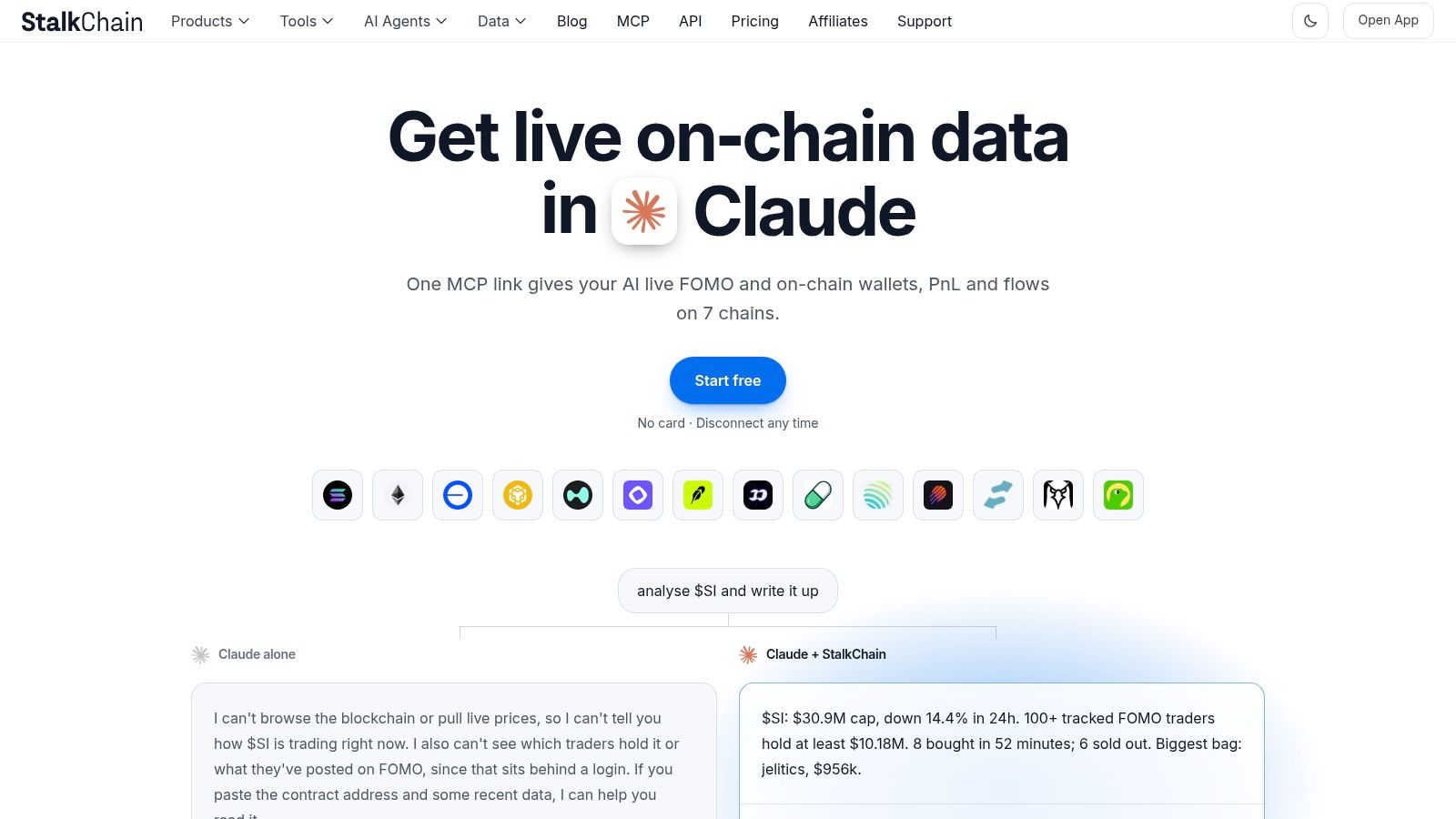
When your question needs current wallet, trader, or token-flow data inside an AI workflow, StalkChain provides access through an MCP server or REST API. Both use one account and credit balance. The data covers wallet holdings, realized and unrealized PnL, token flows, and KOL and whale signals across Solana, Robinhood Chain, Base, BNB Chain, Ethereum, Monad, and Hyperliquid.
One Link, Several Assistants
Connect the hosted MCP server to a supported AI assistant and ask about wallets, traders, holdings, or flows in plain English. It works with Claude, ChatGPT, Grok, Cursor, and Claude Code. The same capabilities are available through the REST API for applications, dashboards, and scripts.
Ninety data tools cover KOL feeds and leaderboards, whale activity, token trends, transactions with wallet attribution, and trader profiles with open positions and PnL. The curated tools also include the Jupiter DCA Tracker and Robinhood Chain analytics for launches, memecoin flow, whale accumulation, and tokenized stocks. StalkChain's Robinhood Chain tools section lets researchers explore the questions those tools answer.
This setup suits research that needs live data in an AI chat or an application. It does not replace judgment about labels or trading signals, and report depth varies by tool. Check the returned data against the question you are trying to answer.
Pricing and Limits
The Starter plan costs $29 per month, whether billed monthly or annually. Annual billing totals $348 per year. Plans include monthly data-call quotas, with unused calls rolling over. Eligible new accounts receive $5 in free credit at signup and first lookup. Each result shows its cost and remaining balance, helping you track usage.
Ask for the receipt: an answer that can't show its source, timestamp and price can't be reproduced, and a number you can't reproduce isn't research.
Notifications cost 250 credits per call. The stalkchain_fomo_resolve_trader tool costs 2,500 credits per call and returns the full live profile of one trader. Read-only research tools do not require private keys; trading flows use a separate funded agent wallet.
2. Nansen
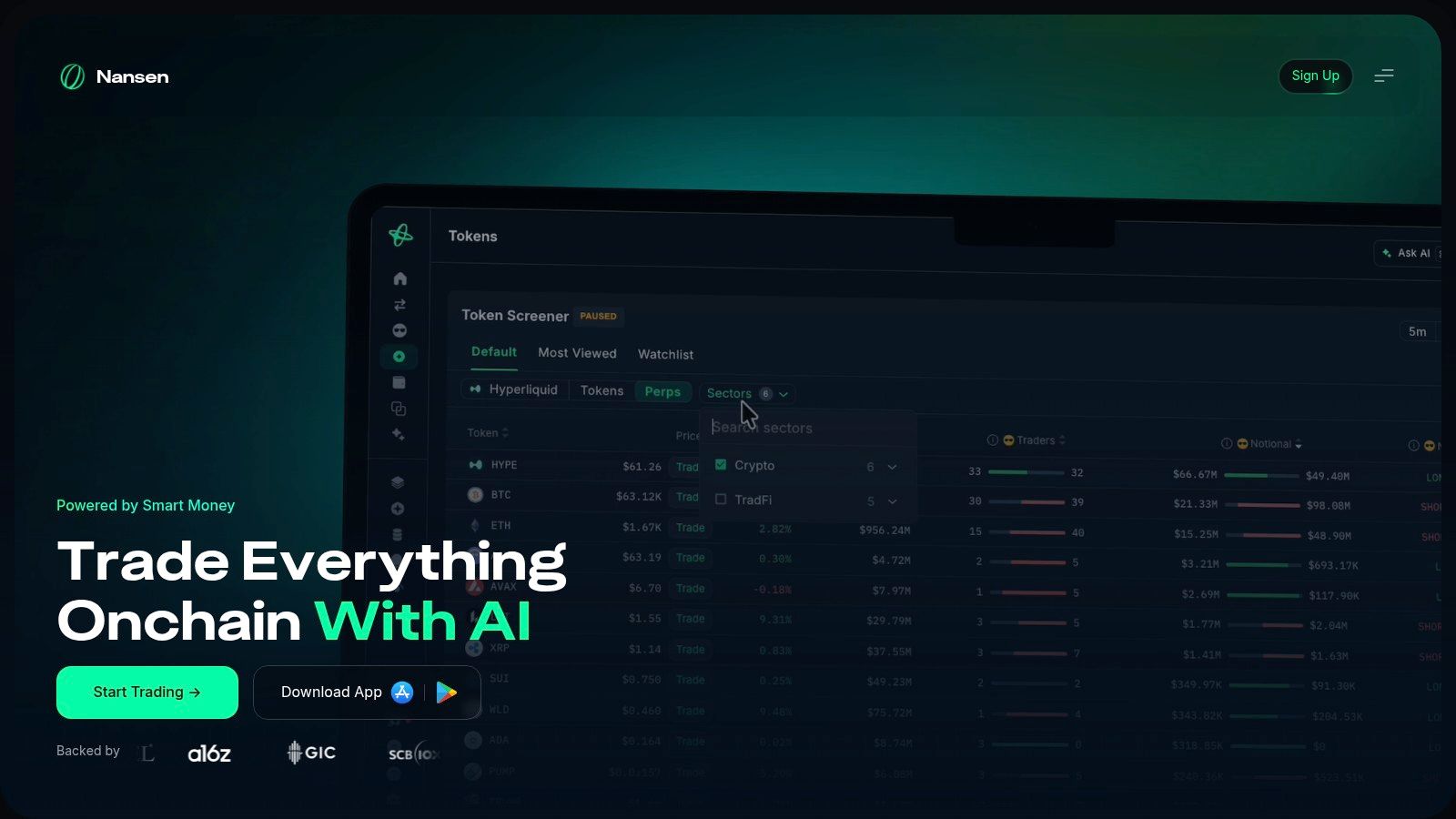
Nansen is the closest like-for-like swap here. Labels sit at the center of the product, with Smart Money views, wallet performance, token analytics and alerts wrapped around them. You can move from "who is this address" to "how has this address performed" without exporting to a spreadsheet.
What Works
- Wallet discovery and token research in one place: no stitching a label database to a separate analytics product.
- Performance context beside the label: a fund up heavily over ninety days tells a different story than one underwater.
- Two delivery paths: a browser product for analysts, API and MCP access for agents and dashboards.
Where It Stops
Labels and Smart Money classifications are the provider's interpretation. Treat each one as a lead and re-check anything you're about to trade on. API usage is credit-based, so cost scales with call volume and endpoint choice, and the fuller cross-chain analytics usually sit on a paid tier. The Nansen alternative comparison covers how those labels get built and where the method diverges from Arkham's.
Site: Nansen
3. Bubblemaps
Say a token launched three weeks ago and four wallets hold 40% of supply. Are they one team? Bubblemaps answers that faster than any table of addresses. Bubble size tracks holdings, connecting lines show detected wallet relationships, and Magic Nodes surface indirect links a manual scan would miss.
What Works
- Concentration at a glance: you see whether supply is spread or sitting in a handful of bubbles.
- Transfer filters: cut the map down to large transfers or a specific value range.
- Time Travel: replay holder distribution at earlier points to see when clusters formed.
- Shareable output: maps can be shared and addresses exported into other tools.
Where It Stops
Bubblemaps shows relationships among holders. It doesn't give entity intelligence, wallet PnL or fund-flow tracing. Maps can lag on new tokens, and a drawn connection is a clue. Attribution is probabilistic: common co-spend clustering works on UTXO chains such as Bitcoin and doesn't transfer cleanly to account-based networks (analysis of blockchain attribution in the RUSI Journal).
Two addresses funded from the same exchange deposit are not automatically the same person. They could be one desk, one market maker's routing wallets, or a copy-trading group that followed the same call.
Site: Bubblemaps
4. Dune
Dune is the tool you reach for when no product has anticipated your question. Write SQL against blockchain datasets, save the query, and publish it as a dashboard other people can read and adapt.
What Works
- Arbitrary questions: wallet cohorts, protocol usage, token distribution, anything expressible in SQL.
- Community dashboards: views of exchange wallets, fund addresses and whale movement already exist, so you start from someone else's work.
- Repeatable pipelines: scheduled queries and data APIs suit research that must run weekly.
- Free exploration: public dashboards are readable at no cost.
Where It Stops
Dune won't label an address for you. You supply the entity list or the heuristic, and you own the maintenance when a label goes stale. It also demands more data fluency than a wallet-intelligence interface, and private queries, heavier execution and API usage are paid. If you're sizing a subscription, the Dune pricing breakdown shows where credits go.
Site: Dune
5. Glassnode
An address label answers "who." Glassnode answers "what is the network doing." It pairs on-chain metrics with spot, futures, options, ETF and macro data, which is the right input when you're judging a market regime rather than chasing one wallet.
What Works
- Cycle context: supply, profitability and activity metrics over long histories.
- One tab instead of two: conventional and on-chain measures sit side by side.
- Historical depth: test whether a pattern held in earlier cycles.
- Broad asset coverage across supported networks.
Where It Stops
This is not a labeled-wallet or address-clustering product, so it won't tell you who sold. Coverage and resolution vary by plan and asset, and API access sits behind higher tiers or add-ons rather than the entry plans. When the question is about a single counterparty, use Glassnode for the backdrop and something else for the actor. For programmatic work, start with this comparison of crypto data APIs.
Site: Glassnode
6. CryptoQuant
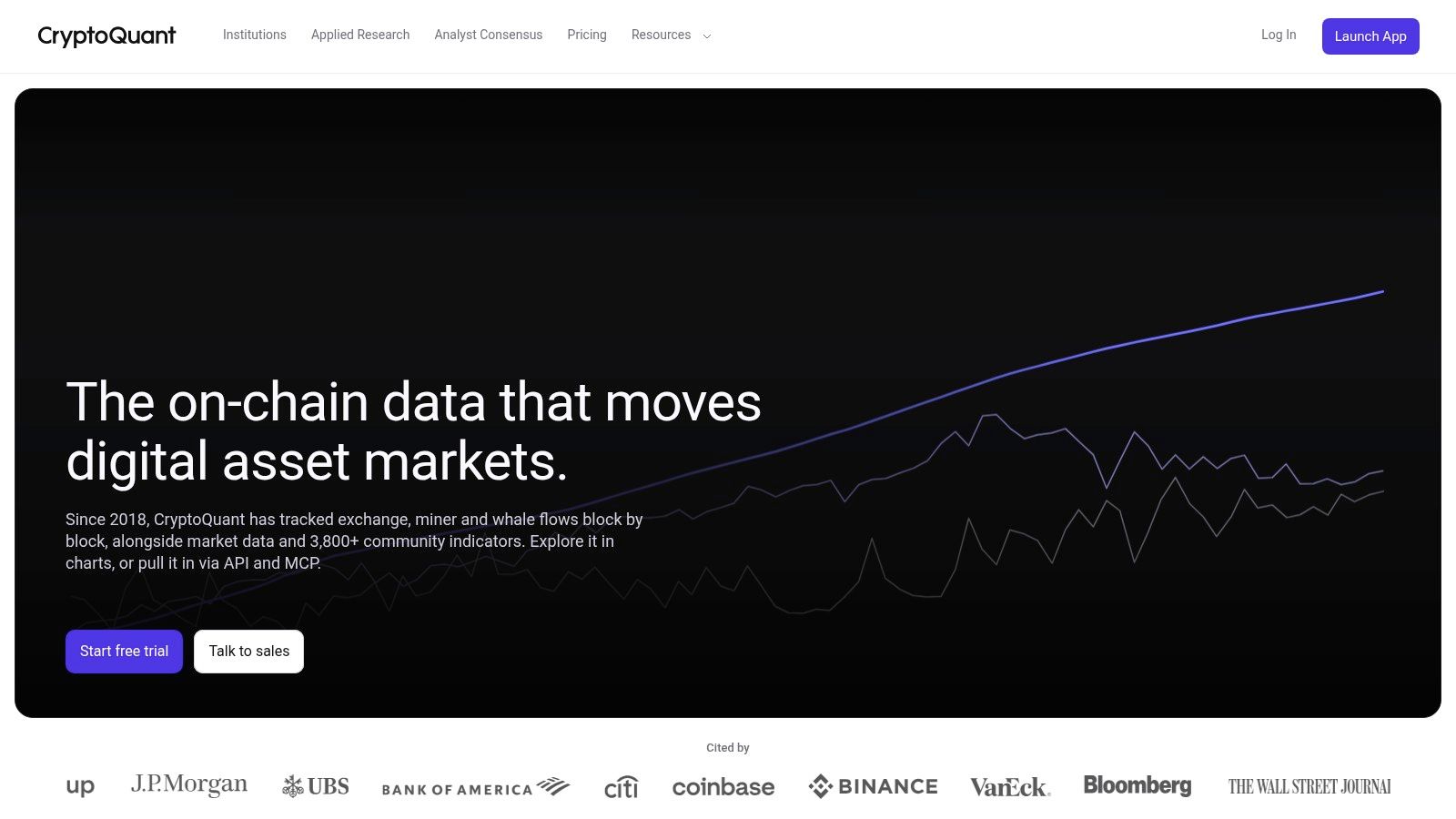
If your Arkham habit is watching exchange inflows to gauge selling pressure, CryptoQuant is the more specialized instrument. Exchange reserves, miner behavior, stablecoin and derivatives metrics are the core of the product rather than a side panel.
What Works
- Exchange flow depth: inflow and outflow series are why subscribers sign up.
- Alerts and dashboards: set thresholds instead of refreshing charts.
- A free tier: enough to test whether the indicators fit your process.
- Higher resolution and on-chain API access on paid plans.
Where It Stops
Tracing one wallet through its counterparties is not this tool's job. Historical depth and API data depend on tier, and an individual subscription covers one user, which matters when a small team plans to share access. Use CryptoQuant for the aggregate flow signal, then return to an entity tool to identify who moved.
Site: CryptoQuant
7. DeBank
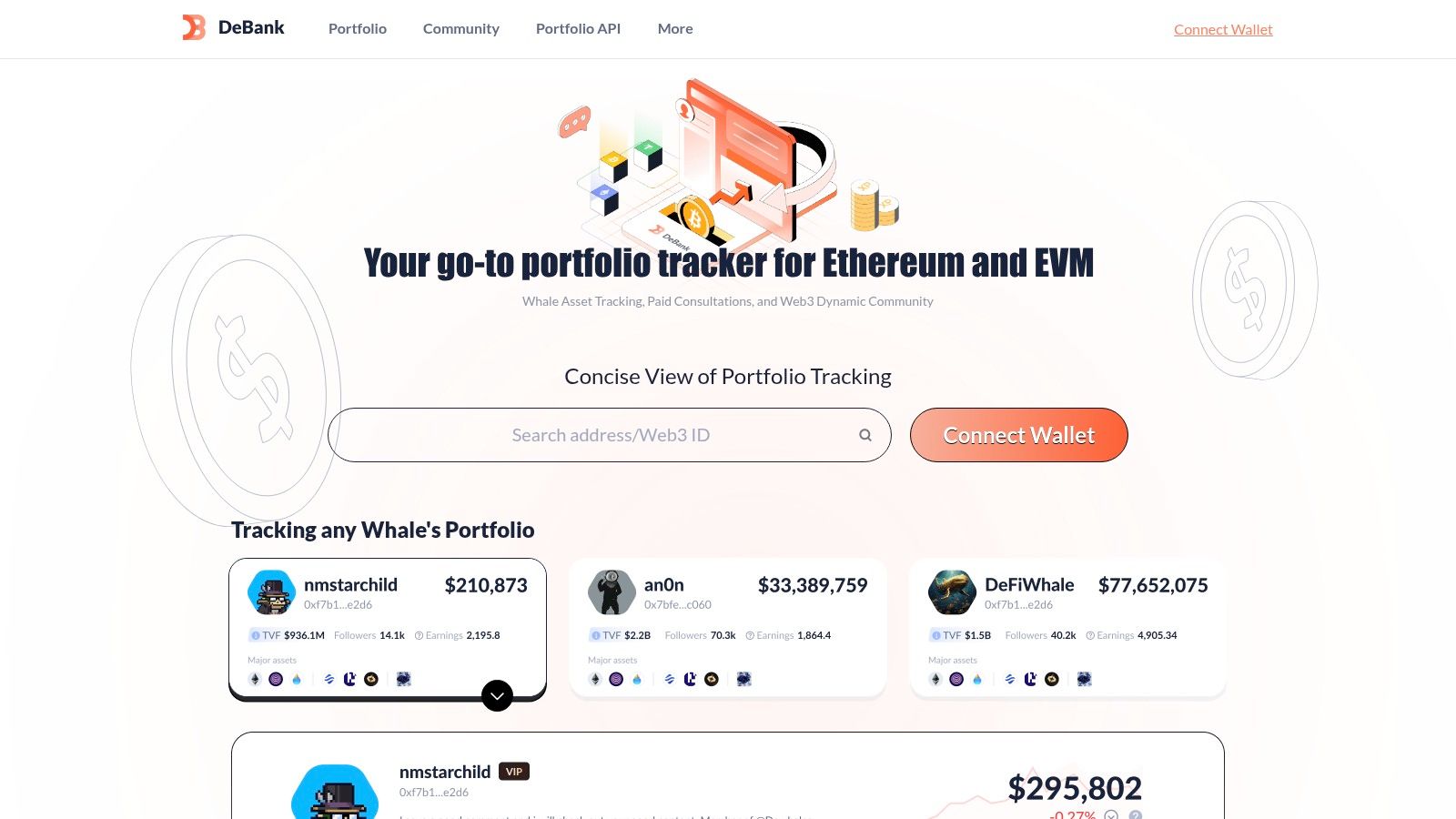
An address lands in your group chat and you want to know what it holds. DeBank gives the fastest answer. Paste it, see balances across supported chains, and read protocol positions without connecting anything.
What Works
- Positions, not just tokens: lending, LP and vault exposure in a single view.
- Transaction history for a quick read on behavior.
- Time comparisons on paid tiers to see how a portfolio shifted.
- DeBank Cloud for teams that want wallet and protocol data through an API.
Where It Stops
A portfolio view is not attribution. DeBank won't tell you whether an address belongs to a fund, a market maker or an exchange omnibus wallet, and it won't trace where the money came from. Some chain or protocol data can fail to load or arrive incomplete, and API compute units become a real cost at volume. Use it for the "what do they hold" step, then switch to an entity tool for "who are they."
Site: DeBank
8. Zerion
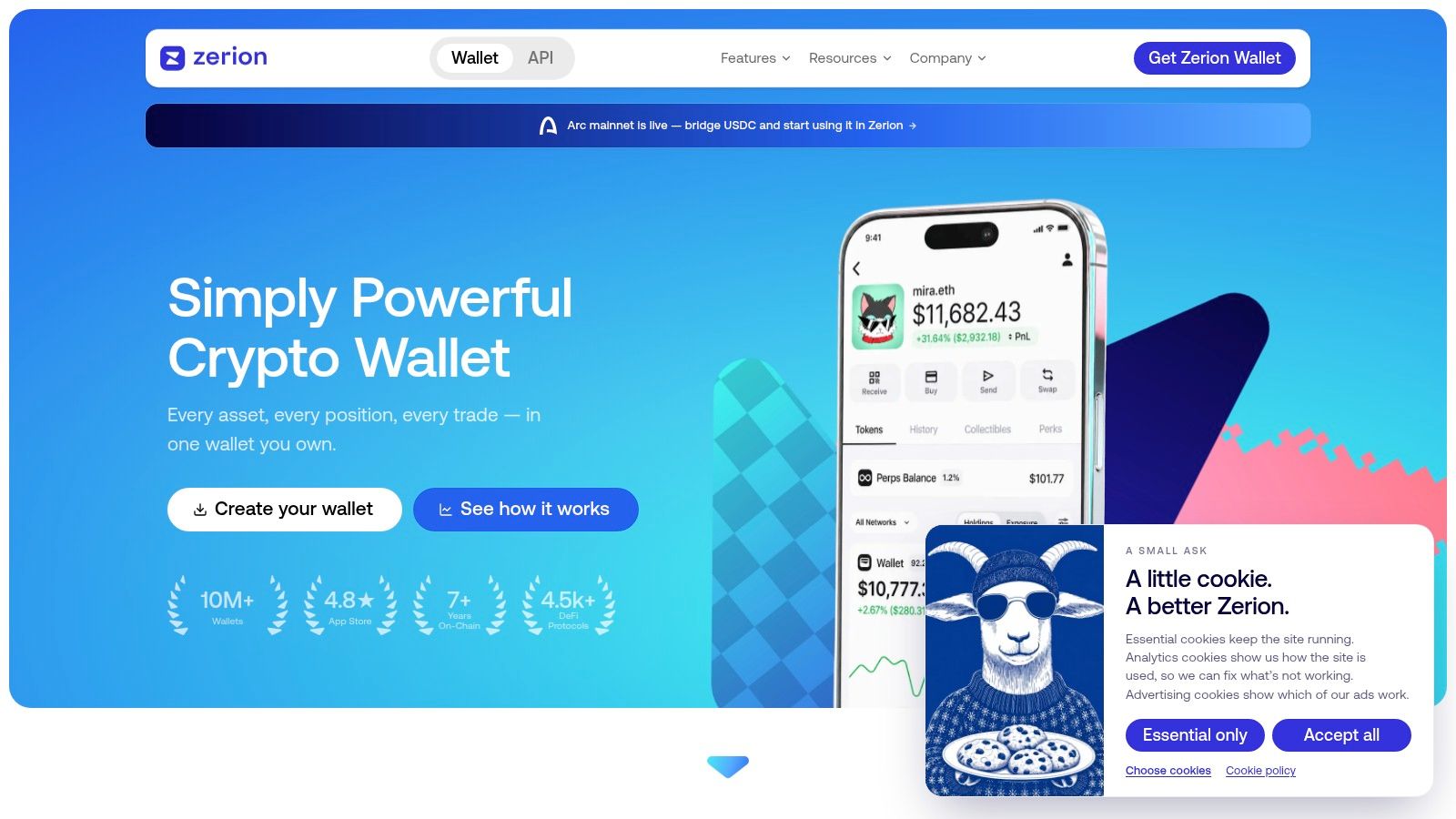
Zerion is built around watch-only monitoring. Add an address you don't control and it aggregates balances, transaction history, NFTs and supported DeFi positions across chains without asking for a key.
What Works
- No key required: watch-only tracking keeps custody risk out of research.
- Automatic position discovery for supported protocols, so you're not adding contracts by hand.
- Activity alerts on watched addresses.
- A readable interface that works on mobile when you're checking a wallet at 2am.
Where It Stops
Portfolio tracking is not entity attribution, and coverage of position types varies by chain and protocol. Alerts tell you something moved; they don't tell you why, or whether the address belongs to the entity you assume it does. Separate API and CLI products exist for builders, and heavier developer use usually means its own access tier.
Site: Zerion
9. Lookonchain
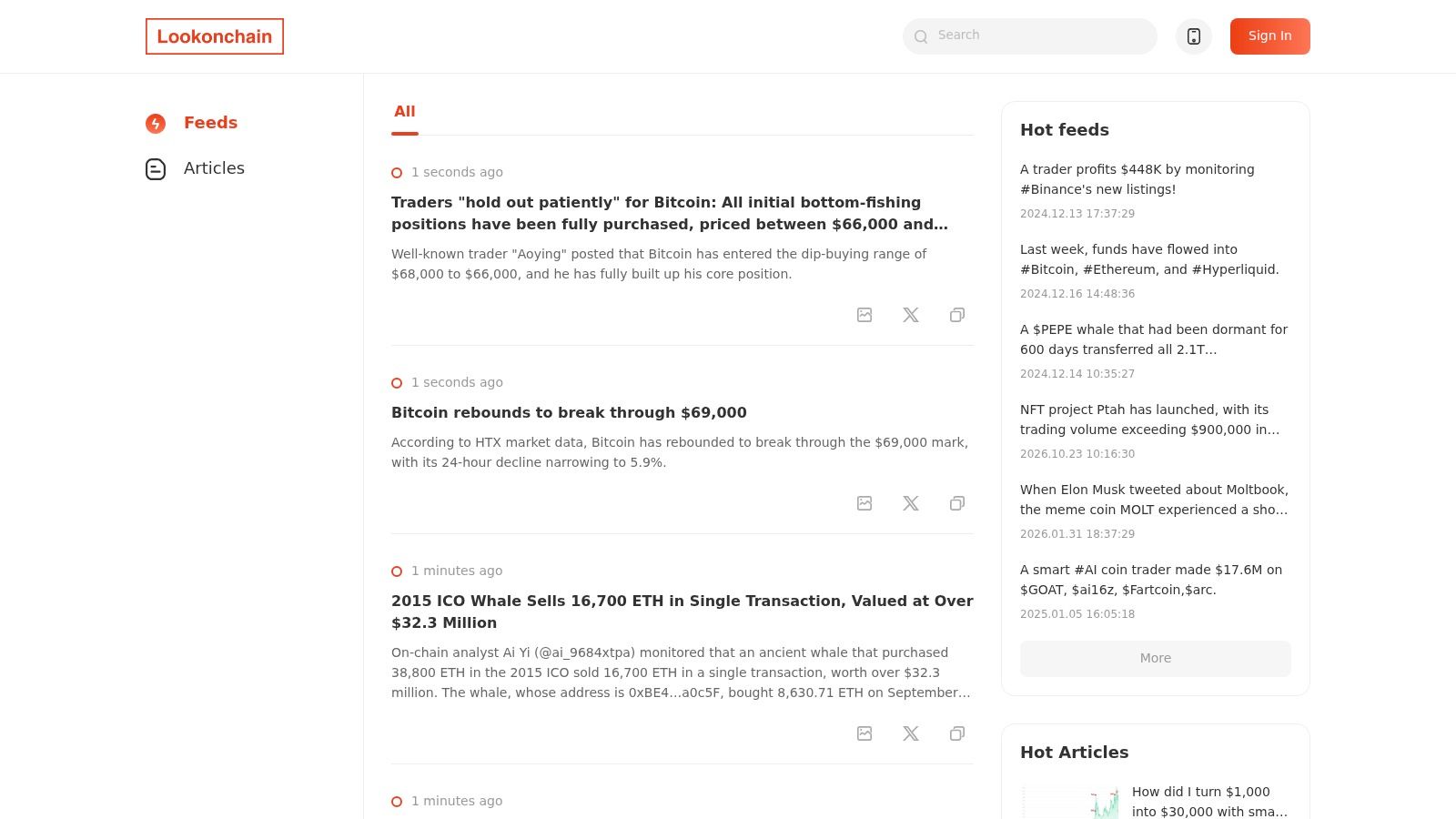
Lookonchain is a feed, not a database. It publishes notable wallet activity and whale or Smart Money findings as updates and articles, often surfacing moves you'd never have thought to query.
A feed works best as a lead generator. Read the post, take the address, and verify the claim in a tool that shows you the transaction path yourself.
What Works
- Discovery: curated examples of large transactions and unusual trader behavior.
- Token pages that combine on-chain context with market news.
- Free access to public content and social channels.
- Speed on the loudest moves of the day.
Where It Stops
Curated coverage is not a monitoring system. Attribution in a post may be estimated or drawn from third-party reporting, and there's no historical investigation layer or API built for integration. If you need a repeatable query, build it elsewhere and use the feed for ideas.
Site: Lookonchain
10. GMGN
GMGN is aimed at the trader watching a token move right now. Smart Money wallet following, real-time wallet activity and Telegram alerts keep the focus on the next few hours rather than the last two years.
What Works
- Signal timing: alerts land while the move is live.
- Wallet following for traders you've already vetted.
- Token discovery inside a trading interface.
- Telegram delivery that matches how active traders work.
Where It Stops
This is token discovery and trading flow, not entity attribution. Wallet classifications are not proof of future performance, and anyone can spin up a channel that looks official, so confirm the app and the alert channel before you act on a message. Research that has to survive a review needs address-level evidence from somewhere else.
Site: GMGN
How the Arkham alternatives compare by research job, core strength, and AI or API access
| Item | Best for | Core strength | AI or API access |
|---|---|---|---|
| StalkChain | AI-assisted on-chain research across multiple chains | Combines wallet, trader, whale, PnL, and token-flow data | MCP access for AI clients and REST API |
| Nansen | Labeled-wallet and Smart Money research | Wallet labels, performance, token analytics, and alerts | REST API and MCP access |
| Bubblemaps | Investigating token-holder concentration | Visualizes top holders and detected wallet connections | No API access specified |
| Dune | Custom on-chain analysis and dashboards | Flexible SQL queries across blockchain datasets | Data APIs and AI-oriented query tools |
| Glassnode | Market and network trend research | Historical on-chain metrics combined with market data | API access through eligible plans or add-ons |
| CryptoQuant | Exchange-flow and market indicator analysis | Exchange, miner, stablecoin, and derivatives metrics | API access varies by plan |
| DeBank | Tracking wallet and DeFi portfolios | Wallet balances and protocol positions | DeBank Cloud API |
| Zerion | Watch-only multichain portfolio monitoring | Aggregated holdings, activity, and supported DeFi positions | Separate API and CLI offerings |
| Lookonchain | Finding leads from notable on-chain activity | Curated whale and Smart Money activity reports | No API access specified |
| GMGN | Active token trading and wallet alerts | Smart Money following and real-time activity signals | No API access specified |
Pick the Tool That Fits Your Research Question
Start with the research job. For wallet attribution, use an entity-attribution tool. For holder concentration, use a visual map. For a custom metric, query the data with SQL. If an AI agent needs live data, check whether the provider offers MCP or API access, then compare the cost of the calls you expect to make.
A market estimate in the blockchain analysis tool market report puts banking and financial services at 45.2% of blockchain-analysis-tool revenue and government at 24.6%, with compliance management at 38.5% of application share and risk management at 31.2%. Those figures point to institutional demand. Institutional buyers tend to weigh auditability, exportable evidence and coverage continuity heavily, though priorities vary by evaluation.
For an Arkham alternative, test candidates against a question with a known answer. Choose a wallet you have attributed manually and compare the label, confidence, timestamp and transaction path each tool returns. A confident label without supporting evidence may be less useful than an “unknown” result that exposes the underlying transfers.
Before committing to a subscription, check three things:
- Reproducibility: Can you rerun the same query later and trace the result? An answer that cannot be revisited is difficult to use as research evidence.
- Cost per answered question: Compare expected research spend, not just the sticker price. Failed lookups can make a low-cost plan expensive.
- Failure behavior: Check what happens at a rate limit, on a chain with limited coverage, or when a label is stale. A useful tool should make these limits clear.
Treat labels and signals as leads, not trading instructions. Attribution is an inference, and no dashboard removes the possibility of error. Keep a manual check for decisions involving meaningful size. The data enrichment tool checklist covers vendor evaluation from a different angle, but blockchain tools still need to be judged on evidence, coverage and cost.
StalkChain delivers live on-chain and social trader data through MCP and REST API, including wallet holdings, PnL, token flows, and KOL and whale signals across seven chains. Customers can connect its hosted MCP server to a supported AI assistant and ask about wallets, traders, holdings and flows in plain English. MCP and REST API use one account and credit balance. Visit StalkChain to explore its tools and assess whether they fit your research workflow.