Quick answer
To assess Robinhood Chain liquidity, compare the position you may need to sell with a fresh size-specific sell quote, its expected output, price impact, fees, and minimum received.
Then verify the pool contract, active liquidity, quote asset, recent liquidity changes, and who can remove or reposition capital.
Market cap, volume, and holder count do not prove exit capacity. Stalkchain's public memecoin leaderboard provides a liquidity edge for discovery, but every proposed exit still needs a current quote and on-chain verification.
What liquidity and exit risk mean on Robinhood Chain
Liquidity is the capital available to trade an asset without moving its price too far. Exit risk is the chance that a holder cannot sell the intended amount near the displayed price.
Robinhood Chain is an Arbitrum Layer 2 with chain ID 4663 and ETH as its gas token. Its EVM structure makes pools, token transfers, approvals, and transaction receipts publicly inspectable.
That visibility does not make every market liquid. A token can show millions of dollars in market cap while a representative sale loses a large percentage to price impact.
The central rule is simple:
Your realizable value depends on the sell route available at your size, not the last price multiplied by your token balance.
Start with Stalkchain's liquidity edge
Open the Robinhood Chain Memecoin Leaderboard. It compares volume, net flow, buy and sell counts, unique buyers, fresh-buyer share, holder coverage, market cap, age, and liquidity edge.
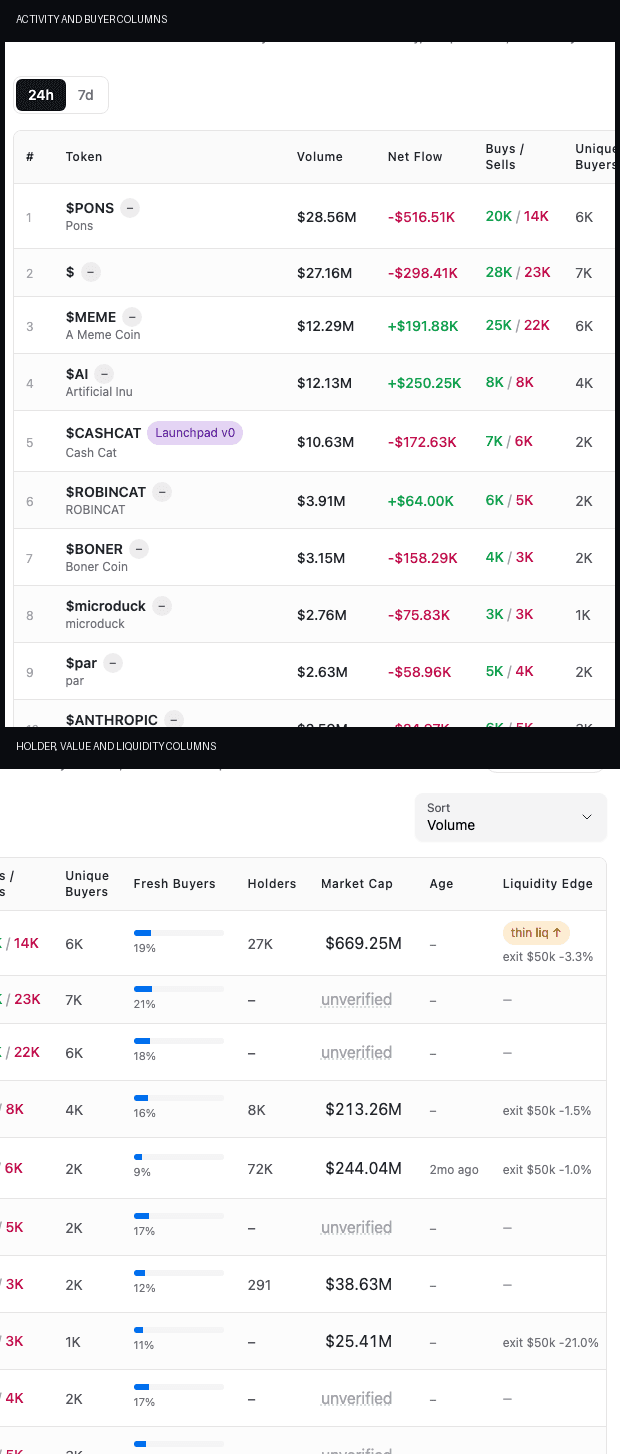
This September 5, 2026 capture shows the liquidity edge beside activity and holder fields. It is a time-stamped discovery snapshot. Missing liquidity is unknown, and every estimate can change with reserves, routing, and trade size.
The liquidity edge estimates the impact of a representative exit. Use it to decide which markets require immediate investigation.
Do not read the estimate as a promise. It is not your current quote, guaranteed output, or proof that the route will remain available.
Use the five-part EXIT framework
A useful liquidity review can be remembered as EXIT plus one final control check:
- E, Exit size: define the token amount you may need to sell.
- X, eXecutable quote: request current output for that exact size.
- I, Impact and minimum received: separate price impact from slippage protection.
- T, Trading pool: verify the pool, pair, active liquidity, and recent changes.
- Control: identify who can remove, reposition, pause, tax, or otherwise affect the route.
This framework prevents a large market-cap or volume number from substituting for executable evidence.
Step 1: Define a realistic exit size
Start with the position you would actually hold. Test at least three sizes:
- A small validation sale
- Half of the proposed position
- The full proposed position
Record the token quantity and expected quote asset for each test. A $50,000 leaderboard estimate may be useful for comparison, but it does not describe a $500 or $200,000 exit.
Position size is part of the market. A pool can support one trader's exit and fail another's.
Include gas and approval needs
Keep ETH available for a token approval, the sell transaction, and a retry if a quote expires. A token balance is not fully actionable if the wallet cannot pay the required gas.
Review allowances separately. An approval lets a spender contract move tokens, so confirm the spender and limit the allowance when practical.
Step 2: Request an executable sell quote
Use a supported swap application that you have independently verified. Enter the exact token contract and the intended sell amount.
A useful quote should expose:
- Input token and amount
- Output token and expected amount
- Route or pool
- Price impact
- Slippage tolerance
- Minimum received
- Venue or route fees
- Estimated network fee
- Quote timestamp or expiry
Reject a workflow that hides the output floor, route, or called contract.
A quote is still temporary. Request it again immediately before any signature because liquidity and price can move between inspection and execution.
Step 3: Separate price impact from slippage
Price impact estimates how much your own order changes the execution price relative to the pool state. Slippage tolerance defines how far execution may move from the quote before the transaction reverts.
These are not interchangeable.
Widening slippage can make a transaction more likely to execute, but it also authorizes a worse fill. It does not add depth to the pool.
The minimum received is the enforceable output floor encoded by the route. Compare it with the expected output and your maximum acceptable loss before signing.
Step 4: Verify the pool and quote asset
A familiar ticker is not enough. Match the token contract across the primary project source, Stalkchain, the chosen venue, and the Robinhood Chain Blockscout token explorer.
Then verify the dominant pool:
- Confirm both token contracts in the pair.
- Identify the pool contract and exchange protocol.
- Inspect current reserves or active liquidity.
- Check recent additions, removals, and large swaps.
- Determine whether liquidity is spread across several pools or concentrated in one.
- Confirm the quote uses the pool you inspected.
Pool fragmentation can make headline liquidity misleading. Capital distributed across incompatible or inactive ranges may not support the route your trade needs.
Step 5: Identify liquidity control
The amount of liquidity matters, but control over it matters too.
Trace the wallets or contracts that supplied material liquidity. Ask:
- Can one wallet remove most of the active depth?
- Is liquidity held in a concentrated position that can be moved out of range?
- Did deployer-linked wallets add the liquidity?
- Have recent removals followed large holder deposits or promotional activity?
- Is the pool paired with ETH, a stable asset, or another volatile token?
- Does the token contract expose privileged controls that affect transfers?
A deep pool controlled by one removable position can disappear quickly. A smaller pool with distributed, persistent liquidity may be more stable, but it can still be too shallow for your exit.
Use the Robinhood Chain holder-distribution workflow to separate pools and infrastructure from economic holders. Then apply the wallet-tracking guide to trace funding and transfers around important addresses.
Example: three leaderboard rows, three liquidity conclusions
A public Stalkchain capture on September 5, 2026 showed three useful comparisons. The figures are historical observations, not current quotes or recommendations.
Artificial Inu
- 24h volume: $12.13M
- Net flow: +$250.25K
- Unique buyers: about 4,000
- Displayed $50K exit estimate: -1.5%
The displayed exit estimate was the least severe of the three. That made Artificial Inu a better candidate for pool verification, not a safe trade. Buyer independence, holder control, pool ownership, and a fresh quote remained unproven.
PONS
- 24h volume: $28.56M
- Net flow: -$516.51K
- Unique buyers: about 6,000
- Displayed $50K exit estimate: -3.3%
Large volume did not cancel measured distribution. The next step was to determine whether repeated turnover came from independent demand and whether the dominant pool could still quote the intended sale.
STONKBROKER
- 24h volume: $1.25M
- Unique buyers: about 1,000
- Holder count: about 26,000
- Displayed $50K exit estimate: -50.9%
The exit estimate was a hard warning. Neither the holder count nor the visible volume made that representative sale acceptable. Pool and routing evidence would need to explain the severe impact before deeper narrative research mattered.
Healthier and riskier liquidity patterns
More defensible pattern
- The intended sell receives a current quote with tolerable impact.
- Minimum received remains inside the prewritten loss limit.
- Active liquidity is meaningful relative to the position.
- Depth persists across repeated checks and more than one market condition.
- Liquidity providers are understood and no single actor controls most usable depth.
- Volume comes from many independent wallets rather than circular routing.
- The token contract and pair assets match across every surface.
Higher-risk pattern
- Market cap is large but a modest sale causes severe impact.
- The buy route works while a representative sell quote fails.
- One wallet can remove or reposition most active liquidity.
- Volume is extreme relative to available depth.
- Liquidity appears only during promotion or ranking spikes.
- The quote hides its route, fees, or minimum output.
- Holder and liquidity fields are missing but treated as reassuring.
False positives to avoid
High volume
Volume can come from short holding periods, repeated routing, related wallets, or incentives. Compare unique wallets, counterparties, and net inventory changes.
Large market cap
Market cap usually applies the latest quoted price to supply. It does not show how much capital can leave the pool near that price.
Many holders
Addresses are not independent owners. Dust distribution and wallet splitting can inflate the count without improving liquidity.
Low impact at a tiny size
A small validation quote can look clean while the full intended exit remains impossible. Test the size you may actually need to sell.
A single successful quote
A quote can become stale or depend on temporary liquidity. Repeat the test and inspect the transaction parameters before signing.
Positive net flow
Positive flow describes a measured window. It cannot prove durable demand, pool safety, or future exit depth.
Verify the final transaction on-chain
If you choose to sell, save the quote and transaction hash. Open the receipt in Robinhood Chain Blockscout and confirm:
- Successful transaction status
- Expected sender and called contract
- Expected token input transfer
- Expected output asset and actual amount received
- Gas paid
- Approval events
- No unrelated transfers
Compare actual received with the quote and minimum received. A wallet notification saying the transaction was submitted is not settlement evidence.
The research-first Robinhood Chain trading guide covers the full quote, approval, signature, receipt, and balance workflow. Stalkchain supports research and discovery, not execution.
Final liquidity checklist
- Confirm Robinhood Chain mainnet and chain ID 4663.
- Match the exact token contract across every surface.
- Define the small, half-position, and full-position sell sizes.
- Request fresh quotes for the amounts you may need to exit.
- Compare expected output, price impact, fees, and minimum received.
- Verify the pool contract, pair assets, and active liquidity.
- Inspect recent liquidity additions and removals.
- Identify who controls or can reposition the liquidity.
- Trace large holders and liquidity providers for shared funding.
- Keep enough ETH for approvals, sells, and a retry.
- Verify any completed transaction in Blockscout.
- Treat missing fields as unknown, not safe.
FAQ
What is exit liquidity on Robinhood Chain?
Exit liquidity is the available market depth that lets a holder sell tokens for another asset. The useful measure is the output available for a specific sell size, not the token's market cap or the wallet's displayed value.
How do I check a Robinhood Chain memecoin's liquidity?
Start with Stalkchain's public memecoin leaderboard and its liquidity edge. Then verify the token and pool contracts, inspect active liquidity and recent changes, identify liquidity control, and request current sell quotes at realistic sizes.
Is low price impact the same as low slippage?
No. Price impact estimates how your order moves the market. Slippage tolerance defines how far execution may move from the quote before reverting. A wider slippage setting can permit a worse fill but cannot create liquidity.
Why can a token have high volume and poor exit liquidity?
The same liquidity can turn over many times. Bots, related wallets, incentives, and short holding periods can produce high volume while the pool remains shallow. Volume measures activity, not the capital available for your sale.
Does Stalkchain execute Robinhood Chain sells?
No. Stalkchain currently provides Robinhood Chain research surfaces. Choose and verify an execution venue independently, inspect every quote and approval, and verify the resulting receipt on-chain.
How often should I recheck liquidity?
Check before entry, before increasing size, after material holder or liquidity-provider changes, and immediately before selling. Quotes and active liquidity can change quickly.
Sources and further reading
- Stalkchain Robinhood Chain Memecoin Leaderboard
- Robinhood Chain official connection documentation
- Robinhood Chain Blockscout token explorer
- Robinhood Chain memecoin analysis guide
- Robinhood Chain holder-distribution guide
Liquidity analysis can reject weak markets and improve position sizing. It cannot guarantee future demand, persistent routes, or a profitable exit.