Quick answer
To trade a memecoin on Robinhood Chain, add chain ID 4663 from Robinhood's official network documentation, fund a limited-purpose wallet with ETH, verify the token contract, and choose a supported swap application independently.
Before signing, compare a live quote with pool depth, price impact, slippage, fees, and a representative sell quote. Stalkchain helps with discovery and research. It does not currently execute Robinhood Chain orders.
What you need before trading
Robinhood Chain is an Arbitrum Layer 2 that uses ETH for gas. Its official documentation lists mainnet chain ID 4663 and the Robinhood Chain Blockscout explorer.
Prepare these five things before interacting with a memecoin:
- An EVM-compatible wallet configured from the official Robinhood Chain connection documentation
- A small amount of ETH on Robinhood Chain for the trade and future gas
- The exact token contract address from a primary project source
- A supported swap application whose domain and contracts you have verified
- A maximum loss and position size decided before reading the quote
Use the safe network and bridge guide if the wallet is not funded yet. Keep long-term assets in a separate wallet. A limited-purpose trading wallet reduces the damage from a malicious approval or application.
Step 1: Build a shortlist from live activity
Start with the Robinhood Chain Memecoin Leaderboard. It compares tokens using volume, net flow, buy and sell counts, unique buyers, fresh-buyer share, holder coverage, market cap, age, and liquidity edge.
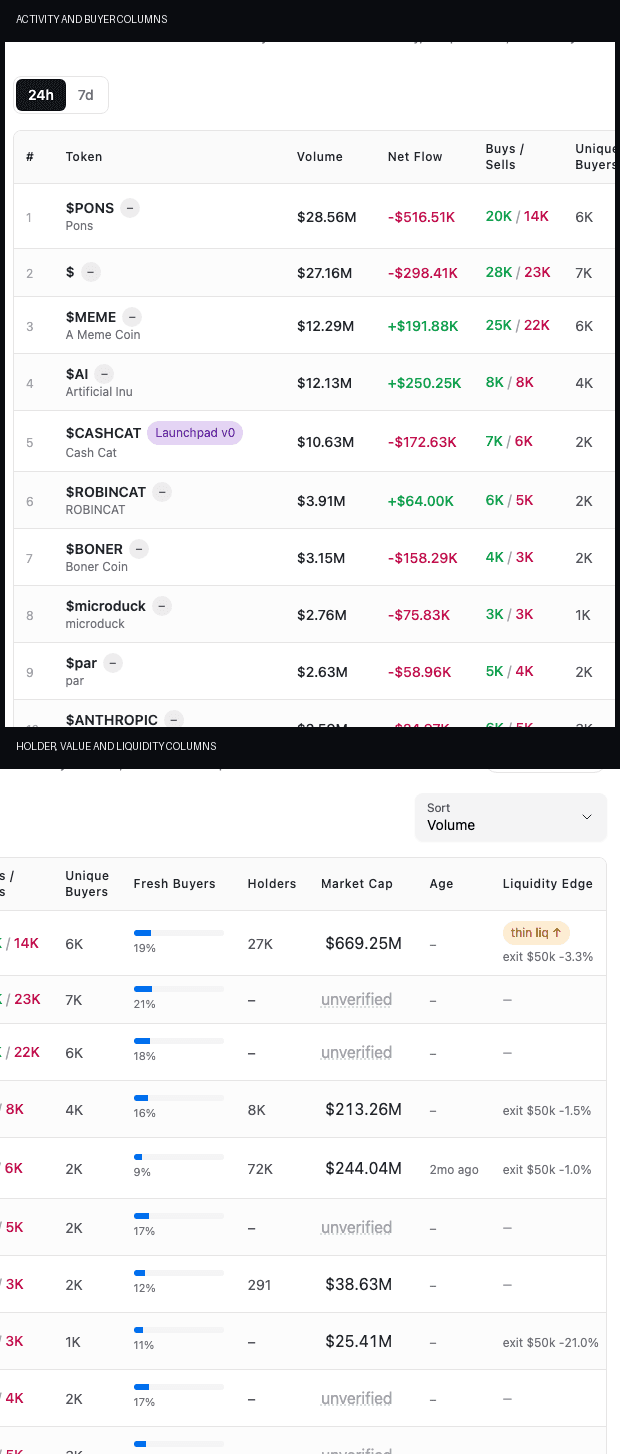
Focused, stacked reading crops from one live public-route capture on September 5, 2026. Use the leaderboard for discovery. Missing fields are unknown, and a strong row still needs contract, holder, wallet, and pool verification.
The fields answer different questions:
- Volume and net flow: Is measured activity expanding, and is buying exceeding selling in the selected window?
- Buys and unique buyers: Is activity broad, or could a small group be producing many transactions?
- Fresh-buyer share: Is new attention arriving, or are coordinated wallets appearing together?
- Holder coverage: Is enough holder data available to support a concentration judgment?
- Liquidity edge: How much could a representative exit move the market?
The memecoin screener guide explains each field. Do not jump directly from ranking to execution.
Set a decision expiry before requesting a quote
Research and execution evidence decay at different speeds. A contract identity can remain valid while the quote, pool depth, and wallet activity become stale within minutes.
Write a small pre-signing record with:
- Token contract and chain ID
- Intended input amount
- Maximum acceptable price impact
- Maximum slippage tolerance
- Minimum acceptable output
- Representative sell size and minimum acceptable sell output
- ETH reserved for approval, entry, and exit gas
- Quote timestamp and expiry
- Pool and router contracts
- Reason the trade is invalidated
If any transaction fails or the quote expires, restart from the quote and pool checks. Do not reuse an old minimum output, gas estimate, route, or approval assumption simply because the token contract has not changed.
Separate four clocks
- Contract clock: refresh when implementation, admin controls, fees, roles, or token behavior changes.
- Market clock: refresh when price, reserves, active liquidity, volatility, or intended size changes.
- Wallet clock: refresh when important holders transfer, buy, sell, bridge, or add/remove liquidity.
- Transaction clock: refresh after a quote expires, a nonce changes, an approval changes, or a transaction fails.
Use the evidence-ledger method to keep historical observations separate from current claims. Use the screener consistency check to reject rows whose activity, breadth, valuation, and exit fields do not support one another.
Step 2: Verify the contract and token behavior
A ticker is not an identifier. Anyone can create a token with a familiar name or symbol.
Copy the contract address from a primary project source, then open it in the Robinhood Chain token explorer. Confirm that the address, symbol, decimals, supply, holder table, transfers, and trading venue all describe the same asset.
Check the verified source and contract interactions where available. Look for unusual behavior such as transfer restrictions, mutable fees, privileged roles, blocklists, mint authority, upgradeability, or transfers that do not match ordinary ERC-20 behavior.
A verified source is useful, but it does not make the economics safe. It only makes the contract easier to inspect.
Step 3: Check holder control and related wallets
Raw holder count measures addresses, not independent owners. Label pools, routers, bridge adapters, burn addresses, treasuries, and vesting contracts before interpreting concentration.
Calculate both views:
- Raw concentration: the exact top 1, 5, 10, and 20 address shares.
- Economic concentration: the largest private holders after known infrastructure is classified separately.
Then trace direct transfers, common funders, synchronized timing, and consolidation addresses. Several small wallets can still represent one actor.
Use the Robinhood Chain holder-distribution method for the full calculation. If one or two wallets dominate the opportunity, apply the wallet-tracking workflow before proceeding.
Step 4: Inspect liquidity and the sell path
Market cap is not exit liquidity. A token can show a large valuation while a modest sale moves its pool sharply.
Before buying, identify the dominant pool and verify:
- The token and quote asset contracts
- Current active liquidity or reserves
- Recent liquidity additions and removals
- Who can remove or reposition liquidity
- Price impact for your intended buy
- Price impact for a representative sell
- Whether the sell route returns a real quote
- Whether recent volume is large relative to usable depth
The sell test matters even if you do not plan to exit immediately. A market that cannot quote a small sale has a structural problem that bullish flow cannot repair.
Test a size ladder, not one convenient quote
Run the sell side at three amounts before entry:
- A small validation sale
- Half of the proposed position
- The full proposed position
Record expected output, price impact, route, fees, and minimum received at each rung. If impact accelerates sharply or the full-size quote disappears, reduce the proposed size or reject the market.
Then identify the pool contract and liquidity providers. A good quote can depend on one concentrated position that its owner can remove or move out of range.
The Robinhood Chain liquidity and exit-risk guide provides the complete EXIT framework: exit size, executable quote, impact and output floor, trading pool, and liquidity control.
Step 5: Compare the quote, price impact, and slippage
A swap quote should show the input amount, expected output, route, fees, price impact, and minimum received or slippage protection.
These terms answer different questions:
- Price impact: how much your order changes the execution price relative to the pool's current state.
- Slippage tolerance: how far execution may move from the quote before the transaction reverts.
- Minimum received: the lowest output the transaction permits after slippage protection.
- Network fee: ETH paid for transaction execution.
- Venue or route fee: any additional fee included by the swap application or pool.
A wider slippage setting can reduce reverts, but it can also authorize a much worse fill. It does not create liquidity.
Reject the trade if the application hides the route, contract, minimum output, or expected fee. Recheck all values after changing the input amount.
Step 6: Review the approval before signing
A token approval lets another contract spend tokens from your wallet. The approval transaction is separate from the swap on many EVM applications.
Before signing an approval:
- Confirm the spender contract belongs to the intended application and route.
- Prefer an exact or limited allowance when practical.
- Check that the token and chain are correct in the wallet prompt.
- Reject unexplained permit, operator, or approval requests.
- Record the transaction hash.
After the trade, review and revoke allowances that are no longer needed. A successful swap does not make an unlimited approval harmless.
Step 7: Execute a small first trade
If every research and quote check passes, start with a size small enough to validate the complete lifecycle.
In the wallet confirmation, verify:
- Robinhood Chain mainnet, chain ID 4663
- The expected application and contract
- The input asset and amount
- The quoted output and minimum received
- The ETH gas estimate
- No unexpected transfers or approvals
Do not speed through a second signature because the first transaction reverted. Identify whether the failure came from stale price, insufficient gas, allowance, slippage, deadline, token behavior, or application error.
Step 8: Verify the receipt and balances
After submission, open the transaction hash in Robinhood Chain Blockscout. A wallet popup saying "submitted" is not final evidence.
Confirm:
- Transaction status is successful
- The sender and called contract are expected
- Token transfers match the intended input and output
- Gas paid is plausible
- The wallet balance changed by the expected amount
- No unrelated token or approval events appeared
Save the entry transaction hash and actual received amount. Those values are more useful for later PnL than a screenshot of the quoted price.
Step 9: Recheck the exit before increasing size
Obtain a current sell quote for part of the actual received balance. Confirm the route, output, price impact, and minimum received again.
Do not increase the position until the observed token behavior matches the assumptions used before entry. Liquidity can move, fees can change, and a route that worked for a buy may not support a clean sell at a larger size.
Use the complete Robinhood Chain memecoin analysis workflow to monitor holder control, liquidity, and large-wallet behavior after entry. The whale tracker method helps determine whether major wallets are accumulating, transferring, or distributing.
Example: let the exit estimate veto the leaderboard rank
During a live check at approximately 00:33 UTC on September 5, 2026, the Stalkchain 24-hour table returned 50 ranked rows. PONS led displayed volume at $28.56M, but net flow was -$516.51K and the $50K exit estimate showed -3.3%.
Artificial Inu showed $12.13M volume, +$250.25K net flow, about 4,000 unique buyers, and a displayed $50K exit estimate of -1.5%. STONKBROKER showed $1.25M volume and about 1,000 unique buyers, yet its displayed $50K exit estimate was -50.9%.
None is a recommendation. The first combines large turnover with net selling. The second deserves buyer and holder verification because positive flow alone cannot establish independence.
The third demonstrates a hard execution warning: a severe representative exit estimate can veto an otherwise interesting token before any wallet signature.
The correct next step is not to chase the strongest color. Verify the contract and pool, inspect holder control, trace important wallets, and request fresh buy and sell quotes at your actual intended size.
Healthier and riskier trading setups
More defensible setup
- The contract address matches across primary sources, venue, and explorer.
- Buyer breadth grows across more than one interval.
- Large holders are labeled and not obviously controlled by one funder.
- The pool supports the planned buy and representative sell with tolerable impact.
- The wallet prompt exposes the exact contract, amounts, and minimum output.
- A small first trade settles with expected transfers and balances.
Higher-risk setup
- The decision depends on ticker, social posts, or a screenshot instead of the contract.
- One wallet or cluster explains most measured demand.
- Holder, age, valuation, or liquidity fields are missing and treated as reassuring.
- The venue hides the route or minimum received.
- The buy quote works, but a representative sell quote fails or has extreme impact.
- The wallet requests an unlimited approval to an unverified spender.
False positives and failure modes
Positive net flow
Positive net flow describes a measured window. One large wallet, circular activity, or short-lived demand can produce it.
High unique-buyer count
Addresses are not automatically independent people. Related wallets can share funding, timing, or control.
High fresh-buyer share
Fresh wallets can show genuine discovery, but they can also be bots or coordinated distribution. Trace their funders and activation times.
Verified contract source
Verification improves transparency. It does not prove fair ownership, safe liquidity, or harmless admin controls.
Successful purchase
A buy succeeding does not prove a sale will succeed. Test the sell route and monitor liquidity separately.
Low displayed price impact
A quote can become stale before execution. It can also omit a fee or rely on liquidity that disappears. Review the minimum output and transaction receipt.
Final checklist
- Configure chain ID 4663 from Robinhood's official documentation.
- Use a limited-purpose wallet and preserve ETH for gas.
- Verify the token contract across primary sources, venue, and explorer.
- Classify top holders and trace related wallets.
- Identify the dominant pool and liquidity controller.
- Compare current buy and representative sell quotes.
- Review price impact, slippage, minimum output, and all fees.
- Approve only the intended spender and amount.
- Start small and verify the transaction receipt.
- Recheck sellability before increasing the position.
- Record entry amount, received tokens, gas, and transaction hashes.
- Treat every screener signal as evidence to investigate, not a trade instruction.
FAQ
Can I trade memecoins directly on Stalkchain?
No. Stalkchain currently provides Robinhood Chain research surfaces, including the public memecoin leaderboard. It does not claim automated Robinhood Chain order execution. Choose and verify a supported swap application independently.
What gas token does Robinhood Chain use?
Robinhood Chain uses ETH for transaction fees. Keep enough ETH in the trading wallet for approval, swap, and possible exit transactions.
How do I find the correct token contract?
Start with a primary project source, then match the address in the swap application and Robinhood Chain Blockscout. Do not rely on the ticker or token name alone.
What slippage should I use?
There is no universal safe setting. The appropriate tolerance depends on liquidity, volatility, order size, route, and token behavior. A wider tolerance authorizes a worse fill and does not fix thin liquidity.
Does a successful buy prove I can sell?
No. Test a representative sell quote before entry and recheck the route after receiving tokens. Transfer restrictions, route coverage, fees, or disappearing liquidity can make exits materially worse.
Is positive net flow a buy signal?
No. It means measured buying exceeded selling during the selected window. Confirm buyer independence, holder control, current liquidity, and the sell path before treating the flow as useful.
Sources and further reading
- Robinhood Chain official connection documentation
- Robinhood Chain token explorer
- Stalkchain Robinhood Chain Memecoin Leaderboard
- Robinhood Chain memecoin screener guide
- Robinhood Chain holder-distribution guide
Memecoins are extremely volatile. Contract checks, on-chain evidence, and controlled execution reduce avoidable mistakes, but they do not eliminate market loss, smart-contract risk, or manipulation.