Quick answer
Verify the exact pool, reserve changes, LP controller, and asset destinations. Then quote your intended sell against current depth. A withdrawal can be extraction, routine LP management, or a migration. The transaction path and remaining executable liquidity determine the risk.
What liquidity removal means on Solana
Liquidity removal happens when an LP owner withdraws assets from a trading pool or closes part of a concentrated-liquidity position. The pool loses token inventory, quote inventory, or both. Traders may then face higher price impact, weaker routing, and a smaller practical exit.
The event is not automatically malicious. Market makers rebalance positions, protocols migrate pools, and concentrated-liquidity providers move ranges as price changes. The analytical job is to identify who removed what, why the transaction shape changed, and how much usable depth remains. The Solana rug checker workflow puts the pool, authority and deployer checks next to this exit analysis.
The four-part exit-risk framework
Read every liquidity event through four dimensions:
- Control: who owned or could close the LP position?
- Magnitude: how much usable depth left relative to the pool and your position?
- Destination: did the assets move to a new pool, a market maker, a treasury, or an ordinary wallet?
- Aftermath: can real quotes still support sells at acceptable minimum output?
A large withdrawal by a deployer-linked wallet with no replacement pool is materially different from a market maker moving liquidity between verified venues. Both may produce a red liquidity candle. Only one necessarily destroys the market.
Step 1: verify the exact mint, pool, and venue
Start from the full token mint and pool address. Symbols are not identifiers, and one token can trade across several Raydium, Meteora, Orca, PumpSwap, or other pools.
Record:
- token mint and token program
- quote mint, usually SOL or a stablecoin
- pool address and venue
- LP mint or concentrated-liquidity position identifier
- transaction signature and block time
- reserves or active liquidity before and after the event
Do not merge pools into one number before verifying them. A token can lose its deepest SOL pool while retaining a shallow stablecoin pool. An aggregate liquidity figure may fall modestly even though the best executable route disappeared.
Step 2: reconstruct the withdrawal transaction
Open the signature in a compatible Solana explorer and separate the instructions and balance changes. Look for the pool program, the position or LP-token owner, token-account deltas, fee collection, and destination accounts.
For a classic LP-token pool, verify how many LP tokens were redeemed and how much of each reserve asset was returned. For concentrated liquidity, inspect whether liquidity was decreased, fees were collected, and the position was closed or merely narrowed.
A token transfer from a pool vault is not enough evidence by itself. Routed swaps, protocol fees, migrations, and account closures can also move pool assets.
Evidence ledger for one event
| Field | What to save | Why it matters |
|---|---|---|
| Signature | Full transaction signature | Reproducible source of truth |
| Position controller | Wallet or authority controlling the LP | Establishes removal power |
| Token out | Raw amount and decimals | Measures token-side change |
| Quote out | Raw amount and decimals | Measures usable exit depth lost |
| Destination | Full receiving accounts | Distinguishes migration from extraction |
| Remaining depth | Fresh sell quotes at fixed sizes | Tests practical exitability |
Use raw amounts for the ledger, then add time-stamped USD estimates. Historical prices and token decimals can be wrong, so the raw transaction must remain recoverable.
Read concentrated-liquidity withdrawals differently
A concentrated-liquidity position can stop supporting the current price without every asset leaving the protocol. Record the position's lower and upper ticks, current tick, liquidity before and after, fee collection, and whether a replacement position was opened.
Separate three events:
- Fee collection: accrued tokens leave the position while its liquidity can remain active.
- Liquidity decrease: part or all of the position's active liquidity is removed.
- Range replacement: the old position loses liquidity and a new position appears at different ticks.
A range replacement can be ordinary management, but it may still leave the market temporarily shallow or place the new range away from spot. Verify that the replacement position is active at the current price before calling depth restored.
Step 3: identify who controlled the liquidity
Trace the LP position back to its controlling wallet or authority. Then compare that address with:
- deployer and team funding trails
- first buyers and early recipients
- top non-infrastructure holders
- treasury or market-maker labels
- known locker or burn addresses
- related pools and migration contracts
A lock badge is not enough. Verify the locker contract, beneficiary, amount, unlock conditions, and whether another untracked position still controls material liquidity.
When the controller is a fresh or intermediary-funded wallet, use the Solana funding-source method. Keep verified value movement separate from ownership attribution. One funding transfer can connect addresses without proving that the deployer, LP controller, and recipient are the same person.
Burned LP tokens can remove one withdrawal path for classic pools, but they do not guarantee safe holder distribution, immutable token controls, deep routes, or permanent demand. Concentrated-liquidity positions also use different ownership mechanics from simple fungible LP tokens.
The first-buyer workflow and Solana wallet tracking guide help connect the position controller to the launch cohort without claiming real-world identity from one funding link.
Step 4: distinguish a rug pull from a migration or rebalance
Pattern more consistent with extraction
- A deployer-linked or previously unlabeled ordinary wallet controls the position.
- Most quote liquidity leaves at once.
- Withdrawn assets move to discretionary wallets or an exchange route.
- No verified replacement pool receives comparable depth.
- Sell quotes deteriorate sharply or disappear.
- Team or early wallets sell around the same window.
Pattern more consistent with migration or LP management
- The transaction references a known migration or pool-management flow.
- Assets move into a verifiable replacement pool or related position.
- The controller has an established market-making or treasury role.
- Total executable depth recovers promptly across valid routes.
- Traders can still obtain competitive sell quotes.
- The project communicates a specific migration that matches on-chain evidence.
These are patterns, not verdicts. A project announcement cannot override a contradictory transaction path, and a temporary depth drop can still harm traders even when the migration is legitimate. After a pull, check whether KOLs are dumping the token to see if tracked traders are selling into the same exit.
Step 5: measure the liquidity change correctly
Headline liquidity is usually a USD estimate of pool reserves. That is useful for screening, but it is not the same as sell capacity.
Track at least four measurements:
- Quote-side reserve change: the SOL or stablecoin available to receive token sells.
- Active liquidity change: particularly important for concentrated ranges.
- Route-level change: whether aggregators still find alternative pools.
- Executable quote change: output and price impact for realistic sell sizes.
Compare the same sizes before and after the event when historical quotes are available. If they are not, label the before-state unavailable instead of reconstructing false precision from a chart.
Step 6: run a sell-depth ladder
Request fresh, non-transactional quotes for several token amounts. A practical ladder might cover 0.25%, 1%, 2.5%, and 5% of the tracked position, plus the full intended exit.
For each size, save:
- input token amount
- expected quote output
- minimum output after slippage settings
- price impact
- selected route and pools
- quote timestamp and expiry
- provider or RPC errors
Do not sign or submit anything to test depth. A quote is enough for research. It still does not guarantee execution because reserves, priority fees, slippage, and competing transactions can change before a swap lands.
Repeat the ladder under a stress assumption. If the current pool has already lost depth, a second withdrawal or simultaneous holder selling can make the live result worse than the first quote suggests.
Verify route continuity, not only quoted output
For every rung, save the route's pool addresses and compare them with the pool under investigation. An aggregator may preserve a good headline quote by moving the trade through another venue, a stablecoin hop, or a new pool.
That can be healthy route recovery, but only when the alternative pools are real, sufficiently liquid, and based on the exact mints. Reject a comparison when the before and after quotes use different input amounts, slippage settings, token decimals, or stale block times.
Classify the result in one of four states:
- Depth preserved: output and minimum output remain comparable through verified pools.
- Depth migrated: a different verified route now carries most executable liquidity.
- Depth degraded: routes still exist, but output or minimum output worsens materially at your size.
- Exit unavailable: no valid quote survives for the intended amount.
This classification is more useful than saying liquidity is simply “up” or “down.” It tells the holder whether an exit still exists and where its capacity now comes from.
Make before-and-after quotes comparable
A quote comparison is invalid when one side uses a different amount, mint precision, slippage setting, route restriction, or market state. Save a compact quote envelope for every observation:
| Field | Why it must match |
|---|---|
| Exact input mint and raw amount | Prevents decimal and position-size drift |
| Exact output mint | Prevents SOL, wrapped SOL, and stablecoin routes from being conflated |
| Slippage and minimum output | Makes the executable protection comparable |
| Allowed or excluded venues | Reveals whether capacity moved to another pool |
| Quote and chain-observation time | Exposes stale or materially skewed comparisons |
| Route legs and pool addresses | Shows where the quoted depth actually comes from |
| Provider response or failure | Keeps missing routes visible instead of dropping them |
When a historical quote envelope is unavailable, compare current scenarios and label the pre-event execution state unknown. Reserve changes can prove that liquidity moved; they cannot recreate the exact output a trader would have received before the event.
Separate expected output from protected output
Expected output is an estimate at the quoted state. Minimum output is the transaction's protection after the selected tolerance. Neither includes every failure mode.
Report both values, plus fees and route age. A route with an attractive expected output but an unacceptable minimum output does not fit the position. A protected output that looked acceptable several blocks ago is not current execution evidence after a material reserve change.
Put an expiry rule on every depth conclusion
Liquidity evidence decays as the market changes. Define the event that invalidates a quote before relying on it, rather than calling yesterday's ladder current.
Re-run the ladder when any of these occurs:
- the inspected pool records a material add or removal
- the best route changes pools or gains an extra hop
- the intended exit size changes
- a top holder or linked cluster transfers toward a venue
- volatility or trading activity moves outside the conditions of the saved quote
- the quote provider reports stale state, an error, or no route
Save observed at, valid for this decision, and invalidated by beside the result. A quote can remain useful as historical evidence after it expires, but it can no longer establish current exitability.
Measure route survivability, not just the best quote
One good aggregator quote can depend on a single pool or one fragile intermediate hop. Save at least the best route and the best route that excludes the pool under review.
Compare:
- quoted output and minimum output
- number of independent pools used
- share of the route carried by the largest pool
- extra token hops and their liquidity
- whether the alternative route survives at larger sell sizes
If removing one pool eliminates every acceptable quote, the token has a single point of liquidity failure. If a second independent route remains close in output across the sell ladder, market access is more resilient even when headline TVL is lower.
Example: representative liquidity-removal readout
Consider this anonymized event:
- The primary SOL pool held $310,000 of reported liquidity before the event.
- One LP controller withdrew 62% of its position.
- The pool's quote-side reserve fell by 49%.
- The controller received both token and SOL assets.
- About one-third of the assets entered a verified replacement pool within six minutes.
- The rest moved to two ordinary wallets with a shared funder.
- A $5,000 sell quote worsened from 2.4% to 8.9% modeled price impact.
- Two top holders sold during the next 20 minutes.
Calling this a complete migration would be unsupported because most depth did not reappear. Calling it definitive theft would also overclaim identity and intent. The defensible read is partial migration with unresolved asset destinations and sharply higher exit risk.
The action is practical: reduce the depth assumption, verify the ordinary wallets, monitor the replacement pool, and size any exposure against the worse route.
Turn the readout into a decision ledger
Do not compress the event into a red or green badge. Record one decision for each evidence layer:
| Layer | Defensible state |
|---|---|
| Transaction | verified withdrawal, unresolved transaction, or not a withdrawal |
| Controller | verified, plausibly linked, or unknown |
| Destination | replacement liquidity, discretionary wallet, mixed, or unresolved |
| Route capacity | preserved, migrated, degraded, or unavailable |
| Position fit | intended exit fits, fits only in stages, or exceeds tested depth |
The final risk label inherits the weakest material layer. A verified migration with an unavailable alternative sell route is still an immediate execution problem. A degraded quote with an unresolved transaction should be described as reduced depth, not automatically as a rug pull.
How holder structure changes the interpretation
A liquidity withdrawal is more dangerous when a small actor set controls both supply and pool depth. Compare the LP controller with actor-adjusted holder concentration using the Solana holder-distribution framework.
Model three combined exits:
- your intended position
- the largest independent holder
- the largest plausible linked cluster
Then test each against the remaining routes. A token with dispersed holders can still be illiquid. A token with one dominant holder and one dominant LP controller has two concentrated failure points.
The whale-accumulation guide explains the other side of the flow: repeated buying may look supportive while a larger holder or LP controller creates the exit overhang.
Use Stalkchain as a liquidity-intelligence surface
Stalkchain's public Liquidity Radar route is live and visibly identifies itself as a Legend tool, free by invite. A logged-out visitor can verify the product surface and access boundary, but cannot inspect the underlying live intelligence rows.
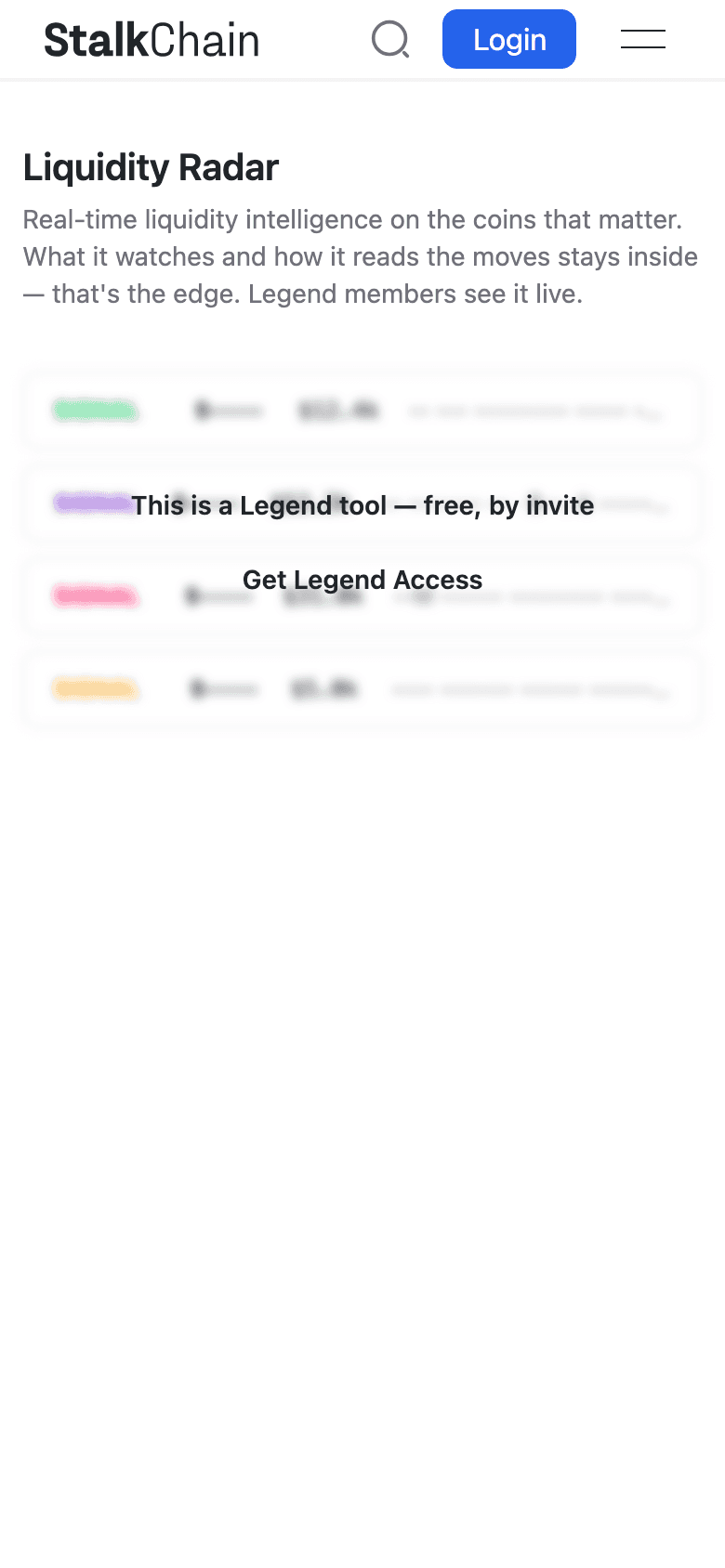
This production capture from August 23, 2026 shows the boundary clearly. The page exposes the liquidity-intelligence interface and masked signal cards, while the underlying event details remain unavailable to a logged-out reader. It is product proof, not proof of any specific liquidity event.
Use the route only within that verified boundary. Do not imply that every reader can see complete pool events without access, and do not treat a gated ranking as transaction proof.
For the full token review, combine liquidity evidence with Insider Scan, the 10-step Solana due-diligence checklist, and direct signature verification. Stalkchain helps prioritize investigation; the pool transaction and fresh executable quote establish the event and exit conditions.
False positives and analytical traps
Pool migration: Liquidity can leave one pool and enter another. Verify destination accounts, replacement depth, and timing.
Concentrated-range movement: An LP may reposition active liquidity without abandoning the market. Price impact can still worsen during the gap.
Routed swap activity: Vault outflows may belong to swaps rather than LP withdrawals. Inspect instructions and both sides of the balance change.
Protocol or market-maker operations: Treasury and inventory management can resemble extraction. Labels help, but transaction paths remain the evidence.
USD valuation errors: Thin-token prices can make reported TVL misleading. Preserve raw reserves and decimals.
Locked-liquidity overconfidence: A verified lock covers a specific position and period. It does not neutralize concentrated holders, shallow alternative routes, or token-control risk.
Final liquidity-risk checklist
- Verify the exact mint, pool, venue, and quote asset.
- Save the transaction signature and block time.
- Identify the LP token or concentrated position.
- Measure raw token and quote reserve changes.
- Trace the controller and receiving accounts.
- Check for a verified replacement pool or migration.
- Compare the controller with deployer and holder clusters.
- Request fresh sell quotes at several realistic sizes.
- Record route, minimum output, impact, and timestamp.
- Define what expires the quote and re-test after that event.
- Stress the exit for thinner depth and simultaneous selling.
- Preserve unresolved attribution and valuation limits.
- Never treat a lock badge or TVL headline as complete safety proof.
FAQ
How can I tell if liquidity was removed from a Solana token?
Verify the pool's withdrawal transaction, LP position, reserve changes, controller, and destination accounts. Then compare remaining executable sell quotes. A chart or TVL change can flag the event, but the transaction establishes what happened.
Does liquidity removal always mean a rug pull?
No. It can be a migration, market-maker rebalance, concentrated-range adjustment, or partial withdrawal. Risk rises when a deployer-linked controller extracts most quote liquidity, no replacement depth appears, and sells become difficult.
Is burned or locked liquidity completely safe?
No. It can restrict withdrawal from a specific position, but it does not prove healthy holder distribution, safe token controls, deep alternative routes, or future demand. Verify the exact position and lock conditions.
How much liquidity does a Solana token need?
There is no universal dollar threshold. The useful test is whether current executable routes can absorb your intended exit and plausible large-holder exits at acceptable minimum output, including under stress.
What is the difference between TVL and exit liquidity?
TVL estimates assets held by a pool. Exit liquidity is the quote output you can actually receive for a sell at a specific size and time. Concentrated ranges, route availability, price impact, fees, and slippage make the two different.
Can Stalkchain verify every liquidity-removal event automatically?
The public Liquidity Radar route verifies that a gated liquidity-intelligence product surface exists. Important events still require transaction, controller, destination, and fresh quote verification. A feed alert is the start of the investigation, not the final verdict.