A Solana wallet tracker API promises the same thing on nearly every landing page: real-time balances, token transfers, and PnL for any address. What those pages rarely show you is how the pricing model behaves at scale, how deep the history goes, or how fresh the data actually is. That gap matters when you are building alerts, portfolio dashboards, or agent workflows on top of Solana's ~400ms slot times.
This guide compares seven Solana wallet tracker APIs on the criteria buyers weigh: pricing and credit mechanics, data depth, latency, chain coverage, and readiness for AI assistants through MCP. We separate published facts from estimates, flag coverage gaps, and provide use-case-specific recommendations rather than a single overall winner.
Key takeaways
- There is no single best Solana wallet tracker API; the right pick depends on whether you need raw infrastructure, multi-chain portfolios, labeled intelligence, or AI-assistant integration.
- Pricing models matter more than headline rates: rollover credits beat per-call billing for bursty research workloads.
- For AI-native workflows, StalkChain's MCP server reduces the need for custom integration code compared to standard REST APIs.
- Helius is strong for building custom trackers; Zerion is strong for multi-chain balances; Nansen is strong for entity labels.
- Solscan's public API is a common starting point but often lacks the throughput required for production wallet tracking.
On this page
- What a Solana Wallet Tracker API Actually Does
- How We Compared the Options
- The 7 Solana Wallet Tracker APIs Side by Side
- Pricing and Credit Models Compared
- Which API Fits Your Use Case?
- Verdict: Best Solana Wallet Tracker API by Use Case
- Frequently asked questions
- Final thoughts
What a Solana Wallet Tracker API Actually Does
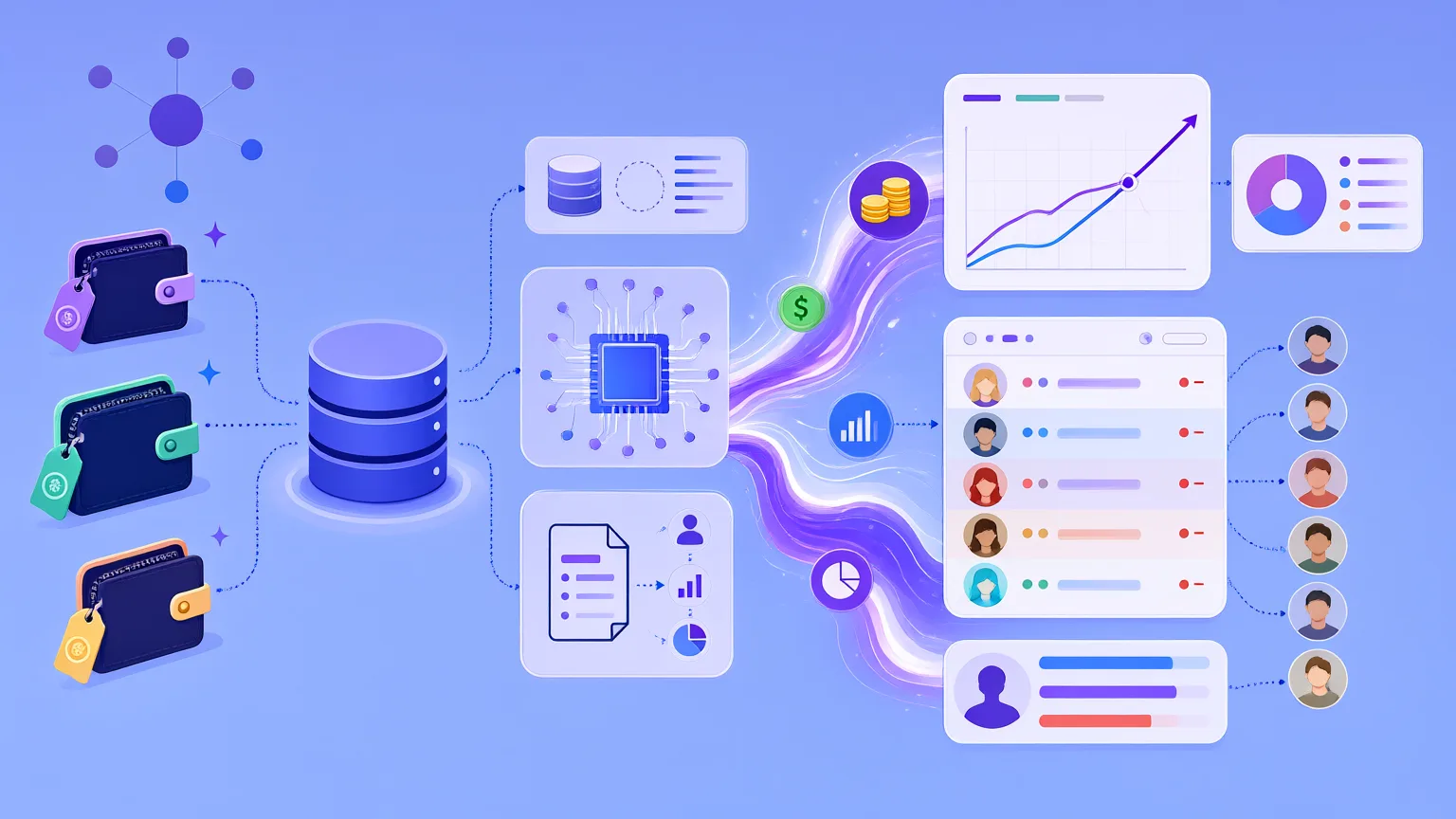
A Solana wallet tracker API gives your software programmatic access to data tied to Solana addresses. Instead of opening a dashboard, you send an address and receive structured output: SOL and SPL token balances, transaction history, profit and loss estimates, and real-time transfer or trade events. The same request pattern works for one wallet or ten thousand.
RPC vs. enriched API vs. analytics API
Most providers sit in one of three layers, and the layer determines what you have to build yourself.
- Raw RPC or gRPC. You get blocks, slots, logs, and account state. Helius frames this as the foundation for a wallet tracker, but you still parse instructions, resolve token metadata, and compute balances. Coverage is complete; interpretation is your job.
- Enriched API. Providers decode transactions, label instruction types (swap, transfer, mint), attach prices, and return holdings or PnL per address. Zerion's Solana API returns decoded transactions and PnL using a schema consistent with its EVM endpoints.
- Analytics layer. Entity labels, smart-money tags, and holder behavior sit on top. Nansen reports over 500 million labeled addresses, enabling attribution of funds, whales, or unknown entities.
Why "wallet tracker" means different things to traders and developers
A wallet tracker app is a finished product: you paste an address and read a screen. A tracker API is an input. Developers need endpoints, rate limits, schemas, and webhooks. Traders often only need the dashboard. Mixing the two categories leads to picking a tool that cannot do the job you actually have.
The newer shift is that APIs now feed LLM assistants and agents, not only dashboards. Natural-language queryability and MCP support increasingly decide whether a data provider can plug into an AI workflow at all. If that is your target, see our guide to Solana MCP servers for wallet and token research.
How We Compared the Options
The five criteria buyers care about
We scored each provider on five axes, using only public documentation and pricing pages reviewed in November 2026:
- Pricing model. Per-call, credit-based, subscription, or free tier. The structure matters more than the headline rate, because it determines how cost scales with query volume.
- Data depth. Balances, decoded transaction history, PnL, and address labels. A balance endpoint is cheap to serve; historical PnL and labeling are not.
- Latency and streaming. REST polling versus WebSocket subscriptions. Streaming shifts cost from request count to connection count.
- Chain coverage. Solana-only or multi-chain through one schema. Multi-chain matters if you already index EVM wallets.
- AI and agent integration. MCP servers, typed tool schemas, and machine-readable docs. This is where coverage gaps are largest.
How we priced a typical research workload
We modeled a researcher tracking 500 wallets, polling balances and history several times daily. That volume exposes mechanics a free tier hides:
- Credits and rollover. Many providers meter by credit, not request. Some credits expire monthly; others roll over. Expiry raises effective cost for bursty workloads.
- Per-wallet vs. per-request billing. A portfolio call covering many chains may be billed as one credit or as many, depending on the provider.
- Rate limits. A 3 RPS cap makes large backfills slow even when quota remains.
- Historical backfill. Deep history is often billed separately from live data, and some plans exclude it entirely.
No vendor paid for placement. Where a claim rests on an estimate rather than a published figure, we label it as an estimate. For related methodology, see our API buyer guide.
The 7 Solana Wallet Tracker APIs Side by Side
Seven options cover most Solana wallet-tracking needs. Each is built around a different data model, so the right pick depends on what you are actually building.
Solana Tracker
REST, WebSocket and gRPC endpoints for token and wallet data. The coverage skews toward DEX activity and token-level events, which suits builders whose product is token-centric rather than portfolio-centric. See the API documentation for endpoint specifics.
Helius
RPC access plus webhooks and parsed transaction streams. Helius gives you primitives rather than a finished tracker, so it fits teams that intend to build their own indexing and attribution layer. The wallet tracker walkthrough shows the intended shape of that work.
Zerion
A portfolio and balance API spanning Solana and 40+ chains through one schema. Base58 Solana addresses return the same enriched payload as EVM addresses. Best when a single multi-chain portfolio view matters more than Solana-native depth.
Nansen
Labeled-address analytics and smart-money data across a large labeled set. Strong for entity attribution, weaker for raw event streams. If you need to know who is behind an address, this is the layer.
CoinStats
A consumer tracker with an all-in-one API. Portfolio monitoring is the core strength; deep on-chain analytics are lighter. Reasonable for dashboards, less so for research tooling.
Solscan
Widely used as a reference point, but the public API is limited and often the first dead end for Python beginners. Treat it as a lookup tool, not a data pipeline.
StalkChain
An MCP server plus REST API that connects Claude, ChatGPT, Grok and Cursor to live wallet, PnL and flow data across seven chains. Data calls run on a subscription model with rollover credits.
| API | Primary strength | Best fit |
|---|---|---|
| Solana Tracker | Token/DEX data, streaming | Token-centric apps |
| Helius | RPC, webhooks, parsed streams | Custom tracker builds |
| Zerion | Multi-chain portfolios | Cross-chain dashboards |
| Nansen | Labeled addresses | Entity attribution |
| CoinStats | All-in-one consumer API | Portfolio monitoring |
| Solscan | Explorer lookups | Ad-hoc checks |
| StalkChain | MCP + REST, AI clients | Agent and research workflows |
For deeper background on wallet data quality, our Solana wallet tracking guides cover methodology and common coverage gaps.
Pricing and Credit Models Compared
Pricing shapes differ more than the data itself. Most providers fall into one of four buckets:
- Free tier only, Nansen's wallet tracker is free to browse for any Solana address, which covers light manual checks but not programmatic access at scale.
- Per-request or per-credit, Solana Tracker and similar APIs bill by call or credit, so cost scales linearly with your query volume.
- Monthly credit bundles, Zerion's published tiers start with a free 2K requests/day plan and move to paid plans capped around 250K requests/month, with DeFi Positions, Wallet P&L, and Portfolio Chart endpoints limited to 25% of each plan's quota and excluded from overages.
- Enterprise contracts, custom volume pricing, usually gated behind a sales call rather than self-serve signup.
Free tiers and what they actually include
Free tiers are useful for prototypes, not production. Zerion's free plan caps at 2K requests/day and 3 RPS. Nansen's free wallet view is browser-based.
Solana Tracker's free tier is rate-limited. Read each provider's docs before assuming a free tier covers your workload, see the Solana Tracker API documentation for its current limits.
The rollover-credit advantage for researchers
Research is bursty. You might investigate 200 wallets in one week, then run nothing for two weeks. Without rollover, unused credits expire and you pay again for the quiet period. Providers that roll credits forward effectively lower your cost for intermittent work.
Rough effective cost by workload:
- Hobby tracker (1K calls/mo), free tiers usually cover this.
- Active analyst (50K calls/mo), monthly bundles beat per-request pricing; rollover matters here.
- AI-agent deployment (unbounded), enterprise contract or overage pricing; per-request models get expensive fast.
Self-serve signup is available from Zerion, Solana Tracker, and Helius. Nansen and most enterprise tiers require a sales conversation.
Educational content, not financial advice. Provider terms and limits change; verify current pricing before committing.
Which API Fits Your Use Case?

The right choice depends less on raw endpoint counts and more on what you are building. Here is how the seven options map to common workflows.
For AI developers and agent builders
StalkChain's MCP server is the native fit for Claude, ChatGPT, Grok, and Cursor. Agents call wallet and token tools directly, without a translation layer.
Other APIs in this comparison expose REST or GraphQL endpoints, so you write custom tool wrappers and maintain them as schemas change. That wrapper work is ongoing, not one-time.
For traders and on-chain analysts
- Entity attribution and smart-money research: Nansen's labels are the differentiator. Its coverage spans 500M+ labeled addresses, which lets you see whether a wallet is a fund, a whale, or an anonymous address.
- Custom alerting and stream-based monitoring: Helius webhooks and Solana Tracker streams lead. Both push events to your endpoint instead of requiring polling.
- Quick Python monitoring on a budget: Solana Tracker and Helius free tiers cover low-volume scripts. Solscan is a common starting point, but its rate limits and narrower history constrain anything beyond casual checks.
For methodology on interpreting what these APIs return, see our guide to reading Solana wallet transaction history.
For app developers shipping a tracker
Multi-chain portfolio dashboards point to Zerion, whose API covers Solana plus 40+ chains through one schema. If your product is Solana-only, Helius and Solana Tracker reduce integration surface. If your users hold assets elsewhere, Zerion avoids stitching providers together.
None of these tools provide financial advice. Treat all outputs as observed data and estimates.
Verdict: Best Solana Wallet Tracker API by Use Case
Quick verdict table
- Best overall for AI-native workflows: StalkChain. MCP plus REST means assistants query live wallet data without custom glue code. You define the tool once and both a chat client and a backend service can call the same endpoints.
- Best for raw infrastructure: Helius. Its wallet tracker guide covers webhooks and parsed transaction streams, which suits teams that want to own the indexing and notification layer.
- Best for multi-chain portfolios: Zerion. One schema spans Solana and 40 other chains, with balances, decoded transactions, prices, and PnL. DeFi positions and PnL endpoints are capped at 25% of each plan quota, so size your tier around those calls.
- Best for labeled intelligence: Nansen. It reports 500M+ labeled addresses, so you get entity context rather than an anonymous base58 string. Wallet tracking is free to browse; API access is a separate commercial conversation.
- Best budget starting point: Solana Tracker. Its documentation describes a free tier, which is enough to validate a prototype before you commit to volume pricing.
- Avoid building on Solscan's limited public API. Coverage and rate limits constrain production use.
What to test before you commit
Run the same checks against each candidate before signing:
- Query a high-activity wallet and time the response for holdings, transfers, and token balances.
- Confirm how the provider handles missing data. A blank field is acceptable; a zero balance that is actually unknown is not.
- Check whether webhooks or streaming exist, or whether you must poll and pay for the difference.
- Read the credit rules for enriched endpoints, which often carry multipliers.
Our Solana wallet tracker shows the output shape we consider baseline. Treat every ranking here as a starting hypothesis, not a benchmark result.
Educational content only. Not financial advice. Provider terms and pricing change; verify current details before purchase.
Frequently asked questions
What is a Solana wallet tracker API?
A Solana wallet tracker API is a service that returns parsed on-chain activity for a given address: token transfers, swaps, balances, and counterparties. Instead of decoding raw Solana transactions yourself, you query an endpoint and receive structured records. Coverage varies by provider, so verify which programs and token standards each one indexes before relying on it.
Which Solana wallet tracker API is best?
There is no single best option. Helius and Solana Tracker suit developers who want parsed transaction history and webhooks. Bitquery is another provider some teams evaluate for query-based access.
Moralis and Covalent are other providers some teams evaluate for multi-chain apps. Choose based on your coverage needs, latency budget, and pricing model, then test against addresses you already know.
How much do Solana wallet tracker APIs cost?
Pricing ranges from free tiers with tight rate limits to usage-based plans billed per request or per credit. Several providers publish tiered plans, and others meter queries; confirm current pricing on each provider's site.
Costs scale with call volume, so estimate your monthly request count first. Terms and limits change, so confirm current pricing on each provider's site.
Can a Solana wallet tracker API track any wallet?
Yes, for public addresses. Solana's ledger is public, so any API can query any address without the owner's consent. What differs is depth: some providers return only recent activity, others full history.
Private keys are never needed. Treat the data as observed on-chain facts, not as identity, since one person can control many wallets.
Final thoughts
No single Solana wallet tracker API wins on every axis. The trade-offs are real: coverage gaps on newer programs, rate limits that surface only under load, and latency that varies by provider. Match the API to your actual workload, not to a feature list. If you need observed wallet behavior, label transfers, and public on-chain history in one place, start with a StalkChain free tier and compare its output against your current source on the same set of addresses. Confirm current pricing and limits directly, since terms change. This article is educational and not financial advice. Report disputed claims with the article URL.