Quick answer
Robinhood Chain is an Ethereum layer 2 built using Arbitrum technology. It uses ETH for gas, posts data through Ethereum blobs and has mainnet chain ID 4663.
Its public mainnet launched on July 1, 2026, with an emphasis on tokenized stocks and other real-world assets.
Robinhood also announced a dedicated Uniswap AMM and integrations with Chainlink, Alchemy and BitGo.
As a new network, however, its liquidity, applications and risk assumptions should be assessed separately from Robinhood’s established brokerage products.
What is Robinhood Chain?
Robinhood Chain is an Ethereum-compatible blockchain designed to bring financial assets and trading activity on-chain.
Robinhood describes tokenized real-world assets and stock tokens as central use cases, rather than treating them as a secondary feature added to a generic network.
“Ethereum-compatible” means developers and users can interact with the chain through familiar Ethereum standards and tooling. Wallets submit transactions, smart contracts manage applications and ETH pays the transaction fees.
The network has its own chain state and chain ID, but it is connected to the wider Ethereum ecosystem through its layer-2 architecture.
This structure creates three distinct layers to keep in mind:
- Robinhood’s consumer products provide the interfaces, accounts and regulated services associated with the company.
- Robinhood Chain provides the public execution environment where blockchain transactions and smart-contract state exist.
- Applications and protocols provide exchanges, markets, custody workflows and other services on top of the chain.
A token or application appearing on Robinhood Chain does not automatically mean Robinhood issued, reviewed or guaranteed it. Public blockchains allow third parties to deploy contracts, which makes contract-level verification necessary.
How Robinhood Chain works
Robinhood Chain is an Arbitrum-based layer 2 that settles to Ethereum. This design aims to make on-chain execution more practical while retaining Ethereum as the underlying settlement and data-publication layer.
Execution happens on the layer 2
Users send transactions to Robinhood Chain rather than submitting every action directly to Ethereum mainnet. The layer 2 executes those transactions and maintains its own current state.
That separation matters for both cost and usability. Applications can offer frequent interactions without requiring every individual trade, transfer or contract call to compete directly for Ethereum mainnet blockspace.
Ethereum remains part of the architecture
Robinhood Chain uses Ethereum blobs for data availability. Blobs are an Ethereum mechanism designed for rollups to publish transaction data more efficiently than placing the same material in ordinary Ethereum calldata.
This does not mean every Robinhood Chain transaction appears as an independent Ethereum transaction. Instead, the layer 2 processes activity and publishes the data required by its rollup design to Ethereum.
ETH pays for gas
Robinhood Chain uses ETH as its gas token. Users therefore need ETH on Robinhood Chain to pay for transfers, swaps and smart-contract calls.
Holding an asset on the network is not enough by itself. A wallet can contain stock tokens, stablecoins or other tokens and still be unable to transact if it has no ETH available for gas.
Chain IDs separate the networks
Robinhood Chain mainnet uses chain ID 4663, while its testnet uses 46630. Wallet software uses chain IDs to distinguish networks and reduce the risk of signing a transaction for the wrong environment.
The testnet is for experimentation and development. Testnet assets generally have no relationship to mainnet assets, even when their names or contract interfaces look similar.
Why Robinhood built a dedicated chain
The network’s clearest strategic focus is the movement of traditional financial assets into programmable, blockchain-based markets.
A dedicated chain gives Robinhood more room to design infrastructure around that use case than it would have through a brokerage interface alone.
Stock tokens and other real-world assets can potentially interact with wallets, automated market makers and smart contracts, subject to the rules governing the assets and the applications involved.
Robinhood’s July 1, 2026 mainnet announcement highlighted several pieces of supporting infrastructure:
- A dedicated Uniswap AMM for on-chain markets
- Chainlink integration for data and related infrastructure
- Alchemy integration for developer access and blockchain tooling
- BitGo integration for institutional custody infrastructure
- An emphasis on real-world assets and stock tokens
These integrations are meaningful because a blockchain market needs more than token contracts. It also needs pricing inputs, liquidity venues, developer infrastructure and custody support.
Their presence does not eliminate market or smart-contract risk, but it indicates the types of activity the network is being built to support.
Robinhood’s announcement also discussed agentic trading. That direction suggests a future in which software agents interact with on-chain financial infrastructure.
Analysts should still separate that product direction from activity already visible and verified on the public ledger.
What users can do on Robinhood Chain
The exact application set will evolve, but a public Ethereum-compatible network supports several basic categories of activity.
Hold and transfer supported assets
Users can hold compatible tokens in a wallet and transfer them between addresses. This can include native ecosystem assets, stablecoins, stock tokens and other contracts deployed on the network.
Before transferring an asset, verify its contract address. A matching ticker or logo is not proof that two tokens are the same.
Trade through decentralized markets
The dedicated Uniswap AMM provides infrastructure for decentralized trading. Users can swap assets when suitable pools and liquidity exist.
Liquidity should be checked independently for every market. A pool can exist while offering poor execution because its depth is limited.
Quoted price, executable price and the reference value of an underlying asset may differ.
Interact with tokenized real-world assets
Robinhood Chain’s defining use case is access to tokenized stocks and other RWAs. These instruments add analytical questions that do not arise in exactly the same way with crypto-native assets:
- What legal or contractual claim does the token represent?
- Who issues or administers it?
- Can it be redeemed, and by whom?
- Which jurisdictions and users are eligible?
- What happens outside the reference market’s trading hours?
- How closely does the on-chain price track the referenced asset?
A stock token is not automatically identical to directly owning the underlying share. The relevant issuer documentation and terms determine the holder’s rights.
Use third-party applications
Because the network is public and Ethereum-compatible, independent developers can deploy applications and tokens.
This openness expands what users can do, but it also creates familiar blockchain risks: copied contracts, misleading token names, malicious approvals and thin-liquidity markets.
For speculative token research, use a repeatable process rather than relying on branding or early price movement.
Our guide to analyzing Robinhood Chain memecoins covers that workflow in more detail.
What on-chain analysts should track
A new chain should be judged by the quality and composition of its activity, not by one headline metric.
1. Active wallets and retention
Daily active addresses show how many wallets interact with the network, but raw wallet counts can be distorted by bots, incentives or users controlling several addresses.
Track cohorts instead:
- How many wallets return after their first day?
- Which applications retain them?
- Are new wallets funded through bridges, exchanges or other on-chain addresses?
- Does activity persist after campaigns or launches end?
Retention is generally more informative than a one-day spike.
2. Liquidity and executable depth
Total value locked is not a complete measure of market quality. Analysts should inspect individual pools, assets and venues.
For each market, check:
- Available liquidity near the current price
- Volume relative to pool depth
- Slippage for realistic trade sizes
- Concentration among liquidity providers
- Sudden deposits or withdrawals
- Whether volume appears organic or mechanically repeated
A high reported volume number can coexist with poor execution.
3. Stock-token premiums and discounts
Tokenized assets may trade above or below their external reference price. The difference can be influenced by liquidity, market hours, access restrictions, redemption mechanics and temporary demand.
The useful signal is not simply that a premium exists. Analysts should ask whether it is persistent, whether it widens outside the underlying market’s hours and whether arbitrage or redemption mechanisms can realistically close it.
4. Mint, burn and transfer flows
For assets with controlled issuance, minting and burning activity can help explain changes in circulating supply. Large transfers may also reveal custody movements, liquidity provisioning or distribution into new wallets.
Interpret these events carefully. A mint is not necessarily a market purchase, and a transfer is not necessarily a sale. Contract events and transaction context matter.
5. Contract deployment and token launches
Open deployment means new tokens can appear quickly. Analysts should monitor:
- Contract creator history
- Source-code verification
- Upgrade or administrative permissions
- Holder concentration
- Early-buyer clustering
- Shared funding sources
- Liquidity ownership and withdrawal risk
A new token’s name or visual similarity to a Robinhood product is not evidence of official affiliation.
6. Cross-chain and venue flows
Robinhood Chain does not exist in isolation. Assets and users can move between networks, centralized services and on-chain venues.
Bridge inflows can indicate new capital, while outflows may reflect migration, custody changes or profit-taking.
Protocol integrations can also connect the chain to broader trading systems.
See our explanation of the Robinhood-Lighter integration for a related example of how execution venues and distribution layers can fit together.
Limitations and risks
Robinhood Chain’s architecture and integrations do not make every asset or application on the network safe.
The ecosystem is new. Public mainnet launched on July 1, 2026, so long-term retention, liquidity quality and application reliability remain developing questions.
Tokenized stocks have issuer-specific terms. Rights, eligibility, transfer restrictions and redemption mechanics can differ from direct share ownership.
Smart contracts can fail. Bugs, compromised keys, unsafe upgrade controls and malicious contracts remain possible.
Prices can diverge. Thin liquidity, market closures and limited arbitrage can cause on-chain prices to separate from external reference prices.
Public deployment creates impersonation risk. A token can copy a recognizable name or ticker without authorization.
Infrastructure dependencies matter. Wallets, RPC providers, bridges, oracles, custody providers and front ends can each introduce separate operational risks.
On-chain data improves visibility, but it cannot by itself establish legal ownership rights, issuer solvency or regulatory eligibility. Use official documentation alongside blockchain analysis.
How to monitor Robinhood Chain
A useful monitoring workflow starts broad and narrows into contract and wallet evidence:
- Watch network-wide activity for changes in transactions, active wallets and liquidity.
- Identify the applications and assets responsible for the change.
- Inspect the relevant contracts and administrative permissions.
- Trace funding, early buyers, major holders and liquidity providers.
- Compare on-chain prices with appropriate external references.
- Recheck the same wallets and markets over time.
Stalkchain Signals can help surface developing on-chain activity, but a signal is a starting point for investigation, not proof of quality, affiliation or future performance.
See the live network
Stalkchain's Daily Trends dashboard is a useful visual model for the evidence an analyst should demand before calling a chain narrative bullish: token-level net flow, persistent buying versus selling, and whether activity survives beyond one burst.
The public explorer shows the operational network rather than a conceptual diagram. It exposes batches, transaction activity, addresses, fees, and the search entry point for on-chain research.
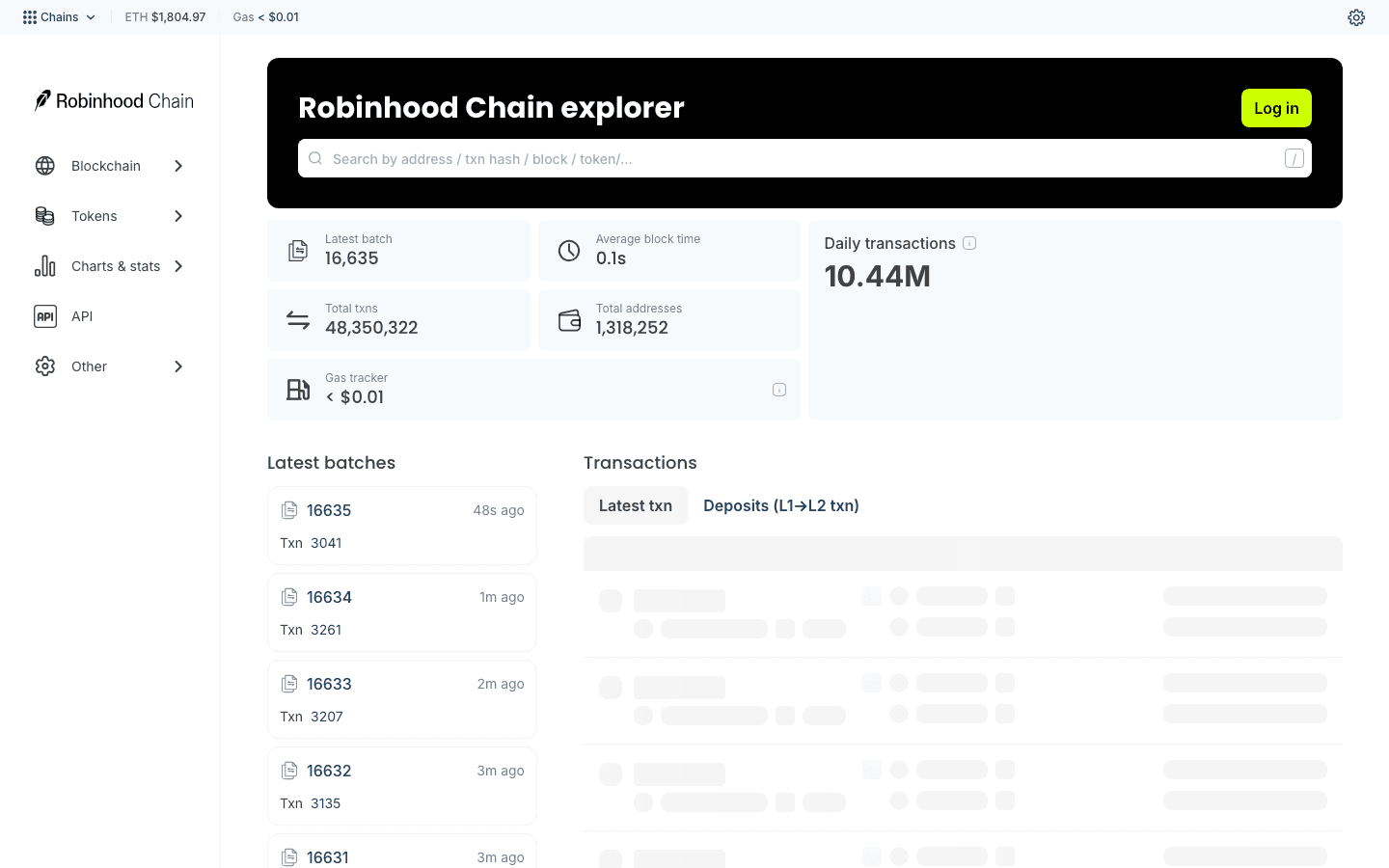
Robinhood Chain Blockscout is the public explorer for network and transaction evidence.
- Confirm chain ID 4663 in the official connection guide.
- Add the network using the Robinhood Chain bridge checklist.
- Test token activity with the memecoin-analysis framework.
- Trace addresses with the wallet-tracking guide.
- Separate large balances from conviction with the whale-accumulation workflow.
FAQ
Is Robinhood Chain its own blockchain?
Yes. It is a public Ethereum layer-2 network with its own chain state and chain ID. It uses Arbitrum technology and relies on Ethereum as part of its rollup architecture.
Is Robinhood Chain an Ethereum network?
It is an Ethereum layer 2 rather than Ethereum mainnet itself. It is Ethereum-compatible, uses ETH for gas and publishes data through Ethereum blobs.
What is the Robinhood Chain ID?
Robinhood Chain mainnet uses chain ID 4663. The testnet uses chain ID 46630. Confirm current network settings through Robinhood’s official documentation before adding the network to a wallet.
What token pays gas on Robinhood Chain?
ETH pays transaction fees on Robinhood Chain. Users need ETH on the correct network to transfer tokens or interact with smart contracts.
When did Robinhood Chain mainnet launch?
Robinhood announced the public Robinhood Chain mainnet on July 1, 2026.
Are Robinhood stock tokens the same as owning shares?
Not necessarily. A stock token’s legal rights, issuer, eligibility rules and redemption terms determine what it represents.
Tokenized exposure should not be assumed to provide the same rights as direct ownership of the underlying share.
Can anyone create a token on Robinhood Chain?
As a public smart-contract network, Robinhood Chain can support third-party deployments. That means users must verify contract addresses and should not assume that a token is official because it uses Robinhood-related branding.
Is Robinhood Chain only for tokenized stocks?
No. Its stated focus includes stock tokens and other real-world assets, but its Ethereum-compatible environment can also support exchanges, wallets and other decentralized applications.