Quick answer
The Robinhood Lighter integration gives eligible Robinhood Wallet users in selected jurisdictions access to perpetual futures powered by Lighter.
Its significance depends on what happens after launch: new deposits, active traders, open interest, fees, retention, and liquidity quality.
Robinhood supplies potential distribution, while Lighter supplies the trading venue. Investors should track the resulting flows rather than assume the announcement guarantees sustainable protocol growth.
Important: This article is for educational purposes only and is not investment advice. Perpetual futures are leveraged products that can result in rapid losses or liquidation.
What Robinhood is integrating
Perpetual futures, usually called “perps,” are derivatives that let traders take leveraged long or short exposure without an expiry date.
Positions are kept close to the underlying spot price through funding payments between long and short traders.
Robinhood’s support documentation describes how users can access and manage these products through Robinhood Wallet.
The venue behind the experience is Lighter.
The practical arrangement can be understood as two layers:
- Robinhood controls distribution and the wallet experience.
- Lighter provides the perpetual futures infrastructure and market execution.
This distinction matters. A wallet integration can reduce friction, but the underlying trading activity must still become economically meaningful.
A large user base creates a possible funnel. It does not tell us how many people are eligible, how many will fund an account, how frequently they will trade, or whether they will remain active after initial incentives end.
Why Robinhood may have chosen Lighter
The integration is notable partly because Hyperliquid is currently the benchmark many traders use when evaluating on-chain perpetual futures venues.
That makes “Why Lighter instead of Hyperliquid?” an obvious question. The answer may involve more than whichever platform has the largest current numbers.
Robinhood may care about factors such as:
- Product integration and wallet compatibility
- Execution quality and latency
- Fee design
- Technical control and customization
- Compliance requirements
- Geographic availability
- Counterparty and infrastructure risk
- The ability to create a Robinhood-native user journey
These factors are difficult to infer from public dashboards alone. An integration decision can reflect commercial or regulatory constraints that never appear on-chain.
The useful question is therefore not whether Lighter is “better” than Hyperliquid in every category. It is whether Lighter can convert Robinhood’s distribution into sustained, defensible activity.
That is the same evidence-first approach used in Stalkchain’s guide to tracking wallets before the crowd moves.
The source video, The Real Reason Robinhood Chose Lighter (Not What You Think), frames the announcement around this same distinction: a partnership headline is the beginning of the analysis, not the conclusion.
The on-chain framework for evaluating the integration
A serious assessment should separate activity, capital, revenue, and value accrual.
1. Net deposits
Start with capital entering and leaving the venue.
Track:
- Gross deposits
- Gross withdrawals
- Net deposits
- Number of unique depositors
- Median deposit size
- Concentration among the largest depositors
Net deposits are more useful than gross inflows because promotional launches can produce large deposits followed by equally large withdrawals.
Concentration also matters. If most new capital comes from a small number of market makers or whales, the integration may look successful in total value while attracting few genuine Robinhood users.
A healthier pattern would combine rising net deposits with growth in smaller, first-time accounts.
2. Active traders and retention
Unique traders measure reach, but retention measures whether the product is useful.
Monitor activity by cohort:
- First-time traders per day or week
- Returning traders after seven and 30 days
- Trades per active account
- Median position size
- Share of activity attributable to new wallets
- Percentage of volume generated by the top traders
An announcement can create a temporary spike in curiosity. Sustainable adoption should produce repeat behavior after the launch period.
If trader count rises while nearly all volume remains concentrated among existing professional accounts, Robinhood’s distribution may not be translating into broad usage.
3. Open interest
Open interest is the value of positions that remain open.
Rising open interest can indicate deeper participation and greater demand for the venue. It can also become unstable when leverage accumulates too quickly.
Read open interest alongside:
- Daily trading volume
- Funding rates
- Liquidations
- Available market liquidity
- Long-versus-short positioning
- Open interest concentration by market
High open interest with extreme funding and thin liquidity may represent crowded leverage rather than healthy growth.
The stronger pattern is gradual open-interest expansion supported by balanced funding, deeper books, and a growing number of independent traders.
4. Fees and protocol revenue
Volume is not revenue.
A venue can report substantial trading activity while charging low fees, subsidizing users, or paying incentives that exceed the revenue generated.
When comparing Lighter with Hyperliquid, separate:
- Notional trading volume
- Gross trading fees
- Rebates and incentives
- Net protocol revenue
- Revenue per active trader
- Revenue relative to open interest
- Revenue retained by the protocol
Fee schedules can change, and dashboard methodologies may differ. Compare equivalent periods and confirm whether a source reports gross fees, net fees, or estimated revenue.
Any numerical claim about current fees should be timestamped. A figure from a launch campaign may become obsolete within days.
5. Liquidity quality
Headline volume can be misleading when it comes from a narrow group of market makers or incentive-driven strategies.
Liquidity quality is better assessed through:
- Bid-ask spreads
- Order-book depth near the mid-price
- Slippage at different order sizes
- Price performance during volatility
- Liquidation execution
- Uptime and failed-order rates
- Market-maker concentration
Robinhood users will experience the integration through execution quality, not a dashboard’s total-volume counter.
If spreads widen sharply during volatile periods or moderate orders move the market excessively, the product may struggle to retain mainstream users.
How to compare Lighter with Hyperliquid
Use a consistent scorecard rather than a wide comparison table:
- Capital: net deposits and depositor growth. Shows whether new money is staying.
- Usage: daily and weekly active traders. Measures actual reach.
- Retention: returning trader cohorts. Separates adoption from launch curiosity.
- Market demand: open interest by asset. Shows persistent position demand.
- Economics: net fees and revenue. Tests whether volume produces cash flow.
- Efficiency: revenue per trader or per unit of open interest. Makes venues of different sizes comparable.
- Liquidity: spreads, depth, and slippage. Reflects the real trading experience.
- Risk: liquidations, funding extremes, and concentration. Reveals fragility hidden by headline growth.
Hyperliquid can serve as a benchmark rather than a binary winner.
For example, Lighter could remain smaller in total volume while showing faster retail-user growth after the Robinhood rollout.
Conversely, it could report rapid volume growth without comparable deposit or trader growth, suggesting activity is concentrated or incentive-led.
Absolute size and marginal growth answer different questions. Track both.
Does the integration support a buyback-and-burn thesis?
A common token thesis is that more Robinhood users will create more trading volume, which will create more fees, which can fund token buybacks or burns.
That chain contains several assumptions:
- Eligible Robinhood users discover the product.
- A meaningful percentage deposit funds.
- They trade repeatedly.
- Their activity generates net fees.
- Those fees accrue to the protocol.
- Governance or protocol rules direct value toward buybacks or burns.
- The purchases are large enough relative to token issuance and market liquidity to matter.
If any link fails, the final token impact may be much smaller than the headline implies.
A buyback should be evaluated using actual transactions and documented policy, not social posts or annualized projections based on a few launch days.
Check:
- Which address executes the buybacks?
- What asset funds them?
- Are purchases scheduled or discretionary?
- Are acquired tokens burned, locked, or held in treasury?
- How do buybacks compare with emissions and unlocks?
- Can the mechanism change through governance?
- Is the activity independently visible on-chain?
A burn is not automatically bullish if new supply enters circulation faster than tokens are removed. Likewise, high protocol revenue does not guarantee token holders receive that value.
Robinhood distribution is the catalyst to watch
The strongest part of the thesis is Robinhood’s potential distribution.
A familiar wallet interface can lower several barriers at once: discovery, onboarding, navigation, and trust. That could expose Lighter to users who would never visit a standalone perpetual futures interface.
But distribution must be measured as a funnel:
- Eligible wallet users
- Users who view the perps product
- Users who deposit collateral
- Users who open a first position
- Users who return
- Users who generate sustainable fee revenue
Only some of these steps are fully observable on-chain. Robinhood controls the top of the funnel, while public blockchain data is more useful after deposits or trades occur.
Analysts should therefore combine official product updates with on-chain deposit, account, and trading data. Neither source is sufficient alone.
Use live Stalkchain signals to identify changes worth investigating, then verify them against venue data and primary documentation.
Legal and jurisdiction risk
Robinhood explicitly limits access to eligible users in selected jurisdictions. That wording is central to the thesis.
Perpetual futures are regulated differently across markets. Availability may change based on residency, account status, product rules, or future enforcement.
The size of Robinhood’s global user base is not the same as the size of the addressable perps market.
Questions to monitor include:
- Which jurisdictions are supported at launch?
- Are major markets excluded?
- Does access require additional eligibility checks?
- Can users deposit and withdraw without unexpected restrictions?
- Do legal changes reduce the available user base?
- Which entity provides the product in each region?
Regulatory limits can weaken the distribution thesis even if the technology performs well.
Direct data checklist
Use this checklist weekly after the integration becomes broadly available:
- Record Lighter net deposits and withdrawals.
- Count new depositors and first-time traders.
- Measure seven-day and 30-day trader retention.
- Track open interest by market, not only in aggregate.
- Compare open-interest growth with volume and funding rates.
- Record gross fees, incentives, and estimated net revenue separately.
- Check the share of volume generated by the top accounts.
- Measure spreads and slippage during both calm and volatile periods.
- Compare Lighter with Hyperliquid over identical dates.
- Verify any buyback or burn using documented addresses and transactions.
- Compare token burns with emissions, unlocks, and circulating-supply growth.
- Monitor Robinhood’s supported jurisdictions and eligibility language.
- Timestamp every dashboard screenshot and numerical claim.
No single metric confirms success. The strongest evidence would be simultaneous growth in net deposits, retained traders, open interest, liquidity depth, and net revenue without excessive concentration or incentives.
What would invalidate the bullish thesis?
The integration would look weaker if:
- Deposits spike at launch and quickly reverse.
- New-account growth fails to produce returning traders.
- Volume grows while fees and net revenue remain negligible.
- Activity is dominated by a few existing accounts.
- Open interest rises alongside extreme funding and liquidation risk.
- Liquidity deteriorates during volatility.
- Buybacks are discretionary, opaque, or overwhelmed by new issuance.
- Jurisdiction restrictions sharply limit Robinhood’s reachable audience.
These outcomes would not necessarily mean Lighter has failed. They would mean the market had priced the distribution narrative faster than the underlying data justified.
Final takeaway
Robinhood’s decision to surface Lighter perpetual futures inside Robinhood Wallet is a meaningful distribution event. It gives Lighter access to a consumer funnel that most on-chain derivatives venues do not have.
The mistake is treating access as adoption.
The durable thesis must appear in net deposits, retained traders, open interest, execution quality, fees, and verifiable value accrual.
Until those signals align, the integration should be monitored as an experiment, not bought as a finished story.
Measure activity through verified contracts
Use Stalkchain Daily Trends as a model for monitoring sustained net flow rather than reacting to one announcement.
Monitor verified contract activity through the Robinhood Chain explorer. The transaction table can show calls, counterparties, value, and fees, but contract attribution and Lighter-specific interpretation require verified addresses and protocol documentation.
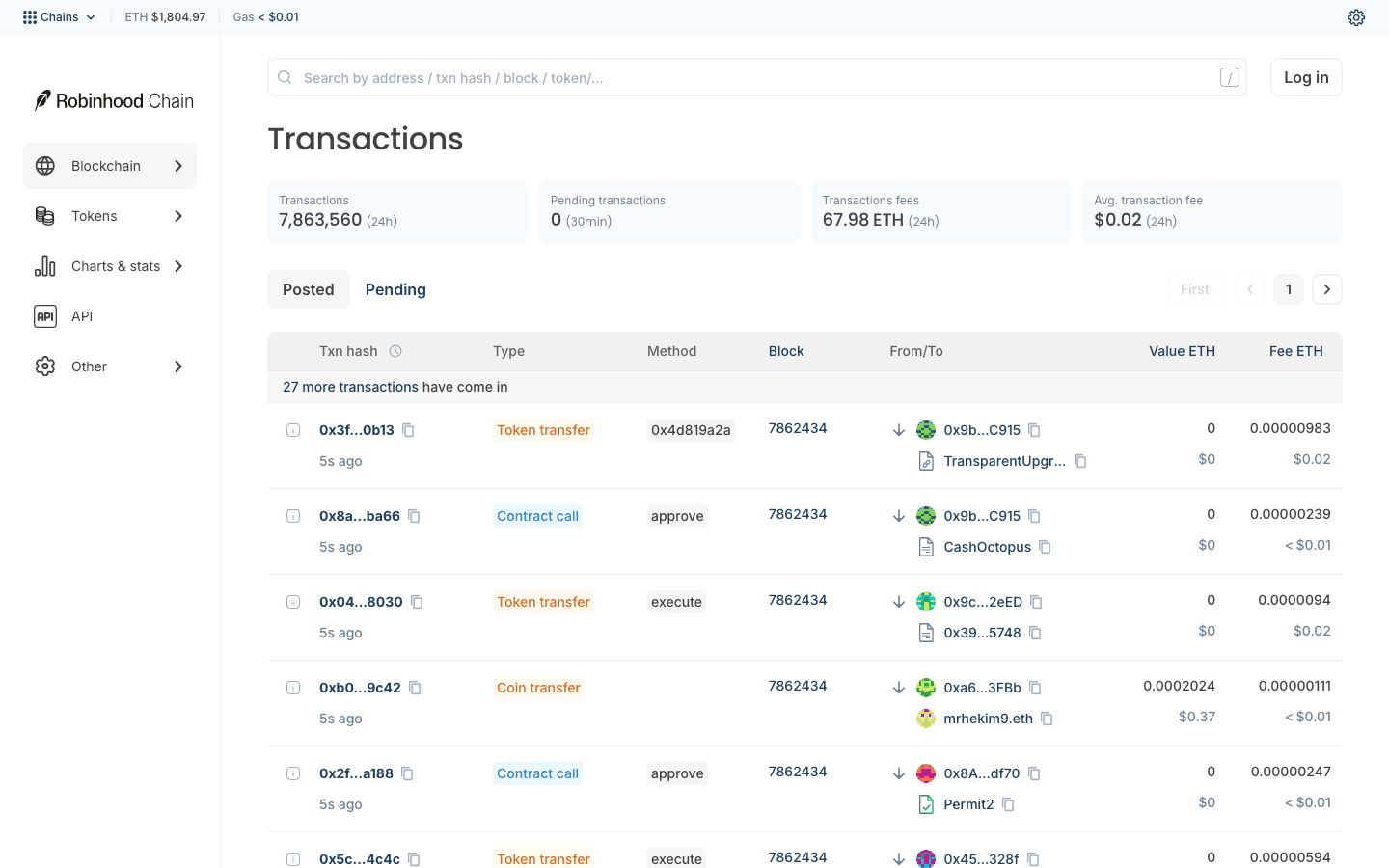
General chain activity does not prove Lighter adoption. Filter only verified Lighter-related contracts before drawing conclusions.
- Verify network claims against Robinhood Chain documentation.
- Track settlement addresses with the wallet guide.
- Separate spot whales using the whale-wallet checklist.
- Estimate results cautiously with the wallet PnL framework.
- Compare repeat performers through the top-trader workflow.
- Watch whether flows become persistent accumulation.
For protocol mechanics, use Lighter's official documentation rather than social summaries.
FAQ
What is the Robinhood Lighter integration?
It is an integration that allows eligible Robinhood Wallet users in selected jurisdictions to access perpetual futures through Lighter.
Robinhood provides the wallet experience and user distribution, while Lighter provides the underlying perpetual futures venue.
Is Lighter replacing Hyperliquid in Robinhood Wallet?
Robinhood’s announcement identifies Lighter as the venue for this perpetual futures experience. That does not establish that Lighter is universally superior to Hyperliquid.
The two should be compared using deposits, active traders, open interest, fees, retention, and liquidity quality.
Does the integration guarantee more revenue for Lighter?
No. It creates a potential source of users, but revenue depends on how many eligible users deposit, trade repeatedly, and generate net fees after incentives and rebates.
Is rising open interest always bullish?
No. Rising open interest can reflect growing demand, but it can also signal crowded leverage. It should be evaluated with funding rates, liquidity depth, trader concentration, and liquidations.
Will higher Lighter volume cause token buybacks or burns?
Not automatically. Analysts must verify the protocol’s current value-accrual rules, the source of buyback funds, the destination of purchased tokens, and how buybacks compare with emissions and unlocks.
These mechanisms and figures are time-sensitive.
Can all Robinhood users trade Lighter perpetual futures?
No. Robinhood states that access is limited to eligible users in selected jurisdictions. Users should consult Robinhood’s current support documentation for availability, eligibility, and risk disclosures.
Sources and further viewing
- Robinhood Chain mainnet and DeFi product announcement
- Robinhood Wallet perpetual futures documentation
- The Real Reason Robinhood Chose Lighter
- How to analyze Robinhood Chain memecoins
Perpetual futures are leveraged products. Small market moves can produce large losses or liquidation.
Availability, protocol mechanics, fee schedules, and token policies can change; verify current primary documentation before acting.