A token jumps 20% overnight, and the explanation is scattered across an explorer tab, a Telegram screenshot, and posts that don't agree. You want a crypto whales tracker that answers one question at a time: who is buying, where funds went, what a token's holders look like, or what the feed says is moving.
Glassnode defines a Bitcoin whale entity as a network entity controlling at least 1,000 BTC, while its address-based count is addresses holding at least 1,000 BTC. One investor, exchange, or custodian can control many addresses, so raw address counts overstate independent participants. Whale-controlled supply was approximately 76% at the 2011 market peak and about 39% of circulating supply by September 2023. Supply-share trends beat a single wallet balance, so a serious tracker needs clustering and history, not only a largest-address list.
Equity researchers already browse SEC insider filing summaries because a large reported position change is public context, not a finished trade thesis. On-chain labels work the same way. They are clues, not proof of who controls the keys.
The ten tools below are grouped by the question they answer. Each one can mislead if you treat size, a label, or a PnL rank as intent.
Table of Contents
- 1. StalkChain
- 2. Nansen
- 3. Arkham
- 4. Whale Alert
- 5. Cielo
- 6. Lookonchain
- 7. CoinGlass
- 8. Bitquery
- 9. Bubblemaps
- 10. DexCheck
- Crypto whales tracker tools at a glance
- Match the Tracker to the Question You Are Asking
1. StalkChain
StalkChain fits the question "who is buying, holding, or selling, and can an assistant answer that without juggling five tabs?" It connects through one MCP link to Claude, ChatGPT, Grok, and Cursor, and exposes the same reads over a REST API for bots, dashboards, and scripts.
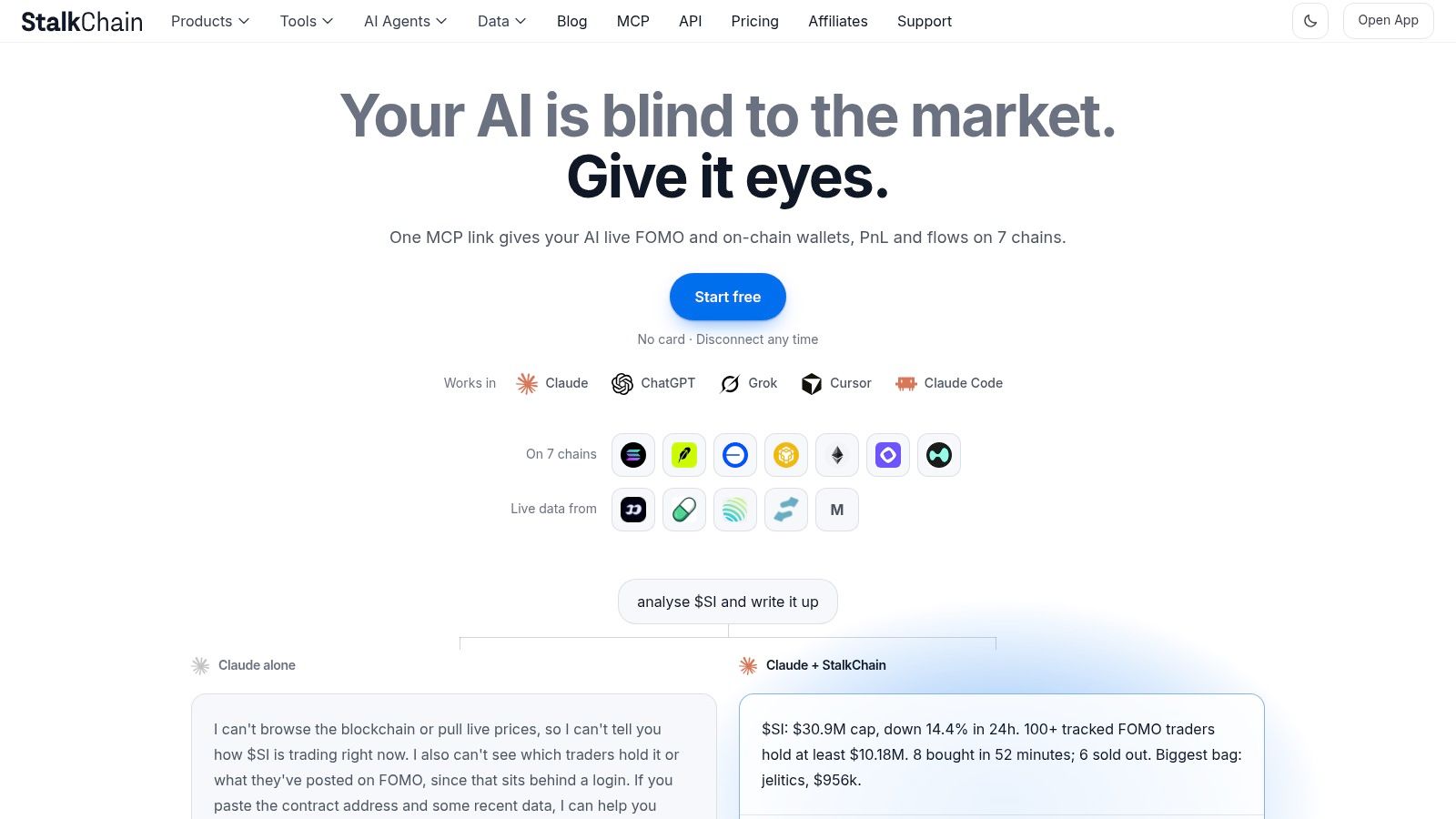
Coverage runs across Solana, Robinhood Chain, Base, BNB Chain, Ethereum, Monad, and Hyperliquid. The practical split is by question. Whale Watch follows live Solana trades above a volume threshold. Wallet Analyzer gives any wallet's PnL, win rate, and best and worst trades with an AI read, and it is free. The analyze token tool returns a full memo on one coin in a single call, covering buy and sell flow, holder concentration, tracked smart-money holders, deployer and insider positions with rug flags. KOL Feed, leaderboards, Daily Trends, Trends Analytics, and the Jupiter DCA Tracker cover the social and flow side. Plans carry monthly data-call quotas with unused-call rollover, and new accounts get $5 in free credit at signup and first lookup; current prices sit on the official pricing page.
Where the assistant still needs you
Glassnode's whale-tracking introduction separates an entity from a single address by clustering wallets believed to share an owner, and its Supply per Whale figure divides BTC in the 100 to 10,000 BTC band by the number of those addresses so consolidation doesn't fake accumulation. The same Glassnode analysis reports the tracked band's share moved from 18.87% on January 1, 2023, to 19.34%. StalkChain reports what wallets did. It does not prove who controls a wallet, why they traded, or what happens next.
- Read-only by design: Research tools do not ask for private keys.
- Call budget is real: Larger reports can spend several data calls, and coverage varies by tool.
- Size is not intent: A Whale Watch print or a holder label shows activity, not a reason or a plan.
- Not a signal service: Traders on X describe using it for smart-money flows and wallet checks. Those are testimonials, not verified performance.
Practical rule: Ask the assistant who bought, then open the receipts. If the cluster changed because of an internal shuffle, throw the "accumulation" label out.
2. Nansen
Nansen answers a narrow question well: which labeled wallets have been active, and how have those wallets performed? Wallet profiles, token-holder views, Smart Money labels, PnL context and Smart Alerts take you from a token name to the addresses behind recent prints. A free tier exists. Paid Pro plans add cross-chain depth and the fuller label set.
A Federal Reserve Bank of Philadelphia working paper on Ethereum wallets from 2018 to 2023 found a significant positive relationship between next-day ETH returns and prior-day increases in holdings by large wallets. The authors treat that as consistent with informed accumulation. They track both wallet counts and ETH held. That is a cohort study, not a reason to copy the next Smart Money buy.
Labels and PnL are context, not proof. A Smart Money tag can identify an entity that has traded well before. It does not establish who controls the wallet today, why a transfer happened, or whether the next trade repeats the last one. Chain coverage is not uniform. A free account gets a limited Smart Alert, not the full stack.
For a side-by-side on workflow fit, this Nansen alternative note is a shorter path than rebuilding the comparison yourself.
Rank the wallet. Don't let the label rank the trade.
3. Arkham
When the question is "where did this pile of funds go after the transfer?", Arkham is the entity layer. You search addresses and labeled entities, trace counterparties, and map flows. Alerts can filter by token, chain, entity, or value, and they can land in email, Telegram, Slack, or a webhook. Core exploration doesn't require a paid subscription. Team and enterprise access may need an arrangement with Arkham.
The catch is attribution. A Banxa primer on whales is blunt that addresses don't identify people, and that labels can be wrong even when they're published. A visible entity page is a hypothesis with a paper trail, not a beneficial-owner certificate. Unlabeled addresses stay hard. Internal exchange reshuffles can look like a sale until both ends resolve to the same service.
I would use Arkham to classify a transfer, then stop. For a narrower workflow comparison, see this Arkham alternative write-up before you assume one graph replaces a watchlist.
4. Whale Alert
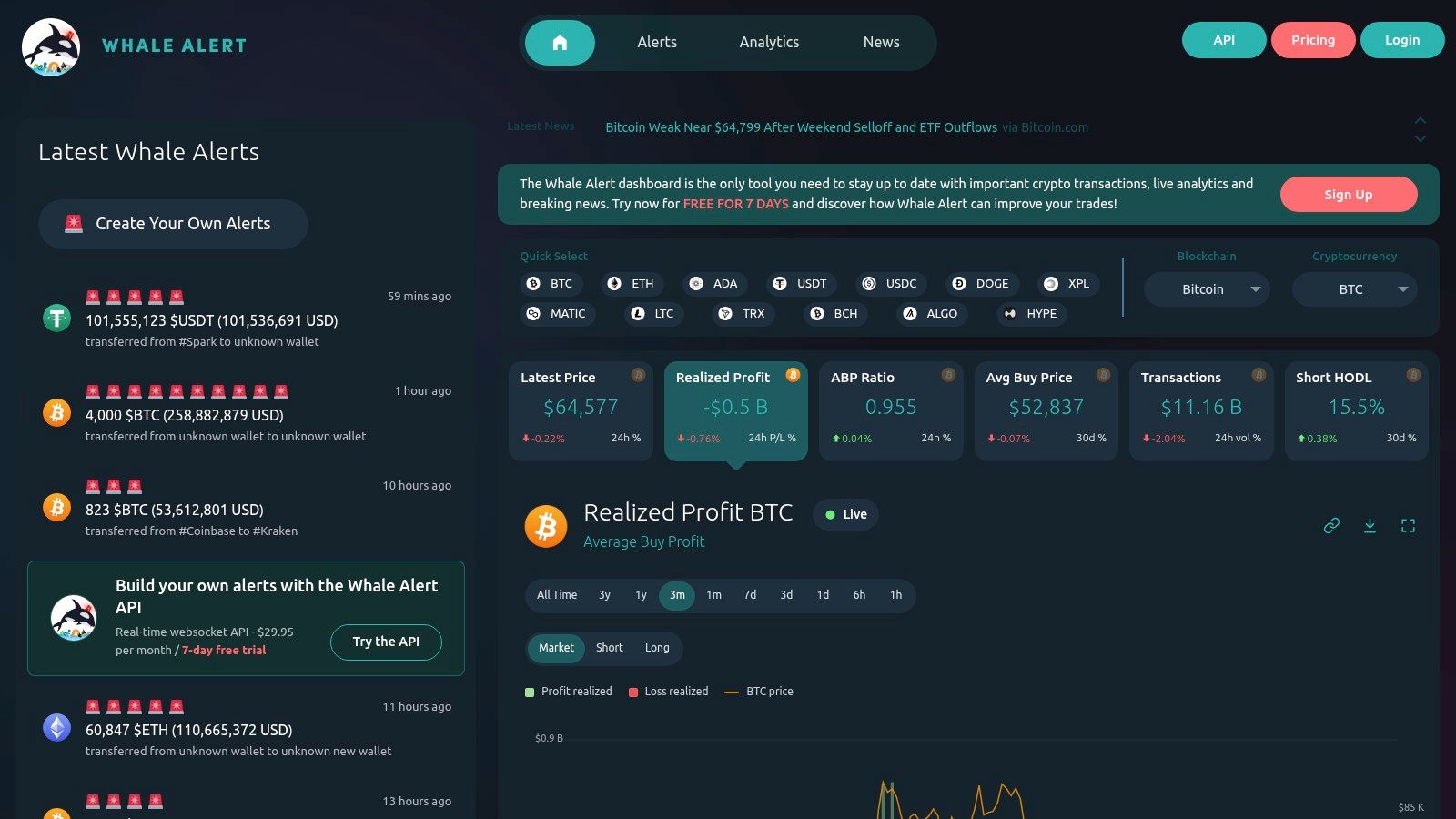
Whale Alert is the large-transfer tape. Filter by asset, value, chain, and transaction type, then take web or mobile pings. Free basic access exists; paid tiers add analytics, on-chain metrics, and API access through WebSocket or REST feeds. Rate limits and feed depth change by plan, so a high-volume subscription gets expensive fast.
Size is the product, and size is the blind spot. CoinDesk's October 2024 market note, citing Glassnode, said whale exchange deposits rose from 5,697.31 BTC in January 2023 to 11,425.87 BTC by mid-2023, roughly doubling. Coins sitting on an exchange are easier to trade. A deposit still does not prove a sale is next. It shows location, not intent, and a large transfer can be an internal reshuffle rather than fresh selling.
If the question is who is accumulating rather than who moved size, start with how to track whales buying crypto and only then subscribe to the raw tape.
5. Cielo
Cielo works when you already have a list of wallets you trust. You follow wallets, sort them into lists, and filter alerts by transaction type, minimum value, and network. Delivery runs through the web app, Telegram, or Discord. Discovery and leaderboards sit on paid tiers. A free tier exists, and the listed Pro and Whale plans are $59 and $199 a month.
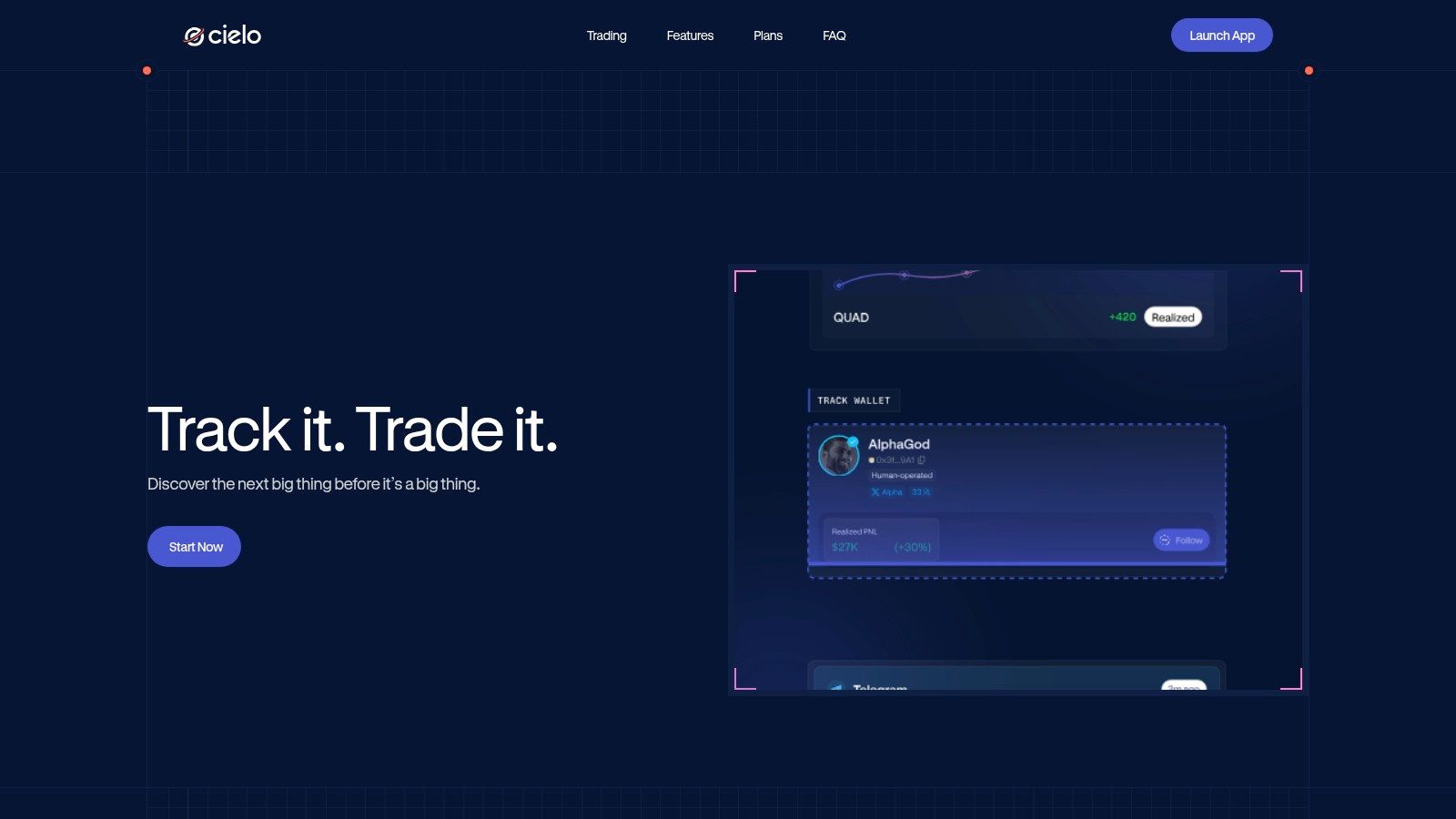
A transfer that is routine on one chain can be market-moving on another, so read every alert in its chain context before you act. Cielo tells you a followed wallet moved size. It does not tell you who controls that wallet, why the trade happened, or whether the position is still open. A list label is shorthand, not proof of ownership. Free tiers cap wallets, profiles, and alerts. Telegram delivery can lag or drop. Some high-volume wallets may be excluded, and PnL on messy activity is easy to get wrong. Use Cielo as a curated inbox, then verify the transaction yourself.
6. Lookonchain
Lookonchain answers "what did a curator decide was worth posting?" The public site and social feed cover large wallet moves and notable trader behavior without an API key or a paid plan. Treat each post as a pointer to an address or a transaction, then reopen it in an explorer or a profiler.
Cointelegraph, citing Santiment, reported Bitcoin whale transactions of at least $100,000 fell from 115,100 in the March 13 to 19 window to 60,200 in the last week of August 2024, about a 48% drop. A quiet curated feed can match a quieter tape, or it can be the posts someone chose to write. You can't tell from the feed alone.
- Fast scan: No watchlist setup, which is why it belongs at the start of a session.
- Selective by design: It is not a complete alert stream.
- No custom logic: You still need another tool for history, filters, and your own thresholds.
Verify the transaction, name the venue, and ignore the caption until both match.
7. CoinGlass
CoinGlass answers a different question: how are large traders positioned in derivatives, not who holds the spot coins. Futures positioning, long and short ratios, liquidations, and supported Hyperliquid whale views sit next to open interest. API endpoints cover whale transfers and whale-index series, with history depending on the endpoint and the plan. Web access and API permissions are not the same product.
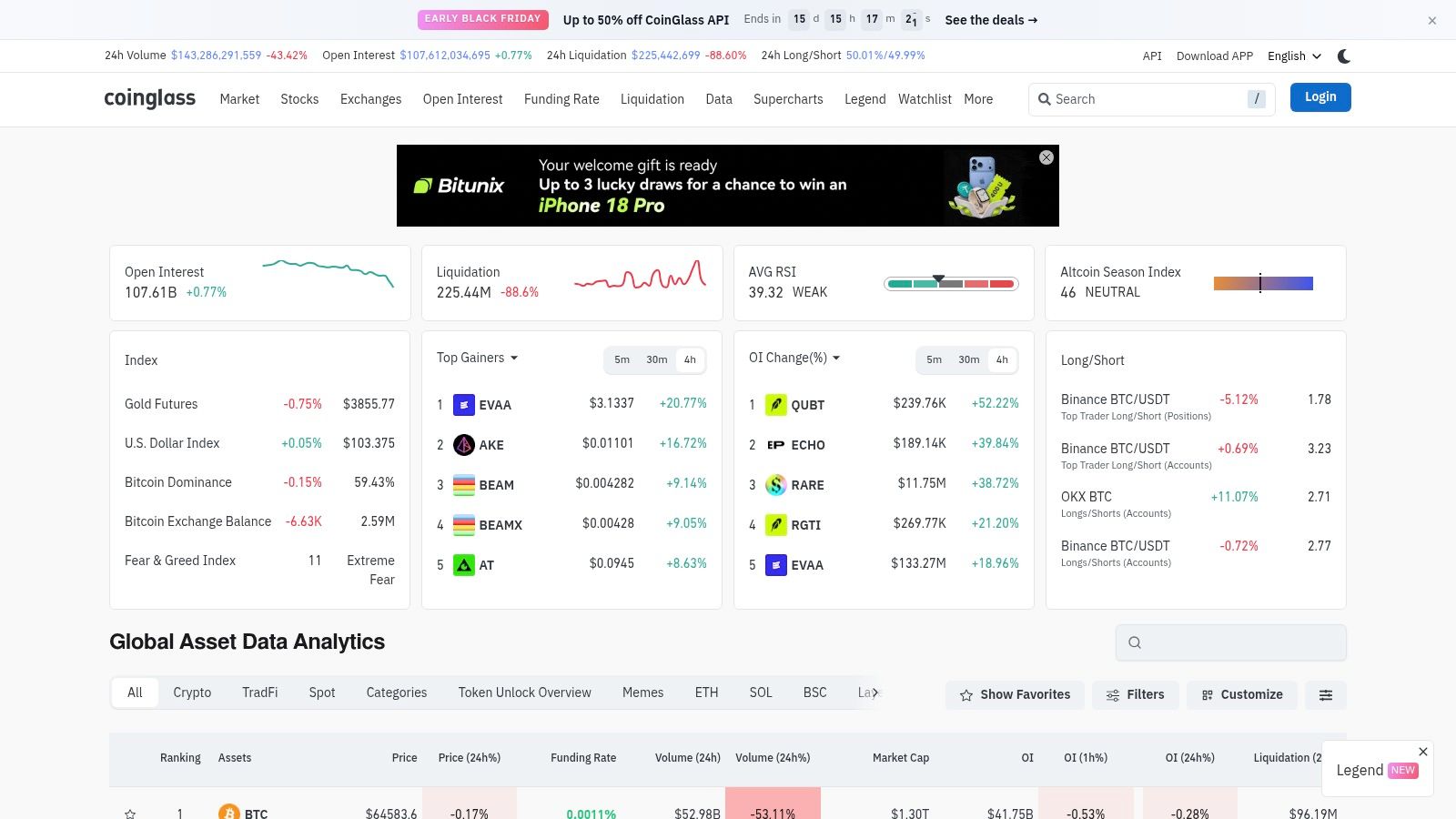
Spot cohorts and perp indexes diverge on purpose. Blockchain Reporter, quoting CryptoQuant CEO Ki Young Ju, said newly identified Bitcoin whale wallets held 1.97 million BTC in 2024, equal to 9.3% of Bitcoin's cumulative supply. That is a wallet-cohort claim. A CoinGlass index is not that balance, and it is not confirmed spot buying.
Don't replace a labeled-wallet pass with a liquidation heatmap. Use the heatmap to see whether a large on-chain move lines up with crowded leverage.
8. Bitquery
Bitquery is the build-it path. GraphQL and REST expose transfers, balances, trades, and money flows on supported networks. Eligible plans add WebSocket streams. An MCP product lets a compatible agent query chain data without you pasting explorer pages into a chat. A free trial and paid plans are published. Limits, history depth, and chain coverage change by plan or add-on.
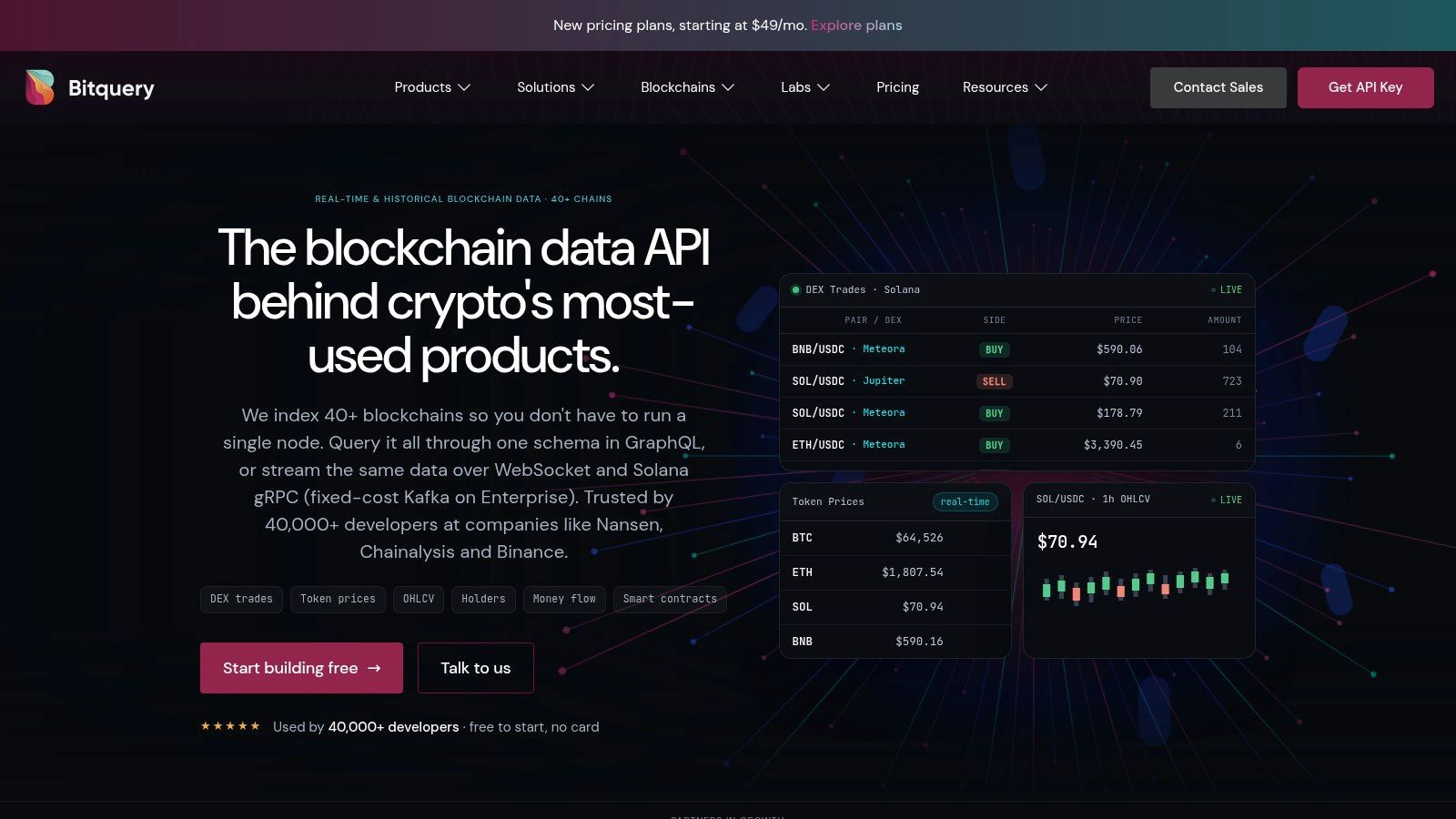
There is no whale button that knows your definition. You write the filter: minimum value, exclude known exchange hot wallets, require the flow to persist across blocks, then join it to a label set you trust. That flexibility is why quant teams and bot builders land here. It is also why a wrong join creates a fake entity. If you want alerts tomorrow morning without writing the query, this is the wrong first tool. If you want a monitor nobody else has productized, it is the right one.
9. Bubblemaps
Bubblemaps answers "what do this token's large holders look like, and which wallets appear connected?" Maps show major holders, relative size, and visible links. That is a pre-trade check on concentration and possible coordination, especially around a fresh launch. It is not a continuous alert product for every chain event.
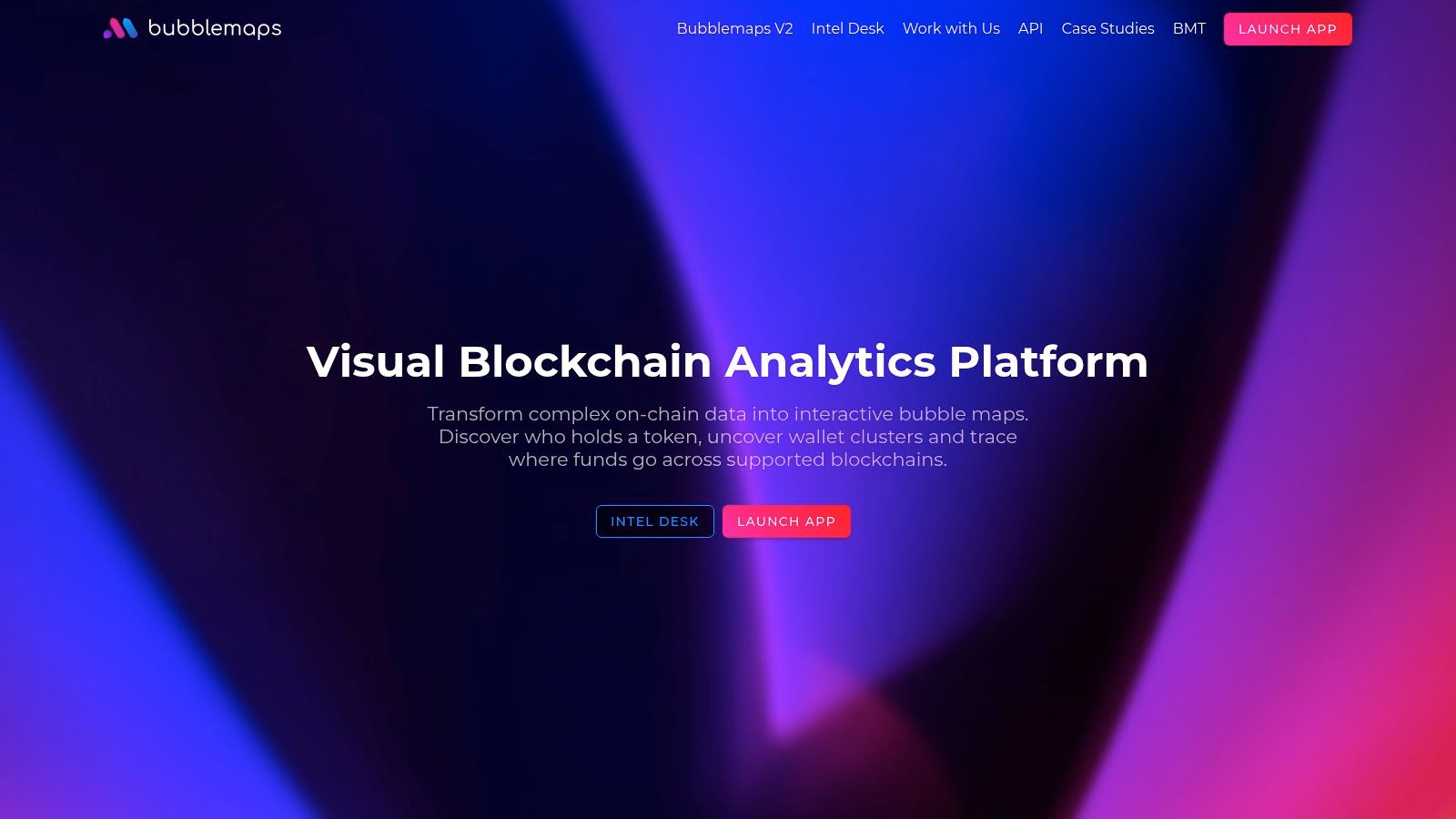
Holder maps need a baseline, or every top-10 chart looks alarming. Investopedia, citing BitInfoCharts, reported that in August 2024 the top 89 Bitcoin wallets held approximately 15.08% of circulating Bitcoin, while four wallets held 3.56%. A small-cap memecoin with a similar picture is a different risk. Bitcoin's distribution is not your token's distribution.
The map covers selected top holders, not every address. A line between bubbles doesn't prove shared ownership or a coordinated dump. Use it to decide whether you even want a watchlist, then leave.
10. DexCheck
DexCheck fits DEX flow: top holders, top traders, whale transactions, KOL activity, and market context on the pool. Realized and unrealized PnL are available for supported traders. Docs describe REST and WebSocket access. Quotas and rate limits depend on the tier. Basic views are enough to see whether a wallet is active. Heavier pulls need a plan check, and chain coverage has to match the pool you care about.
Counts of large holders move even when a leaderboard looks stable. CoinMarketCap Academy said Bitcoin whale entities holding at least 1,000 BTC reached 1,678 in October 2024, an 11.68% year-to-date increase. A PnL rank on a DEX is not that entity count. Methodology, routed swaps, and multi-wallet execution can inflate or hide results. Confirm the wallet's fills against the pool before you treat a ranking as skill.
Crypto whales tracker tools at a glance
The table is a shortlist for the first pass, not a ranking. Read the limitation column before the price column: the costly mistake is buying a tracker that answers a different question than the one you asked.
| Item | Best for | Free access | Starting paid price | Main limitation |
|---|---|---|---|---|
| StalkChain | AI-connected, multi-chain wallet and flow research | $5 free credit at signup for new accounts | Paid plans with monthly data-call quotas | Coverage varies by tool; larger reports use multiple data calls |
| Nansen | Wallet profiles, Smart Money labels, and alerts | Limited free tier | $49/month billed annually, or $69 monthly | Full access to labels, PnL, and multiple alerts requires a paid plan |
| Arkham | Entity-focused wallet investigations and transaction tracing | Core exploration and limited alerts | Not publicly listed; team and enterprise access may require an arrangement | Labels do not conclusively identify every address or owner |
| Whale Alert | Large-transfer alerts and whale transaction data | Basic access available | $14.95/month for retail alerts; API starts at $29.95/month | Transfer size alone does not explain why a movement occurred |
| Cielo | Monitoring a curated list of wallets | Free tier with starter limits | $59/month | Free-tier limits apply; alerts can sometimes be delayed or interrupted |
| Lookonchain | Scanning curated reports of notable on-chain activity | Public website and social content | No paid plan listed | Selective feed, not a complete alert stream |
| CoinGlass | Derivatives, positioning, liquidations, and supported whale data | Free web access; API access by plan | Paid API tiers published | Not a general-purpose wallet tracker; API limits depend on plan |
| Bitquery | Building custom blockchain queries and monitoring workflows | Free trial | Paid plans published | More technical; users must define their own filters and monitoring logic |
| Bubblemaps | Visualizing token-holder concentration and wallet connections | Free basic access | Paid plans published | Focuses on selected holders and does not provide broad continuous alerts |
| DexCheck | DEX analytics, trader performance, whale activity, and KOL signals | Free basic views; paid tiers for API | Paid plans published | Coverage and API access depend on tier; PnL rankings depend on methodology |
Two blind spots run across every row. A label is not proof of ownership; it is a heuristic that can attach the wrong entity to an address. An alert is not intent; size tells you a wallet moved, not whether it is opening, closing, hedging, or shuffling between its own accounts. Use the free tier to test whether a tool can explain a transfer you can already verify by hand. If it cannot, do not trust it on the next one you cannot.
Match the Tracker to the Question You Are Asking
No single crypto whales tracker covers discovery, entity tracing, holder structure, derivatives, and an agent workflow. Split the job.
Start with the question, not the logo. Lookonchain is the public scan when you don't know which wallet matters yet. Whale Alert is the size tape when you only need to know something large moved. Cielo is the inbox once you have a list worth following. Arkham is the trace when both ends of a transfer are the actual mystery. Nansen is the labeled performance layer when you want Smart Money context before you copy anyone. Bubblemaps is the holder picture before you size a position in an unfamiliar token. CoinGlass is the futures positioning picture so you don't confuse a perp index with spot coins. Bitquery is the custom query when the productized filters are too blunt.
StalkChain sits in the agent and API slot: one place to ask who holds a token, what they bought, and what the receipts show, across the chains it covers. Test a free tier or a trial against a token you already understand. If the tool can't explain a transfer you can verify by hand, don't trust it on the next one you can't.
Verify every label and every PnL figure on a second source. A service wallet, a bridge, and a market maker can print the same size transfer for three different reasons. Require the flow to persist, check whether exposure changed, and keep the alert as one input. You still make the decision.
StalkChain gives AI assistants and your own scripts live wallet, flow, and KOL context through one MCP link or a REST API, so a crypto whales tracker question doesn't depend on refreshing five dashboards. Whale Watch, wallet PnL, and token-holder reads stay research inputs, not trade instructions. See what StalkChain returns on a token you already follow before you wire it into an alert.