Quick answer
A fresh wallet on Robinhood Chain can be an early signal when its first funding, first intentional buy, timing, related wallets, retention, and exit behavior form a coherent pattern. Freshness alone is mostly noise.
A new address may be funded from an exchange, a bridge, another self-custody wallet, or a sponsored transaction flow. Never label a wallet an insider solely because it is new or bought early.
What “fresh wallet” means on an EVM chain
For practical analysis, a fresh wallet is an address with little or no observable history before the activity you care about. That may mean:
- its first transaction happened recently;
- its transaction nonce is low;
- it has interacted with few contracts;
- it received its first visible assets shortly before trading; or
- it has no older history on Robinhood Chain.
Those definitions are related, but they are not interchangeable.
Robinhood Chain is an Arbitrum-based Ethereum layer 2. It uses ETH for gas, and its mainnet chain ID is 4663.
That EVM context matters because an address can look new on Robinhood Chain while having a long history on Ethereum or another EVM network. The same 20-byte address can exist across many chains.
A low nonce is also imperfect evidence.
It counts transactions sent by a conventional externally owned account on that chain; it does not summarize token transfers received, activity on other chains, internal calls, or every action routed through smart accounts and bundlers. “Nonce zero” does not necessarily mean “no prior economic activity.”
Why fresh wallets attract attention
New addresses are useful because traders sometimes isolate strategies, launches, or counterparties behind disposable accounts. A coordinated group may fund many addresses shortly before a trade.
A skilled participant may separate a high-risk entry from a primary wallet. A project team may distribute assets across operational wallets.
But ordinary users do the same things for ordinary reasons:
- withdrawing to a new address from a centralized exchange;
- bridging into Robinhood Chain for the first time;
- testing a new wallet app;
- using a smart account created by an application;
- receiving sponsored gas or a relayed transaction;
- rotating addresses for security or privacy; or
- claiming an airdrop before making any trade.
The analytical question is not “Is this wallet fresh?” It is “What explains the wallet’s creation, funding, action sequence, and later behavior better than the alternatives?”
A workflow for analyzing fresh wallets on Robinhood Chain
Stalkchain now has a native Robinhood Chain Fresh Wallets route. The public page confirms that the feed is designed around funding source, funding amount, and first trade, with continuous updates. For a logged-out reader, the table itself is behind the Legend access boundary.
That distinction matters. The live route can be the discovery surface for an eligible user, but a public article should not pretend the underlying rows are visible to everyone. Every important attribution still needs explorer-level transaction proof.
1. Confirm the chain and the address
Start by verifying that you are looking at Robinhood Chain mainnet, chain ID 4663, rather than another EVM network or a test environment.
Record the wallet address, transaction hashes, token contract, pool or venue, and the time window under review.
Then check the same address on other relevant EVM chains. A wallet can be one transaction old on Robinhood Chain and several years old elsewhere. Cross-chain history often changes the interpretation immediately.
2. Find the first visible funding source
Trace backward from the wallet’s first action. Identify the first incoming ETH and the first incoming token balance separately.
The origin usually falls into one of several categories:
- Bridge funding: Assets arrived through an official or third-party bridge flow. This often means the wallet is new to the chain, not new to crypto.
- Centralized-exchange withdrawal: The immediate sender may be a known exchange hot wallet. That creates attribution uncertainty because many unrelated users share the same source.
- Self-custody transfer: Another EOA funded the address directly. This can be more informative, especially when the same funder seeds several new wallets.
- Contract or distribution transfer: Tokens arrived from a distributor, vesting contract, campaign, faucet, or airdrop mechanism.
- Sponsored or relayed flow: A paymaster, bundler, application, or relayer covered gas or submitted the operation.
Do not stop at the immediate sender. A bridge contract tells you how funds entered the chain, but the source-side depositor may be the more useful clue.
An exchange hot wallet usually cannot identify the customer behind a withdrawal. A same-funder pattern becomes meaningful only after you account for shared infrastructure.
3. Separate the first transaction from the first economic action
The earliest transaction may be an approval, wallet initialization, bridge claim, token transfer, contract deployment, or account-abstraction operation. None of those is automatically a buy.
Classify the wallet’s first meaningful token acquisition:
- a swap that spent ETH or another asset;
- an airdrop or claim;
- a direct transfer from another wallet;
- liquidity provision or withdrawal;
- a mint; or
- a protocol reward.
This distinction prevents a common mistake: treating every early token recipient as an early buyer. A wallet that receives tokens from a deployer is analytically different from one that swaps into the token through a public pool.
4. Read the timing in context
Compare the wallet’s funding and first buy with the relevant market events:
- contract deployment;
- pool creation;
- initial liquidity;
- first public announcement;
- rapid price or volume expansion; and
- any migration or bridge opening.
Seconds-level proximity can be interesting, but timing is not proof of privileged information. Bots monitor public mempools, contracts, logs, social feeds, and pool creation events.
On an L2, transaction ordering, sequencing, RPC latency, and indexing delays can also make a clean timeline look more precise than it really is.
Ask whether the wallet acted before information was publicly available, or merely reacted faster than a manual trader could.
5. Check for same-funder and behavioral clusters
One new wallet is ambiguous. A set of new wallets funded by the same upstream address, in similar amounts, within a narrow window, and executing similar trades is more informative.
Look for combinations of:
- one source funding multiple fresh wallets;
- repeated ETH seed amounts;
- sequential or tightly grouped funding transactions;
- the same router, pool, slippage pattern, or calldata shape;
- similar buy sizes and timing;
- synchronized approvals and exits;
- funds converging on the same collector after selling; and
- repeated behavior across more than one token launch.
No single item proves common control. Exchange withdrawal batching, bridge relayers, wallet-app defaults, and campaign instructions can create superficial similarity.
Stronger clustering comes from several independent links that persist over time.
For the broader ecosystem context, see what Robinhood Chain is and how it works.
6. Measure retention, not just entry
An early buy tells you what happened once. Retention shows whether exposure continued.
Track whether the wallet:
- keeps a meaningful share of the position;
- adds after the first buy;
- transfers tokens to another address;
- supplies liquidity;
- sells principal while retaining profit exposure;
- exits immediately after later buyers arrive; or
- becomes inactive after a single campaign-like interaction.
A wallet that buys early and holds through volatility presents a different pattern from one that sells into the first burst of demand.
Neither behavior proves intent, but the difference is central to assessing conviction and exit-liquidity risk.
7. Follow the exit
Trace proceeds after a sale. Do they remain in the wallet, return to the original funder, consolidate into a common collector, bridge away, or reach an exchange deposit address?
Exit paths can strengthen or weaken a cluster hypothesis. Several wallets that were funded separately but later send proceeds to one collector may be related.
Conversely, many wallets withdrawing to the same exchange infrastructure may still be unrelated.
The useful unit of analysis is the complete lifecycle:
- Funding origin
- Wallet setup
- Token acquisition
- Holding or retention behavior
- Sale or transfer
- Final destination of the proceeds
Representative example: early wallets around a new token
Consider a representative, anonymized launch on Robinhood Chain. This is a teaching example, not a claim about a specific token or trader.
- Twelve addresses made their first observable Robinhood Chain transaction within one hour of pool creation.
- Eight received ETH through bridge-related flows from distinct source-side depositors.
- Four received nearly identical ETH amounts from one self-custody address.
- Two of those four bought through the same router within adjacent blocks.
- One address did not buy at all; it received tokens directly from a distributor.
- Three sold most of their positions during the first sharp price expansion.
- One retained more than half its acquired tokens after 24 hours.
- Proceeds from two sellers later converged on the same collector address.
The twelve-wallet “freshness” count is not the main finding. The potentially useful lead is the four-wallet subgroup with a common funder, similar setup, closely timed buys, and partial exit convergence.
Even that pattern supports only a cluster hypothesis. It does not establish who controls the wallets or whether they had non-public information.
Patterns that deserve more attention
More constructive signal
- The wallet is new to Robinhood Chain but has credible, older activity on another EVM network.
- Its first acquisition is a real market buy rather than an airdrop or direct transfer.
- Funding can be traced to an established self-custody wallet with relevant prior behavior.
- The entry is early without being mechanically identical to a large batch of wallets.
- The wallet retains exposure, adds deliberately, or manages the position rather than dumping immediately.
- Similar profitable behavior repeats across unrelated opportunities.
This pattern can indicate an experienced participant using a new chain-specific address. It still does not make the wallet “smart money” by default.
Riskier pattern
- Many new wallets receive identical ETH seeds from one funder.
- Approvals and buys occur in a highly synchronized sequence.
- Tokens arrive by transfer, but the wallets are presented as organic buyers.
- Early wallets control a material share of accessible liquidity or circulating supply.
- Several wallets sell into the same retail-demand window.
- Sale proceeds consolidate to a common collector.
- The cluster repeats around related deployments.
This combination can indicate coordinated execution or manufactured distribution. The next step is deeper contract, funding, and lifecycle analysis, not a definitive label.
False positives that make fresh wallets noisy
Bridge contracts
A bridge contract is shared infrastructure. Many unrelated users may appear to share the same immediate source. Trace the originating deposit where possible and distinguish the bridge from the user behind it.
Exchange hot wallets
A centralized exchange can fund thousands of customers from one address. Same-source funding from an exchange is usually weak clustering evidence unless additional timing and behavioral links exist.
Gas sponsorship and account abstraction
Smart-account systems can create an address at first use, sponsor gas through a paymaster, or route operations through a bundler. The visible transaction sender and the economic owner may not be the same entity.
Low nonce and zero prior ETH balance are especially unreliable in these flows.
Airdrops, campaigns, and direct distributions
A token receipt is not a buy. Campaign participants often follow identical instructions, producing similar transaction sequences without common control.
Wallet migration and address rotation
An experienced user may move to a new address after a security event, for operational separation, or simply because a wallet application generated one. Check where the assets came from and whether prior history exists on other chains.
Shared routers and default settings
Identical router usage, approval amounts, or slippage can come from the same frontend. Treat interface defaults as supporting evidence only when combined with stronger funding or exit links.
Indexing and timestamp limitations
Explorer labels can be incomplete, internal calls may be displayed differently, and cross-chain timestamps may not align perfectly.
Preserve transaction hashes and verify important claims against raw transaction and log data before publishing an attribution.
How to turn freshness into a usable signal
Fresh-wallet analysis works best as a scoring process rather than a binary label. For each wallet or candidate cluster, ask:
- Is the address truly new, or only new to Robinhood Chain?
- What funded its first ETH and first token balance?
- Was the first token acquisition a buy, transfer, claim, or mint?
- How close was the action to liquidity and public information?
- Do independent funding, timing, execution, or exit links connect it to other wallets?
- Did it retain exposure or sell into later demand?
- Where did the proceeds go?
- Does the pattern repeat elsewhere?
The more independent dimensions align, the stronger the lead.
The language should remain calibrated: possible relationship, likely shared workflow, or cluster consistent with coordination are more defensible than “insider wallet.”
Final checklist
Before treating a fresh Robinhood Chain wallet as meaningful:
- verify chain ID 4663;
- check the address across other EVM networks;
- identify the first ETH and token funding paths;
- separate buys from transfers, claims, and airdrops;
- account for bridges, exchanges, relayers, paymasters, and bundlers;
- compare timing with public events and liquidity creation;
- look for multiple independent cluster links;
- measure retention and post-buy transfers;
- follow sale proceeds and collector addresses; and
- state uncertainty explicitly.
Freshness is useful because it narrows the investigation. It becomes a signal only when the surrounding behavior gives it context.
Find and verify a fresh address
Open Robinhood Chain Fresh Wallets to start with chain-native candidates. The logged-out page exposes the product scope and Legend access boundary; eligible users can use the table to inspect funding source, funding amount, and first trade.
If you do not have access, use the public Robinhood Chain whale tracker, KOL screener, or Blockscout transaction table to find an address. Then inspect its first transactions, funding path, contract calls, and related counterparties.
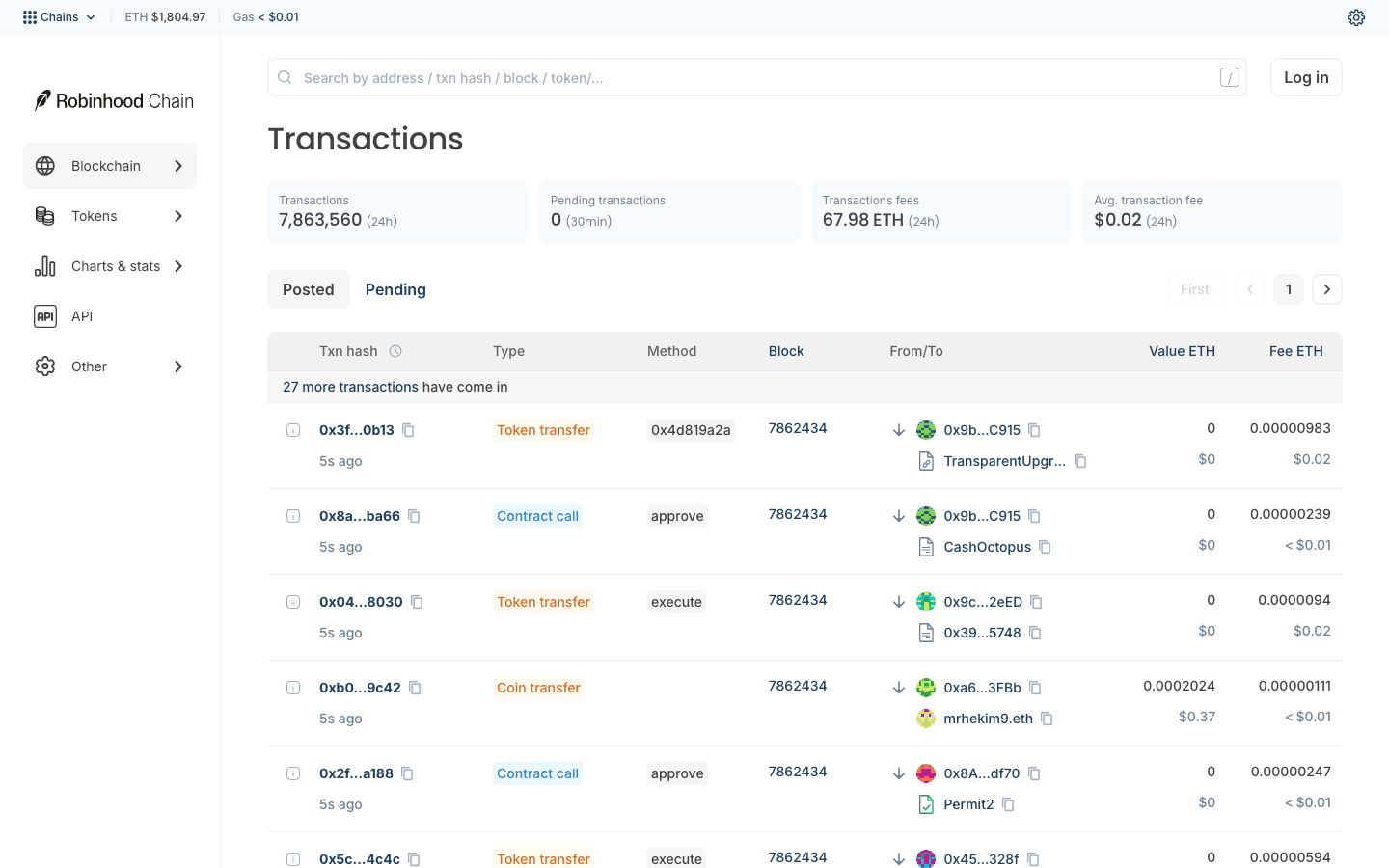
A recent transaction can identify a candidate. Address history determines whether it is genuinely fresh on Robinhood Chain.
- Confirm chain ID 4663 using Robinhood's official parameters.
- Trace first gas with the wallet-tracking guide.
- Compare the address against the best-wallet criteria.
- Check whether fresh addresses cluster around one whale wallet.
- Test whether the cluster is accumulating or distributing.
- For launches, combine this with the memecoin-analysis checklist.
What the native fields can and cannot tell you
- Funding source gives you the immediate origin. Shared bridges and exchanges remain weak identity evidence.
- Funding amount helps compare sizing across nearby wallets. Similar amounts can also come from wallet defaults or campaign instructions.
- First trade separates purposeful trading from an address that only received funds. It does not prove that the trade was informed.
- Continuous updates improve discovery speed. They do not remove indexer latency, cross-chain history, or account-abstraction caveats.
The useful result is a prioritized research queue. The final judgment comes from the complete wallet lifecycle.
FAQ
Does a fresh wallet mean the trader is an insider?
No. A new address can belong to an ordinary user, an experienced trader rotating wallets, a bot, a campaign participant, or a smart account created at first use.
Freshness alone cannot establish identity, control, or access to non-public information.
Is a low nonce enough to prove a wallet is new?
No. A low nonce only describes a limited part of that address’s transaction history on that chain.
It does not capture activity on other EVM chains, incoming transfers, every internal call, or all account-abstraction behavior.
How do I identify the first funder?
Trace the earliest incoming ETH and token transfers separately. Classify the immediate source, then continue through bridge contracts or relayers where possible.
Treat exchange hot wallets as shared infrastructure rather than direct attribution.
Are wallets funded by the same address controlled by one person?
Not necessarily. A self-custody funder seeding several wallets can support a common-control hypothesis, but exchanges, bridges, distributors, and wallet services also fund many unrelated addresses.
Combine funding with timing, execution, retention, and exit evidence.
Why distinguish first buys from first token receipts?
Because a market purchase expresses a different action from an airdrop, mint, claim, or direct transfer. Counting recipients as buyers can make distribution wallets look like organic demand.
What makes a fresh-wallet cluster more credible?
Multiple independent links: a common non-custodial funder, similar funding amounts, closely timed buys, repeated execution patterns, coordinated exits, a shared collector, and recurrence across launches.
Even then, describe the evidence without claiming a real-world identity you cannot prove.
What gas token does Robinhood Chain use?
Robinhood Chain uses ETH for gas. Its mainnet chain ID is 4663.