Quick answer
Find Robinhood Chain wallets worth investigating through the public whale tracker and KOL screener, then open each native wallet profile.
Compare caveated PnL, ROI, win rate, holding time, buys, sells, remaining exposure, funding, and completed trades across a meaningful sample. The result is a research shortlist, not proof of identity or future profitability.
Exchange funding, token concentration, fast entries, and unsolicited transfers all have benign and risky alternative explanations.
What makes a wallet worth watching
There are now three verified public Stalkchain discovery layers for this job:
- Robinhood Chain Whales ranks trade-derived unsold balances by net USD spent and supports token, time, and minimum-spend filters.
- Robinhood Chain KOLs compares linked wallets across 24-hour, 7-day, 30-day, and all-time windows using caveated DEX PnL, win rate, volume, and wallet count.
- Native
/robinhood/w/[wallet]profiles break one address into realized and unrealized PnL estimates, ROI, win rate, median hold, token rows, buys, sells, remaining balances, and activity.
These surfaces prioritize addresses. They do not certify a wallet as skilled, independent, or safe to copy.
Robinhood Chain is an Arbitrum-based Ethereum L2 with chain ID 4663. Transactions cost ETH for gas, every wallet is a standard 0x address, and every interaction follows EVM rules.
That means basic on-chain literacy translates directly to Robinhood Chain research. You need to distinguish a swap from a transfer, decode input data, and read internal calls.
A wallet worth investigating exhibits:
- Intentional behavior: It trades, supplies liquidity, or interacts with known protocols. Wallets that only receive dust are noise.
- Repeat patterns: It returns to the same tokens or protocols over time, rather than making one-off gambles.
- Traceable funding: Its first gas came from a centralized exchange withdrawal, a bridge, or another known wallet.
- Positive net flow: Over a consistent window, the wallet accumulates more value in its target tokens than it sends out.
- Explainable transaction history: Its important swaps, transfers, approvals, and liquidity actions can be reconstructed from raw events.
Any one of these alone is weak. When they converge on the same address, you have a strong candidate.
Repeat behavior vs. luck
The most important filter is repeat behavior. A wallet that buys a token and sells it for a profit once could be lucky.
A wallet that does the same thing with a different token a week later, then again a month later, is executing a repeatable process.
On Robinhood Chain, look for:
- Repeated use of verified contracts: A wallet that consistently uses the same recognized router may have a tested workflow.
- Consistent token categories: Repeated activity within one sector or thesis can indicate a deliberate research process.
- Repeatable timing: Fast entries and gradual accumulation represent different strategies. Judge each pattern across several trades, not one successful example.
Three or more repeatable patterns justify deeper research. They do not prove that the owner is a professional or that future trades will be profitable.
Treat funding as context, not reputation
On Robinhood Chain, as on any EVM L2, the first transaction of a wallet tells a story. How did the address get its initial ETH for gas?
CEX Withdrawal
A centralized-exchange withdrawal shows one possible funding route. It does not identify the owner, prove sophistication, or distinguish a trader from an ordinary user because exchange hot wallets serve many customers.
Bridge in
A bridge receipt proves that value arrived through a bridge route. It does not prove the address owner initiated the source-chain deposit, has a longer time horizon, or is a sophisticated trader.
Match the source deposit and destination receipt by bridge, amount, time, and message identifier where available. Then treat the result as cross-chain continuity evidence, not a skill score.
Self-Custody Wallet Transfer
If the wallet received its first gas from another known wallet (not a CEX hot wallet or bridge contract), trace that funder.
A chain of private wallets may reveal a funding cluster. It can also represent payments, custody, market making, or automation, so preserve alternative explanations.
Fresh Airdrop / Faucet ETH
Faucet-sized funding can be consistent with testing, farming, automation, or ordinary first use. Classify what the wallet did next instead of assigning sophistication from the funding amount.
Working rule: record the first usable gas funding, classify the source, and stop the attribution chain when it reaches shared infrastructure or ambiguous private transfers.
Read concentration as risk before conviction
Once a wallet has a history, measure how concentrated its holdings are.
- High concentration: one or two positions dominate marked value. This can reflect conviction, an airdrop, a team allocation, stale pricing, or an illiquid asset the wallet cannot exit.
- Moderate concentration: several positions contribute meaningful value. Test whether they are independent bets or correlated exposure to the same market.
- Dust-heavy history: many tiny balances can come from failed trades, automated activity, unsolicited transfers, or spam. Exclude them from value calculations unless a liquid market and signed acquisition exist.
On Robinhood Chain, token concentration is easy to measure because EVM explorers show ERC-20 balances natively.
A wallet holding most of its value in one low-cap token has concentrated exposure. That may justify further investigation, but it can also reflect illiquidity, an airdrop, a team allocation, or an inability to exit.
Contract Interaction Hygiene
Because Robinhood Chain is EVM, every meaningful action is a contract call. You can evaluate a wallet's sophistication by reading its interaction history:
Approvals Before Swaps
An ERC-20 swap may require an approval, but it does not always appear as a separate transaction immediately before the swap. Existing allowances, permits, Permit2, routers, and smart-account batching can change the pattern.
Review the actual spender, allowance size, and subsequent contract call. Broad unlimited approvals can increase exposure, while a missing new approval does not by itself indicate failure or poor practice.
Input Data Decoding
EVM explorers decode input data natively. When you look at a wallet's transaction list, check whether it calls swapExactTokensForTokens (a standard swap), transfer (simple send), or something opaque like a raw 0x data blob.
Wallets that interact via known router contracts are generally more reliable than those making direct contract calls to obscure addresses.
Avoidance of Obvious Scams
A flagged counterparty deserves investigation, but addresses can receive dust or unsolicited tokens without initiating contact. Separate inbound spam from transactions signed by the wallet before judging its contract hygiene.
Sales and exit behavior
Exit behavior matters as much as entry behavior, but the pattern alone does not reveal intent:
- Partial sells: may indicate staged risk reduction, but can also reflect route limits or a failed full exit.
- Repeated sells: may indicate systematic profit-taking or simple reaction to changing liquidity. Compare size and timing with the original position.
- Immediate full exit: can reflect a sniper, insider, bot, risk control, or ordinary trader. Check funding and related launches before assigning a label.
- No observed sells: may mean accumulation, abandonment, transfers to another address, or an illiquid position. Reconcile the current balance before deciding.
A coverage-first wallet scorecard
Score evidence quality before scoring performance. A wallet should not graduate to a watchlist merely because one headline number is large.
1. Sample
Pass: enough completed trades across more than one token and market regime.
Common failure: one launch dominates every result.
2. Basis
Pass: material acquisitions, transfers, and fees can be reconstructed.
Common failure: incomplete basis is presented as lifetime PnL.
3. Exit
Pass: gains were realized into executable liquidity.
Common failure: paper profit remains in a thin unsold position.
4. Independence
Pass: related addresses and shared funders are separated.
Common failure: one actor appears as several winning wallets.
5. Repeatability
Pass: the behavior recurs without relying on one exceptional trade.
Common failure: win rate hides one oversized loss or win.
Failing one dimension does not prove the wallet is bad. It tells you which claim you cannot yet make.
Live example: why the top row is not automatically the best wallet
On September 12, 2026, the public Robinhood Chain KOL screener returned a populated 24-hour leaderboard with DEX PnL, realized and unrealized estimates, win rate, volume, trade count, and linked-wallet count.
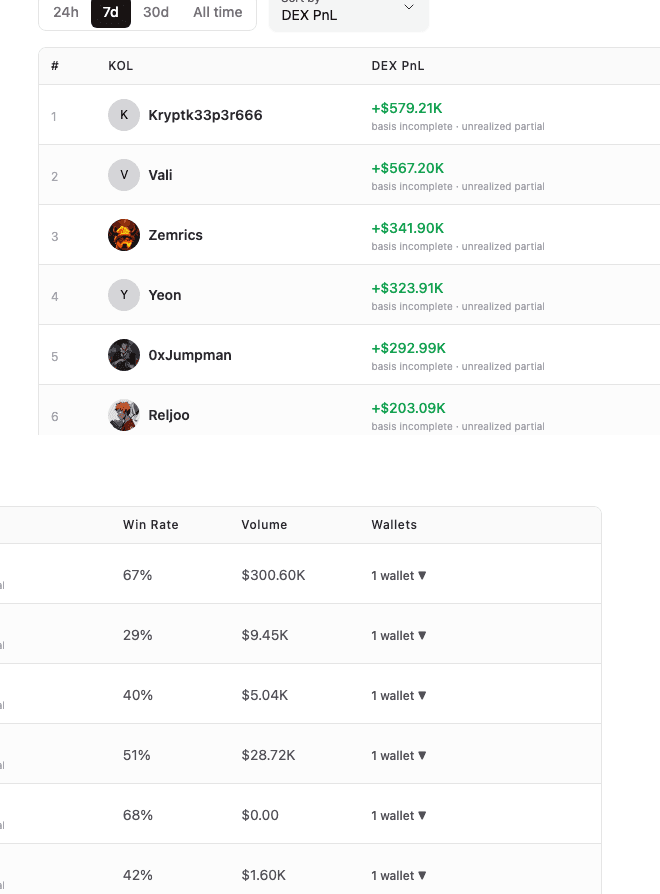
The first row showed about +$2.44M estimated PnL and a 30.6% win rate, but zero realized value, zero covered volume, and zero covered trades for that window. The third row showed about +$996K estimated PnL, yet only about $520 was displayed as realized across 15 covered trades.
All ten returned rows carried incomplete basis and partial unrealized coverage. Each represented one linked wallet. Those fields are useful for prioritization, but they block a lifetime-profitability verdict.
The next check is not "which PnL is biggest?" It is which wallet has the most complete reconstructable basis, realized exits, current exposure, and usable sell depth.
Separate wallet quality from marked inventory
Use three ledgers for every candidate:
- Realized ledger: matched disposals, proceeds, known basis, gas, and venue fees.
- Open-inventory ledger: remaining units, known or unknown basis, current price source, and executable sell value.
- Coverage ledger: transfers, bridge receipts, missing history, stale prices, and unresolved token identity.
Only the first ledger can support a realized-performance claim. The second measures current exposure. The third tells you how much confidence either estimate deserves.
This separation prevents an appreciated but illiquid token balance from being mistaken for repeatable trading skill. It also prevents unknown pre-window inventory from receiving a zero cost basis.
Add negative controls before calling a wallet exceptional
A shortlist contains wallets selected because they already looked interesting. Without a comparison group, common Robinhood Chain behavior can look like skill.
Build two controls for the same observation window:
- Activity-matched control: wallets with similar covered trade count and volume that were not selected for high PnL.
- Exposure-matched control: wallets holding tokens with similar age, liquidity, and volatility, including inactive holders.
Compare realized return, drawdown, turnover, concentration, and executable exit value across the candidate and controls. If the apparent advantage disappears after matching activity or token exposure, the original result may come from market selection rather than wallet process.
Keep failed, inactive, and transferred-out addresses in the research ledger. Removing them after the outcome is known creates survivorship bias and inflates the apparent quality of the remaining wallets.
Representative Patterns
Here are representative archetypes you may find on Robinhood Chain:
- CEX-funded, 50+ trades on one DEX, three current positions. Investigate the repeat activity, but do not use shared exchange funding as evidence of skill.
- Bridge-funded, supplies liquidity on one AMM, keeps the position open for weeks. Persistent exposure is visible; profitability still requires fee, basis, and exit reconstruction.
- Faucet-sized funding, 200+ small trades across 40 tokens. This may reflect automation, testing, farming, or speculation. Classify it before scoring it.
- Receives a token repeatedly but never signs a trade. Treat it as a distribution or custody lead, not a trading-performance sample.
- Fresh wallet buys once and exits in the next block. The behavior may matter for insider or sniper research, but it is not a repeatable skill sample.
Use these patterns to decide what to verify next. None is a self-contained quality score.
Example: reading a public whale candidate
A representative first pass starts with the whale leaderboard:
- select a fixed window and minimum net-spend threshold;
- note the wallet, token, net tokens, average cost, net USD spent, and last activity;
- treat estimated position as display-only when a defensible live price is available;
- open the address profile and check whether headline exposure is concentrated in one token;
- compare realized results with remaining unrealized inventory; and
- verify the largest buys, sells, and transfers in Blockscout.
Workflow Checklist
Here is the research sequence you can run for any Robinhood Chain wallet:
- Check funding origin: Where did the first ETH come from: an exchange, a bridge, or an unknown wallet?
- Count meaningful interactions: Exclude zero-value transfers and dust. Count swaps, liquidity deposits, and protocol calls.
- Measure token concentration: Calculate the share of portfolio value held in the largest position.
- Assess profit-taking: Check whether exits are partial, complete, gradual, or immediate.
- Review contract safety: Look for flagged addresses, unusual approvals, and unverified spenders.
- Find repeat patterns: Compare trade type, timing, and position size across several tokens.
- Trace related funding: Follow upstream wallets until the origin can no longer be identified reliably.
- Measure net token flow: Over a fixed period, determine whether the wallet is accumulating or distributing.
- Run negative controls: Compare with activity-matched and exposure-matched wallets, including inactive and failed cases.
A wallet that performs well across several checks may deserve a place on a research watchlist. The score is a prioritization tool, not proof of skill or a recommendation to copy its trades.
Investigate a candidate wallet
Start with Robinhood Chain Whales or the KOL screener. Open a candidate's native wallet profile, then use the Robinhood Chain transaction table to compare contract methods, counterparties, timing, transferred value, and fees across several completed actions.
Transaction activity can prioritize wallets for research. It cannot prove who controls them or whether future trades will be profitable.
- Reject tiny samples.
- Apply the wallet-tracking checklist.
- Trace fresh-wallet clusters.
- Recalculate performance using the wallet PnL method.
- Compare positions with the whale-wallet framework and accumulation test.
- For new tokens, use the memecoin workflow.
- Promote it only when it matches the top-trader criteria.
The official Robinhood Chain connection guide is authoritative for chain identity; the same 0x address can exist across EVM chains.
Use Ethereum's transaction documentation when decoding whether an interaction is a transfer, approval, contract call or swap.
FAQ
Q: Do I need a special tool to find wallets on Robinhood Chain?
A: You need a data source that explicitly supports Robinhood Chain. The official Blockscout explorer provides public address and transaction records, while Stalkchain provides verified Robinhood Chain discovery views. Generic EVM or Arbitrum support does not automatically mean a product indexes chain ID 4663.
Q: How is Robinhood Chain different from Solana for wallet research?
A: The biggest difference is the transaction model. On Solana wallets share the same address space and program interactions are account-based.
On Robinhood Chain, an externally owned account can send ETH directly or call a contract. Swaps commonly involve routers or pools, while allowances may come from an earlier approval, a permit, or a batched flow.
Blockscout can decode verified contracts and expose logs and internal calls. Unverified contracts and custom multicalls may still require manual decoding.
Q: Are "whale" wallets the same as "best" wallets?
A: No. A whale wallet holds a large position but may rarely trade or may trade poorly. Process and repeatable outcomes matter more than position size alone.
Q: What about wallets that only receive airdrops?
A: Airdrop receipts alone are low-signal events because they do not reveal trading intent. Later swaps or liquidity activity provide more useful evidence.
Q: Can I filter wallets by how they interact with new token launches?
A: Yes. Repeated entries shortly after verified liquidity events may indicate active monitoring or automation. Timing alone does not establish skill, independence, or future profitability.