Quick answer
To track Robinhood Chain whale wallets, open the Stalkchain whale leaderboard, choose a time window and minimum net spend. Compare net tokens, average cost, net USD spent, last activity, and the current marked position.
For network-wide monitoring, separate newly funded wallets, large transfers, and multisig executions into distinct alert lanes.
Treat the leaderboard as discovery, not proof. Open the wallet and Blockscout evidence to classify swaps, transfers, bridge movements, LP actions, and realistic exit liquidity.
Finally, check related addresses and create alerts for meaningful balance changes rather than raw transaction volume.
What counts as a whale wallet?
A whale is not simply an address with a large token balance.
For practical analysis, a Robinhood Chain whale is an address or related wallet cluster that can materially affect one or more of these:
- Circulating token supply
- Available liquidity
- Short-term buy or sell pressure
- Holder concentration
- Market confidence
- The ability of other holders to exit
The definition is relative. A wallet holding 1% of a thinly traded token may matter more than one holding a much larger dollar value in a deep, liquid market.
You should therefore evaluate whale size against:
- The token’s circulating supply
- Its liquid supply inside active pools
- Average trading volume
- Pool depth
- The wallet’s historical behavior
- Other addresses likely controlled by the same entity
The objective is not to find the biggest number. It is to determine how much influence an entity can exercise and what it appears to be doing with that influence.
Use the right ownership denominator
A whale percentage can use total supply, circulating supply, or liquid supply. Those denominators can produce very different conclusions.
Start with the explorer's raw holder percentage, then label pools, routers, adapters, burn addresses, treasuries, and vesting contracts. Keep infrastructure visible even when it is excluded from a private-holder ranking. A pool balance affects liquidity, while a treasury or adapter can still affect economic control.
Next, calculate the top 1, 5, 10, and 20 economic-holder shares. Trace the largest addresses before assuming they represent independent owners. Shared private funding, repeated transfers, coordinated timing, and common consolidation destinations can turn several addresses into one practical risk cluster.
The Robinhood Chain holder-distribution guide demonstrates the raw-versus-economic calculation with live Blockscout evidence. Use that framework before deciding whether a leaderboard row is large relative to the actual holder base.
Start with the live Robinhood Chain whale tracker
The Robinhood Chain whale tracker is now the native starting point for this workflow. The public table ranks trade-derived unsold balances across wallets and lets you filter by token, all-time or seven-day activity, and minimum net USD spent.
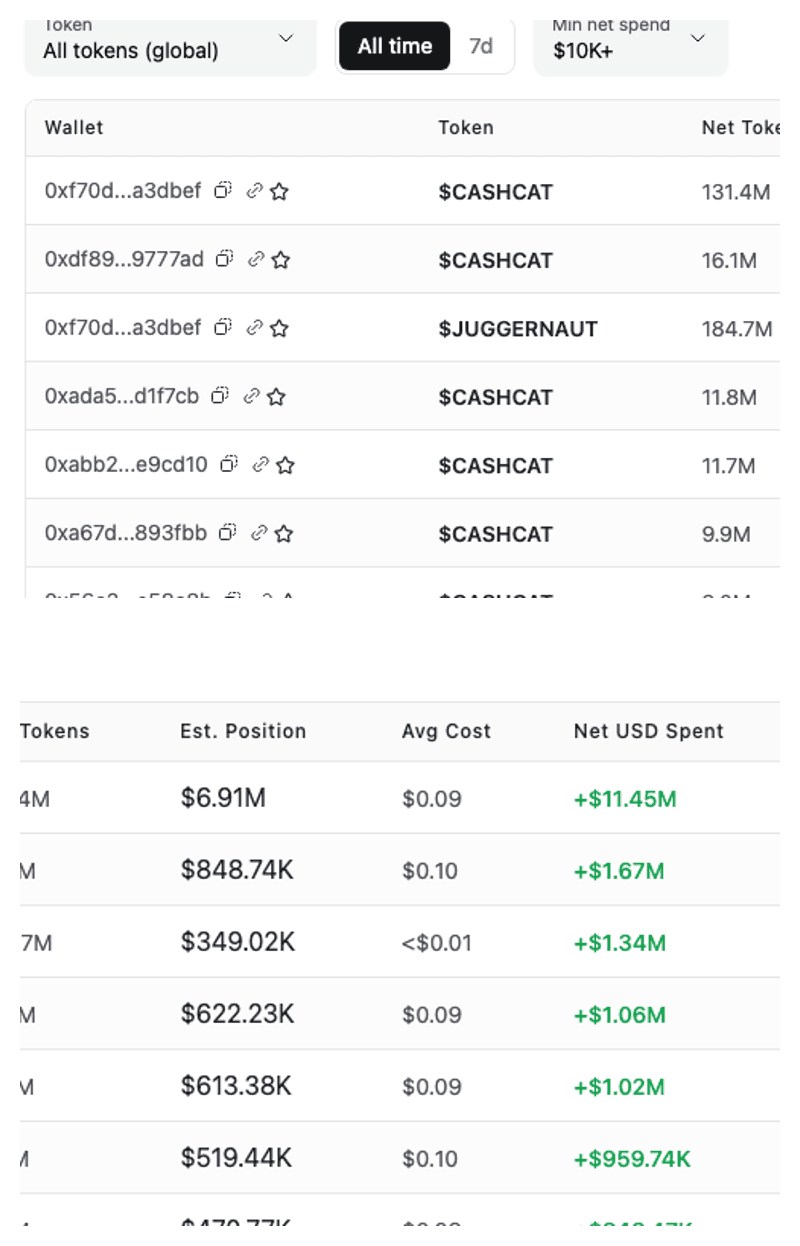
Stacked reading crops from one live product capture on July 24, 2026. Values change with new trades and prices. Estimated position is display-only, and Stalkchain leaves it unverified when a defensible live price is unavailable.
The screen exposes seven useful fields:
- Wallet: the address to investigate, with direct Blockscout and tracking actions.
- Token: the asset associated with the unsold balance.
- Net tokens: trade-derived buys minus sells in token units.
- Estimated position: unsold balance multiplied by a verified live price when available.
- Average cost: the trade-derived acquisition estimate.
- Net USD spent: quote value spent on buys minus quote value received from sells.
- Last activity: the age of the most recent included trade.
The July 24 capture showed one address appearing across CASHCAT, JUGGERNAUT, and other tokens. That is more useful than treating every row as an independent whale. It tells you to open the address, compare token-level positions, and test whether one portfolio or related cluster dominates several leaderboards.
Do not read the largest estimated position as the best wallet. A marked position can be far above or below net cash spent, and neither figure proves that the full balance can exit near the displayed price.
Before you start: collect the right identifiers
You need at least one reliable starting point:
- A token contract address
- A wallet address
- A liquidity-pool address
- A transaction hash
- A bridge deposit or withdrawal
- A holder list from a block explorer or analytics tool
Verify contract addresses through an official project source whenever possible. Token tickers and names are easy to copy, while contract addresses are unique.
If you are starting without an address, use the Robinhood whale leaderboard to find candidates. Wallet Finder is archived and should not be used as the current product path.
Robinhood Chain is EVM-compatible, so the core method is similar to analyzing wallets on Ethereum and other EVM networks.
If you are comparing methodologies across ecosystems, see our guide to tracking Solana wallets, where account models and transaction structures require different interpretation.
Triage large movements in three separate lanes
A useful Robinhood Chain movement monitor should not put every large transfer in one feed. Split candidates by the question they answer.
Lane 1: newly funded wallets
Start with the first successful inbound ETH, stablecoin, or other liquid-asset transfer to an address. A “new wallet” should have no earlier outbound activity in the reviewed chain history, not merely a recent first appearance in one token table.
Record the funding transaction, amount, asset, source, wallet age, and first action after funding. Then exclude or label:
- bridge and exchange service addresses;
- routers, pools, treasuries, distributors, and contracts;
- mint and burn legs;
- internal calls that duplicate the same economic movement;
- dust that did not enable meaningful activity.
A large first deposit is a capital-readiness signal. It becomes a trading signal only after the wallet swaps, supplies liquidity, deploys a contract, funds other addresses, or takes another economically relevant action.
Lane 2: large movements in general
Group every transaction's related transfer legs before ranking it. Routers, bridges, wrappers, and multicalls can emit several records for one economic movement. Summing the raw events can count the same capital repeatedly.
For each grouped movement, preserve both gross value and classification:
| Movement | Evidence to confirm | What it may mean |
|---|---|---|
| Wallet-to-wallet transfer | Net balance changes and no reciprocal swap flow | Funding, custody, payment, OTC settlement, or internal movement |
| DEX swap | Pool or router call plus reciprocal asset flow | Market buy or sale at an executable route |
| Bridge movement | Verified bridge contracts and paired message path | Capital entering or leaving the chain |
| Treasury transfer | Verified project or treasury relationship | Operational allocation, not automatically market demand |
| Liquidity action | Pool assets plus LP position mint, burn, or update | A change in market depth and LP exposure |
Unpriced tokens need a separate lane. Rank them by raw quantity and defensible supply share rather than inventing USD values from an illiquid or manipulated pool.
Lane 3: multisig activity
Treat multisig actions as governance events, not ordinary wallet transfers. First verify the multisig implementation, owners, signing threshold, and modules from source code, emitted events, or a defensible registry.
Monitor four event classes:
- Value movement: deposits, withdrawals, swaps, bridge calls, and token transfers.
- Control changes: owner additions or removals and signing-threshold changes.
- Permission changes: approvals, modules, guards, delegates, and upgrade authority.
- Execution outcomes: successful, failed, cancelled, or replaced proposals when the implementation exposes them.
A small owner or module change can carry more risk than a large routine transfer. Keep severity rules for control changes separate from USD thresholds.
Minimum evidence record
Every alert should preserve enough information to reproduce the finding:
- transaction hash, block, timestamp, and success state;
- token contract, decimals, raw amount, and normalized amount;
- valuation source and observation time, or an explicit unpriced label;
- sender, recipient, signer, and contract or EOA classification;
- movement category and known counterparty labels;
- related transfer legs inside the same transaction;
- wallet first-seen time and prior outbound activity for fresh-wallet claims;
- multisig owners, threshold, and configuration change when relevant.
This evidence-first structure prevents a large number from becoming an unsupported story.
Step 1: label contracts before labeling behavior
The first rule of whale tracking is simple: identify the counterparties.
An address sending tokens to a decentralized-exchange router is not doing the same thing as an address sending tokens to another externally owned account. Likewise, a transfer to a bridge contract is not automatically a sale.
Label common address types:
- Liquidity pools
- Swap routers
- Token contracts
- Bridge contracts
- Multisig wallets
- Vesting contracts
- Staking contracts
- Treasury wallets
- Centralized-exchange deposit addresses
- Smart-account infrastructure
- Unverified contracts
Look at the address’s bytecode or contract label, verified source code, event logs, and repeated transaction patterns. A contract that receives assets from thousands of unrelated wallets is unlikely to be a private whale.
Do not assign intent until counterparties are identified. “Sent 10 million tokens” is only a movement. “Sent 10 million tokens to a pool and received the quote asset” is evidence of a swap.
Step 2: measure balance delta, not transaction count
Raw transaction count is noisy. Balance delta is more useful.
For a chosen period, calculate:
Net token change = ending token balance - starting token balance
Then separate the change into categories:
Net accumulation = tokens acquired through swaps - tokens sold through swaps
Net transfers = tokens received from wallets - tokens sent to wallets
This distinction prevents a common mistake: treating a transfer between two related addresses as fresh buying or selling.
Review the wallet across several windows, such as:
- The latest hour
- The latest day
- The latest seven days
- The period since its first token interaction
A wallet may appear to be accumulating over one hour while distributing over seven days. Multiple windows reveal whether the activity is a new position, routine rebalancing, or part of a longer exit.
Focus on direction and consistency rather than a single snapshot.
Step 3: trace the wallet’s funding source
Funding history can reveal whether an address is genuinely independent.
Start with the earliest inbound transaction that supplied gas or purchase capital. Then follow the source backward.
Check whether the wallet was funded by:
- A bridge
- A centralized exchange
- Another large holder
- The token deployer
- A treasury or multisig
- A wallet already active in the same token
- A common funding address shared by several holders
A deposit from a major bridge or exchange does not prove independence because attribution often ends at that service.
However, several supposedly unrelated wallets funded by the same private address within a short period deserve closer inspection.
Record both the immediate funder and the earliest traceable origin. If the address received tokens before receiving gas, investigate whether a relayer, smart account, or sponsored transaction system was involved.
Step 4: distinguish swaps, transfers, and internal movements
An ERC-20 Transfer event does not tell you why tokens moved.
Classify each significant movement by examining the full transaction:
Swap
A swap usually involves:
- A call to a router or pool
- Token outflow and another asset inflow
- Swap-related event logs
- A measurable change in pool reserves
Wallet transfer
A wallet transfer moves tokens without an obvious reciprocal asset inside the same transaction. It may represent:
- Internal wallet management
- Payment
- OTC settlement
- Distribution to another participant
- Preparation for a later sale
Contract deposit
Tokens may be deposited into:
- Staking contracts
- Vesting systems
- Lending protocols
- Bridges
- Smart-account modules
The wallet’s visible balance falls, but its economic exposure may remain.
Liquidity action
Adding liquidity transfers two assets into a pool and typically returns a liquidity position. Removing liquidity does the reverse. Neither action should automatically be labeled a buy or sell.
When the transaction trace is complex, inspect emitted events and asset flows rather than relying on the transaction’s top-level method name.
Step 5: map distribution and transfer destinations
When a whale sends tokens out, trace the next destination.
Create a simple flow map:
Source whale
├── Wallet A → holds
├── Wallet B → swaps into pool
├── Bridge contract → moves to another network
└── Staking contract → retains economic exposure
The first hop may hide the real action. A whale can distribute tokens to several addresses that sell separately, making the original wallet appear inactive.
For each destination, check:
- When the address was created or first funded
- Whether it shares a funder with the source wallet
- Whether it sends assets back to the source
- Whether it uses the same router and timing patterns
- Whether it ultimately deposits into the same exchange or bridge
- Whether it sells shortly after receiving tokens
Repeated coordination matters more than one shared interaction. Many legitimate users touch the same popular router or bridge.
Step 6: evaluate liquidity and realistic exit pressure
A whale’s displayed balance is not the same as its realizable exit value.
Inspect the token’s active pools and ask:
- How much quote-asset liquidity is available?
- Is liquidity concentrated in one pool?
- Is liquidity locked or controlled by a small group?
- How much price impact would a partial exit create?
- Are there transfer taxes, restrictions, or unusual token mechanics?
- Does the wallet own liquidity positions as well as tokens?
Model several sale sizes rather than assuming the wallet can exit at the current quoted price. Thin pools can produce extreme slippage, failed transactions, or fragmented routing.
A wallet may distribute gradually because a direct exit would be economically destructive. That makes changes in sell cadence, destination count, and pool usage especially important.
For a broader token-level process, read how to analyze Robinhood Chain memecoins.
Step 7: run cluster checks
Wallet clustering is the process of testing whether multiple addresses may belong to the same entity.
Useful cluster signals include:
- A shared non-service funding source
- Repeated transfers between addresses
- Similar creation and funding times
- Coordinated buys or sells
- Identical contract interaction sequences
- Shared nonce or smart-account infrastructure
- Consolidation into one destination
- Common exchange deposit behavior
Treat clustering as probabilistic. One common link is rarely enough.
Use confidence levels:
- Low confidence: one weak overlap, such as using the same router
- Medium confidence: shared funding plus similar timing
- High confidence: repeated funding, coordinated transfers, and consolidation into a common private wallet
Never present a wallet cluster as confirmed ownership unless there is direct attribution.
Step 8: monitor wallet growth and exits
Track changes in both token balance and total wallet composition.
A useful monitoring record includes:
- Current token balance
- Percentage of supply
- Change since the previous observation
- Assets received through swaps
- Assets sent through swaps
- Transfers to new wallets
- Transfers to known contracts
- Estimated pool impact
- New funding sources
- Newly linked addresses
Use the Track wallet action in the Robinhood whale tracker, then watch meaningful events. Good alert rules include:
- Token balance changes above a chosen percentage
- First transfer to a known pool or router
- Distribution across several fresh wallets
- Large bridge deposits or withdrawals
- Liquidity removal
- A new common funder across watched addresses
- Repeated sales within a short window
Avoid alerts for every transaction. Contract approvals, spam tokens, gas top-ups, and routine smart-account operations create unnecessary noise.
Use an exposure-change ledger, not a notification list
For each checkpoint, carry forward four separate balances: wallet-held tokens, verified cluster-held tokens, attributable protocol or LP exposure, and unresolved outflows. Then record swap buys, swap sells, internal transfers, external transfers, and protocol actions as distinct columns.
This turns an alert stream into a reconciliation. If a wallet sends tokens to an unresolved address, do not immediately subtract them as a sale or preserve them as owned exposure. Put the amount in the unresolved bucket until the destination supplies evidence.
Use three timestamps for every review: the last included block, the market-price observation, and the liquidity quote. A fresh wallet event paired with an old price or exit quote is still stale evidence.
Example: the same alert, three possible conclusions
A tracked wallet sends 30% of its token balance to a new address.
- If the destination sells through a pool, the cluster is distributing.
- If the destination retains the tokens and shares repeated private funding or return flows, the cluster may have reorganized custody.
- If the destination deposits into a verified vault, wallet custody fell while economic exposure may remain.
The alert is identical in all three cases. Destination follow-through changes the conclusion.
Cash Cat: a time-sensitive case study
The source video for this article examines major Cash Cat wallets, including their distribution, exits, funding paths, and wallet growth.
Cash Cat is useful as a case study because it demonstrates the correct questions to ask of a concentrated, fast-moving token.
However, wallet balances, market conditions, liquidity, and ownership hypotheses can change quickly. Any figures or performance claims shown in a video are historical observations, not permanent facts.
A responsible review would reproduce the analysis from current chain data:
- Confirm the Cash Cat contract address.
- Export or inspect the current largest holders.
- Remove pools, contracts, bridges, and known treasury addresses.
- Compare each remaining wallet’s historical and current balances.
- Trace its initial funding.
- Follow distributions beyond the first hop.
- Identify swaps separately from transfers.
- Check whether related wallets are selling.
- Compare potential exits with current liquidity and slippage.
- Set alerts for future balance changes.
The value of the example is the framework, not a frozen ROI or market-cap number.
Good vs risky whale patterns
More constructive patterns
- Accumulation occurs across multiple periods rather than one isolated transaction.
- The wallet retains exposure after moving assets into staking or liquidity.
- Transfers go to established operational wallets rather than batches of fresh addresses.
- Selling is limited relative to pool depth.
- Holder concentration declines without coordinated dumping.
- Funding history does not connect directly to the deployer or a dominant cluster.
Riskier patterns
- Several top holders share a private funding source.
- A whale distributes tokens to fresh wallets that sell soon afterward.
- Large balances are supported by shallow liquidity.
- The same cluster controls tokens and removable liquidity.
- Transfers repeatedly precede sharp pool outflows.
- Public holder rankings understate exposure spread across related addresses.
- A whale receives tokens directly from the deployer without a clear vesting or treasury explanation.
These patterns indicate areas for investigation. They do not predict price direction on their own.
False positives to avoid
Mistaking a bridge for a whale
Bridge contracts can hold large balances on behalf of many users. Label them before ranking holders.
Treating liquidity provision as buying
Adding liquidity changes balances but is not equivalent to purchasing the token at market.
Calling every outbound transfer a sale
A transfer may lead to staking, bridging, custody, or another wallet owned by the same entity.
Assuming an exchange deposit means immediate selling
A deposit may precede a sale, but it can also be collateral movement, custody, or internal rebalancing.
Clustering users through shared infrastructure
Popular routers, relayers, bridges, and exchanges connect unrelated wallets. Shared infrastructure alone is weak evidence.
Ignoring proxy and smart-account behavior
The visible address may be a contract wallet controlled through another account or module.
Reading current balance as total historical exposure
A wallet with a small current position may previously have accumulated and distributed a much larger amount.
Final checklist
Before acting on a Robinhood Chain whale signal, confirm that you have:
- Verified the token contract
- Labeled pools, routers, bridges, treasuries, and contracts
- Measured balance deltas across multiple timeframes
- Separated swaps from transfers and contract deposits
- Traced the wallet’s earliest funding source
- Followed large transfers beyond the first destination
- Checked related wallet clusters with multiple signals
- Compared the wallet’s position with real pool liquidity
- Estimated slippage for plausible exit sizes
- Reviewed liquidity additions and removals
- Created alerts for meaningful state changes
- Documented uncertainty instead of assigning unsupported ownership
No individual wallet movement is sufficient evidence for a trade. Use whale tracking as one part of a broader on-chain research process, not as investment advice.
Verify the leaderboard signal before following it
Use the native leaderboard to identify candidate flows, then open the address and classify swaps, transfers, approvals, bridge movements, and contract interactions separately.
The tracker identifies trade-derived candidates. Blockscout and the wallet profile provide the transaction context needed to test the interpretation.
- Record funding source with the wallet-tracking workflow.
- Compare realized behavior with the wallet PnL methodology.
- Decide whether balance changes represent accumulation or disguised distribution.
- Compare the address with the token's holder distribution, then check linked fresh wallets and score repeat behavior with the best-wallet framework.
- For perpetuals, separate spot transfers from the Robinhood-Lighter integration.
The Ethereum transaction documentation explains why a transfer list alone cannot reconstruct intent.
FAQ
Can I track Robinhood Chain wallets with Ethereum tools?
Often, yes. Robinhood Chain uses EVM-style addresses, contracts, logs, and transaction traces, so the analytical concepts are familiar.
Tool support still depends on whether a specific explorer or analytics platform indexes the network.
How do I know whether a whale sold?
Confirm that the transaction interacted with a pool or router, that the whale’s token balance decreased, and that another asset flowed back to the wallet or its route. A token transfer by itself does not prove a sale.
What percentage makes a wallet a whale?
There is no universal threshold. Compare the wallet with circulating supply, liquid supply, pool depth, daily volume, and other holder clusters. Market influence matters more than an arbitrary percentage.
How can I identify wallets controlled by the same entity?
Look for shared private funding, repeated transfers, coordinated timing, common consolidation addresses, and similar interaction sequences. Use several independent clues and express the result as a confidence level.
Should I copy trades from a whale wallet?
A tracked wallet may have a different cost basis, time horizon, liquidity arrangement, or relationship to the project. Its visible transaction may also be an internal transfer rather than a trade.
Analyze the full context before drawing conclusions.
How often should whale alerts run?
For fast-moving tokens, near-real-time alerts may be useful for large swaps, distributions, or liquidity removal. For slower positions, hourly or daily balance snapshots can reduce noise.
Alert thresholds should reflect liquidity and token concentration.