Quick answer
Verify the full address, record native SOL, group token accounts by mint, and identify protocol-held positions. Add timestamped prices, then request a fresh sell quote for the actual size. A displayed Solana wallet balance does not prove cost basis, ownership, profit, or executable value.
What a Solana wallet holding means
A holding is an asset or protocol claim currently controlled by an address. It may be native SOL, an SPL token balance, wrapped SOL, an LP position, a vault receipt, or another account whose value must be decoded from program state.
This is narrower than a complete portfolio. One person can use several addresses, while one address can hold assets through several token and protocol accounts.
Keep four questions separate:
- Quantity: how many raw units does the address control?
- Location: which wallet, token, vault, stake, or LP accounts contain the exposure?
- Marked value: what is the estimated value at a stated price and time?
- Executable value: what would a current route return for the intended sell size?
A wallet overview may answer part of the first three. It rarely answers all four by itself.
Before you start: save the exact address and checkpoint
Copy the complete address from a transaction, an explorer, or another trusted source. Do not rely on a shortened label or social profile.
Record the observation time and the data sources you use. Balances, prices, routes, and liquidity can change while the investigation is open.
Your evidence note should include:
- complete wallet address
- checkpoint time and timezone
- native SOL balance
- token account addresses and mints
- raw amounts and verified decimals
- price source and price time
- protocol positions included or excluded
- spam and unpriced assets excluded
- fresh exit quote, route, minimum output, and quote time
Use the broader Solana wallet tracking workflow when you also need funding, transactions, performance, and related addresses.
Step 1: record native SOL correctly
Start with native SOL. Keep the raw lamport balance and the normalized SOL amount.
Do not assume all SOL is available for a trade. The wallet may need SOL for transaction fees, priority fees, rent, account creation, or instructions already being prepared. Wrapped SOL belongs in its token account until it is unwrapped.
A closed token account can return rent to the owner. That inbound SOL is not trading profit.
Step 2: group token accounts by mint
Solana wallets can have several token accounts for the same mint. Group balances by mint before calculating a holding.
For every material mint:
- Confirm whether it uses the SPL Token or Token-2022 program.
- Read the mint's decimals from the mint account.
- Sum only accounts controlled by the reviewed owner.
- Preserve delegated, frozen, escrowed, or restricted states.
- Separate wrapped SOL from native SOL.
- Exclude spam only with an explicit rule.
A human-readable amount is:
raw token amount / 10^mint decimals
Wrong decimals can inflate or shrink a balance by orders of magnitude. Verify the mint before using a token name, symbol, logo, or price.
Separate mint identity from canonical asset identity
Two balances can represent the same broad economic asset while remaining different Solana mints. Native, wrapped, bridged, liquid-staking, stablecoin, and tokenized-equity variants can have different issuers, authorities, transfer rules, pools, and redemption paths.
Use the exact mint as the primary ledger key. Add a separate canonical-asset field only when a defensible registry maps several variants to one underlying asset.
The Solana Foundation's open-source Tokens project provides a curated asset and variant model. A listing is identity enrichment, not an issuer guarantee or safety approval.
Keep both views:
| View | Grouping rule | Use |
|---|---|---|
| Mint-level inventory | One row per exact mint and token program | Authorities, balances, pools, transferability, and sell quotes |
| Canonical-asset exposure | Group only variants with a supported mapping | Broad economic exposure across wrappers or issuers |
| Unresolved identity | Preserve exact mint without grouping | Prevent symbol or logo matches from merging unrelated tokens |
Do not add two variants at a shared displayed price unless each mint has a supported conversion or redemption relationship at the checkpoint. A bridged asset can trade away from its reference asset, and one variant can lose routing or redemption while another remains liquid.
Check whether the token can actually move
Quantity does not prove transferability. Before calling a balance sellable, inspect the token program, mint state, account state, and extensions that can change transfer behavior.
For a material Token-2022 holding, check for:
- transfer fees that reduce the received amount
- transfer hooks that add program-specific conditions
- non-transferable configuration
- frozen accounts or an active freeze authority
- permanent delegate or other authority settings
- withheld fees that are not ordinary wallet inventory
Record the mint and account configuration at the same checkpoint as the balance. An interface can display the right raw quantity while a route fails because the token has restrictions or requires extra accounts.
Do not hide low-value and unpriced tokens
A useful interface may filter spam and dust for readability. Your research record should still state what was excluded.
Use three value states:
- Priced: a defensible current price exists for the exact mint.
- Unpriced: quantity is known, but price coverage is missing or unreliable.
- Excluded spam: the token was omitted under a stated spam rule.
Unpriced is not the same as worthless. It means the valuation is unresolved.
Step 3: find exposure outside ordinary token accounts
A zero wallet token balance does not always mean the position is closed. Inventory may sit in:
- a liquidity pool or concentrated-liquidity position
- a staking or restaking account
- a vault or yield strategy
- an escrow or vesting contract
- a lending position
- a sibling wallet
LP and vault receipt tokens are claims, not ordinary spot holdings. Decode the protocol state to estimate the underlying assets. Record whether fees, rewards, debt, lock conditions, and out-of-range liquidity are included.
The Solana liquidity-removal guide explains why pool custody and withdrawable liquidity must be tested separately.
Step 4: attach prices without creating false precision
A portfolio value is a timestamped estimate:
normalized quantity × defensible price for the exact mint
Check that the price belongs to the same mint and that supply, decimals, and market-cap relationships are plausible. A tiny pool can print a last price that cannot value a large wallet position honestly.
Keep quantity and valuation separate. If price coverage fails, preserve the quantity and mark the value unresolved.
Marked value versus executable value
Marked value applies a reference price to the full quantity. Executable value comes from a current route for the actual sell size after price impact, fees, slippage, transfer restrictions, and available depth.
| View | Useful for | Does not prove |
|---|---|---|
| Raw balance | Exact controlled units at the checkpoint | Cost basis or USD value |
| Marked value | Comparable portfolio estimate | Full-size sale proceeds |
| Fresh sell quote | Time-sensitive route output | Future output or guaranteed fill |
| Historical buys | Covered acquisition evidence | Basis for transferred-in inventory |
Request more than one quote size when the position is material. A small quote can look healthy while the full position crosses thin liquidity.
Reconcile a route quote with account restrictions
A successful indicative quote does not prove the wallet can execute it. The quote service may price the mint without checking every account state, extension, required hook account, or wallet-specific restriction.
Keep the evidence in this order:
- Verify the owner, token program, mint, decimals, and raw quantity.
- Check account state and material mint extensions.
- Request a fresh quote for the intended raw size.
- Preserve route, fees, price impact, minimum output, and expiry.
- Treat the output as indicative until the exact transaction can be built and simulated for that wallet.
If the quote covers only part of the balance, report the covered quantity. Do not apply its unit price to the unquoted remainder.
Build a quantity ladder before applying a price
One headline token balance can hide several smaller quantities with different meanings. Preserve a quantity ladder for every material mint:
| Quantity | What it means | Evidence required |
|---|---|---|
| Gross account quantity | Raw units across included accounts | Account addresses, mint, token program, decimals, checkpoint |
| Controlled quantity | Units under the reviewed owner or supported authority path | Owner, delegate, freeze, escrow, and protocol state |
| Transferable quantity | Units that can move under current token and account rules | Mint extensions, account state, hook requirements, transfer-fee treatment |
| Routable quantity | Units accepted by a current executable route | Exact raw input, route, quote time, and restrictions |
| Minimum-output value | Conservative output protected by the quoted transaction terms | Minimum output, fees, slippage setting, and expiry |
Do not force the ladder to decrease through guesswork. If a protocol position cannot be decoded or a transfer hook cannot be evaluated, mark the next quantity unresolved. Report the last verified level and the excluded amount.
For example, a wallet may show 10 million gross units, control 9.6 million after excluded withheld fees, have 8 million currently transferable, and receive a defensible full-size route for only 5 million. Applying the route's unit price to all 10 million would combine incompatible evidence.
Step 5: reconcile holdings with transaction history
Current quantity tells you what remains, not how it arrived. Read successful balance changes in chronological order.
Separate:
- swaps that increased or reduced exposure
- transfers in and out
- airdrops and rewards
- LP or vault deposits and withdrawals
- account closures
- failed transactions
Carry basis through transfers only when the source lot can be traced. Do not assign zero cost to transferred-in tokens or call transferred-out tokens sold.
Use the dedicated Solana wallet profitability method before turning holdings into PnL, ROI, or win-rate claims. For upstream SOL and related-wallet evidence, follow the wallet funding-source workflow.
Reconcile checkpoint drift while the wallet keeps moving
A holdings snapshot and transaction history can disagree because they were observed at different times. Save a block time or narrow checkpoint window for both.
Use this reconciliation order:
- Record balances at the holdings checkpoint.
- Identify every successful signature between the history cutoff and that checkpoint.
- Apply raw native and token balance changes in order.
- Add newly created accounts and remove only accounts proven closed.
- Re-read balances if the wallet moved during the investigation.
Do not patch a timing mismatch with a current USD price. Quantity must reconcile first.
If the wallet remains active, publish a bounded conclusion such as “6.2 million units controlled at 09:15 UTC.” Avoid presenting the snapshot as a stable portfolio statement.
The Solana wallet transaction-history workflow explains how to preserve signatures, failures, fees, and account changes between checkpoints.
How to compare balances across multiple wallets
Checking several Solana wallets at once is useful for treasury reviews, wallet clusters, airdrop eligibility, and holder research. It also creates a new failure mode: adding addresses together before proving which balances are independent.
Build one row per address at the same checkpoint:
| Field | Record per wallet | Do not assume |
|---|---|---|
| Native balance | Lamports, normalized SOL, observation time | Every lamport is spendable |
| Token balance | Mint, program, raw amount, decimals | One token account equals the full holding |
| Protocol exposure | Position account and underlying assets | A receipt token is ordinary spot inventory |
| Relationship state | Independent, related, or unresolved | One shared service proves common ownership |
| Exit estimate | Quote size, output, route, minimum output, time | Small-quote pricing applies to the combined position |
Use a single block or the narrowest practical time window. If one wallet moves while the others are being read, save that movement and refresh the affected row. A cluster total assembled from different checkpoints can show inventory that never existed at one time.
Deduplicate before calculating actor-level exposure
Do not sum a transfer twice. If wallet A sends 2 million tokens to wallet B inside the review window, a before-and-after report can count the same lot once in A's opening balance and again in B's closing balance.
Reconcile the cluster as a flow ledger:
- Sum opening raw quantities across the reviewed addresses.
- Add external inflows and covered acquisitions.
- Subtract external outflows, covered disposals, burns, and protocol deposits not included elsewhere.
- Treat transfers between reviewed wallets as internal movements, not new inventory.
- Compare the result with the synchronized closing quantities.
Only combine wallets when funding, transfers, synchronized behavior, or return flows support the relationship. A shared exchange hot wallet, aggregator, or RPC label does not establish one actor.
Example: a representative holdings reconciliation
Consider an anonymized wallet at a fixed checkpoint:
- 18.4 native SOL
- 2 token accounts holding the same mint, totaling 6.2 million tokens
- 1 wrapped-SOL account holding 3.1 SOL
- 1 LP receipt whose underlying assets were not yet decoded
- displayed token mark of $42,000
- fresh full-size sell quote returning $25,600 before the user's slippage limit
- 1.8 million additional tokens transferred out to a sibling candidate
The defensible conclusion is not that the wallet has a liquid $42,000 token position. It controls 6.2 million visible units, has unresolved LP exposure, and has a time-sensitive executable estimate far below the mark. Actor-level exposure may be higher if the sibling relationship is corroborated.
This snapshot also says nothing exact about profit until buys, transfers, fees, and remaining inventory reconcile.
Healthy and risky holdings evidence
Stronger evidence
- Complete address and checkpoint are saved.
- Every material token account is grouped by verified mint.
- Native SOL and wrapped SOL are separated.
- Protocol-held exposure is decoded or clearly unresolved.
- Prices have exact-mint and timestamp coverage.
- A fresh quote tests the intended exit size.
- Token program, account state, and material mint extensions are checked.
- Transfers are traced before PnL is calculated.
Riskier evidence
- A screenshot shows only a headline USD balance.
- Token names or symbols substitute for mint verification.
- Unpriced assets silently become zero.
- Several accounts for one mint are missed or double-counted.
- LP receipts are valued like ordinary tokens.
- A last price is treated as full-size sale proceeds.
- A route quote is treated as executable without checking wallet-specific token restrictions.
- Related-wallet inventory is ignored while conviction is inferred.
Stress-test executable value instead of quoting one number
A single sell quote is a snapshot for one size, route, block context, and slippage setting. It is not a liquidation value for the whole holding.
Build an exit ladder for each material token:
| Test | Question | Evidence to save |
|---|---|---|
| Small size | Is ordinary routing available? | Input, output, route, fees, impact, quote time |
| Medium size | Where does depth begin to deteriorate? | Same fields plus change from the small quote |
| Full intended size | What is the current whole-position estimate? | Minimum output, route split, expiry, restrictions |
| Route-exclusion test | Does value depend on one pool or intermediary? | Alternative output or explicit route failure |
Compare effective output per token across the ladder. Deterioration can be nonlinear, so multiplying a small quote by the full quantity can materially overstate proceeds.
Report an executable-value range
Use a range when route availability, transfer fees, token extensions, or block-to-block liquidity can change the result. The upper bound can use the best fresh indicative quote. The lower bound should use the minimum output or a conservative executable scenario with every known fee included.
Label unsupported inventory separately. If only 40% of the position receives a defensible quote, report executable evidence for that 40%. Do not extrapolate it across the rest.
Reconcile reserve needs and protocol exits
For native SOL, subtract a stated operating reserve before estimating deployable value. For LP, vault, stake, or escrow exposure, first estimate withdrawable underlying assets, then quote those assets separately.
Do not value a protocol receipt by applying a spot price to its raw units unless the redemption ratio and withdrawal conditions support that treatment. Locked, out-of-range, indebted, or fee-bearing positions need their own coverage state.
Use Stalkchain for discovery, then verify holdings on-chain
Start with Smart Money Transactions to find recently active wallets. The public table exposes transaction time, wallet, sold asset, bought asset, and USD value.
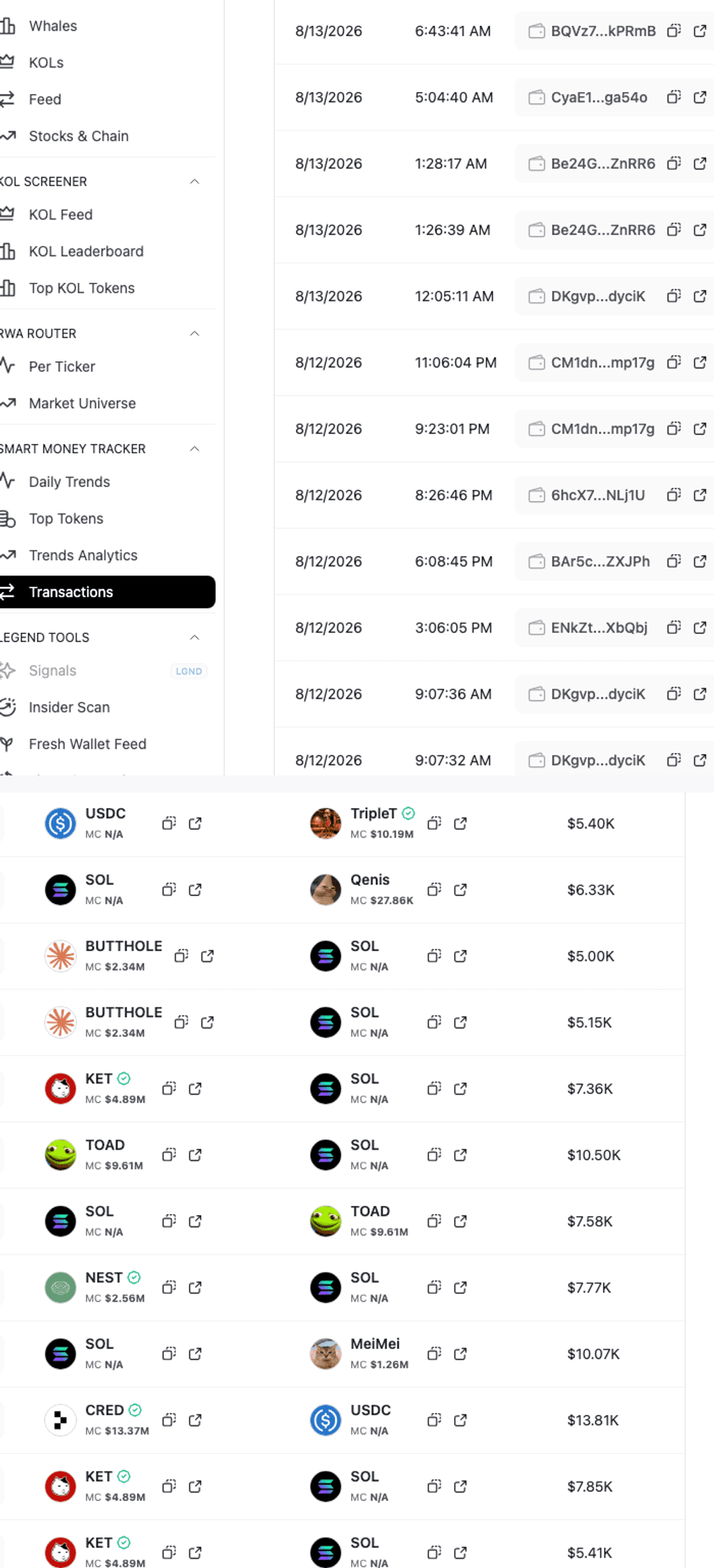
This production capture uses stacked, unaltered interface crops so the table remains readable on a phone.
It shows a wallet-discovery surface, not the wallet's complete SOL balance, every token account, protocol positions, transferred inventory, or executable exit value. Open the complete address and transaction signatures before building the holdings snapshot.
Use Fresh Wallets Feed when wallet age and funding context matter, KOL Feed for attributed wallet leads, and Insider Scan for token-level concentration. The guide to finding smart money wallets explains how to combine exposure with repeatability, independence, and liquidity.
False positives to avoid
- Zero visible balance: tokens may have moved to a protocol or related wallet.
- Large marked balance: the pool may not support a full-size exit.
- Many token accounts: several accounts can belong to one mint and one position.
- Unpriced token: missing price coverage does not prove zero value.
- Transferred-in inventory: visible quantity does not reveal acquisition cost.
- Airdrop or spam: receipt does not prove purchase or conviction.
- Wrapped SOL: counting it with native SOL and again as a token double-counts exposure.
- LP receipt: its displayed token amount does not equal the underlying assets.
Final checklist
- Verify the full Solana address.
- Save the checkpoint time and sources.
- Record native SOL in lamports and SOL.
- Group all token accounts by verified mint.
- Add canonical-asset mappings separately, without merging mint-level risk or quotes.
- Check token program, decimals, delegates, and freezes.
- Separate native SOL from wrapped SOL.
- Decode protocol positions or label them unresolved.
- Preserve unpriced and excluded assets explicitly.
- Attach exact-mint prices with timestamps.
- Request fresh exit quotes for realistic sizes.
- Trace transfers before assigning cost basis.
- Reconcile related wallets before claiming actor-level exposure.
- Deduplicate internal transfers before summing several wallets.
- Test small, medium, and full intended exit sizes.
- Save route concentration, minimum output, expiry, and quote time.
- Report quoted and unquoted inventory separately.
- Decode protocol withdrawals before pricing receipt tokens.
- Preserve gross, controlled, transferable, and routable quantities separately.
FAQ
How do I see all tokens in a Solana wallet?
Inspect the owner address with a compatible Solana RPC or explorer, then group every token account by mint. Include Token-2022 accounts and state which spam, dust, or closed accounts were excluded.
Is a Solana wallet balance the same as its portfolio value?
No. A balance is a quantity. Portfolio value applies prices to quantities, while executable value estimates what a current route would return for a specific sell size.
Should wrapped or bridged variants be combined in one wallet balance?
Keep exact mint balances separate first. You may add a second canonical-asset exposure view when a reliable mapping supports the relationship, but price, redemption, transfer rules, liquidity, and exit quotes still need to be checked for each mint.
Why can a wallet's USD balance be wrong?
Common causes include wrong mint decimals, stale or mismatched prices, illiquid last trades, missing token accounts, double-counted wrapped SOL, spam tokens, and protocol positions that were not decoded.
Do wallet holdings prove conviction?
No. A holding can be intentional, illiquid, transferred, vested, forgotten, protocol collateral, or part of a related-wallet operation. Use the transaction sequence and current exit depth before interpreting intent.
Can holdings show whether a wallet is profitable?
Not by themselves. Profitability requires acquisition basis, sales, transfers, fees, remaining inventory, and defensible historical and current prices. Incomplete coverage should produce a partial result, not exact PnL.
What is the difference between controlled and sellable balance?
Controlled balance is the quantity the address can direct under current account rules. Sellable balance is the quantity a current route can execute under liquidity, transfer, slippage, fee, and protocol constraints.
How do I check several Solana wallet balances at once?
Read every address at one checkpoint, group token accounts by verified mint, and keep internal transfers out of the combined inflow and outflow totals. Show raw address balances separately from any actor-level total because wallet relationships can remain unresolved.