When engineering teams debate MCP vs API, why do they treat it as a cage match where one protocol has to kill the other? That framing creates bad architectures before anyone writes a single line of code. It pushes builders either to wrap deterministic cron jobs in an agent protocol they don't need, or to hand-code brittle REST glue for every AI assistant their analysts want to try.
In practice, MCP vs API isn't a choice between competing technologies. It's a question of where the protocol boundary belongs and who controls each call. When your application code decides which endpoint to hit, a REST API keeps execution predictable, fast to debug, and easy to audit. When a language model decides which capability to invoke from a plain-English prompt, the Model Context Protocol gives that model a standard way to discover tools and pass typed arguments.
Most real projects don't stall on syntax or throughput. They stall on governance, credentials, and operational control once an autonomous model sits in front of live production data. Understanding how both interfaces work side by side lets you put the right boundary in the right place from day one.
Table of Contents
- MCP and REST API Side by Side
- Two Layers of the Same Capability
- How Discovery and Tool Calls Differ
- Authentication, Permissions and Control
- Performance, Cost and Maturity Trade-Offs
- Which Interface Fits Your Project
MCP and REST API Side by Side
Start with the operational differences that decide which interface fits a given caller. Every row below maps how a conventional REST integration compares to an MCP connection across the criteria that shape production engineering work.
| Criterion | REST API | MCP |
|---|---|---|
| Primary caller | Developer code: dashboards, bots, scripts | AI assistant or agent host |
| Who selects the call | Application code builds each request | The model picks a tool from the discovered list |
| Discovery | Endpoints documented in an OpenAPI spec | Server lists tools with names, descriptions and input schemas |
| Message format | HTTP methods, URLs and JSON bodies | JSON-RPC 2.0 messages |
| Transport | HTTPS | stdio locally, Streamable HTTP remotely |
| Authentication | Bearer API key or OAuth access token | OAuth sign-in inside the AI client |
| Best fit | Scheduled jobs, dashboards, trading infrastructure | Natural-language research in chat |
These two interfaces aren't rivals fighting over the same job. On StalkChain, access to the exact same on-chain and trader data is available over both MCP and a REST API, included on every plan, with one API key used in code for REST calls. One backend serves both surfaces, which means you never have to choose between feeding a production script and answering ad hoc questions in chat.
How to Read This Comparison
Don't scan the table looking for a universal winner. Find the row that matches your primary caller first. If a cron job, React dashboard, or execution bot is driving the traffic, the REST column already tells you what you need, and you can look at our blockchain data API guide for structuring those programmatic pipelines.
Next, check the authentication and workflow rows before committing to a single path. Moving from a static API key in a backend vault to an OAuth sign-in inside an AI client shifts how you track usage and manage access. If you're curious how hosted agent endpoints package tool schemas and client configs in the wild, reviewing a live reference like the NotFair MCP server setup shows how minimal the client-side wiring can look once the server owns tool metadata.
Engineering heuristic: Match the interface to who chooses the next step. Deterministic software belongs on REST; open-ended reasoning belongs on MCP.
Two Layers of the Same Capability
Where should the protocol boundary sit, and who is allowed to choose the next call? That question settles more real projects than a feature-by-feature comparison of MCP and REST.
REST is application-facing. A developer reads the contract, builds explicit HTTP requests, sets authentication headers, parses JSON, and writes branching logic around known endpoints. Every path is fixed before the job runs. The program owns each call.
MCP is AI-host-facing. A client connects once, inspects the tools exposed for that account, and invokes them through a protocol built for model-driven workflows. The host can propose the next tool. You still choose which server to attach and which account it can reach. Chain coverage and permissions vary by tool, so the published tool list is the published limit on what the model may do.
MCP adds an interoperability layer an AI host can speak, in front of the same data operations a REST client already calls.
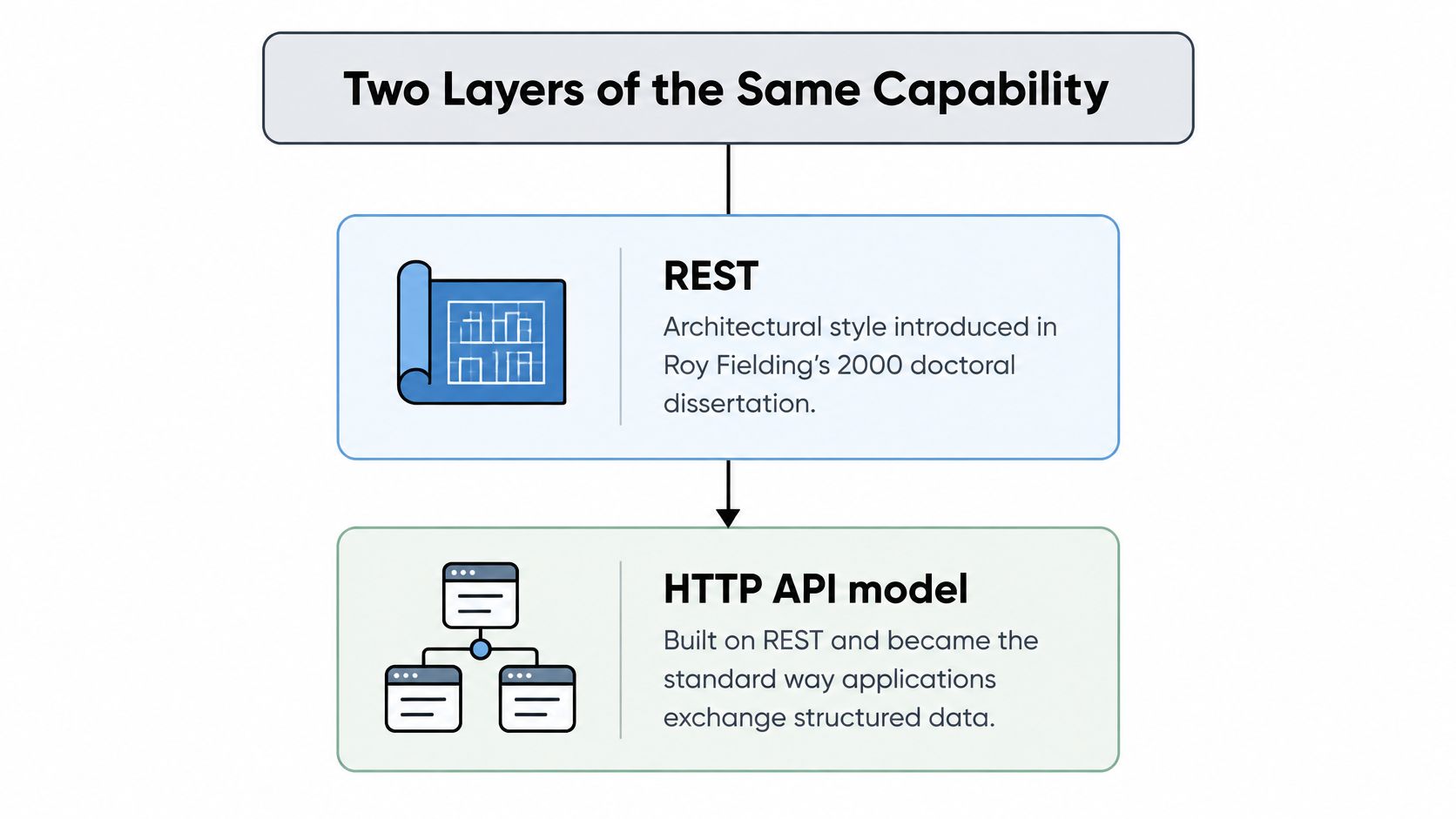
The boundary belongs where control of the next call changes hands. REST keeps that choice in your code. MCP hands a bounded version of it to the AI host.
One wallet-holdings operation shows the split. Over REST, a portfolio team runs a scheduled job every fifteen minutes, writes balances into Postgres, and refreshes a Grafana panel. The script never improvises. The caller, the schedule, and the next write all stay with the team.
Expose that same operation through an MCP server and an analyst can ask whether a specific whale rotated out of a token since yesterday. The assistant discovers the wallet tool, supplies the address, reads the structured result, and may follow with a token-flow lookup. The capability stays shared. Control of the sequence moves from hard-coded branches to the host's reasoning, inside the tools that server published.
I would draw the line at the point where a human no longer wants to name the next request. Jobs that must repeat the same call stay on plain HTTPS, where your code authenticates and each response states what it cost. Open questions, where the useful follow-up is unknown until the last answer arrives, belong on MCP. One account can serve both without pretending the two interfaces govern the call the same way.
How Discovery and Tool Calls Differ
The practical difference sits at the protocol boundary. REST makes the developer choose the call before runtime. MCP lets the assistant discover tools and choose the call from context. Both paths can reach the same StalkChain data, but the party controlling execution is different.
The diagram below traces the classic three-step developer sequence for an HTTP API call before you compare it against an AI client's runtime discovery flow.
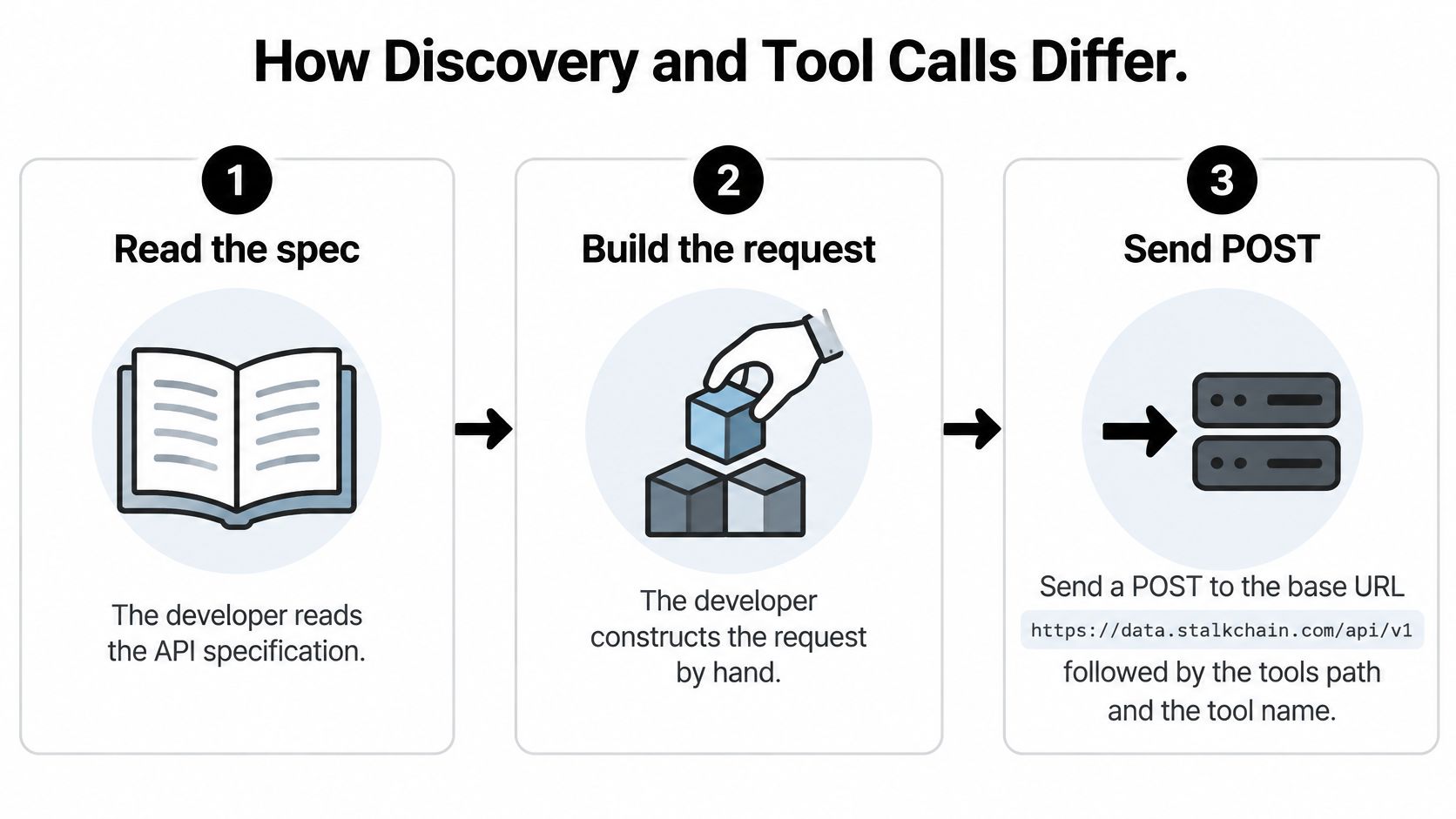
The REST Request Path
- Read the contract: You open the OpenAPI specification, find the exact tool name you need, and inspect its required JSON input fields.
- Construct the request: Your application code assembles the headers, authentication credential, and JSON request body.
- Send the POST call: Your service fires an HTTP
POSTto the base URLhttps://data.stalkchain.com/api/v1followed by/tools/and the tool name, passing inputs as JSON. - Parse and route: Your code inspects the HTTP status, deserializes the JSON payload, and executes the next hard-coded step in your pipeline.
This path is predictable because the developer owns every branch. The request is written down, reviewable, and repeatable, which matters for dashboards, bots, scripts, and backfills. Every response says what it cost, so cost can be handled in the same code path as parsing and retries.
The MCP Discovery and Call Path
- Register the server once: You copy the MCP link
https://data.stalkchain.com/mcpinto a supported AI client. The same link works across Claude, ChatGPT, Grok, Cursor, Claude Code, and any other MCP-compatible host. - Discover available tools: The client queries the server for the tools available for your account, pulling back each tool's name, plain-English description, input schema, and expected result shape.
- Select and invoke at runtime: Based on your prompt, the model picks the matching wallet, PnL, token-flow, KOL, or whale tool and fills in the typed arguments.
- Exchange JSON-RPC messages: Per the MCP transports specification, messages travel as JSON-RPC 2.0 payloads over stdio for local processes or Streamable HTTP for remote servers, which uses HTTP
POSTand can stream updates with Server-Sent Events.
That metadata helps an assistant choose an operation from a user question, but it does not make blockchain reads faster. Latency still comes from cache policy, upstream RPC response times, serialization, and quota enforcement. I would treat discovery as a control surface, not a performance feature.
After connecting an MCP server to a new client, inspect the exact tools discovered for the account. Chain coverage and permissions vary by tool, and AI hosts do not always support every remote transport feature in the same way. That check is the cheap part of governance, and it prevents a tool list from becoming an invisible permission set.
Authentication, Permissions and Control
Control sits on different sides of the protocol boundary. REST lets your code choose every call. MCP lets the model choose among tools already granted to the account. The wire format does not decide which of those is acceptable.
With the REST API, application code selects the endpoint and the parameters, then authenticates with a Bearer API key from the dashboard or an OAuth access token. A missing or revoked credential is rejected immediately as HTTP 401 unauthorized. A tool runs as a POST to /api/v1/tools/ plus the tool name, inputs sent as JSON. The path is visible in review before anything ships, and the same data is available over plain HTTPS without an MCP client. One API key is what that code uses. MCP and REST draw from the same account and the same credit balance.
MCP inverts who starts the call. As the MCP server tools specification defines it, tools are model-controlled: the assistant discovers them and invokes them from conversational context rather than from a function a developer hardcoded. Chain coverage and permissions vary by tool, so the catalog one client sees for an account is not a guarantee of what another session, or another host, will expose. A prompt can stay inside a valid schema and still name the wrong wallet, chain, or time window. That is a different failure mode from a script whose endpoints were fixed at deploy time.
Why Model-Controlled Tools Need an API Gateway
Remote MCP servers belong behind an API gateway that enforces authentication, authorization, rate limiting, and structured logging. Treat that as ordinary production practice for any host that can reach live data, not as an optional extra on a single-URL connection. It matters more when one server aggregates several chains and upstream providers. Analysts get one connection. Authorization, audit trails, and failure handling all concentrate at that choke point.
Putting an AI agent in front of live market data doesn't eliminate API security requirements. It means your server has to validate every argument as if an untrusted user typed it, because a confused model effectively can.
For live on-chain intelligence, I'd enforce four operational defaults on any MCP deployment:
- Default to read-only tools: Keep research tools strictly read-only and isolated from funded trading capability or private signing keys.
- Validate model-generated arguments: Enforce schema validation and bounds checks on wallet addresses, chain identifiers, and date ranges before any upstream query.
- Return full execution metadata: Include provenance, timestamps, query cost, and remaining quota on every response so operators and audit logs can see what ran and what it spent. Cost and balance belong on the answer.
GET /api/v1/meshows balance, calls left, and usage by tool. - Separate rate limits from account budgets: HTTP 429
rate_limitedapplies only to unauthenticated calls. Authenticated use is governed by credit balance. When credits run out, the API returns HTTP 402out_of_credits, and the next call works immediately after a plan is in place.
REST is the fit when you need a fixed allowlist and a call path that matches what review approved. MCP is the fit when an operator should ask in plain English and the host should pick among tools that account may already use. I would not drop one for the other. Decide which calls the model may start, and which calls only your code may start.
Pre-Deployment Governance Checklist
Before handing an MCP connection or API key to a trading desk or an engineering squad, write down three concrete answers:
- Approved tool scope: Document the exact tools an assistant may call on each account, and confirm write or execution actions are excluded. Inspect the tools discovered. Coverage is not the same for every tool.
- Credential ownership: Name an owner for every REST API key and every OAuth client registration. Do not leave credentials in a shared Slack channel.
- Rotation and revocation procedure: Time how fast you can revoke a compromised token, confirm the next call returns HTTP 401, and schedule routine rotation for production bots.
Performance, Cost and Maturity Trade-Offs
Performance comparisons around MCP vs API depend on where you draw the measurement boundary. Server-framework execution, upstream data retrieval, and an assistant choosing tools are different workloads. Neither interface has a built-in speed advantage across all three.
An independent benchmark covered on the Model Context Protocol Java SDK blog tested 3.9 million requests across three rounds and reported average latency of 0.835 ms for Java, 0.855 ms for Go, 10.66 ms for Node.js, and 26.45 ms for Python. These results describe MCP implementations under a synthetic workload. They do not measure end-to-end crypto-data retrieval or establish an MCP-versus-REST winner.
HTTP headers and protocol framing also contribute overhead, particularly when payloads are small. REST does not eliminate those costs, and adding MCP does not tell you how much they matter relative to the upstream query.
Measure the complete path you will deploy.
Run identical operations over both interfaces and record p50, p95, and p99 latency, sustained throughput, payload bytes, error rate, time-to-first-event, and upstream data-source latency. Separate server execution from assistant orchestration so a slow tool-selection step does not look like a slow data endpoint. Discovery and streaming may justify extra framing in an interactive workflow; a predetermined batch job has less reason to carry those layers. The practical question is which component controls each call and what that control costs.
Ecosystem Maturity Gaps
REST has mature proxies, APM tools, and standardized HTTP clients. MCP client support needs closer inspection: a 2025 measurement study summarized in the Nevermined MCP adoption statistics report examined 341 MCP clients, finding 95 supported Streamable HTTP as of August 2025, roughly 27.9%, and classified more than 50% of examined MCP projects as low-value or abandoned.
Treat those findings as a reason to test compatibility, rather than a verdict on every MCP integration. Check server listings such as our curated MCP server directory, then test your intended server with your actual AI client. A directory entry alone does not establish transport compatibility or dependable operation. Keeping REST available gives programmatic workloads a path that does not depend on MCP client behavior.
Credit Budgets Across Both Interfaces
Agent-driven lookups make call count as important as individual tool price. StalkChain delivers MCP and REST access from one account and one credit balance. Every plan includes the same tools and per-answer cost and remaining balance reporting; only the call allowance differs.
| Tool | Credit cost | Condition |
|---|---|---|
| Token snapshot | 500 | Standard token data read |
| Compare snapshots | 0 | No API call is made |
| Token candles | 250 | Growth-plan upstream only; otherwise 402 or 403 |
| Notifications | 250 | One call |
Trader profile (stalkchain_fomo_resolve_trader) |
2,500 | Full live profile of one trader |
Budget for the calls a workflow executes, not just the prompt that starts it. Composite tools call several endpoints and report the total credits spent, so interface choice alone does not determine the bill.
When credits run out, the API returns HTTP 402 (out_of_credits). The next call works immediately after you pick a plan.
Which Interface Fits Your Project
Who holds the next call decides the interface, not which protocol is newer. The Model Context Protocol 2026-07-28 specification splits MCP into three primitives by control: prompts are user-controlled, resources are application-controlled, and tools are model-controlled. The spec treats tools as functions that query databases, call APIs, or run computations. MCP belongs on the AI side of that boundary, orchestrating calls into APIs. It does not replace the API.
Start from the workflow in front of you. Five crypto and engineering cases show where that boundary should sit.
Five Common Scenarios
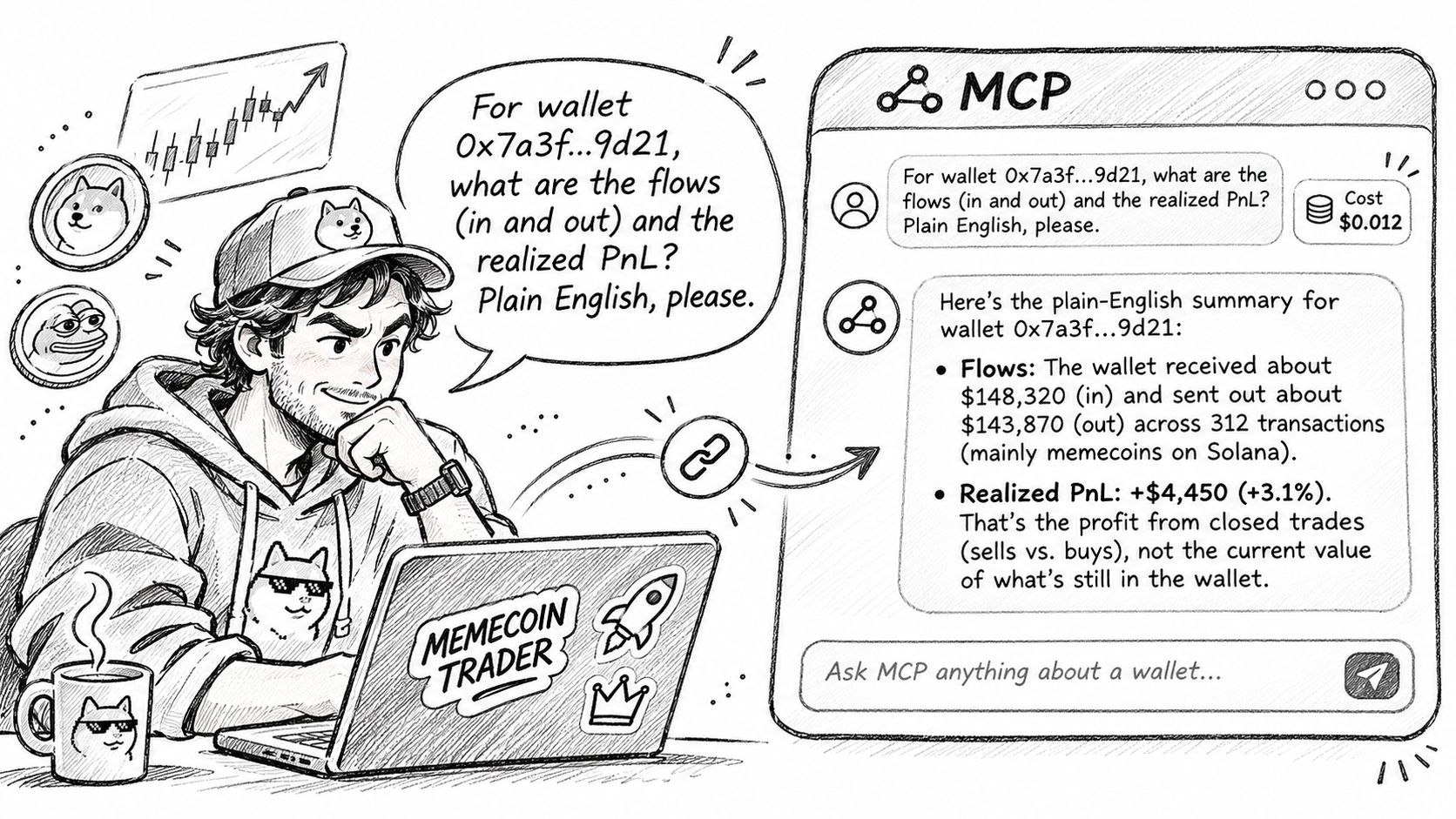
A memecoin trader wants a whale's recent token flows and realized PnL mid-session, with no code in the way. Connect the hosted MCP server to a supported assistant (Claude, ChatGPT, Grok, Cursor, Claude Code, or any MCP client) and ask about wallets, holdings, and flows in plain English. The model picks the tool. Each answer still prints its credit cost and the remaining balance, so a chatty session cannot hide spend.
A quant pulling hourly wallet holdings into a Python backtest gets nothing useful from an LLM here except latency and nondeterminism. Call the plain HTTPS REST API with one API key. No MCP client. Payloads follow the OpenAPI spec, and every response states what it cost. You own the schedule, the retries, and the schema.
A portfolio manager tracking KOL and whale activity usually needs both. Daytime follow-ups stay in chat over MCP. Overnight, a REST-fed dashboard drives standing alerts. StalkChain Data is the same account and the same credit balance on both paths, so chat and production do not drift into two products. What changes is who initiates the call: the model in chat, your job runner in production.
A plugin author should start inside the target IDE, not a generic connector diagram. In Cursor, click Add to Cursor, confirm the StalkChain MCP server, sign in in the browser, and press Approve. Then watch live tool discovery. Chain coverage and permissions differ by tool, and a crowded tool list burns context before it helps. The token and latency benchmarks for agents are a practical check when you decide how many tools a model should see at once.
A Web3 product team shipping a public token dashboard next to an internal research desk should split the boundary on purpose. Historical backfills and scheduled refreshes go over REST. MCP stays on the internal analyst desk. If execution comes later, keep research pipelines on REST, leave MCP tools read-only, and send any live trade through a separate funded agent wallet. That split is the same control problem covered in AI agents in crypto workflows.
Decision Matrix by Situation
Match the immediate requirement to a starting interface.
| Situation | Start with | Why |
|---|---|---|
| Interactive research in chat | MCP | Discovery and natural language do the work; the model chooses the tool |
| Scheduled jobs, dashboards or bots | REST | Your code owns each request, with deterministic contracts |
| Teams spanning chat and production | Both, on one account | Same data and one credit balance; only who initiates the call changes |
| Building an MCP connector | MCP | Test tool discovery against each target client before you widen the tool list |
| Trading automation | REST for pipelines | Keep research read-only; trade from a separate funded agent wallet |
Your First Ten-Minute Test
You can see the boundary in under ten minutes. Four steps:
- Connect the MCP endpoint: Add
https://data.stalkchain.com/mcpto your AI client and complete the OAuth sign-in. The same link works in every supported AI. - Run one live wallet question: Ask in plain English for a wallet's holdings or recent flows, and check which tool the model selected.
- Check the reported cost: Read the credit cost and remaining balance on the assistant's answer.
- Hit the REST account endpoint: Call
GET /api/v1/mewith your API key. It shows balance, calls left, and usage by tool before you pick a plan.
The Starter plan costs $29 per month billed monthly or $29 per month billed annually ($348 per year). MCP and REST are both on that plan. Pick the interface by who starts each call and how much control you need. One shared data layer can serve both.