Quick answer
A Robinhood Chain token due diligence check should verify the exact contract, current activity, buyer independence, economic holder concentration, pool liquidity, sellability, and privileged contract controls.
Use Stalkchain to compare live token activity and attributed wallets, then confirm contracts, holders, transfers, approvals, pools, and receipts in Robinhood Chain Blockscout. Treat missing fields as unknown. No score, holder count, or profitable wallet proves that a token is safe.
What Robinhood Chain token due diligence should answer
Token due diligence is a structured attempt to disprove a trade thesis before risking capital. It should answer seven questions:
- Identity: Is this the intended contract on Robinhood Chain mainnet?
- Activity: Does measured demand come from meaningful, independent participants?
- Ownership: Who controls the circulating supply?
- Liquidity: Can the intended position be sold at an acceptable cost?
- Wallet quality: Are important buyers repeat performers, insiders, bots, or unexplained fresh wallets?
- Contract control: Can an administrator alter transfers, fees, supply, or access?
- Execution: Does the current quote, approval, transaction, and receipt match the intended action?
A token does not pass because most answers look good. An unverifiable contract or unusable sell path can veto the entire setup.
Start with the public Stalkchain research surface
Open the Robinhood Chain memecoin screener to compare volume, net flow, buy and sell counts, unique buyers, fresh-buyer share, holder coverage, market cap, age, and liquidity edge.
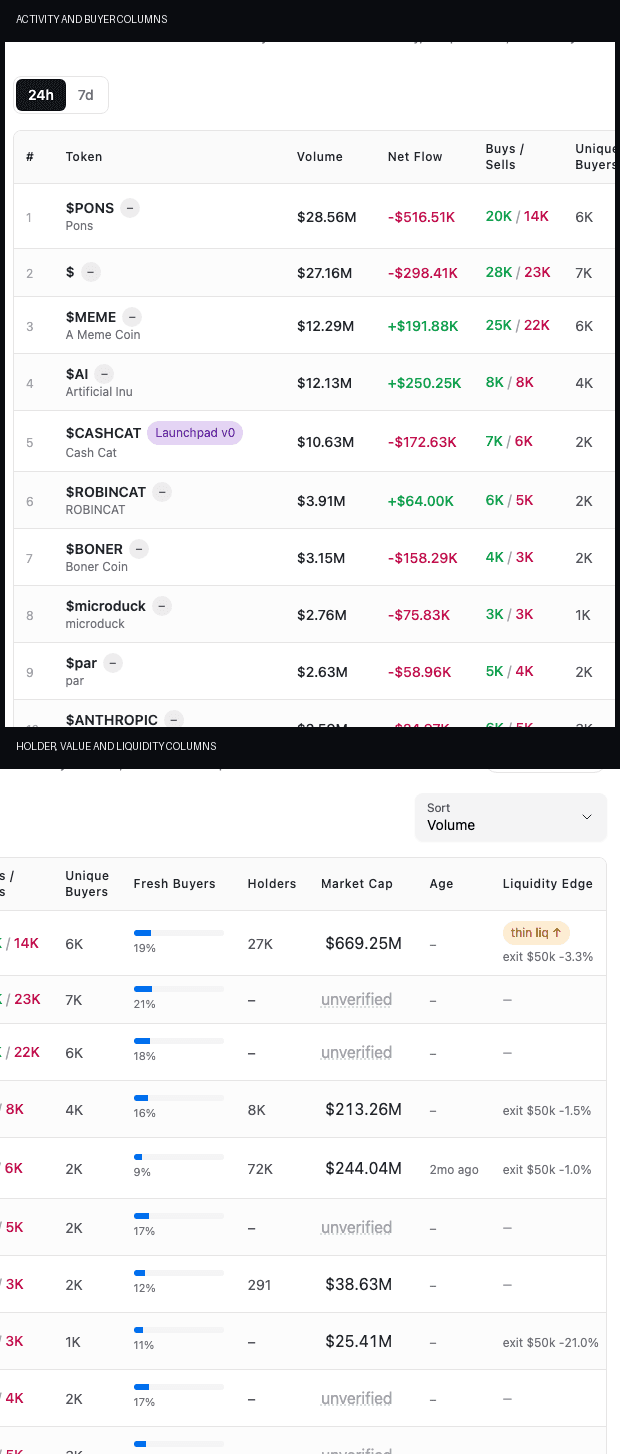
This public-route capture from September 5, 2026 shows the fields used to build a research queue. Values change. Missing holder, age, valuation, or liquidity fields are unknown, not zero.
The screener is a discovery layer. A high-volume row can still depend on one cluster. Positive net flow can occur in a thin market. A high fresh-buyer share can reflect genuine discovery, bots, or coordinated wallets.
Use the KOL screener only after basic contract and liquidity checks. Attributed-wallet activity can reveal attention, but incomplete cost basis and partial unrealized coverage limit PnL conclusions.
Use a four-state evidence ledger
Record each claim as one of four states:
- Verified current: confirmed from a current route, quote, contract state, or recent transaction.
- Verified historical: accurate for a recorded timestamp, but not proof of the present state.
- Inferred: supported by several observations but not proven.
- Unknown: missing, stale, conflicting, or not independently verified.
Add a refresh trigger to every important claim. Liquidity becomes stale when reserves, price, route, or position size changes. Wallet exposure becomes stale after transfers or swaps. Holder concentration becomes stale after large movements, minting, burning, bridging, or supply changes.
This prevents a historical screenshot from silently becoming a current trading claim.
Step 1: verify the contract and network
Robinhood Chain mainnet uses chain ID 4663 and ETH for gas. Confirm the network through Robinhood's official connection documentation.
Then match the token contract across:
- An official project source
- Stalkchain
- The selected swap application
- Robinhood Chain Blockscout
- The pool or route used by the quote
Check the token name, symbol, decimals, total supply, verified source status, deployer, creation transaction, and active pools. The contract address is the identity. A matching ticker is not enough.
Hard veto: stop if the address cannot be matched across the primary source, explorer, and intended venue.
Step 2: test whether activity is broad or concentrated
Read volume beside net flow, trade count, and unique buyers. These fields answer different questions.
- Volume measures turnover.
- Net flow measures direction within the selected window.
- Trade count measures events.
- Unique buyers estimate participation breadth.
- Fresh-buyer share identifies wallets that need deeper inspection.
A token with 2,000 buys from 40 wallets is not equivalent to one with 2,000 buys from 1,000 wallets. Neither pattern proves independence until funding and counterparties are checked.
Inspect whether one wallet or cluster explains most net buying. Look for repeated round trips, matching sizes, synchronized timing, common funders, and direct transfers among participants.
The memecoin screener workflow explains how to identify these field mismatches before spending time on deeper review.
Step 3: separate addresses from economic owners
Open the holder list for the exact contract. Label pools, routers, bridges, burn addresses, treasuries, vesting contracts, token adapters, and other infrastructure before judging private-holder concentration.
Calculate at least two views:
- Raw concentration: top 1, 5, 10, and 20 addresses exactly as listed.
- Economic concentration: top holders after each documented infrastructure classification.
Do not delete every contract from the analysis. A pool affects exit depth. A treasury or adapter can affect supply. An unlabeled contract remains unknown until its role is established.
Then trace large economic holders for shared funding, direct transfers, common counterparties, synchronized activation, and consolidation. One entity can split supply across many addresses.
Use the complete Robinhood Chain holder-distribution method when ownership or sell pressure controls the thesis.
Step 4: verify liquidity with a realistic sell
Market cap is not exit capacity. Define the position you may need to sell and request current sell quotes at three sizes:
- A small validation amount
- Half the proposed position
- The full proposed position
For each quote, record the input amount, expected output, route, pool, price impact, slippage tolerance, minimum received, fees, gas estimate, and expiry.
Verify the pool contract, pair assets, active liquidity, recent additions or removals, and the wallets or positions that control usable depth. A deep-looking pool can still depend on one removable or out-of-range position.
The Robinhood Chain liquidity and exit-risk guide covers quote construction, pool checks, and receipt reconciliation in detail.
Step 5: investigate important wallets
Review wallets that dominate early buying, current net flow, supply, or liquidity. For each wallet, record:
- First funding source and timestamp
- First token interaction
- Swaps versus transfers
- Current balance and unsold exposure
- Realized proceeds where reconstructable
- Common counterparties
- Activity across other launches
- Transfers to fresh wallets, pools, bridges, or exchanges
Use the public Robinhood Chain whale tracker to identify trade-derived accumulation, then open the address-level profile where available. Estimated position values still require current price and sell-depth checks.
Use the wallet-tracking workflow for transaction evidence and the wallet PnL guide before treating displayed profitability as complete.
A profitable early wallet may be an insider, deployer, market maker, or promoter. Repeat behavior across unrelated launches is stronger evidence than one winning trade, but it still does not prove future performance.
Step 6: review contract privileges and wallet approvals
When verified source or readable contract metadata is available, inspect:
- Ownership and administrator roles
- Upgradeability and implementation contracts
- Minting, burning, pausing, freezing, or blacklist controls
- Transfer fees or configurable taxes
- Maximum transaction or wallet restrictions
- Proxy and delegate-call behavior
- Liquidity or treasury controls
If the source is unverified, do not assume ordinary ERC-20 behavior. Observe transfers cautiously and treat hidden behavior as unresolved.
Review wallet approvals as a separate security decision. Confirm the spender contract belongs to the intended application. Avoid unexplained unlimited allowances and revoke permissions that are no longer needed.
Step 7: write the invalidation rules before signing
A due diligence note should state what would make the thesis wrong. Examples include:
- Net buying becomes persistent distribution across two comparable windows.
- A large holder or linked cluster moves supply toward a pool.
- The full-size sell quote exceeds the predefined impact limit.
- Usable liquidity falls below the planned exit requirement.
- A contract role, fee, or implementation changes.
- Buyer growth is explained by dust, one funder, or circular trading.
- The attributed wallet no longer holds meaningful exposure.
Prewritten invalidation rules reduce the temptation to reinterpret risk after price moves.
Example: how to interpret a live research row
On September 27, 2026, the public 24-hour screener showed PONS with approximately $5.59 million in volume, +$507,270 net flow, about 4,000 unique buyers, 15% fresh buyers, 27,000 holders, a displayed $636.82 million market cap, and a $50,000 exit estimate near -3.2%.
That row supports several observations, but no trade verdict:
- Activity and net flow were positive in the measured window.
- Buyer breadth appeared material, but independence was unverified.
- Holder count did not reveal economic concentration.
- The displayed exit estimate was more useful than market cap for initial sizing, but it was not a current personal quote.
- Contract controls, pool ownership, wallet clusters, and full-size sellability still required verification.
The correct next action was a contract, holder, pool, and wallet review. It was not to convert the row into a buy signal.
More defensible and higher-risk patterns
More defensible pattern
- The contract matches across primary source, explorer, venue, and pool.
- Demand persists across comparable windows and several unrelated wallets.
- Economic concentration is measured after documented classifications.
- Important wallets have understandable funding and retain current exposure.
- The intended sell receives a fresh quote inside the risk limit.
- Liquidity control and contract privileges are known.
- Every unknown is visible in the research note.
Higher-risk pattern
- The ticker matches but the contract identity is ambiguous.
- One cluster explains most demand or supply.
- Fresh wallets share a funder and activate together.
- Holder count grows through transfers rather than purchases.
- Market cap rises while usable liquidity remains thin.
- A representative sell fails or has severe impact.
- Privileged contract controls or approval spenders are unexplained.
False positives to avoid
Positive net flow
It describes one measured window. One large buyer or temporary route can dominate it.
Many holders
Dust transfers, infrastructure contracts, and wallet splitting can inflate address breadth without broad ownership.
High win rate or PnL
Incomplete basis, partial unrealized coverage, missing transfers, and one outlier can distort the result.
KOL convergence
Several attributed wallets may follow the same public information or promotion. Check entry timing, current exposure, and crowding.
A successful buy quote
Buyability does not prove sellability. Test the exit side at the planned size.
Verified source code
Verification makes code inspectable. It does not make the contract safe, immutable, or free from privileged roles.
Final Robinhood Chain token checklist
- Confirm chain ID 4663 and reserve ETH for gas.
- Match the exact contract across every relevant surface.
- Record source verification, roles, and upgradeability.
- Compare volume, net flow, trades, and unique buyers.
- Trace fresh-buyer funding and timing.
- Label infrastructure before calculating concentration.
- Calculate raw and economic top-holder shares.
- Trace large wallets and clusters for current exposure.
- Verify the dominant pool, active liquidity, and controller.
- Request sell quotes at small, half, and full position sizes.
- Record price impact, fees, slippage, and minimum received.
- Confirm approval spender and allowance scope.
- Write thesis invalidation rules before signing.
- Verify any completed receipt and balance change in Blockscout.
- Keep unknown and stale evidence visible.
FAQ
How do I research a token on Robinhood Chain?
Start with Stalkchain's public memecoin screener to compare activity, buyers, holder coverage, valuation, and liquidity. Then verify the exact contract, holder distribution, pools, wallets, contract controls, current quotes, and any completed transaction in Robinhood Chain Blockscout.
What is the most important token check?
Contract identity is the first hard gate. Liquidity and sellability are the next practical gates. Strong activity cannot compensate for the wrong contract or an exit that cannot be executed at the planned size.
Does a high holder count mean ownership is distributed?
No. Holder count measures addresses. Pools, contracts, dust recipients, and multiple wallets controlled by one entity can inflate the number. Label infrastructure and trace wallet relationships before estimating economic ownership.
Can Stalkchain tell me whether a Robinhood Chain token is safe?
No. Stalkchain provides research surfaces and on-chain evidence. No analytics tool can prove that a token is safe or predict its price. Contract, wallet, liquidity, and execution risks still require independent verification.
Does Stalkchain execute Robinhood Chain token trades?
No. Stalkchain currently supports research and discovery. Choose the venue independently, verify the quote and approval, inspect every wallet prompt, and confirm the final receipt on-chain.
How often should I repeat due diligence?
Repeat the affected checks whenever price, liquidity, holder balances, contract roles, routes, or wallet exposure changes. Recheck the quote and approval immediately before signing because execution evidence expires quickly.
Sources and further reading
- Stalkchain Robinhood Chain memecoin screener
- Stalkchain Robinhood Chain KOL screener
- Robinhood Chain official connection documentation
- Robinhood Chain Blockscout token directory
- How to analyze Robinhood Chain memecoins
Due diligence improves the quality of the questions and can reject weak setups. It cannot guarantee contract safety, future liquidity, or a profitable outcome.