Quick answer
A Robinhood Chain KOL tracker helps you shortlist attributed influencer wallets by DEX PnL, win rate, volume, and recent activity. You can then inspect the wallets and transactions behind each ranking.
Stalkchain provides 24-hour, 7-day, 30-day, and all-time leaderboard windows plus Feed and Top Tokens tabs. Treat incomplete basis, partial unrealized coverage, and empty tabs as limitations, not trading signals.
What the Robinhood Chain KOL tracker shows
The Stalkchain Robinhood KOL Tracker is a research surface for wallets attributed to crypto KOLs on Robinhood Chain. The public page currently exposes three views:
- Leaderboard: ranked KOLs with DEX PnL, win rate, volume, and linked-wallet count.
- Feed: a transaction-oriented table with time, KOL, wallet, action, token, amount, and trade fields when qualifying records are available.
- Top Tokens: a token table with KOL net buy, KOL buyers, market cap, and trade links when qualifying activity is available.
The leaderboard supports 24-hour, 7-day, 30-day, and all-time windows. Top Tokens supports 12-hour, 24-hour, and 7-day windows.
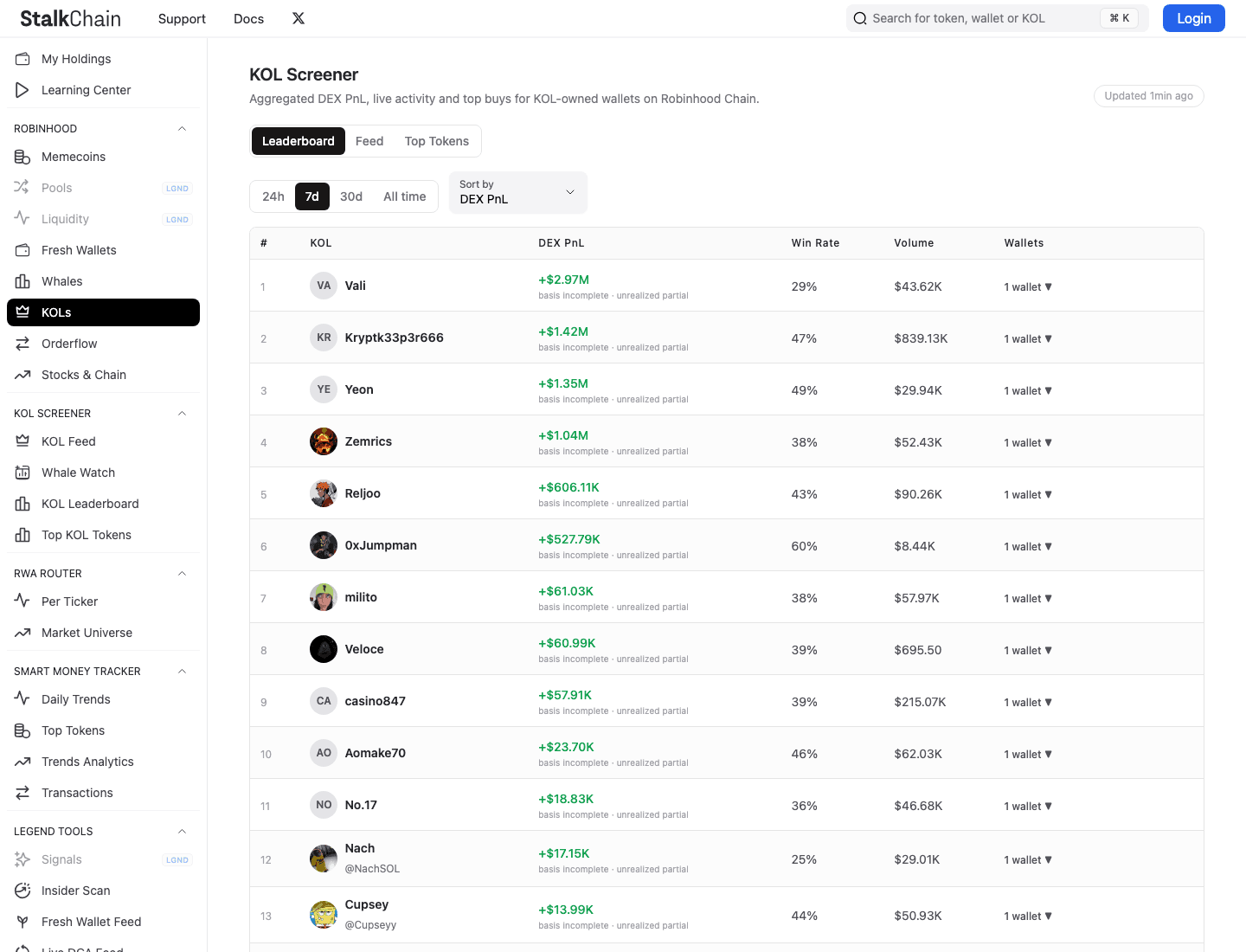
Live Robinhood Chain KOL leaderboard capture from September 4, 2026. Rows change as the underlying windows and prices update. Labels such as basis incomplete and unrealized partial are part of the result, not fine print to ignore.
How to read the leaderboard without copying it blindly
A leaderboard compresses many transactions into a few columns. Each column answers a different question, and none is sufficient by itself.
DEX PnL is an estimate with a coverage state
Positive DEX PnL can identify a wallet worth reviewing. It does not prove a complete return history.
A basis incomplete label means the system cannot fully establish what some inventory cost. Tokens may have arrived before the measured window, through another wallet, from a bridge, or by transfer. Treat the displayed result as incomplete.
An unrealized partial label means not every open balance has complete mark-to-market coverage. A large unsold position can therefore change the economic result.
The dedicated Robinhood Chain wallet PnL guide explains how swaps, gas, transfers, bridges, and remaining inventory affect the estimate.
Win rate needs a denominator
Win rate shows the share of classified outcomes recorded as wins. Always ask how many trades contributed and whether positions are closed.
A 70% win rate across a small or incomplete sample can be less useful than a lower rate across many fully reconstructed trades. Compare win rate with average gain, average loss, drawdown, fees, and open inventory.
Volume measures activity, not skill
High volume may come from many independent decisions, repeated routing, churn, or one concentrated period. It can also amplify fees and slippage.
Use volume to understand the scale of activity. Use transactions to determine whether the activity was profitable, repeatable, and executable for a later follower.
Linked wallets require attribution checks
The wallet count opens the addresses associated with a KOL. Attribution is a research lead, not proof that one person controls every address at every moment.
Trace direct transfers, funding sources, counterparties, and timing. A shared exchange funding address is weak evidence because unrelated customers can receive funds from the same hot wallet. The wallet-tracking workflow shows how to build a transaction timeline without overstating common control.
A five-part framework for evaluating a KOL
Use coverage, consistency, context, capacity, and current exposure as the review framework.
- Coverage: Are basis and unrealized values complete enough to compare?
- Consistency: Does the wallet perform across several time windows and completed trades?
- Context: Which tokens, market conditions, and transaction types produced the result?
- Capacity: Could your intended position enter and exit without unacceptable price impact?
- Current exposure: Is the wallet still holding, adding, reducing, or fully exited?
This framework separates an interesting historical row from an actionable research candidate.
Step 1: Compare more than one time window
Start with 7 days or 30 days to find active candidates. Then compare the same KOL across 24 hours and all time.
Look for three patterns:
- Persistent: positive results and continued activity across several windows.
- Event-driven: most performance appears in one short period or one token.
- Deteriorating: historical results remain positive while the recent window weakens.
Window comparison does not remove basis limitations. It reveals whether the displayed pattern is concentrated or persistent.
Step 2: Expand the linked wallet
Record the address before leaving the tracker. Open it in the public Robinhood Chain explorer and inspect:
- First inbound funding transactions
- Recent swaps and token transfers
- Failed transactions and gas costs
- Interactions with verified contracts
- Transfers to other attributed or fresh wallets
- Current token balances
- Bridge deposits and withdrawals
Use the Robinhood Chain Blockscout explorer for public transaction evidence. Confirm chain ID 4663 and important contracts against Robinhood's official connection documentation.
Step 3: Reconstruct representative trades
Do not audit only the best-looking trade. Select several completed trades from different dates and market conditions.
For each trade, capture:
- Quote asset spent at entry
- Token units acquired
- Quote asset received at exit
- Units still held
- Gas and venue fees
- Price impact and available liquidity
- Transfers that may change cost basis
Classify the result as closed win, closed loss, open, or indeterminate. If acquisition cost is unknown, keep it indeterminate.
Step 4: Use Feed and Top Tokens as context, not confirmation
The Feed can connect a KOL to a displayed action when qualifying records are available. Top Tokens can show whether several tracked KOLs are net buyers of the same token.
Both views can be empty for a selected window or registry state. Do not turn absence into a bearish conclusion, and do not infer activity that the interface does not show. During the September 4, 2026 verification, Feed and Top Tokens both displayed qualifying rows.
When a token appears, verify it through the Robinhood Chain memecoin research workflow. Check the contract, holders, liquidity, market depth, fresh-buyer quality, and representative sell path.
A group of KOL buyers can increase attention and crowding at the same time. It does not guarantee independent conviction.
Cross-check KOL demand against the memecoin screener
When Top Tokens contains a qualifying row, open the same contract in the Robinhood Chain memecoin screener. Compare KOL net buying with overall net flow, unique buyers, fresh-buyer share, holder coverage, token age, and liquidity context.
The new memecoin screener guide explains how to interpret those fields without treating a high rank as a trade signal.
A more useful convergence has several attributed wallets participating while overall buyer breadth and liquidity improve. A riskier pattern has KOL attention arriving after one wallet already moved the market or while early holders are distributing.
This cross-check still cannot establish motive. It tells you whether attributed activity sits inside broader demand or a concentrated, crowded move.
Step 5: Decide whether the trade can be followed safely
A profitable historical trade may no longer be reproducible. The KOL could have entered earlier, used a smaller size, received a better route, or already started selling.
Before considering execution, check:
- Current pool liquidity
- Quoted output for your intended buy
- Quoted output for a representative sell
- Price impact and slippage limits
- Token transfer restrictions or taxes
- KOL's remaining exposure
- Concentration among related wallets
- Your maximum loss and invalidation condition
Stalkchain does not turn a leaderboard row into automatic order execution. Research and execution remain separate decisions.
Representative leaderboard readout
The following is a time-stamped observation from the public 24-hour leaderboard at 00:22 UTC on September 12, 2026. Values change with prices, covered transactions, and open positions.
- The first row showed about +$2.44M DEX PnL, a 30.6% win rate, zero covered 24-hour volume, and zero covered trades.
- Its displayed realized result was $0. The entire positive estimate came from unrealized value, while both basis and unrealized coverage were flagged incomplete.
- The second row had the same structure: about +$1.16M estimated PnL, but zero displayed realized result, volume, and covered trades for the window.
- The third row showed about +$996K estimated PnL, of which only about $520 was displayed as realized, alongside 15 covered trades and roughly $14.5K of volume.
- All ten returned rows had one linked wallet and incomplete basis. Every row also had partial unrealized coverage.
This exposes a crucial ranking trap. A large PnL number can coexist with no covered trading activity in the selected window because the estimate includes marked open inventory.
Reconcile the leaderboard with current activity
The Feed and Top Tokens views were also populated during the same check. The Feed returned 20 recent rows and included buys and sells across Uniswap v2, v3, and v4. Top Tokens returned 14 rows for the 24-hour window.
The top net-buy token showed about $1,199 from one KOL buyer. Several negative-flow rows showed zero KOL buyers because sells can remain in the ranked set after the buyer count falls to zero. Market cap was explicitly unavailable where the price failed the page's sanity check.
Use this reconciliation order:
- Confirm that the leaderboard window contains covered trades and volume.
- Separate displayed realized value from marked unrealized value.
- Open Feed to identify the transactions active in the same period.
- Use Top Tokens to see whether demand came from one attributed buyer or several.
- Verify the wallet, token contract, venue, and transaction independently.
The tabs answer different questions and may use different aggregation rules. Their values should not be added together as portfolio PnL.
Compare state changes, not just leaderboard positions
A rank can change because a wallet traded, an open token repriced, coverage improved, or another row moved. Save a small state record each time you review a candidate so those causes do not collapse into one number.
Record these fields for the same wallet and selected window:
- observation time and leaderboard position;
- displayed DEX PnL and its basis and unrealized labels;
- win rate and covered volume;
- linked-wallet count;
- important Feed actions and Top Tokens exposure; and
- independently verified current balances and exits.
Then classify the change.
Transaction-led: New covered buys or sells explain the movement. Reconstruct the trades before changing your view of the wallet.
Mark-led: PnL moved while covered activity barely changed. Treat this as a price or inventory revaluation until proven otherwise.
Coverage-led: A basis, price, or unrealized-coverage state changed. Recalculate the comparable history instead of treating the revision as fresh performance.
Peer-led: The wallet's evidence is stable, but its rank changed because other rows moved. This says little about the wallet itself.
Useful and risky patterns
More useful pattern
- Performance remains competitive across several windows.
- Several completed trades explain the result.
- Cost basis and remaining inventory can be reconstructed.
- Position sizes fit the available liquidity.
- The wallet takes profits without relying on one final exit.
- Funding and wallet relationships have plausible explanations.
Riskier pattern
- One token or one day explains most displayed PnL.
- Basis is incomplete and open inventory is large.
- High volume comes from repeated churn.
- The wallet entered before liquidity was available to ordinary traders.
- Related wallets distribute into later demand.
- Copying the trade would create materially worse price impact.
False positives to avoid
One successful launch
A large win can dominate all-time PnL. Review multiple completed outcomes before labeling the wallet repeatable.
High win rate with tiny wins
Many small wins can be overwhelmed by one large loss. Compare payoff size and drawdown, not only the percentage.
Shared funding
Two wallets funded by the same exchange address are not automatically controlled by one entity. Require direct transfers or repeated coordinated behavior before strengthening the attribution.
Transfers classified as trades
Bridges, self-transfers, airdrops, and liquidity movements can distort simple PnL. Decode the transaction and contract rather than relying on token direction alone.
KOL convergence
Several attributed wallets buying the same token may reflect independent research, shared information, coordinated promotion, or followers reacting to the same public event. The table cannot identify motive.
Empty tabs
No Feed or Top Tokens rows does not mean no trades occurred. It means the selected view supplied no displayed qualifying records at that time.
Tool workflow: build a verified watchlist
Open the Robinhood Chain KOL Tracker, compare 7-day and 30-day rankings, and shortlist only rows whose caveats you understand. Then use the top-trader methodology to inspect funding, entries, exits, and current inventory.
For wallet-level judgment, apply the best-wallet framework. If the candidate is accumulating rather than exiting, test that interpretation with the whale accumulation guide.
Final checklist
- Compare at least two leaderboard windows.
- Save comparable observations and classify rank changes as transaction-led, mark-led, coverage-led, or peer-led.
- Read basis and unrealized coverage labels.
- Expand and record the linked wallet.
- Verify the wallet on chain ID 4663.
- Reconstruct several completed trades.
- Include gas, fees, transfers, and remaining inventory.
- Treat empty Feed or Top Tokens views as unknown context.
- Test current buy and sell liquidity independently.
- Separate KOL attribution from proof of control.
- Set your own position size and invalidation rule.
FAQ
What is the best Robinhood Chain KOL tracker?
Stalkchain provides a public Robinhood Chain KOL tracker with leaderboard, Feed, and Top Tokens views. The leaderboard supports multiple time windows and exposes linked wallets plus caveated performance estimates. The best workflow still verifies each candidate with public transactions.
Does the tracker show real profit?
It shows estimated DEX PnL. Labels such as basis incomplete and unrealized partial identify important coverage gaps. Do not treat the displayed number as audited portfolio profit.
Can I see which wallet belongs to a KOL?
The leaderboard exposes linked wallets attributed to each listed KOL. Attribution should be treated as a research lead. Verify funding, direct transfers, and recurring behavior before concluding common control.
Why are Feed or Top Tokens empty?
A tab may have no displayed qualifying rows for the selected window or registry state. During the September 4, 2026 verification, both tabs displayed rows; on July 21, 2026, neither did. An empty view is an availability state, not evidence that no Robinhood Chain trades occurred.
Should I copy the highest-ranked KOL?
No. Ranking is a discovery shortcut. Verify completed trades, current exposure, contract risk, liquidity, slippage, and your own position limit before making an independent decision.
Does Stalkchain execute Robinhood Chain trades?
This tracker is a research surface. It does not claim automatic Robinhood Chain order execution. Verify the token, venue, quoted output, fees, slippage, and sell path independently before any trade.
Sources and further reading
- Stalkchain Robinhood Chain KOL Tracker: public leaderboard, Feed, Top Tokens, and linked-wallet interface
- Robinhood Chain connection documentation: official network parameters
- Robinhood Chain Blockscout explorer: public transactions, contracts, and addresses
- How to track Robinhood Chain wallets: transaction-level workflow
- Robinhood Chain wallet PnL analysis: cost-basis and unrealized-coverage caveats