Quick answer
Use the Stalkchain Robinhood KOL Screener to compare attributed KOL wallets by DEX PnL, win rate, volume, wallet count, and recent activity across several windows.
Then open the linked wallets and verify funding, swaps, exits, fees, and remaining inventory on-chain. You can also read each trader's theses against their holdings to see whether the stated reasoning matches what they hold.
The ranking is a research shortlist, not a copy-trading signal. Incomplete cost basis, partial unrealized data, one profitable period, or a high win rate can make performance look stronger than the full record.
What Defines a Top Trader
Robinhood Chain is an Arbitrum-based Ethereum L2 with chain ID 4663 and ETH as its gas token. A top trader is not simply a wallet that moves large volume.
The useful signals are repeatability, realized returns, controlled position sizing, and clean transaction history.
- Pool activity needs contract verification. Confirm the factory, router, token pair, and liquidity before treating a swap as meaningful.
- Early entry is only one dimension. A fast purchase can reflect skill, automation, privileged information, or simple luck.
- Perpetual activity should be analyzed separately. The Robinhood-Lighter integration does not make Lighter a Robinhood-owned venue or turn every related wallet into a Robinhood Chain trader.
A strong candidate therefore shows several independent signals: repeatable entries, controlled sizing, completed profitable exits, and funding or withdrawal patterns that can be explained from on-chain evidence.
Start with the Robinhood Chain KOL Screener
The Robinhood Chain KOL Screener is the fastest way to build a candidate list. It has three views: Leaderboard, Feed, and Top Tokens. The leaderboard can be filtered to 24 hours, 7 days, 30 days, or all time and sorted by DEX PnL. The dedicated KOL tracker guide explains every view and its coverage states.
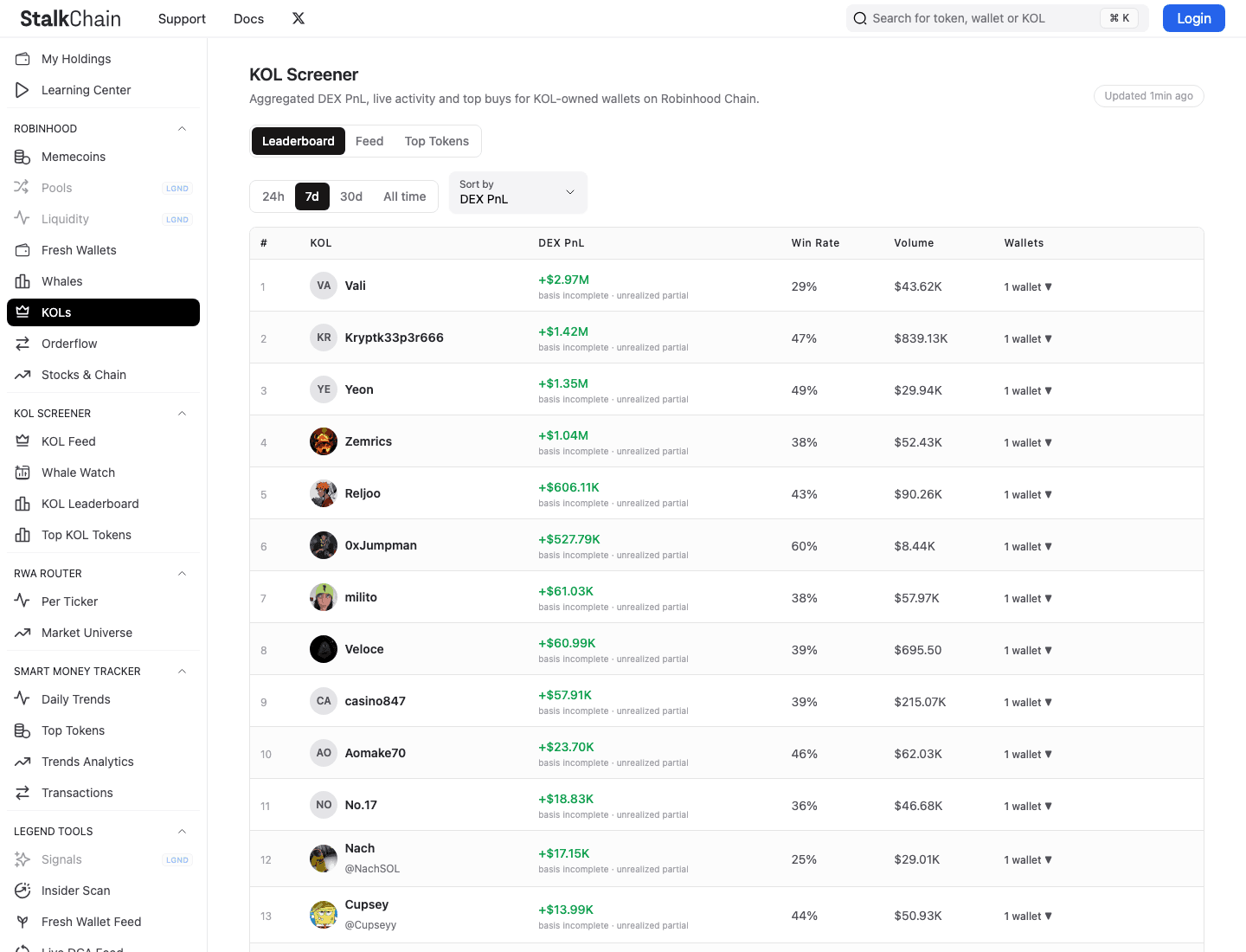
Live Robinhood Chain KOL data captured September 4, 2026. The PnL column explicitly marks incomplete basis and partial unrealized coverage where applicable, and the top rows in the default view are dominated by open-position estimates rather than realized proceeds.
Read the columns together:
- DEX PnL is a starting estimate. Treat rows marked
basis incompleteorunrealized partialas incomplete, not as settled profit. - Win rate needs sample-size context. A high percentage over a small or open set of positions is not equivalent to a long verified record.
- Volume shows activity, not skill. High turnover can coexist with poor net results, fees, or concentrated risk.
- Wallets lets you inspect the addresses attributed to each KOL. Expand them and verify the actual transaction history before drawing conclusions.
- Feed and Top Tokens help explain what generated the leaderboard result. Use them to check whether performance came from repeated decisions or one outsized position.
Representative shortlist observation
The public leaderboard changes as its windows, prices, and open positions update. A 24-hour check at 00:22 UTC on September 12, 2026 returned ten rows sorted by DEX PnL.
The first two rows showed about +$2.44M and +$1.16M estimated PnL, yet both showed zero realized result, zero covered volume, and zero covered trades for the selected period. The third row showed about +$996K estimated PnL, but only about $520 was displayed as realized across 15 covered trades.
Every returned row had incomplete basis, partial unrealized coverage, and one linked wallet. That makes the ranking useful for discovery, but not for declaring the first address the best trader.
Apply a realized-evidence gate
Before promoting a row to a watchlist, ask whether the selected window contains enough realized evidence to support the claim.
Pass the row forward when:
- covered buys and sells can be matched into completed outcomes;
- realized value is meaningful relative to the headline estimate;
- volume and trade count agree with the transactions you can inspect;
- transferred inventory and remaining exposure are reconciled; and
- a representative exit was possible at the wallet's size.
Hold the row as incomplete when:
- estimated PnL is almost entirely unrealized;
- the window shows no covered trades or volume;
- unknown acquisition basis could dominate the result;
- one thin token explains most marked value; or
- the wallet moved inventory before a sale could be reconstructed.
This gate does not demote profitable open positions. It limits the strength of the claim you can make from incomplete evidence.
Add token-level context before ranking the wallet
A wallet can look skilled because one thin token moved sharply after its entry. Before comparing traders, open each important token in the Robinhood Chain memecoin screener and review the activity that surrounded the trade.
The memecoin screener workflow helps separate broad demand from one-wallet volume, repeated buys, coordinated fresh wallets, and weak liquidity. Record whether unique-buyer growth, holder coverage, and usable liquidity supported the move at entry and exit.
This makes the trader comparison more realistic. A wallet that repeatedly earns returns in markets with broad participation and executable exits is more informative than one whose displayed PnL depends on positions that later followers could not enter or sell at similar prices.
Benchmark candidates against an eligible cohort
Do not compare a candidate only with the current top row. Define the cohort before looking at the outcome, then keep the rules fixed for the review.
A defensible cohort might require:
- at least one covered transaction in the selected window;
- nonzero covered volume;
- the same spot-only or derivatives-only activity class;
- a minimum number of reconstructable closed positions; and
- no unresolved token identity or unusable exit route in the reviewed sample.
Report the candidate's realized return, payoff ratio, drawdown, covered trade count, and executable exit value relative to that eligible group. Keep open or incomplete rows visible, but do not let them set a realized-performance benchmark.
This avoids two selection errors. Survivorship bias appears when only current winners enter the sample. Activity bias appears when a marked but inactive wallet is compared directly with wallets that actually traded during the window.
For a repeatable review, preserve three lists: all rows seen, rows eligible for realized comparison, and rows excluded with reasons. A trader can move between lists when evidence changes, but the original observation should remain auditable.
1. Funding and Setup
Every wallet's journey begins with a funding transaction. On Robinhood Chain the most common on-ramp is the canonical bridge from Ethereum (Arbitrum One or directly via the Robinhood Bridge).
Start your research here.
Workflow:
- Open the Robinhood Chain Blockscout explorer and confirm chain ID 4663.
- For a wallet selected for investigation, inspect its first few inbound ETH transfers and record whether funding came from a bridge, exchange hot wallet, contract, or another externally owned account.
- Cross-reference the funding address. A shared exchange hot wallet commonly funds unrelated customers, so it is not enough to establish common control. Look for additional links such as direct transfers, repeated synchronized behavior, or shared operational contracts.
Funding origin describes the route by which assets arrived. It does not reliably classify the owner's experience or intent.
2. Entry Timing and Accuracy
Entry timing is one useful signal when a wallet interacts with a newly created, verified pool.
What to look for:
- Sort the wallet's transaction history by timestamp. Identify the first swap involving a token whose pool was created within the past few blocks.
- Measure the block and timestamp difference between pool creation and the wallet's first swap. Compare it across several events rather than treating one fast entry as proof of skill.
- A short delay can result from automation, active monitoring, routing infrastructure, privileged information, or luck. Timing alone cannot distinguish among them.
Early entry can matter because the first swaps help establish a pool's trading range. Consistently fast entries may reflect automation, active monitoring, privileged information, or luck.
Transaction timing alone cannot distinguish among those explanations.
3. Position Sizing
Once you have identified a wallet with good entry timing, check whether their position sizing is deliberate rather than random.
Metrics to inspect:
- Consistency across entries. Compare position sizes and balance-relative exposure across enough completed trades to see whether a pattern exists. Do not impose an arbitrary threshold without a documented sample.
- Position changes. Increasing size after a win may reflect a strategy, higher available capital, or simple risk escalation. Evaluate the full sequence and drawdown, not one sizing decision.
- Liquidity ranges. Concentrated-liquidity positions express a chosen price range, but narrow is not automatically sophisticated or profitable. Results depend on volatility, fees, rebalancing, and impermanent loss.
4. Hit Rate vs. Size
A useful leaderboard candidate balances win rate with position size and net results. Stalkchain provides the first comparison layer, but transaction-level verification remains necessary:
- Start with the screener's DEX PnL, win rate, volume, and selected time window.
- Expand the KOL's linked wallet and record the buy transaction and later sell transaction for each reviewed token.
- Reconstruct acquired units, disposed units, fees, and remaining inventory. Mark unknown pre-window basis instead of silently treating it as zero.
- Score each reviewed position as closed win, closed loss, open, or indeterminate.
A wallet with a positive return across a meaningful sample may deserve further review. Compare win rate, average gain, average loss, position size, fees, and drawdown together.
No single threshold makes a wallet safe to copy.
5. Separate derivatives from spot activity
If official documentation identifies Lighter-related contracts or settlement addresses, classify those interactions separately from spot swaps. Do not attribute a generic contract call to Lighter from timing or method labels alone.
- Obtain verified addresses from current Robinhood or Lighter documentation.
- Decode calls and events against the verified ABI.
- Separate deposits, withdrawals, funding payments, fees, position changes, and liquidations.
- Compare derivatives and spot results over the same period without combining unlike exposures.
If verified addresses or complete data are unavailable, mark derivatives attribution as unknown rather than filling the gap with an estimate.
6. CEX-Linked Activity
Transfers to a known exchange or bridge can help explain capital flows, but they do not confirm profitability or ownership.
Check:
- Does the wallet send USDC or ETH to a known CEX hot wallet address? (Coinbase deposit addresses are documented; Robinhood deposit addresses are visible in the bridge UI.)
- Review the frequency and size of outbound bridge transactions. Regular transfers to an exchange may represent profit-taking, but they may also be treasury management or movement between accounts.
- A wallet that never bridges out may be compounding, holding, moving through another route, or simply inactive. The absence of an exchange transfer does not reveal intent.
7. Interpret patterns as hypotheses
The same observed behavior can have several explanations. Use a hypothesis table to decide what evidence to collect next.
| Observation | Possible explanation | Important alternative | Next check |
|---|---|---|---|
| Repeated early pool entries | Automated monitoring or routing | Team, market-maker, or chance activity | Compare funding, counterparties, and outcomes across several pools |
| Large derivatives-related transfers | Active leveraged trading | Treasury or settlement movement | Require verified contracts and decode position events |
| Repeated same-block contract calls | Arbitrage or automation | Router, bot service, or shared infrastructure | Trace calls, fees, inventory changes, and net outcome |
8. Workflow Overview
Here is the repeatable workflow in summary:
- Build a seed list: Open the Robinhood KOL Screener and compare several time windows, not only the current leaderboard.
- Trace funding: Identify the first meaningful source of ETH and other assets.
- Audit entries: Review several completed swaps and compare timing and position size.
- Estimate results: Calculate gains, losses, and fees across completed round trips.
- Separate derivatives: Review perpetual activity independently from spot trading.
- Inspect outflows: Look for withdrawals, bridges, and transfers to labeled counterparties.
- Cross-check the feed: Confirm which trades and tokens explain the KOL's aggregate result.
- Rank candidates: Use a transparent score to decide which wallets merit continued observation.
- Preserve the cohort: Record every observed row, the eligibility rule, and each exclusion reason before comparing performance.
Stalkchain exposes native Robinhood Chain KOL leaderboard, Feed, and Top Tokens views. The latter two may be empty for a selected window or registry state, and both displayed qualifying rows on September 4, 2026.
These surfaces accelerate discovery, but they do not remove the need to verify linked wallets, basis coverage, and transactions.
Verify KOL rankings with public transactions
Use Stalkchain to identify the candidate, then open the linked wallet in the Robinhood Chain transaction table and classify its completed activity. Method labels and counterparties help separate approvals, transfers, swaps, and other contract calls.
The screener supplies the ranking layer. The explorer supplies transaction evidence. Both are needed when the displayed PnL warns that basis or unrealized coverage is incomplete.
- Confirm chain ID 4663 with Robinhood's official network guide.
- Build a timeline with the wallet-tracking workflow.
- Reconstruct outcomes with the wallet PnL method.
- Compare funding and exit discipline with the best-wallet framework.
- Separate spot whales using the whale-wallet guide from activity related to Lighter.
- Check whether conviction is accumulation or distribution.
Turn KOL research into a risk plan
Research and execution should remain separate. If a token survives the KOL, wallet, holder, liquidity, and contract checks above, define position size, invalidation conditions, maximum acceptable slippage, gas reserve, and a representative sell path instead of copying the KOL's transaction blindly.
Keep monitoring the KOL feed for exits, but do not let one wallet override your position limit or risk rules. Start with small size and check quoted output, route, price impact, slippage, gas, transfer restrictions, and available exit liquidity.
FAQ
Does Stalkchain have Robinhood Chain top trader data?
Yes. The Robinhood KOL Screener ranks attributed KOL wallets using DEX PnL, win rate, volume, and wallet count. It supports 24-hour, 7-day, 30-day, and all-time windows.
Feed and Top Tokens views can be empty when no qualifying records are displayed for a selected window; both displayed rows during the September 4, 2026 verification. Treat incomplete basis and partial unrealized labels as material limitations.
Should I copy a Robinhood Chain KOL trade automatically?
No. A KOL signal should not bypass contract, liquidity, slippage, position-size, and exit checks. Verify the linked wallet and transaction, then make an independent decision.
What block explorer should I use?
Use the Robinhood Chain Blockscout explorer as the public starting point. Confirm important addresses and contracts against official project documentation before relying on labels.
How do I identify Lighter-related activity?
Use only contract or settlement addresses verified in current Robinhood or Lighter documentation. The Lighter integration guide explains which activity metrics matter, but it should not replace primary-source address verification.
Can I automate this workflow?
Partially. The funding-trace, entry-timing, and CEX-outflow steps can be scripted via the explorer's API or an archival RPC endpoint (chain ID 4663).
Lighter P&L aggregation requires decoding custom contract events and is harder to automate without a dedicated indexer.
How do I verify the venue behind a displayed trade?
Open the transaction and inspect the called contract, logs, token movements, and verified source code. Compare the router, factory, and pool addresses with current protocol documentation. Do not identify a venue from a method label or interface similarity alone.
What gas token does Robinhood Chain use?
ETH is the gas token listed in Robinhood's official connection parameters for chain ID 4663. Consult current network documentation for settlement architecture rather than inferring it from the wallet configuration alone.
Sources and Further Reading
-
Stalkchain Robinhood Chain KOL Screener: live KOL leaderboard, feed, top-token views, and linked wallets
-
Robinhood Chain connection documentation: official network identity and connection details
-
Robinhood Chain Blockscout explorer: public transaction and contract records
-
Uniswap v3 documentation: concentrated-liquidity AMM reference
-
How to track wallets on Robinhood Chain: Stalkchain research guide
-
How to find the best wallets on Robinhood Chain: Stalkchain research guide
-
Robinhood-Lighter integration explained: Stalkchain research guide