Almost every guide to real time crypto data opens with the same advice: buy the lowest latency you can afford, sub-second or nothing. That advice sounds rigorous, and it's half wrong.
Speed tells you how fast a number reached your screen. It says nothing about whether the number is final, complete, or economically meaningful. A wallet alert that fires in 300 milliseconds against a block that later gets skipped is worse than one that fires four seconds later and admits it hasn't finalized. A token can print a spectacular trade spike and still have no real demand behind it.
So treat speed and certainty as two separate engineering questions. Then add a third that most dashboards skip entirely: what kind of behavior the movement represents.
Table of Contents
- What Real-Time Crypto Data Includes and Why Speed Matters
- Finality Decides When Real-Time Data Is Safe to Act On
- How Real-Time Data Travels From Blockchain to Your Screen
- Why On-Chain Activity Is Not the Same as Real Demand
- Who Uses Real-Time Crypto Data and What For
- How to Vet a Feed and Set Your Freshness Rule
What Real-Time Crypto Data Includes and Why Speed Matters
Real time crypto data is blockchain and exchange information that arrives fast enough to change a decision you're about to make. A trade that just executed. A wallet that just moved tokens out of a position it held for months. A liquidity pool that just lost half its depth. A coin that launched ninety seconds ago.
That definition stays deliberately vague about speed, because the speed is the part you work out for your own case.
Real time is a deadline, not a speed
Ask what a stale reading would cost you. A trade alert that reaches you in two seconds is useful. The same alert after a minute is history. A holder-concentration check on a five-minute cadence is fine, because nobody makes money on the fourth decimal of top-10 holder share. A daily trend chart with a day of delay still shows you which sectors are rotating.
Working rule: set your refresh interval from the cost of being wrong, not from the fastest number a vendor can print.
A price board is useful only while it reflects the market in front of you. Last week's weather forecast doesn't help you decide whether to carry an umbrella this morning, and last hour's price board doesn't tell you what you'd pay at the pump right now.
| Data Type | What It Reveals | Freshness Needed | Typical Use |
|---|---|---|---|
| Trades and prices | executed buys and sells and the last price | sub-second to seconds | price alerts and execution checks |
| Order book depth | resting bids and asks at each price level | seconds | slippage estimates |
| Wallet balances and transfers | holdings and movements per address | per block | tracking whales and insiders |
| Token flow and holder stats | buys, sells, unique buyers, top 10 holder share | 5-minute to 24-hour windows | launch screening |
| OHLCV candles | open, high, low, close and volume per interval | 1 second to 1 day | charting and backtests |
| Trader positions and PnL | open positions, realized and unrealized profit | per trade | trader performance tracking |
| Social and KOL signals | posts, calls, likes and replies around a trade | minutes | sentiment and conviction checks |
| New token launches | newly created tokens and developer activity | per block | launch radar |
Notice the split. The top rows are event-driven, and each event is worthless if it arrives late. The bottom rows are summaries, where a few minutes of lag barely changes the answer.
Volume is what pushes periodic exports out of date. CoinGecko's 2024 annual crypto industry report put spot trading volume on centralized exchanges at roughly $6.0 trillion in the fourth quarter of 2024, up 111.7% from the third quarter, with average daily trading volume of $200.7 billion. The ten largest spot DEXs moved about $1.8 trillion across the full year, up 159.3% from 2023.
Against that flow, a nightly CSV export is a photograph of a river. If you're weighing how much latency costs a professional desk, crypto feed latency for prop traders is a useful companion read on where the milliseconds go.
Before you shop for a feed, write down the two or three data types your decision depends on. Those set your freshness requirement. Everything else is a nice-to-have that will inflate your bill.
Finality Decides When Real-Time Data Is Safe to Act On
Seeing a transaction and settling it are different events. A card terminal prints APPROVED in about a second, yet the merchant's money doesn't land that second. Blockchains work the same way, and the gap is much easier to ignore because the screen shows a number either way.
On Solana, a transaction marked processed means an RPC node has observed it in the latest block, but that block can still be skipped. The confirmed and finalized states are the ones that give non-reversible settlement under normal protocol assumptions, and they usually arrive quickly. Solana's transaction confirmation documentation describes a target slot time of about 200 milliseconds, with finalization roughly 150 milliseconds after block production.
| Chain | First Observed State | Settled State | Typical Settlement Time |
|---|---|---|---|
| Solana | processed | confirmed, then finalized | finalized about 150 ms after block production |
| Ethereum | pending in the mempool, then included in a block | finalized | about 15 minutes |
| Other supported chains | the head block your node reports | finalized under that chain's own rules | set by each network's consensus, so read the provider's documentation per chain |
The Ethereum figure comes from Ethereum's single slot finality roadmap, which puts current proof-of-stake finality at roughly 15 minutes. That is not a bug to be optimized away by a better WebSocket. It's consensus.
Store the commitment level, not a confirmation checkbox
The practical architecture is a two-speed system. Ingest processed events to fire low-latency alerts, then reconcile balances, PnL, and token flows once the event reaches finalized. Keep a commitment field on every record, and store four things alongside it: the observed slot or block, the commitment level at the moment you read it, the RPC observation timestamp, and the finalized timestamp.
Deduplicate on transaction signature plus instruction index, because the same swap reaches you from multiple nodes and multiple retries.
Engineering note: a Boolean called
confirmedwill cost you a weekend of debugging. A string that saysprocessed,confirmed, orfinalizedtells you how much trust to place in the row.
Skip this and the failure is easy to picture. A dashboard credits a wallet transfer to a forked block, a leaderboard ranks a trader on it, and six hours later the balance and the PnL disagree with each other. Nobody can tell which number lied.
How Real-Time Data Travels From Blockchain to Your Screen
Every feed you use is a chain of five stages, and each one adds delay. Speeding up the last stage does nothing for the first four.
- Node. A machine run by your provider receives a new block and the transactions inside it. The block has to propagate across the network first, which costs real time.
- Parser. Software decodes the logs and token amounts from each transaction, applying the right decimals and handling wrapped and bridged variants.
- Indexer. Each decoded event is normalized into one schema with chain, block or slot, timestamp, and wallet, so a Solana swap and an Ethereum transfer can sit in the same table.
- Enrichment. Labels get attached: token names, trader identities, prices, holder context. This stage is where most "why is this number wrong" bugs live, because a stale price feed misprices everything downstream.
- Delivery. An API pushes events to subscribers or answers queries.
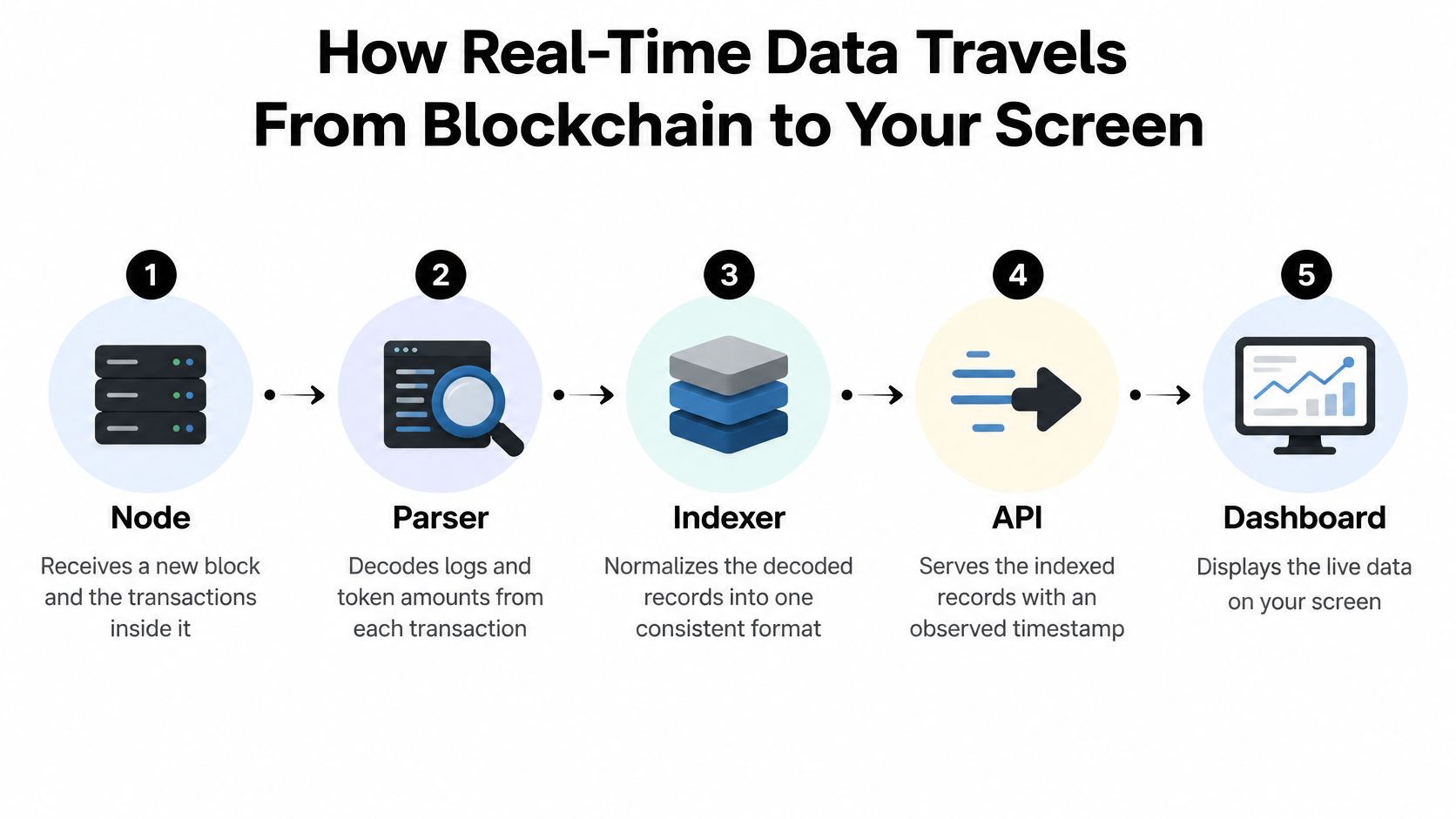
Where the delay accumulates
Network propagation and parsing usually cost tens to hundreds of milliseconds. Indexing and enrichment are where providers differ most, and where a "live" claim deserves a timestamp. None of these five stages includes the chain's own settlement window, which no transport choice can shorten.
| Delivery Method | How Data Arrives | Best For | Main Trade-off |
|---|---|---|---|
| WebSocket stream | events pushed as they happen | live alerts and dashboards | needs reconnect and duplicate handling |
| REST polling | the app requests the latest state on a schedule | periodic reports and lookups | stale between requests and rate limits apply |
| Scheduled alert or webhook | provider sends a message when a rule is met | notifications on wallet moves or launches | only as good as the rule definition |
| Historical backfill | bulk pull of past events | PnL history and model training | not live and can be large |
Alert bots and dashboards can watch tracked traders, token flows, and new launches on a schedule and push changes to wherever the reader already looks, which is usually a phone rather than a terminal. That's often a better fit than a stream, because readers don't want a firehose, they want six messages a day that matter.
If you're wiring this up yourself, the blockchain data API guide covers the request patterns and pagination side of it.
Streams for live alerts. Polling for periodic reports. Backfills for PnL history and model training. Pick per job, not per company.
Why On-Chain Activity Is Not the Same as Real Demand
A ledger records what happened, not why. That gap is bigger than any latency figure on a dashboard.
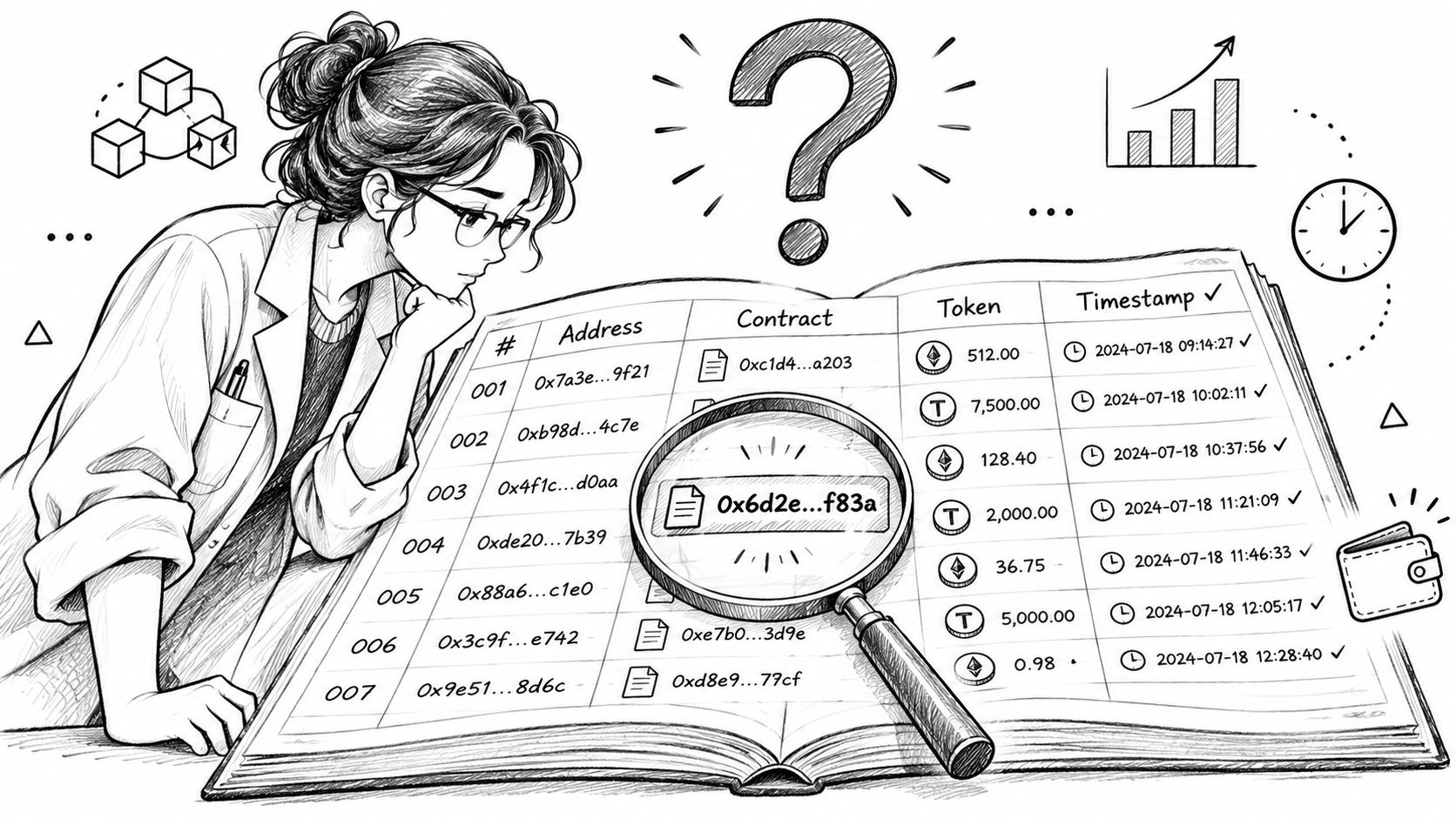
Public chains expose addresses, tokens, amounts, timestamps, and contracts. They don't encode intent. So a burst of volume can look bullish while it's mostly bots cycling funds, arbitrage between two pools, an exchange shuffling its own hot wallets, or MEV extraction that never represents a buyer with a view.
The scale of that gap is measurable. A 2025 BCG white paper on stablecoin payments estimated approximately $62 trillion in gross annual stablecoin transfers against about $4.2 trillion in economic activity once non-economic flows were filtered out. The same paper attributed $94.2 billion in stablecoin settlements to identifiable payment firms from January 2023 through February 2025, while noting that broad on-chain totals carry trading, DeFi, MEV, and other noise inside them.
Here is what that looks like when you build it into a pipeline rather than a research paper.
Label the movement, not just the size
Attach a confidence class to every event: probable payment, exchange transfer, liquidity operation, bot or MEV pattern, or unknown. Four inputs sharpen those labels. Wallet history tells you whether this address behaves like a treasury or a sniper. Counterparty relationships show whether the funds went to a fresh wallet or back to a known venue. Contract context distinguishes a swap on a router from a transfer to a bridge. Behavioral baselines catch a wallet whose usual transfer size suddenly jumps by orders of magnitude.
The contrarian conclusion is uncomfortable for anyone selling milliseconds: faster refresh does not automatically produce better signals. Classification quality often matters more than speed.
This is also where wallet-level tools do more work than transaction counters. If you want the practical version, this guide on how to track whales buying crypto covers the wallet and flow side in more depth.
Three questions worth asking about any spike
- Who sent it? A named exchange hot wallet, a fund, a deployer, or an address funded eleven minutes ago from a mixer.
- Which contract or counterparty was involved? A swap through a router is trading. A transfer to a payment processor is commerce. A transfer to a bridge is migration.
- How does it compare with that wallet's normal pattern? A transfer far larger than anything that address has sent before is a signal. The same size from a market maker's wallet is routine.
Ask those three before asking how fast the alert arrived.
Who Uses Real-Time Crypto Data and What For
Different readers pull different things from the same feed, and most arguments about "live" data are really arguments between two of them.
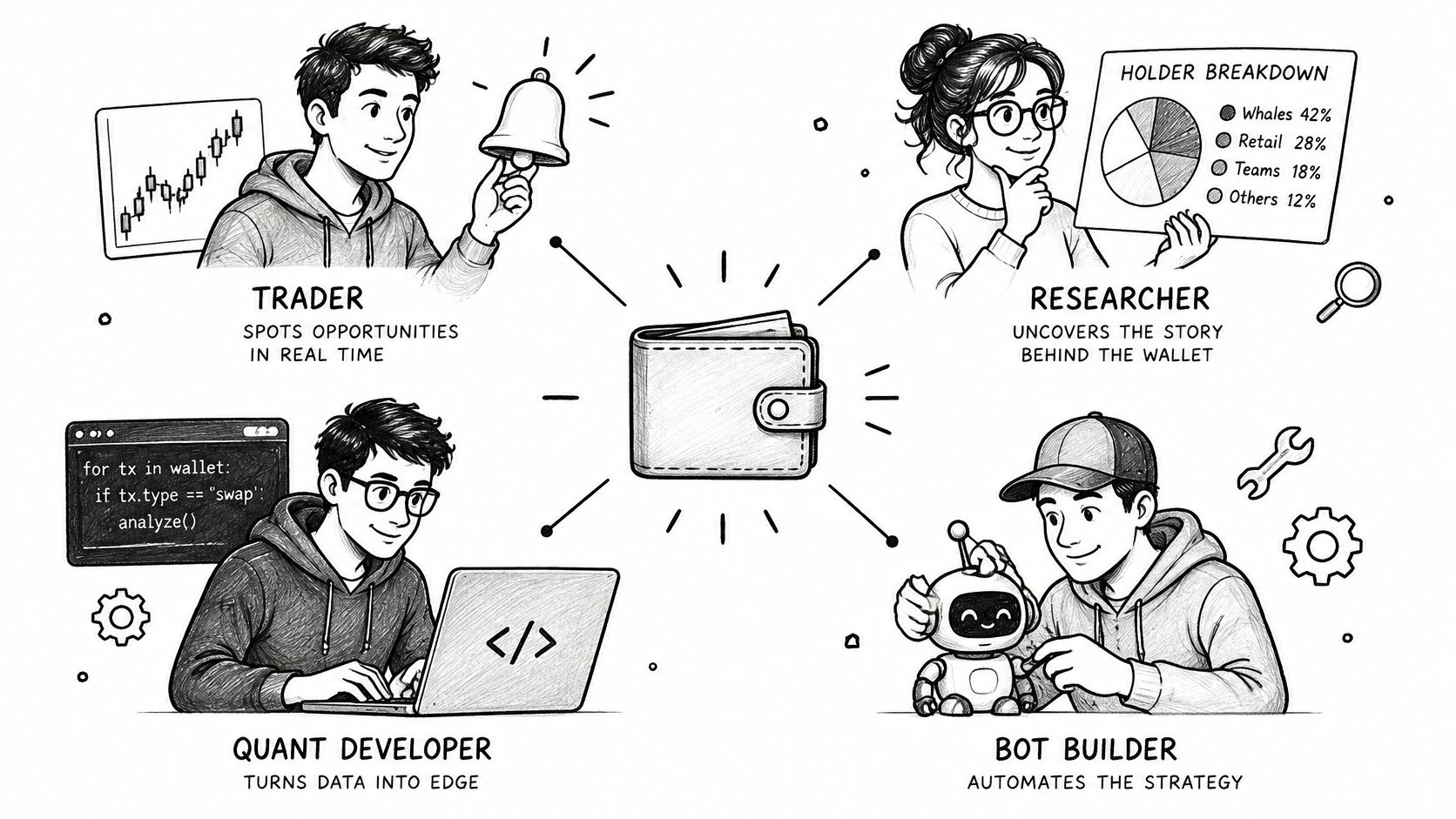
Traders want alerts on tracked wallets, token flows, and fresh launches, and they measure success in seconds. Researchers want holder breakdowns and trader histories, and they'll wait five minutes for a correct answer. Quant developers and bot builders need two different systems: a stream that triggers logic now, and a backfill that lets them test whether that logic ever worked. Portfolio managers and analysts follow KOL and whale activity across several chains at once. Web3 product teams turn all of it into dashboards and alerts their own users can read.
AI agent developers sit apart from the rest. A language model can't reliably browse chain state or log into a private dashboard in the middle of a conversation, so it needs data it can call as a tool.
Say a trader asks an assistant, mid-conversation, who is buying a token. The useful answer names the wallets, the PnL on those positions, and the receipts behind the claim, not a confident guess. A trader working through Claude, ChatGPT, or Grok can get exactly that: who is buying, holding, or selling, with wallets, PnL, and receipts attached.
Why the data crosses borders
Blockchain activity ignores banking hours, which makes this a global data problem rather than a national market one. A Bank for International Settlements working paper examined Bitcoin, Ether, Tether, and USD Coin flows across 184 countries from 2017 through 2024. Cross-border flows fell to about $400 billion in 2022 during the crypto-market turmoil, then recovered to roughly $600 billion by the second quarter of 2024.
Two things follow from that. Activity can contract hard under stress, and it can rebound across many jurisdictions without a single settlement venue. The mix matters too: Bitcoin and Ether are volatile native assets, while Tether and USD Coin track the dollar and carry most of the transfer volume.
The audience is not small. Global cryptocurrency ownership reached 562 million people in 2024, up from 420 million in 2023, according to Triple-A's crypto ownership report.
One feed can serve all of these readers. No single freshness setting can, which is why the next part is a checklist rather than a recommendation.
How to Vet a Feed and Set Your Freshness Rule
Run this procedure once per provider, before you build anything on top of it. It works the same way for a free endpoint and a paid one.
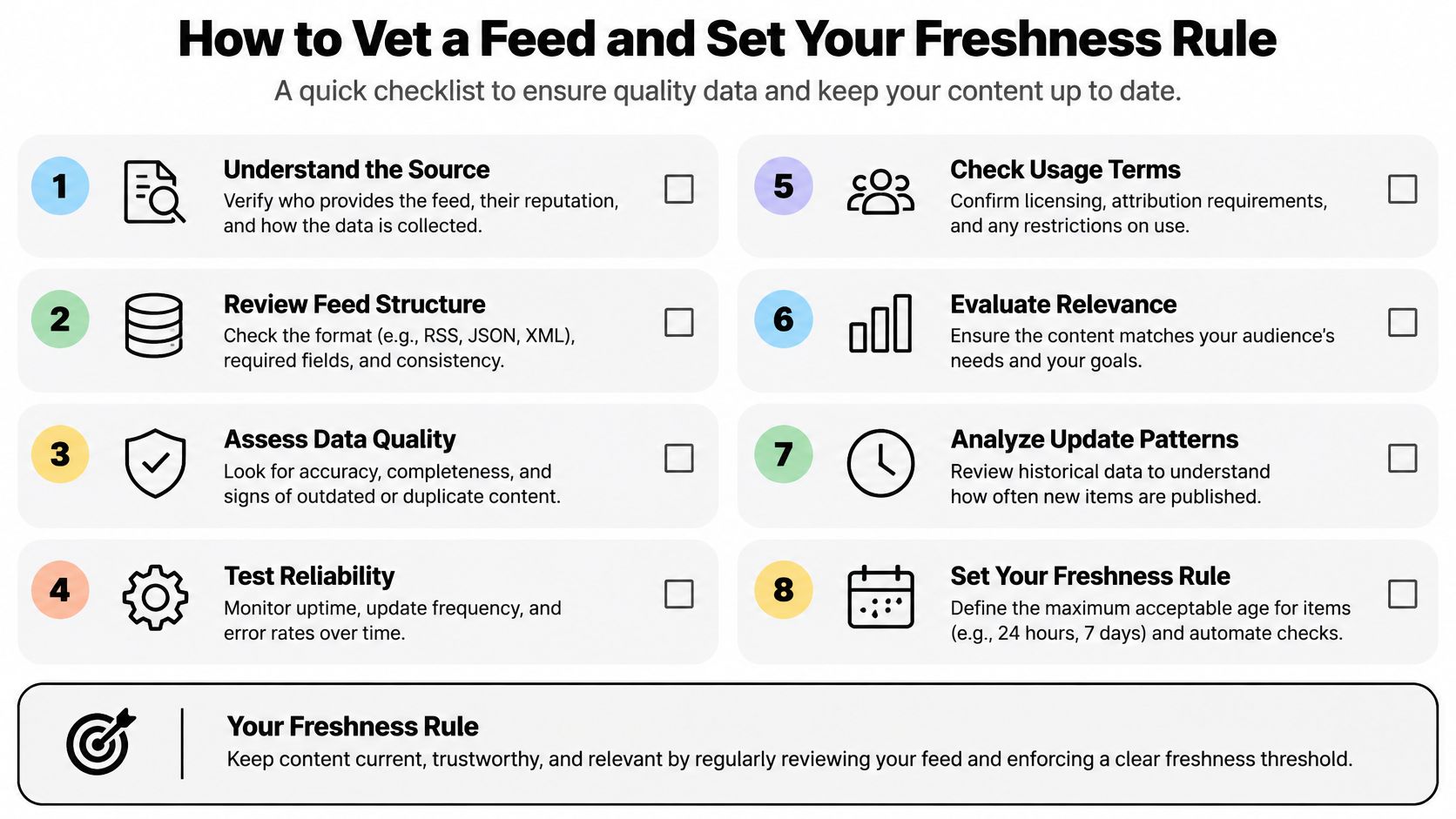
The eight checks
- Freshness label. Does every result carry an observed time and an indexing delay? If a price arrives with no timestamp, treat it as a snapshot, not a live figure.
- Finality status. Can the response distinguish processed, confirmed, and finalized? A feed that marks everything settled will eventually hand you a balance that no longer exists.
- Chain coverage and per-chain rules. Ask which networks are included and what settlement window each one has. Our own coverage runs across Robinhood Chain, Solana, Base, BSC, Ethereum, Monad, and Hyperliquid perps, and those windows are not interchangeable.
- Source transparency. Ask which upstream providers feed the endpoint, then check whether those sources match what you think you're buying. Our data comes from FOMO, StonkFun, and Jupiter, and you should expect any provider to name its upstreams the same way.
- Staleness behavior. When a source doesn't answer, does the response say so, or does it serve the last good value without warning? Silent staleness is the failure mode that ruins models.
- Attribution confidence. Do wallet and trader labels carry a confidence class, or is every label presented as fact? This one separates an analytics product from a data dump.
- Cost per answer. Is usage visible on every call, or do you find out at the end of the month? A feed that shows cost and remaining balance per response lets you budget a backfill before you run it.
- Replay support. Can you re-pull history and reconcile against finalized state? MEV research from the fourth quarter of 2025 keeps returning to the same tension: preconfirmations can shrink perceived inclusion time, while real-world RPC failures, including responses built on a reorganized block instead of the canonical one, mean a single response is never authoritative on its own.
For the research side of the same workflow, this overview of crypto research tools shows how lookups, screening, and history fit together around one dataset.
Turn the checks into a build rule
Write down the data types your decision needs, then set a freshness and finality rule per type. Processed events drive alerts and get flagged provisional in the UI. Finalized state drives dashboards, balances, and realized PnL. Backfills feed reports and any model training you do.
Store the commitment level, block or slot, observation timestamp, and finalized timestamp with every event you keep. Reconcile finalized balances on a schedule, and run one historical backfill against a known-good window before you go live. If the backfill doesn't reproduce what you expect, the feed isn't the problem yet.
The test that settles it: ask the provider to show which KOLs hold a token and how much, who is buying the same coin right now, and what traders wrote about their trades. Those three answers exercise freshness, attribution, and history at once.
That's what StalkChain Data returns, over a plain HTTPS REST API with no MCP client required, so the same calls back a dashboard, a bot, or a backfill. You can start with $5 in free credit at signup, and every answer shows its cost and your remaining balance.
Speed is the easy part to buy and the hardest part to interpret. StalkChain gives you the other half of the picture: live wallet holdings, realized and unrealized PnL, token flows, and KOL activity across seven chains, delivered as data an AI agent or your own code can call directly. Start with $5 in free credit at StalkChain, run the eight checks against a token you already know well, and see whether the labels match what you'd have concluded by hand.